AI Diet Planner App Development: Features, Cost, Process, and Tech Stack
Key Takeaways
- An AI diet planner combines trusted nutrition data, calculation rules, recommendation systems, and generative AI to create personalized meal plans.
- A strong MVP should include user onboarding, meal-plan generation, nutrition checks, meal swaps, recipes, grocery lists, and progress tracking.
- Nutrition values and allergy checks should come from verified databases and controlled rules, not directly from an AI language model.
- Development costs may range from about $30,000–$60,000 for a basic MVP to more than $150,000 for professional, clinical, or enterprise platforms.
- Privacy, security, allergy controls, output validation, monitoring, and professional review are essential for reducing risk and building trust.
- Advanced features such as food-photo recognition, wearable integration, pantry scanning, and adaptive recommendations should be added after the core product has been validated.
Maintaining a practical meal plan involves more than meeting calorie goals. Users must consider allergies, food preferences, budgets, cooking time, available ingredients, fitness routines, and changing health needs. Traditional plans often overlook these factors, forcing people to adjust nutrients, portions, and recipes manually.
Demand for personalized nutrition support is growing. The World Obesity Federation estimates that nearly 3 billion adults could be living with overweight or obesity by 2030, including 1.13 billion adults with obesity. The World Health Organization also projects that the global economic cost of obesity could reach $3 trillion annually by 2030.
At the same time, investment in digital health continues to expand. Grand View Research estimates that the market could grow from USD 87.7 billion in 2026 to USD 187.5 billion by 2033, covering mobile health apps, analytics, telehealth, and connected devices.
AI diet planner app development addresses this need by combining verified nutrition data, calculation logic, recommendation models, generative AI, and user feedback. With the right AI development services, businesses can create applications that generate personalized meal plans, adjust recommendations, prepare grocery lists, and explain how meals match user goals.
However, a reliable AI diet planner is more than a recipe-generating chatbot. It requires trusted nutrition databases, strict allergy and dietary rules, output validation, and controlled AI systems to deliver safe, accurate, and scalable recommendations.
Build a Smarter AI Diet Planner with Prismetric
Prismetric develops personalized diet planning apps with verified nutrition data, intelligent recommendations, and secure AI architecture.
Get Started for Free
What Is an AI Diet Planner App?
An AI diet planner app is a digital product that generates and adapts meal recommendations based on information about the user.
The application may collect:
- Age, height, weight, and activity level
- Weight-management or fitness goals
- Dietary preferences
- Allergies and intolerances
- Preferred foods and cuisines
- Cooking experience and available time
- Grocery budget
- Household size
- Available ingredients
It can use these inputs to prepare daily or weekly meal plans, calculate portions, recommend recipes, generate grocery lists, and suggest suitable ingredient substitutions.
The term “AI” does not refer to one technology. A diet planning platform may use recommendation algorithms to rank meals, constraint logic to enforce nutrition rules, computer vision to identify food from images, and a large language model to understand conversational requests.
For example, a user could ask:
“Suggest a high-protein vegetarian dinner that takes less than 20 minutes and does not contain dairy.”
The language model can interpret the request, but it should not invent the nutrient values. A controlled application retrieves suitable recipes, checks their ingredients, verifies their nutritional content, and presents options that satisfy the defined requirements.
AI Diet Planner vs. Calorie Tracker vs. Traditional Meal Planner
These products may share features, but they solve different parts of the nutrition workflow.
| Capability |
Calorie tracker |
Traditional meal planner |
AI diet planner |
| Main purpose |
Records consumed food |
Provides predefined plans |
Generates and adapts personalized plans |
| Personalization |
Basic calorie or macro targets |
General diet categories |
Goals, restrictions, behavior, budget, and schedule |
| Food logging |
Manual entry or barcode |
Usually limited |
Text, voice, image, barcode, or receipt |
| Meal changes |
Mostly manual |
Limited to existing templates |
Context-aware swaps and substitutions |
| Grocery planning |
Sometimes available |
Basic ingredient lists |
Dynamic quantities and household planning |
| User feedback |
Tracks historical entries |
Usually static |
Can influence future recommendations |
| Conversational support |
Rare |
Rare |
Natural-language questions and changes |
A calorie tracker helps users understand what they have already eaten. A traditional planner provides ideas for what to eat. An AI diet planner can connect planning, logging, adaptation, and guidance within one product.
Greater personalization does not automatically create accurate recommendations. The result still depends on the quality of the food database, calculation methods, user information, and validation rules behind the interface.
Who Should Build an AI Diet Planner App?
An AI diet planner can support several business models. The right feature set depends on the audience and the type of guidance the product is expected to provide.
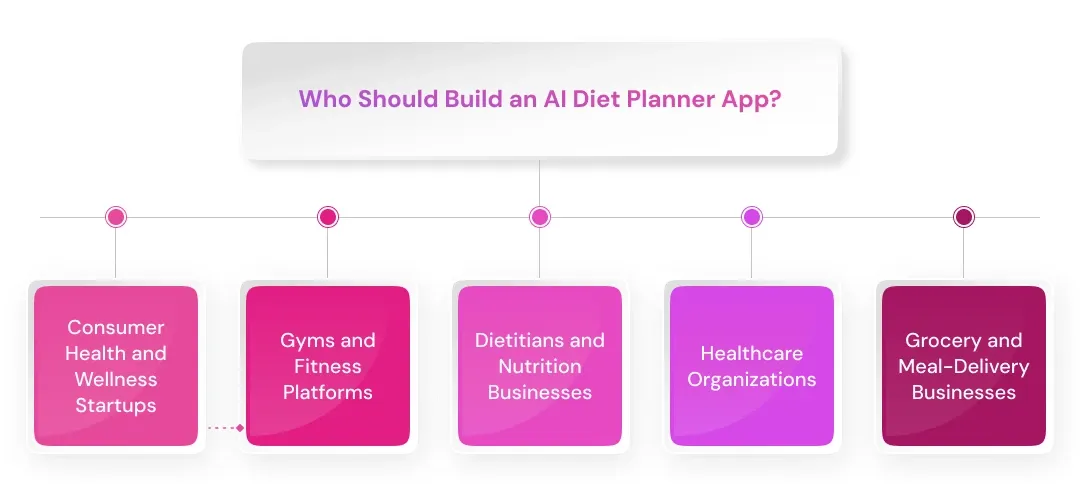
Consumer Health and Wellness Startups
Consumer applications can support weight management, balanced eating, muscle gain, or general wellness. Common capabilities include personalized meal plans, recipe recommendations, food logging, progress tracking, and paid subscriptions.
The main product challenge is sustained engagement. Users may stop following a plan if recipes are repetitive, expensive, difficult to prepare, or disconnected from their normal eating habits. The application should learn from meal swaps, rejected recommendations, cooking preferences, and budget changes.
Gyms and Fitness Platforms
Fitness businesses can connect meal planning with workout schedules and activity data. The product may offer training-day calorie targets, protein-focused meal suggestions, recovery meals, and dashboards that allow coaches to review client progress.
Automated recommendations should remain editable. Coaches may need to change targets or replace meals based on context the software cannot capture.
Dietitians and Nutrition Businesses
Dietitians can use AI-assisted applications to prepare draft meal plans, summarize food logs, calculate nutritional totals, and suggest equivalent substitutions.
In this model, AI supports repeatable planning and administrative work. The dietitian retains responsibility for reviewing recommendations and deciding whether they are suitable for the client.
Healthcare Organizations
Healthcare providers may use diet planning software in patient education, wellness programs, or nutrition-sensitive care pathways. These products may require clinician review, documented protocols, role-based access, audit trails, and stronger validation.
A product that provides general wellness information has a different risk profile from one that makes patient-specific clinical recommendations. Businesses should define this boundary before development begins.
Grocery and Meal-Delivery Businesses
Grocery platforms, meal-kit companies, and food-delivery services can connect meal recommendations with products that users can purchase.
The system may generate recipes based on available inventory, seasonal ingredients, household size, dietary preferences, and price. It can then convert the meal plan into a grocery list or shopping cart.
Commercial priorities should never override allergy exclusions or other safety rules.
How Does an AI Diet Planner App Work?
An AI diet planner typically follows seven steps:
- Collect user information: The app gathers goals, preferences, restrictions, activity data, and lifestyle requirements.
- Calculate nutrition targets: Controlled formulas determine calorie, protein, carbohydrate, fat, and other relevant ranges.
- Retrieve approved food data: The system searches verified food and recipe sources.
- Apply constraints: Rules exclude allergens, unsuitable ingredients, unrealistic portions, and meals that fall outside defined targets.
- Rank suitable meals: A recommendation layer considers preferences, cost, preparation time, variety, and previous behavior.
- Support conversation: A language model interprets requests, explains recommendations, and helps users modify the plan.
- Validate the result: The application checks calorie totals, nutrients, allergens, serving quantities, and conflicting restrictions before displaying the plan.
Each component has a defined responsibility. Nutrition databases provide nutrient records. Rules engines enforce dietary boundaries. Recommendation models rank eligible meals. LLMs manage conversational interaction. Computer vision can support photo-based food logging, while monitoring systems track errors, corrections, latency, and unsafe outputs.
Once this working model is clear, the next decision is what to include in the first release. The feature set should solve a defined user problem without turning the MVP into an expensive platform that is difficult to validate.
Core Features of an AI Diet Planner App
The first version of an AI diet planner should help users complete one clear workflow: provide their requirements, receive a suitable meal plan, make practical adjustments, and turn the plan into daily action.
Trying to include food-image recognition, wearable integrations, predictive coaching, family planning, and clinical workflows in the initial release can increase development cost without proving that users value the core product. A focused minimum viable product, or MVP, makes it easier to test recommendation quality, user engagement, and willingness to pay.
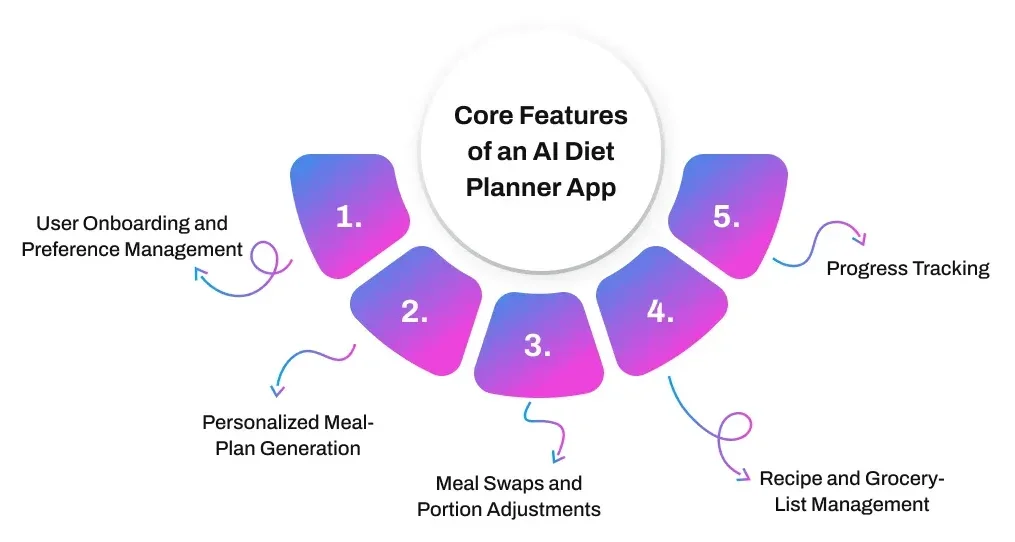
User Onboarding and Preference Management
Personalization begins with reliable user information. The onboarding process should collect enough data to generate a relevant plan without asking users to complete an unnecessarily long questionnaire.
Core inputs may include:
- Age, height, weight, and activity level
- Weight-management or fitness goal
- Dietary pattern
- Food allergies and intolerances
- Preferred and disliked ingredients
- Cooking time and skill level
- Meal frequency
- Grocery budget
The application should allow users to update this information later. Dietary needs and personal circumstances change, and a meal planner that treats onboarding answers as permanent may continue producing unsuitable recommendations.
For sensitive inputs, the interface should explain why the information is needed. A user is more likely to provide weight, activity, or allergy data when the application connects each question to a clear planning function.
Personalized Meal-Plan Generation
Meal-plan generation is the central feature of the product. The application should create a daily or weekly plan that reflects the user’s calorie range, nutrient targets, restrictions, schedule, and preferences.
A useful plan should include more than recipe names. Each meal should provide:
- Portion size
- Calorie and macronutrient information
- Ingredients
- Preparation time
- Cooking instructions
- Allergen information
- Suitable substitutions
The system should also distribute meals realistically across the day. A plan may meet the total calorie target but still be impractical if most calories appear in one meal or if every recipe requires extensive preparation.
The user should be able to generate a complete plan or request one meal at a time. This gives people more control and reduces the cost of regenerating an entire week when only one recommendation needs to change.
Meal Swaps and Portion Adjustments
Users rarely follow a meal plan exactly as generated. Ingredients may be unavailable, schedules may change, and a recommended recipe may not match the user’s appetite or preferences.
A practical AI diet planner should let users:
- Replace one meal
- Substitute an ingredient
- Adjust a portion
- Change the preparation-time limit
- Select a lower-cost option
- Recalculate the remaining meals
The replacement should remain nutritionally comparable where possible. For example, changing a high-protein breakfast should not silently reduce the user’s daily protein total.
This feature connects AI capabilities to a real user need. Rather than regenerating generic suggestions, the application adapts the plan while preserving the relevant dietary constraints.
Also Read: How to Build an AI MVP: Step-by-Step Guide
Recipe and Grocery-List Management
Each recipe page should give users enough information to prepare the meal confidently. Ingredients, measurements, preparation steps, nutritional values, and allergen warnings should be easy to review.
The grocery-list feature can then combine ingredients from several recipes into one weekly list. It should consolidate duplicate items, convert quantities into usable shopping units, and organize products by categories such as produce, dairy alternatives, grains, and pantry items.
Users should also be able to remove ingredients they already have. More advanced versions may estimate cost or connect the list to a grocery retailer, but the MVP can begin with a clear, editable checklist.
Progress Tracking
Progress tracking should help users understand how they are following the plan without overwhelming them with charts.
An MVP may track:
- Meals completed
- Daily calorie and macro totals
- Planned meals versus logged meals
- Weekly adherence
- Weight or fitness-goal progress
- Frequently replaced meals
This information can also improve future recommendations. If a user consistently skips a particular breakfast or replaces recipes that take longer than 20 minutes, the system can use those signals when ranking future meals.
Progress data should support reflection, not create a false impression of medical certainty. Weight and nutrition outcomes depend on many factors beyond app usage.
Advanced AI Features to Add After MVP Validation
Once the core planning workflow has demonstrated value, the product can introduce more complex AI capabilities.
Conversational Nutrition Assistant
A conversational assistant allows users to modify plans in everyday language. They may ask:
- “Make tomorrow’s dinner vegetarian.”
- “Use cheaper ingredients this week.”
- “I have eggs, spinach, and rice. What can I cook?”
- “Replace this meal with something I can take to work.”
The LLM should translate the request into structured instructions for the recipe, nutrition, and validation services. It should not bypass allergy rules or generate unverified nutrient values.
Food-Photo Recognition
Computer vision can reduce the effort required to log meals. The user takes a photo, and the system identifies likely foods, estimates portions, and matches the result to nutrition records.
The output should be presented as an estimate. Sauces, oils, hidden ingredients, plate size, and camera angle can all affect accuracy. Users need a simple way to confirm the food, change the portion, or correct the result before it is added to their record.
Pantry and Receipt Scanning
A pantry-aware application can recommend meals based on ingredients already available at home. Receipt scanning can extract purchased products and update the user’s ingredient list.
These features may help reduce repeated purchases and support budget-based planning. They also require reliable product recognition, unit normalization, and user correction when an item is identified incorrectly.
Adaptive Meal Planning
An adaptive planner uses feedback and behavior to improve future recommendations. It may consider accepted meals, repeated substitutions, cooking-time preferences, food ratings, and meals consumed outside the plan.
The system should avoid making permanent assumptions from isolated actions. Skipping one breakfast does not necessarily mean the user dislikes breakfast. Direct preference controls should remain available.
Features for Dietitians, Coaches, and Administrators
Professional platforms require different capabilities from consumer applications.
A dietitian or coach dashboard may allow authorized professionals to review plans, edit nutrient targets, monitor client food logs, communicate with users, and approve recommendations before they are published.
The administrative portal may support:
- User and subscription management
- Recipe and content controls
- AI usage monitoring
- Validation-failure review
- Notification management
- Role and permission settings
- Audit logs
These tools help businesses operate the product rather than simply deliver features to users. They are particularly relevant when recommendations require professional review or when several coaches manage a large client base.
Recommended User Experience
A well-designed product should move the user from setup to the first useful plan with as little friction as possible.
The initial flow may follow five stages:
- Select a goal.
- Add dietary restrictions and core profile information.
- Set cooking time, budget, and food preferences.
- Review the calculated targets.
- Generate and customize the first plan.
After onboarding, the daily dashboard should show today’s meals, nutrient progress, food-logging controls, and quick options for replacing a recommendation.
The weekly planner should provide a seven-day view, identify repeated ingredients, support batch cooking, and allow users to move or replace meals without rebuilding the entire schedule.
Each recipe page should answer three questions clearly: What do I need, how do I prepare it, and why was it recommended? Explaining the reason behind a meal can improve trust and help users identify unsuitable assumptions.
Feedback should be part of the main workflow. Users need visible controls to dislike a recipe, report incorrect nutrition information, change a restriction, or correct an AI-generated result.
How to Prioritize MVP Features
Feature prioritization should reflect the first target audience and business model.
| Build in the MVP |
Add after validation |
Specialized or enterprise |
| User profile and goals |
Photo-based logging |
Clinical workflows |
| Meal-plan generation |
Voice logging |
Health-record integrations |
| Nutrition validation |
Pantry scanning |
Multi-organization controls |
| Meal swapping |
Wearable adaptation |
Custom model development |
| Recipes and portions |
Family planning |
Advanced audit systems |
| Grocery lists |
Predictive reminders |
Clinical governance tools |
The MVP should establish whether users trust the plans, return to the application, and find the recommendations practical. Advanced technology cannot compensate for meals that are inaccurate, expensive, repetitive, or difficult to prepare.
Turn Your AI Diet Planner Idea Into a Working MVP
Build essential features such as personalized meal plans, nutrition validation, meal swaps, grocery lists, and progress tracking.
Build Your MVP
Product Differentiation and User Trust
The market is crowded. In its 2024 Health Breach Notification Rule analysis, the FTC estimated that approximately 193,000 apps across the Apple App Store and Google Play Store were categorized as “Health and Fitness” as of March 2024. The agency also described the figure as a rough proxy that may be both under- and over-inclusive.
A new AI diet planner therefore needs a clearer differentiator than automated recipe generation. That differentiation may come from reliable nutrition calculations, regional food coverage, budget-aware planning, transparent recommendations, professional review, accessible design, or stronger privacy controls.
Once the product team has defined these capabilities, the next step is to determine how the application’s data, AI models, rules, APIs, and user interfaces will work together. That requires a layered architecture rather than a single generative AI integration.
Recommended Architecture for an AI Diet Planner App
An AI diet planner should use a layered architecture in which each component performs a controlled function. The interface collects user requests, but one unrestricted model call should not calculate nutrients, enforce allergies, and generate recommendations.
Separating these responsibilities makes the product easier to test, scale, and audit. It also allows the development team to replace an AI provider or nutrition data source without rebuilding the entire application.
Core Architecture Layers
Application Layer
The application layer includes the mobile app, web portal, dietitian dashboard, and administrative console.
The consumer interface manages onboarding, meal plans, food logging, recipes, grocery lists, and feedback. Professional dashboards support plan review and client monitoring, while the administrative console controls users, content, permissions, AI usage, and system alerts.
A consumer MVP may begin with one cross-platform app and a lightweight administrative portal. Native development may be more suitable when the product depends heavily on camera processing, background health data, or device-specific features.
Identity and User Profile Layer
This layer manages authentication, user roles, consent records, dietary preferences, allergies, goals, and subscription status.
Professional products should separate user, coach, dietitian, and administrator permissions. The backend must verify who can read or change specific information rather than relying only on interface controls.
Consent and permission records should also be stored in a structured format. This helps the business identify which data a user has agreed to share and which connected services are allowed to access it.
Nutrition Data Layer
The nutrition data layer provides the food, nutrient, serving, recipe, ingredient, and allergen records used by the planning system.
USDA FoodData Central is one possible source for U.S.-focused nutrient information. Its API provides food-search and food-detail endpoints, applies a default limit of 1,000 requests per hour per IP address, and publishes its data in the public domain. Foundation Foods is updated in April and October, while branded-food data is updated monthly. These numbers affect caching, synchronization, and data-refresh decisions.
A production application may also require licensed recipes, barcode data, regional food databases, restaurant information, and internal ingredient mappings. The system should normalize serving units and food names before calculating a meal plan.
Nutrition Rules and Constraint Engine
The rules engine applies boundaries that should not depend on generative AI. It may enforce:
- Calorie and macronutrient ranges
- Allergy and ingredient exclusions
- Dietary patterns
- Portion limits
- Preparation-time restrictions
- Grocery budgets
- Meal-variety requirements
The engine should reject hard violations and score softer preferences separately. A peanut allergy is a hard exclusion. A preference for Mediterranean food is generally a ranking signal.
This distinction prevents the application from sacrificing safety to satisfy a less important preference.
AI Orchestration and Recommendation Layer
The orchestration layer connects the language model with approved application tools. Instead of allowing the model to invent a meal plan, the system can require structured outputs and restrict it to functions such as recipe search, nutrient lookup, meal replacement, and grocery-list generation.
The recommendation pipeline first removes ineligible meals. It then ranks the remaining options according to preference fit, cost, preparation time, previous feedback, and meal variety.
A startup may not need a custom machine-learning model at launch. Rules and weighted ranking can support the first release. A learning-based recommendation model becomes more useful after the application collects enough reliable interaction data.
Data, Analytics, and Monitoring Layer
The platform should record plan versions, user corrections, accepted recipes, AI responses, validation results, response times, and inference costs.
These records help the development team investigate why a meal appeared and determine whether a model, prompt, rule, or nutrition-data update changed the result.
Logs should exclude personal information that is not required for monitoring. The business should also define how long AI conversations, food images, and recommendation histories are retained.
What the LLM Should and Should Not Do
A large language model can understand user requests, explain meal recommendations, simplify recipe instructions, summarize food logs, and interpret statements such as:
“Replace this dinner with a cheaper vegetarian option that I can prepare in 15 minutes.”
The LLM should not act as the authoritative source for calorie values, allergy status, or medical suitability.
When a user requests a peanut-free dinner with at least 30 grams of protein, the LLM can interpret the request. The recipe service should retrieve candidates, the allergen engine should remove unsafe foods, and the nutrition service should verify the protein amount before the response is displayed.
This tool-based approach gives the application control over calculations and safety checks while preserving the convenience of conversational interaction.
Computer Vision and Recommendation Models
A food-image processing pipeline may:
- Check image quality.
- Identify likely foods.
- Estimate portions.
- Match the result to nutrition records.
- Generate a confidence score.
- Ask the user to confirm the result.
The output should remain an estimate. Camera angle, hidden ingredients, cooking oil, sauces, and plate depth can all affect accuracy. Users need a confirmation screen where they can change the detected food or portion before saving the entry.
For meal recommendations, the system can combine direct preferences with signals such as accepted meals, repeated substitutions, cooking-time choices, and recipe ratings. It should preserve variety and avoid treating one skipped meal as a permanent preference.
Recommended Technology Stack
| Component |
Common options |
Main selection consideration |
| Mobile application |
Flutter, React Native, Swift, Kotlin |
Cross-platform speed versus native device access |
| Web dashboards |
React, Next.js, Angular |
Dashboard complexity and team expertise |
| Backend |
Python, Node.js |
AI tooling, service requirements, and existing skills |
| Database |
PostgreSQL |
Structured profiles, plans, recipes, and transactions |
| Cache and queues |
Redis and managed messaging |
Fast retrieval and background processing |
| File storage |
Cloud object storage |
Food images, reports, and exports |
| AI layer |
Hosted APIs or self-hosted models |
Privacy, cost, latency, and customization |
| Cloud |
AWS, Azure, or Google Cloud |
Existing infrastructure and governance |
| Monitoring |
Application and model observability tools |
Reliability, safety, and AI spending |
The technology stack should reflect the product’s risk, scale, integration requirements, and internal expertise rather than framework popularity.
Health and External Integrations
On iOS, HealthKit provides permission-based access to health and fitness information, including nutrition-related data such as macronutrients, micronutrients, water, and caffeine. Applications should request only the data types required for their defined features.
On Android, new development should prioritize Health Connect rather than creating a long-term dependency on Google Fit.
Google’s 2026 documentation states that Google Fit APIs will be supported only until the end of 2026 and recommends Health Connect or the Google Health API for new integrations. Health Connect is built into Android 14, supports the SDK from Android 8, and requires Android 9 or higher for the separate Health Connect application. By default, an app can read up to 30 days of data from before permission was granted; accessing older history requires an additional permission.
An AI diet planner may also connect with barcode providers, grocery retailers, payment gateways, notification services, consultation platforms, and enterprise identity systems. Each integration should be assessed for data quality, user permissions, licensing, failure handling, and vendor dependency.
The architecture should allow these external services to change without weakening the nutrition calculations, dietary constraints, and safety controls at the center of the product.
AI Diet Planner App Development Process
Developing an AI diet planner requires more than connecting a mobile interface to a language model. The team must define how nutritional targets are calculated, which data sources are authoritative, how restrictions are enforced, and when automated recommendations require human review.
A structured development process helps the business validate these decisions before investing in advanced features.
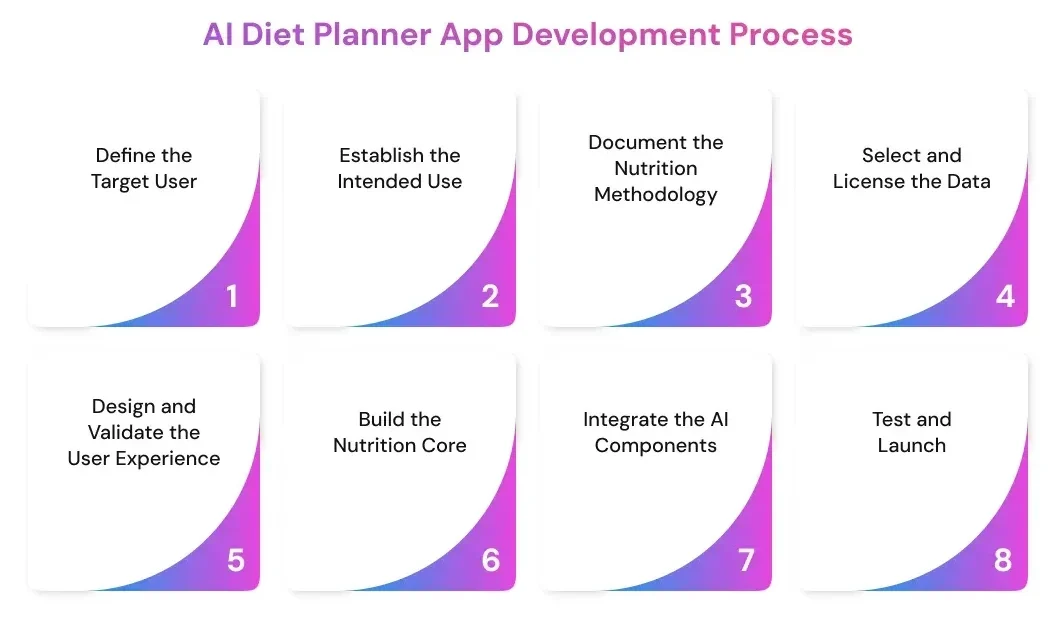
Step 1: Define the Target User
The first step is identifying who the product will serve. Potential users may include:
- General wellness consumers
- People following fitness programs
- Dietitian clients
- Athletes
- Families
- Patients participating in nutrition-sensitive care programs
Each audience has different requirements. A consumer meal planner may focus on convenience, grocery cost, and cooking preferences. A dietitian platform may require professional approval, client records, and audit history. A healthcare application may need stronger validation, system integrations, and governance.
The initial release should address one primary audience rather than attempting to support every nutritional use case.
Step 2: Establish the Intended Use
The intended use describes what the product is designed to do and how users are expected to rely on its recommendations.
The application may provide:
- General nutrition education
- Wellness-focused meal planning
- Fitness-related nutrition support
- Professional decision support
- Patient-specific clinical recommendations
This distinction affects product claims, testing requirements, regulatory exposure, and the level of human oversight required.
A wellness application may help users plan balanced meals. A product that recommends a therapeutic diet for a diagnosed condition carries a different level of responsibility and may require regulatory analysis before development proceeds.
Step 3: Document the Nutrition Methodology
The team should define the nutritional rules before designing the AI interaction.
The methodology may cover:
- Energy requirement formulas
- Protein, carbohydrate, and fat ranges
- Portion calculations
- Meal-level nutrient distribution
- Dietary pattern definitions
- Allergy exclusions
- Unsafe calorie thresholds
- Ingredient substitution rules
- Micronutrient limits where relevant
These rules should be reviewed by qualified nutrition professionals. They should also be versioned so the business can identify which methodology produced a particular recommendation.
Step 4: Select and License the Data
Nutrition and recipe data affect every generated plan. The development team should evaluate prospective providers based on nutrient coverage, regional relevance, serving information, update frequency, commercial-use rights, and API availability.
Recipe content requires particular attention. A business may have permission to retrieve nutrient data without having the right to reproduce recipe instructions or images.
The system should also define how it will handle missing values, inconsistent units, duplicate foods, and changes made by external providers.
Step 5: Design and Validate the User Experience
The design process should test the highest-risk workflows before full development begins.
These may include:
- Completing onboarding
- Generating the first plan
- Replacing a meal
- Reporting an allergy
- Correcting a food image
- Reviewing nutritional values
- Creating a grocery list
- Upgrading to a paid plan
Prototype testing can reveal whether users understand the recommendations and whether the application asks for too much information before demonstrating value.
Step 6: Build the Nutrition Core
The nutrition database, calculation services, and constraint engine should be developed before the conversational AI layer.
This approach gives the product a controlled foundation. The system can calculate targets, retrieve suitable foods, exclude prohibited ingredients, and validate meal totals without relying on generated text.
Step 7: Integrate the AI Components
The LLM should communicate with approved services through structured requests. Tool access may include recipe search, nutrient lookup, plan modification, and grocery-list generation.
The application should define:
- Which functions the model can call
- Which data it can access
- Which outputs require validation
- When the system should refuse a request
- When a professional should review the response
- What happens when the model or an external service is unavailable
Step 8: Test and Launch
Testing should cover calculations, dietary restrictions, interface behavior, security, accessibility, performance, and AI output quality.
A controlled beta can help the team measure user corrections, recommendation acceptance, retention, response latency, and inference cost before a wider release.
Nutrition Accuracy and AI Safety
An AI-generated meal plan should pass validation before it reaches the user.
The validation layer may check:
- Total calories
- Macronutrient distribution
- Portion sizes
- Allergy conflicts
- Excluded foods
- Duplicate meals
- Missing ingredients
- Unrealistic quantities
- Contradictory user preferences
The application should also identify requests that require a safer response. Examples include extreme calorie restriction, rapid weight-loss demands, medication-related dietary questions, eating-disorder signals, and requests for diagnosis or treatment.
In these situations, the product may reject the requested target, provide a general safety message, or direct the user to a qualified professional.
Food-photo results also require uncertainty controls. The interface should display likely foods, serving estimates, and confidence information, then ask the user to confirm or correct the entry.
Ongoing evaluation should track nutritional validation failures, allergy-rule violations, user corrections, unsupported claims, response time, and the cost of generating each plan. A low technical error rate does not by itself prove that recommendations are clinically appropriate, so high-risk use cases may still require dietitian or clinician review.
Data Privacy and Security
Diet planner applications may collect weight, allergies, eating behavior, activity, location, medical context, and religious or cultural food preferences. Some of this information can reveal sensitive details even when the application is positioned as a wellness product.
The security design should include:
- Encryption in transit and at rest
- Role-based access
- Strong authentication
- Consent management
- Minimum-data collection
- Secure credential storage
- Audit logging
- Retention and deletion rules
- Vendor security reviews
- Incident-response procedures
- Backup and recovery testing
The OWASP Mobile Application Security Verification Standard provides a current baseline for evaluating controls involving storage, cryptography, authentication, network communication, platform interaction, and resistance to tampering.
Security requirements should also extend to AI providers, analytics platforms, cloud vendors, nutrition APIs, and any other service that receives user information.
Regulatory Considerations
Regulatory requirements depend on the product’s users, claims, data flows, location, and relationship with healthcare organizations.
HIPAA
HIPAA does not automatically apply to every consumer nutrition app. It generally applies to covered healthcare providers, health plans, healthcare clearinghouses, and relevant business associates handling protected health information on their behalf.
When a software provider creates, receives, maintains, or transmits electronic protected health information for a covered organization, the parties may need a business associate agreement and appropriate HIPAA safeguards.
FTC Health Breach Notification Rule
Consumer health applications outside HIPAA may still fall under the FTC Health Breach Notification Rule. Amendments effective from July 29, 2024 clarified the rule’s relevance to health apps, connected devices, and similar products.
For breaches involving 500 or more people, notice generally must be submitted to the FTC at the same time affected users are notified and no later than 60 days after discovery.
FDA Product Classification
The FDA issued updated final guidance on general wellness products on January 6, 2026. The guidance addresses low-risk products that promote a healthy lifestyle and helps distinguish them from functions that may fall under medical-device oversight.
A diet planner’s claims matter. General meal-planning support may remain within a wellness context, while software intended to diagnose, treat, or manage a disease may require a different regulatory approach.
GDPR and the EU AI Act
Under the GDPR, health information is sensitive personal data. Processing it generally requires a valid legal basis, an applicable Article 9 condition, appropriate safeguards, and documented risk controls.
The EU AI Act entered into force on August 1, 2024 and becomes broadly applicable on August 2, 2026, subject to exceptions and phased requirements. Whether an AI diet planner faces specific obligations depends on its intended purpose, deployment context, and risk classification.
Once the product scope, architecture, and risk controls are defined, the business can estimate development more credibly. Cost depends not only on the number of screens, but also on personalization depth, data licensing, integrations, validation, security, and intended use.
How Much Does AI Diet Planner App Development Cost?
There is no universal price for developing an AI diet planner app. The budget depends on the number of platforms, product complexity, nutrition data requirements, AI features, professional workflows, integrations, and regulatory responsibilities.
As a general market reference, Clutch’s July 2026 pricing data places the average mobile app development project at approximately $90,780, with an average reported timeline of around 11 months. This figure covers mobile applications across many industries, so it should be treated as a benchmark rather than a direct estimate for an AI nutrition product.
A useful way to estimate the investment is to divide the product into levels.
| Product level |
Typical scope |
Relative investment |
| Prototype |
Clickable design, sample meal plans, limited technical validation |
Low |
| Focused MVP |
User profiles, meal generation, recipes, grocery lists, basic AI assistant |
Moderate |
| Advanced consumer app |
Food-image recognition, subscriptions, wearables, adaptive recommendations |
Moderate to high |
| Professional platform |
Dietitian dashboard, client management, approval workflows, reporting |
High |
| Clinical or enterprise platform |
Healthcare integrations, advanced governance, auditability, regulatory validation |
Highest |
The main cost drivers include:
- Native versus cross-platform development
- Number of user roles and dashboards
- Nutrition and recipe data licensing
- LLM and computer-vision integrations
- Custom recommendation models
- Wearable and healthcare integrations
- Security and compliance requirements
- Geographic and language coverage
- Testing and professional nutrition review
Businesses must also budget for ongoing operations. These expenses may include cloud infrastructure, AI model usage, data-provider fees, monitoring, security testing, customer support, model evaluation, and product maintenance.
AI usage should be estimated against expected user behavior. A user who generates one weekly plan creates a different cost profile from someone who uses conversational coaching, image analysis, and meal regeneration several times each day.
Model location can also affect spending. OpenAI’s 2026 API documentation states that eligible regional-processing endpoints for models released on or after March 5, 2026 carry a 10% pricing uplift. This illustrates why privacy and data-residency decisions should be included in the operating budget rather than treated only as technical requirements.
Also Read: AI Development Cost: Complete Guide for Businesses
AI Diet Planner Development Timeline
The schedule should follow product risk rather than screen count alone.
A typical development plan may include:
- Product discovery and intended-use definition
- Nutrition methodology and data selection
- UX design and prototype testing
- Backend and mobile development
- AI and third-party integrations
- Nutrition, security, and functional testing
- Controlled beta launch
- Product improvement based on user feedback
A focused MVP may reach beta sooner than the broader 11-month app-development average reported by Clutch, while a clinical or multi-platform product may require a longer schedule because of integrations, validation, and governance. This should be treated as a planning inference rather than a guaranteed delivery period.
Monetization Models for an AI Diet Planner
The business model should align with the audience and the value delivered.
Common options include:
- Freemium access with paid planning features
- Monthly or annual subscriptions
- Family plans
- Dietitian consultations
- Employer wellness programs
- B2B software licensing
- White-label platforms
- Grocery and meal-kit partnerships
- API access for other applications
App-store fees must be included in subscription economics. Apple’s Small Business Program applies a 15% commission to qualifying paid apps and in-app purchases for eligible developers with up to $1 million in prior-year proceeds.
Google Play’s published fee structure includes a 15% fee on the first $1 million in annual earnings for developers enrolled in the relevant tier, while automatically renewing subscriptions are generally subject to a 15% fee. Programs, regions, and transaction methods can create exceptions, so businesses should verify the applicable terms before finalizing pricing.
Sponsored meals or grocery products should never bypass allergy restrictions, user exclusions, or nutrition safety rules.
Metrics and KPIs to Track
An AI diet planner should measure product performance and recommendation quality separately.
Product metrics may include:
- Onboarding completion
- Time to first meal plan
- Plan acceptance
- Meal-swap frequency
- Grocery-list usage
- Weekly active users
- Retention
- Trial conversion
- Subscription churn
AI and safety metrics may include:
- Nutrition-validation pass rate
- User correction rate
- Allergen-rule violations
- Unsupported response rate
- Food-recognition confidence
- Recommendation acceptance
- Response latency
- Inference cost per active user
Weight loss should not be the only measure of success. Adherence, user confidence, planning time, food waste, and professional review time may provide a more complete view of product value.
Common Development Challenges
Nutrition applications can fail even when the interface and AI conversation appear polished.
Common challenges and mitigation approaches include:
- Incorrect nutrient totals: Use verified databases and automated calculation tests.
- Hallucinated recipes: Restrict generation through retrieval and structured outputs.
- Uncertain food-image results: Display confidence and require user confirmation.
- Regional food-data gaps: Add localized datasets and ingredient mappings.
- Contradictory restrictions: Detect conflicts before generating a plan.
- High AI costs: Use model routing, caching, request limits, and shorter structured prompts.
- Low user retention: Adapt plans to budget, time, preferences, and past behavior.
- Privacy concerns: Collect only the information required for defined features.
- Vendor dependency: Create an abstraction layer between the application and AI providers.
Vendor dependency is a practical concern. Google discontinued certain Gemini 2.0 Flash model versions on June 1, 2026 and directed developers toward newer releases. Applications tied directly to one model identifier may therefore require urgent changes when providers retire models.
Future Opportunities for AI Nutrition Products
Future development may include:
- On-device food recognition
- Pantry-aware meal generation
- Voice and multimodal food logging
- Family nutrition planning
- Culturally localized recommendations
- Human-and-AI coaching
- Grocery-budget optimization
- Food-waste reduction
- More contextual wearable integration
These capabilities should be introduced only when they improve an established workflow. A more advanced model does not solve weak nutrition data, unclear product positioning, or low user trust.
How to Choose an AI Diet Planner Development Partner
A suitable development partner should understand both software engineering and the risks of AI-supported nutrition.
Evaluation criteria may include:
- Health and nutrition product experience
- Access to qualified nutrition professionals
- AI model evaluation capabilities
- Mobile and backend development expertise
- Nutrition data integration
- Security and privacy experience
- MLOps and monitoring
- Transparent data licensing
- Clear code and data ownership
- Post-launch maintenance
The company should also explain where AI is useful, where deterministic rules are safer, and how the system will handle uncertain or high-risk requests.
How Prismetric Can Help Build Your AI Diet Planner
Prismetric provides end-to-end AI and Generative AI Consulting and Development Services to turn your diet-planning concept into a secure, scalable, and user-friendly product. Our team handles product strategy, UX design, nutrition-data integration, AI implementation, testing, deployment, and ongoing optimization.
As the company behind Vitara.ai, Prismetric uses its in-house AI platform, reusable components, and proven development workflows to accelerate delivery. This foundation helps reduce repetitive development work, shorten time to market, and build reliable AI capabilities without compromising customization, security, or product quality.
- Define the right MVP features, user journeys, architecture, and monetization strategy.
- Integrate verified nutrition databases, recommendation engines, LLMs, and validation rules.
- Build consumer apps, dietitian dashboards, admin panels, and third-party integrations.
- Implement privacy, allergy controls, output monitoring, and role-based access.
- Use Vitara.ai to prototype, test, and deploy intelligent features more efficiently.
- Provide post-launch support, performance monitoring, and feature improvements as the platform grows.
Plan Your AI Diet Planner App with Confidence
Get expert guidance on features, architecture, development cost, timeline, integrations, security, and long-term scalability.
Get a Free Consultation
Conclusion
A successful AI diet planner requires more than generative recipe creation. It needs reliable nutrition data, controlled calculations, safety rules, useful personalization, secure architecture, and continuous monitoring.
Businesses should begin with a focused MVP that solves one clear planning problem. Advanced features such as food recognition, wearables, predictive recommendations, and clinical integrations can follow after the core product has demonstrated accuracy, usability, and demand.
An experienced AI application development partner can help define the product scope, select the architecture, estimate the investment, and build a system that supports both user needs and long-term business requirements.
Frequently Asked Questions
The cost depends on platforms, features, data licensing, AI usage, integrations, and compliance. A focused consumer MVP requires a smaller investment than a professional or clinical platform with dashboards, healthcare integrations, and advanced governance.
The timeline depends on product scope and validation requirements. Discovery, nutrition methodology, design, development, AI integration, testing, and beta feedback should all be included rather than estimating the schedule from the number of screens.
A practical MVP should include onboarding, dietary preferences, meal-plan generation, nutrition validation, recipes, meal swaps, grocery lists, and basic progress tracking.
There is no universally superior model. Teams should compare instruction accuracy, structured output, latency, privacy, cost, tool use, and deployment requirements. The architecture should also make it possible to replace the provider.
The application should retrieve nutrient values from verified databases, normalize serving sizes, perform calculations through controlled application logic, and validate totals before showing the plan.
Not every consumer wellness app is covered by HIPAA. Applicability depends on the organization, data relationship, users, and whether the product handles protected health information for a covered entity or business associate.