AI Automation ROI Framework: A Practical Guide to Measure Real Business Value
Key takeaways:
- AI automation ROI should measure realized business value, not just theoretical time savings, productivity gains, or tasks completed by AI systems.
- A complete ROI calculation includes software, development, integration, data preparation, training, governance, monitoring, maintenance, and other ownership costs.
- Strong AI automation business cases start with measurable workflow baselines covering processing time, labor effort, errors, throughput, and operating costs.
- Benefit realization rates help businesses separate potential value from savings, capacity, revenue, or cost avoidance they can actually capture.
- Tracking ROI across adoption, efficiency, quality, reliability, and strategic outcomes helps organizations decide which AI automation initiatives deserve further investment over time.
AI automation can save employee time, reduce repetitive work, improve processing speed, and support higher transaction volumes. But those improvements do not automatically translate into financial returns. Businesses need a structured way to determine whether the value created by automation justifies the money, time, data, integration, and organizational effort required to implement it.
An AI automation ROI framework measures the financial, operational, and strategic value generated by AI automation against its total cost of ownership. It connects workflow-level improvements such as hours saved, lower error rates, or faster processing with business outcomes such as cost avoidance, additional capacity, margin improvement, or revenue growth.
The important distinction is between potential value and realized value. If an AI system saves 2,000 employee hours but the organization cannot redirect those hours toward productive work, avoid additional hiring, or reduce operating costs, treating the entire time saving as financial ROI can overstate the return.
Businesses evaluating AI workflow automation should therefore measure not only what the technology can automate, but also how much of that improvement the organization can actually convert into measurable business value.
What Is an AI Automation ROI Framework?
An AI automation ROI framework is a structured method for comparing the measurable value created by AI-powered automation with the full cost of implementing and operating it. The framework considers financial returns alongside operational efficiency, quality improvements, user adoption, AI reliability, and longer-term strategic outcomes.
Traditional ROI calculations usually compare investment with financial gain. AI automation requires a broader view because many benefits appear first as operational changes.
For example, an automated document-processing workflow may:
- reduce the time employees spend reviewing invoices or claims;
- lower the number of manual data-entry errors;
- process a larger volume of documents without expanding the team;
- shorten approval or response times;
- allow employees to focus on exceptions and higher-value decisions.
Each improvement creates potential business value, but the organization still needs to determine how that value will be realized.
Saved employee time may create value through avoided hiring rather than immediate payroll reduction. Faster customer service may improve retention rather than directly reduce costs. Lower error rates may reduce rework, refunds, compliance exposure, or manual review.
This is why enterprise teams should evaluate financial ROI, operational ROI, quality outcomes, and strategic value together rather than relying on one productivity metric.
Organizations planning larger automation programs may also use specialized AI workflow automation services to identify suitable workflows, establish baseline metrics, design integrations, and define measurable outcomes before scaling automation across business functions.
Know the ROI Before You Scale AI Automation
Prismetric helps assess workflow costs, automation potential, expected benefits, and realization rates so you can build a stronger AI business case.
Assess Your AI ROI
How Do You Calculate AI Automation ROI?
The basic AI ROI formula compares the value the organization actually realizes with the total cost required to create that value.
AI Automation ROI (%) =
(Total Realized AI Value − Total Cost of Ownership) ÷ Total Cost of Ownership × 100
The word realized matters. A credible AI automation ROI calculation should avoid assuming that every projected hour saved, task automated, or efficiency improvement becomes a financial benefit.
A stronger calculation separates three variables:
Potential AI Value = the economic value that automation could create if all expected benefits were captured.
Benefit Realization Rate = the percentage of that potential value the organization can realistically convert into cost savings, additional capacity, revenue, or another measurable outcome.
Realized AI Value = Potential AI Value × Benefit Realization Rate.
For example, suppose an automated workflow creates an estimated $200,000 in annual productivity capacity. If the business expects to convert 60% of that capacity into additional output or avoided hiring, the realized productivity value would be:
$200,000 × 60% = $120,000
If the AI automation system costs $80,000 to implement and operate during the same period:
ROI = ($120,000 − $80,000) ÷ $80,000 × 100 = 50%
The example shows why measuring only theoretical time savings can produce an inflated business case. The ROI model becomes more useful when it reflects what the organization can actually capture.
What Costs Should Be Included in AI Automation ROI?
The total cost of ownership for AI automation should include more than software licensing. A complete calculation should account for the resources required to design, deploy, integrate, govern, and maintain the system.
Typical costs include:
- AI software, platform, or model fees;
- API and model inference costs;
- workflow discovery and solution design;
- application or automation development;
- enterprise data preparation;
- integration with ERP, CRM, document management, or other systems;
- cloud and infrastructure expenses;
- employee training and change management;
- security, governance, and compliance controls;
- human review and exception handling;
- monitoring, maintenance, and ongoing optimization.
Businesses estimating these investments can also review the factors that influence AI development cost, particularly when automation requires custom models, enterprise integrations, or complex data pipelines.
What Benefits Should Be Included in AI Automation ROI?
AI automation benefits should be tied to measurable business outcomes rather than broad claims about productivity.
Common benefit categories include labor capacity reclaimed, cost avoidance, reduced errors and rework, higher workflow throughput, faster cycle times, improved service quality, additional revenue, and better use of existing employees.
A practical framework can calculate individual benefits separately:
Labor capacity value = Hours reclaimed × Fully loaded hourly employee cost
Error reduction value = Errors avoided × Average cost per error
Throughput value = Additional transactions processed × Contribution value per transaction
Revenue contribution = Incremental revenue × Contribution margin
Separating these benefit categories makes the ROI calculation easier to audit and helps business leaders identify exactly where AI automation is creating value.
The 6-Step AI Automation ROI Framework
A practical AI automation ROI framework should measure value from the workflow level upward. The process starts by selecting a business outcome, establishing a reliable baseline, and calculating the full investment required. Only then should the organization estimate benefits, determine how much value can realistically be realized, and calculate ROI under different scenarios.
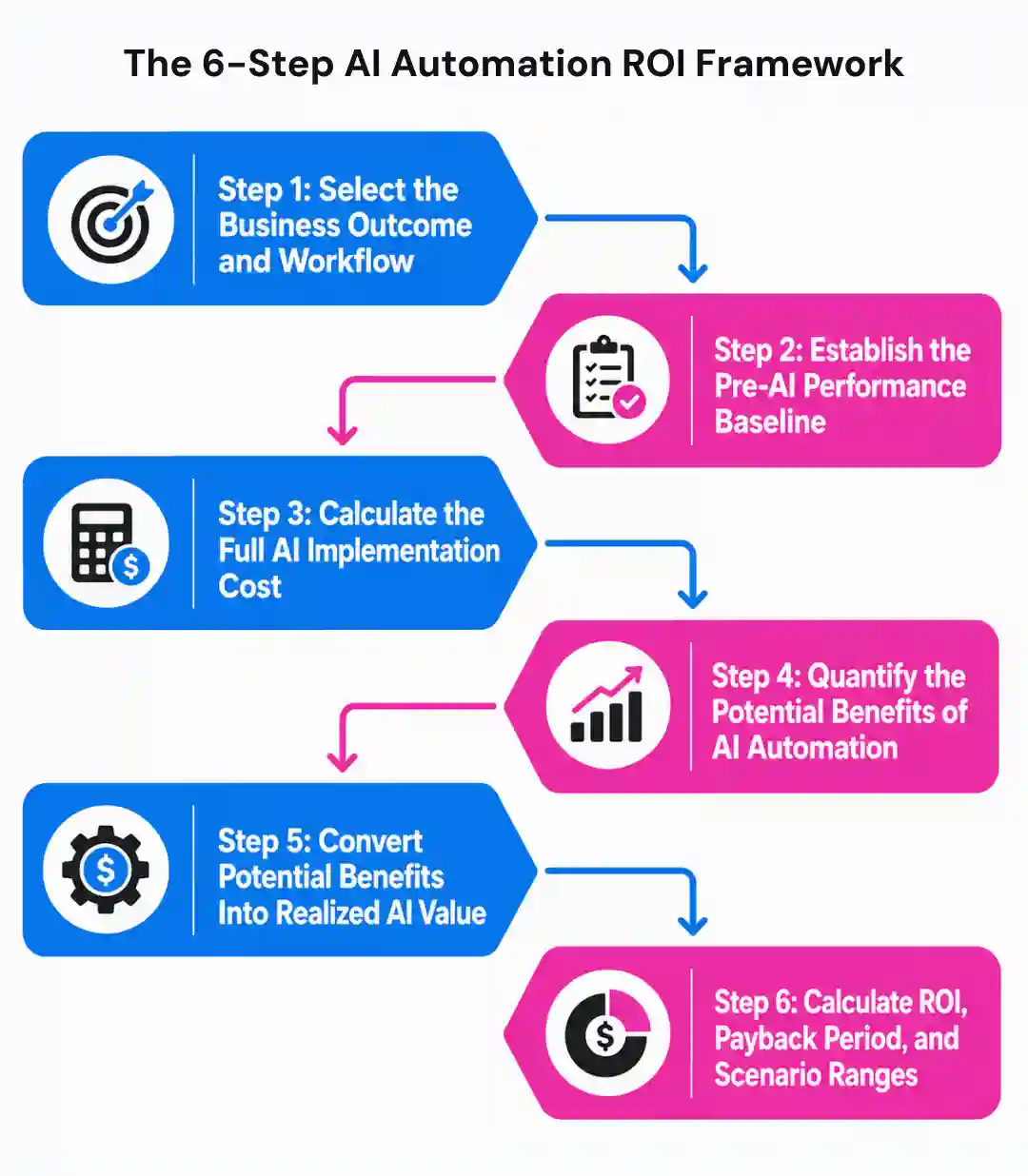
Step 1: Select the Business Outcome and Workflow
The first step in measuring AI automation ROI is choosing a workflow where automation can address a measurable business problem. Instead of starting with “Where can we use AI?”, start with “Which workflow creates enough cost, delay, errors, or capacity constraints to justify automation?”
This distinction matters because not every repetitive task is a strong candidate for AI.
A workflow may be suitable for automation when it has:
- high transaction or task volume;
- significant manual processing time;
- predictable inputs and outputs;
- measurable error or rework costs;
- sufficient historical data;
- frequent handoffs between systems or teams;
- clear service-level or processing-time targets;
- potential for cost avoidance, capacity growth, or revenue improvement.
For example, an accounts payable team may process thousands of invoices every month. Employees may manually extract supplier details, validate purchase orders, enter information into an ERP system, and route exceptions for approval.
An AI-enabled workflow could extract invoice data, validate fields against business rules, compare information with connected systems, and send only exceptions to employees for review. The business case becomes measurable because the organization can compare promodel evaluation and updatescessing time, error rates, manual effort, and cost per invoice before and after automation.
A structured AI workflow discovery checklist can help teams evaluate workflows based on automation feasibility, data availability, integration requirements, expected value, and operational risk.
One practical way to prioritize opportunities is to score each workflow across five areas:
| Evaluation factor |
What to measure |
| Volume |
Number of tasks or transactions processed |
| Manual effort |
Employee hours required per task |
| Process cost |
Labor, rework, and operating costs |
| Automation feasibility |
Data quality, workflow predictability, and system access |
| Business impact |
Potential effect on cost, capacity, customer experience, or revenue |
High-volume workflows with significant manual effort and measurable business impact often provide a clearer basis for an AI workflow automation ROI calculation than low-frequency processes with unclear outcomes.
Businesses evaluating several automation opportunities may also benefit from working with an AI automation agency to assess process economics, technical feasibility, integration dependencies, and expected value before committing development resources.
Step 2: Establish the Pre-AI Performance Baseline
An AI ROI measurement process needs a baseline that shows how the workflow performs before automation. Without baseline data, teams may know that a process feels faster after implementation but cannot reliably determine how much operational or financial improvement the AI system created.
The baseline should reflect the same metrics that will be measured after deployment.
Depending on the workflow, useful baseline metrics may include:
- tasks or transactions processed each month;
- average handling time per task;
- total employee hours spent on the workflow;
- fully loaded labor cost;
- cycle or turnaround time;
- error and rework rates;
- cost per transaction;
- escalation or exception rate;
- throughput per employee;
- customer satisfaction or service-level performance.
Consider a customer support workflow where employees manually classify incoming requests and route them to the correct team. Before introducing AI automation, the organization should measure how many requests arrive each month, how much time employees spend classifying them, how often requests are routed incorrectly, and what those mistakes cost.
The same metrics can then be measured after deployment.
This creates a clear comparison:
Improvement = Post-AI performance − Pre-AI baseline
For metrics where lower values are better, such as handling time or error rates, the calculation can be reversed to show the reduction.
The baseline period should also represent normal business activity. A single unusually busy or quiet week can distort the calculation. Organizations may need several weeks or months of historical data when workflow volume changes because of seasonality, promotions, reporting periods, or other business conditions.
Reliable baselines also depend on reliable data. If process information is fragmented across spreadsheets, ERP systems, CRM platforms, ticketing tools, and operational databases, teams may need to improve data collection before building the ROI model.
This is one reason enterprise automation projects often depend on data engineering services to consolidate, clean, and prepare operational data for analytics, AI systems, and performance measurement.
Step 3: Calculate the Full AI Implementation Cost
The third step is calculating AI implementation costs across the entire lifecycle, not just the initial development or software subscription. A realistic cost model should include one-time implementation expenses, recurring technology costs, and the internal organizational effort required to keep the automation reliable.
A useful approach is to divide the investment into three categories.
One-Time Implementation Costs
These costs occur primarily during planning, development, and deployment:
- workflow analysis and requirements gathering;
- AI solution design;
- custom development and configuration;
- data preparation;
- API and enterprise system integrations;
- testing and validation;
- security and access-control implementation;
- deployment and initial infrastructure setup.
Integration can represent a significant part of the implementation effort when AI automation needs access to ERP, CRM, HR, finance, document management, or other enterprise systems. Businesses with complex environments may require dedicated AI integration services to connect AI capabilities with existing applications without disrupting operational workflows.
Recurring Operating Costs
Recurring expenses continue after deployment and should be included in the total cost of ownership:
- AI platform or software subscriptions;
- API and model inference usage;
- cloud computing and storage;
- monitoring and observability;
- application maintenance;
- model evaluation and updates;
- integration maintenance;
- cybersecurity controls;
- technical support.
Some costs may increase as automation volume grows. For example, model inference expenses can rise when the number of processed documents, conversations, or automated tasks increases.
Organizational and Change Costs
AI automation also requires employee and management effort that may not appear on a software invoice.
These costs can include:
- employee training;
- change management;
- workflow redesign;
- subject-matter expert participation;
- human review of exceptions;
- governance and compliance activities;
- internal IT and security resources.
Including these expenses creates a more credible automation ROI calculation because the business compares expected benefits with the resources genuinely required to deploy and operate the solution.
Once the workflow, baseline, and total investment are established, the next step is to quantify the value AI automation could create and then determine how much of that potential value the organization can realistically capture.
Step 4: Quantify the Potential Benefits of AI Automation
The fourth step in the AI automation ROI framework is estimating the economic value the automated workflow could create. Potential benefits should be calculated from measurable changes such as labor hours reclaimed, errors avoided, additional transactions processed, faster cycle times, or incremental revenue rather than broad claims about productivity.
This step answers a practical question: If the automation performs as expected, where will the business value come from?
Calculate Labor Capacity Reclaimed
Labor capacity value measures the economic value of employee time that AI automation can free from repetitive work.
A simple formula is:
Labor Capacity Value = Hours Reclaimed × Fully Loaded Hourly Employee Cost
Fully loaded employee cost should include more than base salary where appropriate. It may account for benefits, payroll expenses, and other employment costs used by the organization for internal financial planning.
Consider a finance team that spends 1,000 hours each year manually reviewing and classifying documents. If AI automation reduces that workload by 600 hours and the fully loaded labor cost is $50 per hour:
600 × $50 = $30,000 in potential labor capacity value
However, this does not mean the organization has automatically saved $30,000 in cash. The business still needs to determine how those 600 hours will be used. That distinction becomes important in Step 5.
Organizations evaluating where automation can reduce operating expenses can also review practical examples of how AI helps businesses cut costs across data processing, customer operations, forecasting, and other enterprise workflows.
Calculate the Value of Error and Rework Reduction
AI automation can create value by reducing repetitive errors, duplicate processing, incorrect data entry, and unnecessary manual rework.
The potential value can be calculated as:
Error Reduction Value = Errors Avoided × Average Cost per Error
The cost of an error depends on the workflow. An incorrect invoice may create extra employee work. A wrongly routed support ticket may delay resolution. An inaccurate order entry may lead to returns, refunds, or customer dissatisfaction.
For this reason, organizations should calculate the actual operational cost of errors rather than assigning an arbitrary value.
AI can support these workflows by extracting information, validating data against predefined rules, identifying unusual entries, and routing uncertain cases for human review.
Calculate Throughput and Capacity Value
Some AI automation projects create more value through additional capacity than direct cost reduction.
The basic calculation is:
Throughput Value = Additional Transactions Processed × Contribution Value per Transaction
For example, an insurance operations team may use automation to process more claims with the same number of employees. A logistics company may handle more shipment exceptions without expanding its operations team. A customer service organization may resolve a higher volume of routine requests while employees focus on complex cases.
This type of value is particularly relevant when demand is growing but the business wants to avoid increasing headcount at the same rate.
Businesses assessing broader automation opportunities can explore how AI in business process automation is used to automate document handling, routing, data processing, customer operations, and other repeatable workflows.
Calculate Revenue Contribution Carefully
AI automation may also contribute to revenue when it improves a workflow connected directly to sales, conversion, retention, or customer capacity.
A simplified formula is:
Revenue Contribution = Incremental Revenue × Contribution Margin
Using contribution margin rather than total revenue helps prevent the ROI model from overstating financial value.
For example, an AI-powered sales workflow may help representatives respond to qualified leads faster. A customer service automation system may reduce response delays that contribute to churn. An AI agent may help employees retrieve product or account information more quickly during customer conversations.
Revenue attribution is often harder to prove than labor savings or error reduction. Businesses should therefore use conservative assumptions and distinguish directly attributable revenue from revenue that AI may only have influenced.
Step 5: Convert Potential Benefits Into Realized AI Value
Potential benefit and realized value are not the same. Realized AI value is the portion of projected operational benefit that the organization can actually convert into cost reduction, avoided expenditure, additional output, revenue, or another measurable business result.
This distinction helps prevent one of the most common problems in enterprise AI ROI calculations: treating every saved hour as a financial saving.
A practical formula is:
Realized AI Value = Potential AI Benefit × Benefit Realization Rate
The benefit realization rate represents how much of the theoretical value the organization expects to capture.
Suppose AI automation frees employee capacity worth $150,000 per year. If management expects to convert 70% of that capacity into increased transaction volume and avoided hiring:
$150,000 × 70% = $105,000 in realized value
The remaining $45,000 may still represent useful employee capacity, but it should not automatically be included as realized financial ROI.
How Can a Business Determine the Benefit Realization Rate?
The benefit realization rate should reflect what happens after the automation saves time or improves the workflow.
Ask questions such as:
- Will reclaimed employee hours reduce overtime?
- Can the business avoid planned hiring?
- Will employees use the time to process additional work?
- Can additional capacity support more customers or transactions?
- Does faster processing create measurable revenue?
- Are employees actually using the automated workflow?
- How frequently do employees need to correct AI outputs?
- How many transactions still require manual intervention?
Adoption also matters. An automation system that could theoretically save 10 minutes per task will create little enterprise value if only a small percentage of employees use it.
Organizations moving from isolated pilots to production systems may use an AI implementation approach that includes user adoption, integration, monitoring, governance, and business-performance measurement rather than treating deployment as the end of the project.
The same principle applies to agentic systems. Agentic process automation can coordinate multi-step activities across connected tools, but organizations still need to measure completion rates, human approval requirements, exception handling, and operational reliability before assigning financial value.
Step 6: Calculate ROI, Payback Period, and Scenario Ranges
Once the organization knows its expected realized value and total cost of ownership, it can calculate AI automation ROI, net benefit, and payback period. Scenario modeling should then test how the business case changes when assumptions such as adoption, automation rate, cost, or transaction volume vary.
The primary calculation remains:
AI Automation ROI (%) =
(Realized AI Value − Total Cost of Ownership) ÷ Total Cost of Ownership × 100
Businesses should also calculate:
Net AI Benefit = Realized AI Value − Total Cost of Ownership
And:
Payback Period = Initial Investment ÷ Average Monthly Net Benefit
Payback shows how long the project may take to recover its initial investment. ROI shows the return relative to the amount invested. These metrics answer different financial questions, so enterprise decision-makers should evaluate both.
Use Conservative, Expected, and Upside Scenarios
AI ROI forecasts depend on assumptions. Instead of presenting one number as certain, build at least three scenarios.
| Scenario |
Typical assumption |
| Conservative |
Lower adoption, smaller efficiency gains, higher operating cost |
| Expected |
Most likely adoption, performance, and cost assumptions |
| Upside |
Strong adoption, higher workflow volume, better benefit realization |
Scenario modeling can vary factors such as:
- employee adoption;
- percentage of tasks successfully automated;
- AI accuracy and exception rates;
- transaction volume;
- inference and infrastructure costs;
- labor costs;
- maintenance requirements;
- benefit realization rate.
This gives CFOs, CIOs, operations leaders, and AI teams a more useful decision range than a single optimistic ROI percentage.
Organizations evaluating more complex enterprise deployments may also need enterprise AI development services when automation involves multiple systems, custom workflows, governance controls, or AI agents operating across several business functions.
Turn AI Efficiency Into Measurable Business Value
Automate high-value workflows with the right data, integrations, governance, and performance metrics to improve cost, capacity, and operational outcomes.
Explore AI Automation
How Should AI ROI Metrics Change as AI Adoption Matures?
AI ROI metrics should evolve as an organization moves from experimentation to operational optimization and business transformation. Early programs should measure adoption and learning. Production deployments should focus on efficiency and quality. Mature AI programs should increasingly measure financial contribution, capacity creation, and new business outcomes.
A practical maturity model includes four stages:
| AI maturity stage |
Primary measurement focus |
Example AI ROI metrics |
| Exploring |
Adoption |
Active users, pilot participation, workflow usage |
| Optimizing |
Efficiency |
Time saved, cycle time, throughput, automation rate |
| Enhancing |
Quality |
Error reduction, rework, SLA performance, customer outcomes |
| Transforming |
Business value |
Cost avoidance, margin contribution, capacity, AI-enabled revenue |
Exploring: Measure Adoption and Learning
At the exploring stage, the organization is testing whether AI can support a workflow reliably enough to justify wider deployment.
Relevant metrics include pilot participation, employee adoption, successful task completion, and user feedback.
Businesses deciding whether to move from experimentation into production may also compare an AI PoC vs. AI MVP to determine whether the immediate objective is proving technical feasibility or validating a usable business solution.
Optimizing: Measure Workflow Efficiency
Once AI enters regular operations, the focus should move toward measurable workflow improvements.
Common AI ROI metrics include:
- hours reclaimed;
- processing time;
- cost per transaction;
- automation rate;
- throughput;
- exception rate;
- human intervention rate.
Teams evaluating available platforms may also compare AI workflow automation tools based on integration support, orchestration capabilities, monitoring, scalability, and suitability for the target workflow.
Enhancing: Measure Quality and Business Outcomes
At the enhancing stage, AI should be evaluated not only on whether it completes tasks faster, but also on whether it improves the quality of the process.
Teams may track error rates, rework, SLA compliance, escalation rates, customer satisfaction, decision consistency, or other workflow-specific outcomes.
Transforming: Measure Enterprise-Level Value
At the transforming stage, the organization evaluates whether AI contributes to broader financial and strategic outcomes.
Metrics may include avoided hiring, additional operating capacity, faster time to market, margin improvement, new AI-enabled services, or incremental revenue that can be credibly attributed to AI-supported workflows.
The appropriate metrics will vary by business model and industry. Organizations exploring broader adoption can examine enterprise AI applications across different industries to understand how AI value changes across finance, healthcare, manufacturing, retail, logistics, and other operating environments.
AI Automation ROI Scorecard: Which Metrics Should You Track?
An AI automation ROI scorecard should combine financial, operational, quality, adoption, reliability, and strategic metrics. Tracking only cost savings can hide important signals such as low employee adoption, high exception rates, or poor output quality that may limit the value an AI automation system creates in production.
A useful scorecard can organize metrics into six categories:
| Metric category |
What to track |
What it tells the business |
| Financial |
ROI %, net benefit, payback period, cost per transaction |
Whether the investment creates measurable economic value |
| Operational |
Hours reclaimed, cycle time, throughput, automation rate |
Whether the workflow performs more efficiently |
| Quality |
Error rate, rework, SLA compliance, output accuracy |
Whether automation improves or maintains process quality |
| Adoption |
Active users, workflow usage, utilization rate |
Whether employees actually use the AI system |
| Reliability |
Exception rate, escalation rate, human intervention, task completion |
Whether the automation performs consistently in production |
| Strategic |
Capacity created, avoided hiring, time to market, attributable revenue |
Whether AI contributes to broader business outcomes |
The specific metrics should match the workflow.
For example, an invoice-processing automation may prioritize cost per invoice, processing time, extraction accuracy, exception rate, and employee hours reclaimed. A customer service AI agent may instead track resolution time, escalation rate, successful task completion, customer satisfaction, and cost per resolved request.
Organizations operating several AI systems may also use business intelligence services to combine financial, operational, and AI performance data into dashboards that give business and technology teams a consistent view of ROI.
The goal is not to collect every possible metric. The goal is to identify the smallest set of indicators that shows whether AI is being used, whether the workflow is improving, and whether those improvements create measurable business value.
What Are the Most Common AI Automation ROI Measurement Mistakes?
The most common AI ROI measurement mistakes are counting theoretical productivity as cash savings, ignoring the full implementation cost, measuring adoption without business outcomes, and calculating ROI without a reliable pre-AI baseline. These errors can make an automation project appear more financially successful than it actually is.
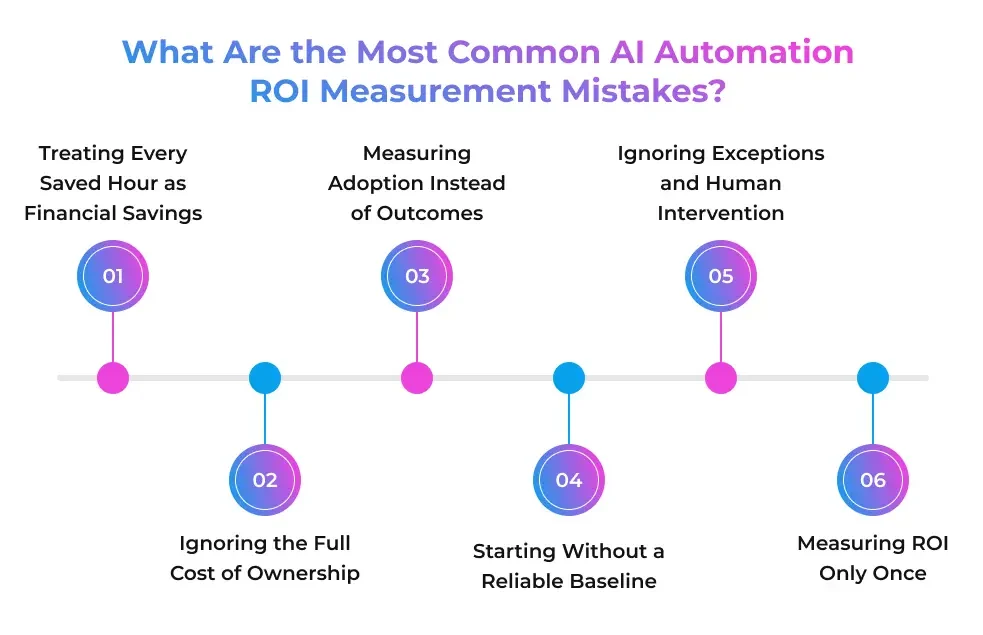
1. Treating Every Saved Hour as Financial Savings
If AI saves 500 employee hours, the organization has created capacity. It has not necessarily reduced spending.
That capacity becomes realized financial value when the business can use it to avoid hiring, reduce overtime, increase transaction volume, generate more revenue, or redirect employees toward measurable higher-value work.
This is why labor capacity and financial savings should be reported separately until the business can show how reclaimed time is being used.
2. Ignoring the Full Cost of Ownership
Software licensing represents only one part of an enterprise AI investment.
Integration, data preparation, security, infrastructure, training, governance, human review, model usage, monitoring, and maintenance can materially affect the business case.
Organizations evaluating generative AI components should also account for cost variables such as model usage, retrieval infrastructure, cloud consumption, and ongoing evaluation. These considerations are explored further in Prismetric’s guide to generative AI development cost.
3. Measuring Adoption Instead of Outcomes
High usage does not necessarily mean high ROI.
Employees may frequently use an AI tool without reducing cycle time, improving quality, increasing capacity, or lowering process costs. Adoption should therefore be treated as an enabling metric rather than the final measure of success.
A stronger measurement chain is:
Adoption → Workflow improvement → Business outcome → Realized value
4. Starting Without a Reliable Baseline
Without pre-AI measurements, teams cannot confidently attribute performance changes to automation.
For example, if transaction volume increases after deployment, the business should know whether the AI system created that improvement or whether demand simply increased during the same period.
Baseline data helps separate normal business variation from genuine automation impact.
5. Ignoring Exceptions and Human Intervention
An AI workflow may automate most of a process but still require substantial employee involvement when confidence is low, data is incomplete, or business rules are unclear.
These interventions consume time and reduce the effective automation rate.
The business should measure:
- percentage of tasks completed without intervention;
- number of exceptions;
- average time spent resolving exceptions;
- escalation frequency;
- cost of human review.
This is particularly relevant when assessing AI in RPA, where AI capabilities may handle less structured inputs while traditional automation executes deterministic system actions.
6. Measuring ROI Only Once
AI automation performance can change after deployment.
Workflow volume may increase. Model or API costs can change. Employees may adopt the system more widely. Data quality may deteriorate. New exceptions may appear.
ROI should therefore be recalculated at defined intervals using current operational and financial data.
How Can Businesses Maximize AI Automation ROI?
Businesses can improve AI automation ROI by prioritizing workflows with measurable economics, validating assumptions through smaller deployments, increasing employee adoption, reducing exception handling, improving data and integrations, and reinvesting in automations that consistently create realized value.
The following practices can improve the probability of a stronger business case.
Prioritize High-Value Workflows
Start with processes where the organization can clearly measure cost, manual effort, errors, capacity constraints, or revenue impact.
A simple automation with clear economics may create a stronger return than an ambitious AI initiative whose business outcome is difficult to quantify.
Reviewing practical applications of AI in business can help teams identify where AI is being applied to document processing, customer operations, analytics, forecasting, and other enterprise workflows.
Validate Value Before Scaling
A pilot or limited production deployment can test whether assumptions about automation rate, accuracy, adoption, and operational impact hold under real conditions.
Scaling should follow evidence rather than enthusiasm.
Organizations that need to move from a business case into deployment can use AI implementation services to plan data requirements, integrations, governance, deployment, monitoring, and value measurement around the target workflow.
Improve Adoption and Workflow Design
Employees need to understand when to use the automation, how to handle exceptions, and when human judgment is still required.
A technically capable system can underperform financially when employees bypass it or duplicate automated work manually.
Workflow design should therefore consider:
- user roles;
- approval points;
- exception handling;
- notifications;
- escalation logic;
- access permissions;
- employee training.
Reduce Integration and Data Friction
AI automation creates more value when it can access the information and systems needed to complete work.
Disconnected applications often force employees to copy data manually between systems, weakening both the automation rate and the ROI calculation.
The next optimization opportunity may therefore be an integration or data problem rather than a model problem.
Expand Successful Automation Carefully
Once a workflow demonstrates reliable performance and measurable value, businesses can evaluate adjacent processes with similar characteristics.
For example, a successful document-processing automation may create a foundation for related workflows in claims, procurement, compliance, onboarding, or customer operations.
Organizations exploring more autonomous workflows can assess relevant agentic AI use cases before deciding where tool-using AI agents provide enough value to justify the additional governance and monitoring requirements.
For more complex agent-based workflows, AI agent development services can support tool integration, orchestration, guardrails, approval points, monitoring, and evaluation requirements.
Move From AI ROI Estimates to Real Business Results
Prismetric can help you validate assumptions, build a focused pilot, measure realized value, and scale automations that deliver proven returns.
Talk to Our AI Experts
How Can Prismetric Help Improve AI Automation ROI?
Prismetric can help businesses turn an AI automation ROI framework into a practical implementation plan by identifying suitable workflows, defining measurable outcomes, and aligning automation initiatives with business priorities.
The team supports AI consulting, workflow automation, data engineering, AI integration, and implementation, helping organizations address the technical foundations that influence ROI.
Prismetric can also help connect AI systems with existing enterprise applications, prepare reliable data pipelines, and design automation around real operational requirements rather than isolated technology experiments.
This approach can help businesses move from ROI estimation to measurable deployment while maintaining focus on scalability, integration, and long-term business value.
Frequently Asked Questions About AI Automation ROI
There is no universal percentage that defines a good AI automation ROI. An acceptable return depends on implementation cost, business risk, payback expectations, workflow volume, strategic importance, and the organization’s alternative uses for the same capital.
A relatively modest ROI may still be valuable when automation addresses compliance risk, capacity constraints, or a strategically important process. A higher projected ROI may be less attractive when the calculation depends on uncertain adoption or unrealistic productivity assumptions.
Businesses should compare AI projects using consistent financial assumptions rather than relying on a generic industry benchmark.
An AI consulting services engagement can help organizations assess potential use cases, implementation feasibility, expected business value, risk, and prioritization before larger investments are approved.
Calculate AI automation ROI by subtracting total cost of ownership from realized AI value, dividing the result by total cost of ownership, and multiplying by 100.
AI Automation ROI (%) =
(Realized AI Value − Total Cost of Ownership) ÷ Total Cost of Ownership × 100
Realized value can include captured labor capacity, cost avoidance, error reduction, throughput gains, and attributable revenue. Total cost should include development, software, integration, infrastructure, training, governance, monitoring, and maintenance.
The time required to achieve AI automation ROI depends on the initial investment and the amount of net value created each month. A high-volume workflow with limited integration complexity may reach payback sooner than a large enterprise program involving several systems, business units, security controls, and change-management requirements.
The basic calculation is:
Payback Period = Initial Investment ÷ Average Monthly Net Benefit
Businesses should calculate payback using measured or conservative expected benefits rather than assuming maximum automation from the first month.
An AI ROI model should include one-time implementation costs, recurring technology expenses, and organizational costs.
Typical cost categories include development, licenses, model or API usage, data preparation, integrations, infrastructure, employee training, cybersecurity, governance, human oversight, monitoring, maintenance, and optimization.
For generative AI programs that involve model selection, RAG, evaluation, enterprise data, or governance, organizations may also work with generative AI consulting services to define technical requirements and estimate the resources required for implementation.
Yes. Robotic process automation, or RPA, typically follows predefined rules for structured and repeatable tasks, while AI automation can process less structured inputs such as documents, natural-language requests, images, or variable workflow conditions.
AI automation ROI models may therefore need additional metrics for model accuracy, exception handling, human review, inference cost, and output quality.
Businesses comparing the approaches can review this robotic process automation guide to understand where rule-based automation fits and where AI capabilities may be required.