AI PoC vs AI MVP: What’s the Difference?
The success of an AI product depends on the right business problem, reliable data, and careful testing before full-scale development.
One of the first steps in this journey is AI idea validation. It may look like a small step, but validating an AI idea before jumping into complete development can save you time, money, and many technical surprises later.
The two most common approaches to testing an AI product idea are building an AI Proof of Concept and an AI Minimum Viable Product. Both help you reduce risk, but they serve different purposes. If you are wondering how AI PoC vs AI MVP differs and which one is right for your business, here is a clear rundown that will help you make the right choice.
Key Takeaways
- An AI PoC helps you check whether your AI idea can work technically with your data, model, workflow, and business logic.
- An AI MVP is the first usable version of your AI product that real users can test, experience, and give feedback on.
- In contrast to an AI MVP, the purpose of an AI Proof of Concept is to validate feasibility, not to launch a polished product.
- Identifying data issues, model limitations, integration risks, and performance gaps early through AI PoC development reduces costly mistakes during later development stages.
What’s an AI Proof of Concept (PoC)?
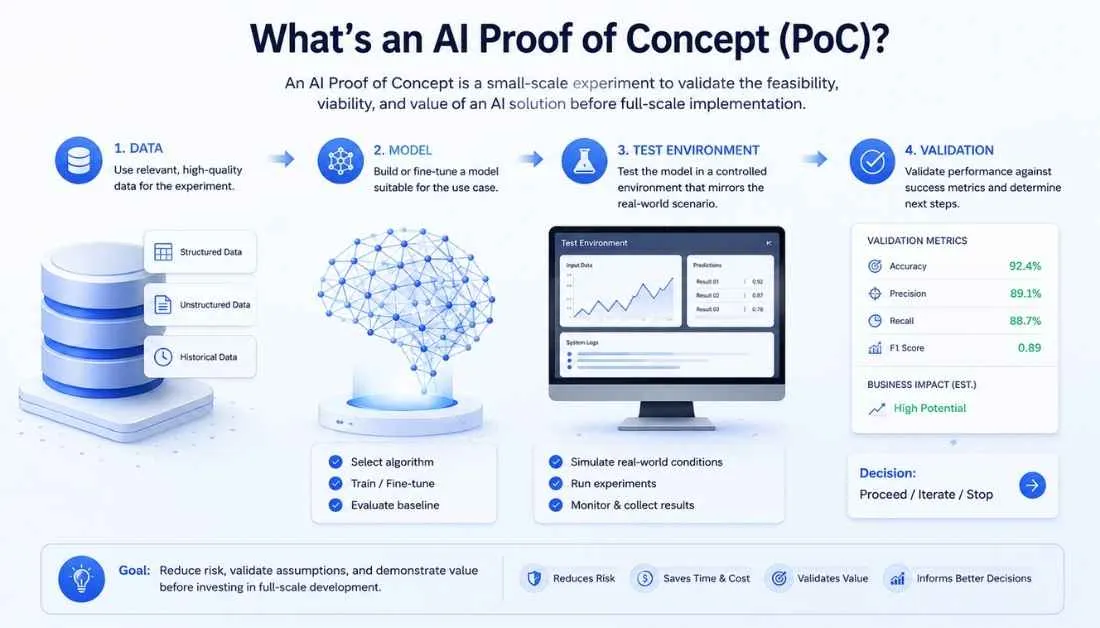
An AI PoC is a feasibility study before the development of a full-fledged AI product. It is a small, focused, and usually internal project aimed at validating whether a specific AI feature, model, automation flow, or technical assumption can actually work as expected.
In simple words, an AI Proof of Concept answers one important question: Can this AI idea work in practice?
For example, a retail company may want to use AI to forecast product demand. Instead of building a complete forecasting platform right away, the company can start with an AI PoC. The PoC can test historical sales data, check prediction accuracy, compare model performance, and show whether the idea is technically worth pursuing.
How an AI PoC works
AI PoC development helps validate that the data, AI model, tools, infrastructure, and technical resources you need are suitable for the selected use case. Since it is mainly used for internal validation, an AI PoC often keeps the user interface simple and focuses more on the model’s behavior, data flow, accuracy, response quality, or processing speed.
At this stage, the goal is not to build a production-ready AI system. The goal is to test the core assumption.
An AI PoC may use a limited dataset, a basic interface, manual data uploads, mocked APIs, and a controlled testing environment. The code may not always be reused in the next phase because the PoC is created to prove feasibility, not to support long-term scale.
AI PoC best practices
For an AI Proof of Concept to be successful, it is essential to understand what you want to prove and why it matters for your business. Here are several steps you can take to create an effective AI PoC.
- Set clear goals. Define the scope of your AI PoC, identify the business problem, and decide what question the PoC must answer. Keep the scope tight so your team does not waste time testing too many things at once.
- Check data readiness. Review the quality, format, volume, and accessibility of your data before model testing starts. AI depends heavily on data, so poor data can weaken even a strong use case.
- Define measurable success metrics. Set clear benchmarks for accuracy, latency, response quality, automation rate, cost savings, or process efficiency. These metrics help you decide whether the AI idea is feasible.
- Run your AI PoC project. An AI PoC is not a smaller version of the final product. It usually tests one AI workflow, model, feature, or integration. If you need to test several AI use cases, run separate PoCs for each one.
- Track model and business performance. Compare your results against the success metrics. Check whether the AI model performs well enough to support the business case.
- Document your findings. Record what worked, what failed, what data issues appeared, and what improvements are required before moving to AI MVP development.
Once you finish the AI PoC stage, you will better understand your idea’s technical constraints, data limitations, model behavior, and business potential. If your concept proves viable, you can move to the AI MVP development phase with more confidence. But if it does not work, don’t worry. That is the right time to adjust your use case, improve your data, change the model approach, or pivot without major loss.
Reasons to use an AI PoC
Developing an AI PoC is an excellent way to test your AI idea at a low cost and within a limited timeframe before making a larger investment.
An AI Proof of Concept can also help you:
- Verify the selected AI development approach
- Check the technical feasibility of a complex AI solution
- Test whether your existing data is useful for AI model development
- Identify model accuracy, latency, and performance limitations
- Evaluate what AI tools, infrastructure, and talent you need
- Reduce the risk of failure during AI MVP or full-scale AI product development
You usually do not build an AI PoC for public users. However, if your AI project involves complex machine learning, generative AI, computer vision, NLP, predictive analytics, or AI agent development, you can use a PoC to show stakeholders that the idea will not fail for technical reasons.
It also helps decision-makers see real evidence instead of relying only on assumptions. With the right AI PoC development partner, your business can validate the idea, understand the risks, and plan the next step more clearly.
What’s an AI Minimum Viable Product (MVP)?
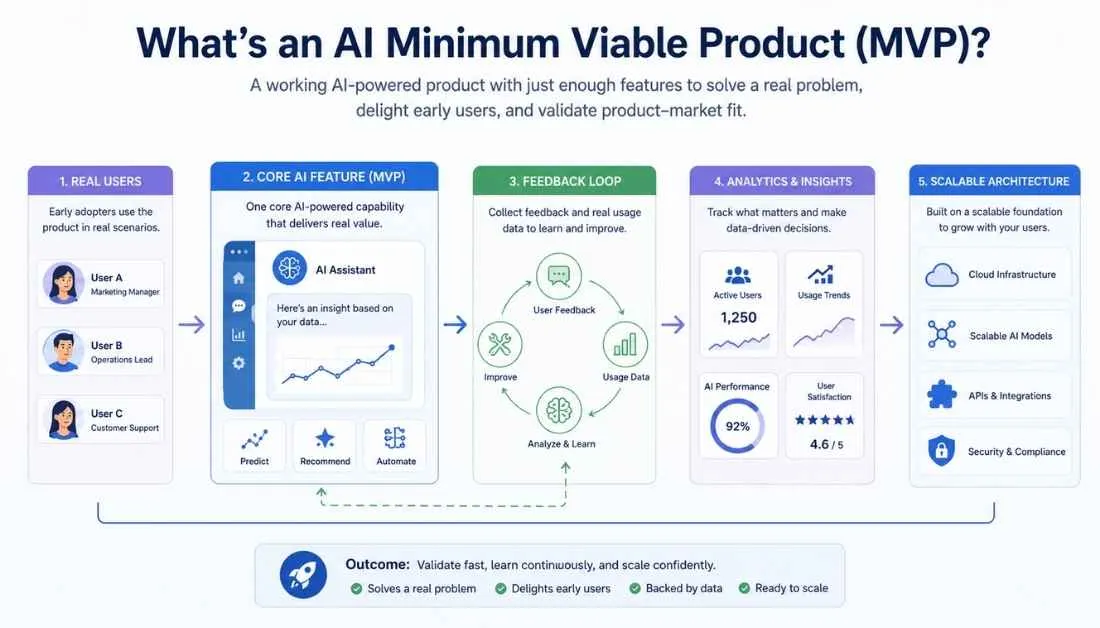
An AI MVP is the first usable version of your AI-powered product that includes only the core features required to solve a real user problem.
Unlike an AI PoC, an AI MVP is not built only to prove whether the idea can work technically. It is built to test whether real users can use the AI solution, get value from it, and give feedback that helps improve the product further.
In simple words, an AI Minimum Viable Product answers one important question: Will users find this AI solution useful enough to adopt, use, or pay for?
For example, suppose a healthcare startup wants to build an AI-based symptom checker. An AI PoC may first test whether the model can understand patient inputs and provide accurate suggestions. Once that feasibility is proven, an AI MVP can offer a simple interface where selected users enter symptoms, receive AI-generated guidance, and share feedback on accuracy, usability, speed, and trust.
An AI MVP gives your business a working version of the product that users can actually experience.
An AI MVP is a functional product version with enough AI capabilities to solve the core problem, collect user feedback, and validate business value before full-scale development.
AI MVP development is especially useful when you already know the AI idea is technically possible, but you still need to validate user demand, business impact, product usability, and long-term scalability.
How an AI MVP works
AI MVP development starts after you have enough confidence in your AI concept. This confidence may come from a successful AI PoC, internal research, competitor analysis, existing user demand, or a clear business case.
At this stage, the goal is to build a usable product with only the most important AI functionality. You do not add every feature you have in mind. You focus on the core feature that creates real value for early users.
An AI MVP may include a working user interface, authentication, data input, AI model integration, dashboard, reporting, feedback collection, basic security, and cloud deployment. It may not include advanced personalization, complex automation, multi-role workflows, enterprise-grade analytics, or every future integration.
The MVP should be simple, but it should not feel broken.
This is where AI MVP differs from a basic experiment. A PoC may run in a controlled environment, but an MVP should work for real users in real conditions. It should handle actual inputs, give useful outputs, collect feedback, and show whether your AI product idea has market value.
Main characteristics of an AI MVP
An AI MVP should be practical, focused, and user-ready. It should give your target users enough value to test the product and give meaningful feedback.
The main characteristics of an AI MVP include:
- Core AI functionality. An AI MVP includes the most important AI feature that solves the main user problem. This may be a recommendation engine, chatbot, prediction model, document analyzer, image recognition feature, or AI automation workflow.
- Usable interface. Users should be able to interact with the AI feature without technical help. The interface should be simple, clear, and easy to understand.
- Real user testing. An AI MVP is built for selected users, early adopters, customers, employees, or stakeholders who can test the product in real scenarios.
- Feedback collection. The product should help you collect feedback on model accuracy, user experience, response quality, usefulness, and business value.
- Basic performance stability. The AI MVP does not need to support millions of users, but it should be stable enough for controlled usage.
- Data handling. The product should collect, process, store, and use data responsibly. AI MVP development should consider data privacy, access control, and compliance needs from the beginning.
- Measurable outcomes. The MVP should help your team track user engagement, task completion, adoption, retention, error rates, cost savings, or revenue potential.
- Scope for improvement. An AI MVP should create a clear path for future iterations, model retraining, feature upgrades, and full-scale AI product development.
The main idea behind an AI MVP is not to launch a perfect product. The idea is to launch a focused product that proves whether the AI solution can create value in the real world.
You may also like:
How to Build an AI Software Solution from Scratch
Reasons to use an AI MVP
An AI MVP is useful when your business wants to move beyond technical validation and test how the AI solution performs with real users.
Many AI projects look promising in presentations and internal demos. But the real test begins when users interact with the product, enter unpredictable data, ask difficult questions, expect fast responses, and compare the experience with their existing workflow.
AI MVP development helps you avoid building a full-scale AI product based only on assumptions.
An AI Minimum Viable Product can help you:
- Validate market demand for your AI-powered product
- Understand whether users actually need the solution
- Collect real feedback on AI accuracy, usability, and performance
- Check whether the AI feature fits naturally into user workflows
- Identify missing features before investing in full-scale development
- Test user willingness to adopt, continue using, or pay for the solution
- Measure business impact through real usage data
- Improve the AI model with feedback and real-world inputs
- Create early traction for investors, stakeholders, or internal decision-makers
- Build a stronger foundation for future AI product development
An AI MVP can also help your business prioritize what matters most. Instead of guessing which features users want, you can watch how they interact with the product and make decisions based on evidence.
For instance, a logistics company may build an AI MVP to predict delivery delays. Early users may find that prediction accuracy is useful, but they may also need alerts, map integration, or route suggestions. This feedback helps the company shape the next product version with more confidence.
That is why an AI MVP is a smarter step before developing a full-scale AI platform. It helps your team validate not only the AI model but also the product experience, business value, and customer acceptance.
With the right AI MVP development company, you can turn a validated AI concept into a usable product that supports real users and prepares your business for growth.
AI PoC vs AI MVP: What’s the Difference?
Before choosing between AI PoC vs AI MVP, it is important to understand that both approaches belong to different stages of AI product development.
An AI PoC comes first when your business needs to check whether the AI idea can work technically. An AI MVP comes later when your business needs to test whether the AI-powered product can create value for real users.
Here is a quick comparison of AI PoC vs AI MVP.
| Comparison factor |
AI Proof of Concept |
AI Minimum Viable Product |
| Main purpose |
Tests technical feasibility |
Tests user value and market demand |
| Key question |
Can this AI idea work? |
Will users use this AI solution? |
| Development stage |
Early validation stage |
Product validation stage |
| Target audience |
Internal teams, technical experts, stakeholders |
Early users, customers, employees, or pilot users |
| Main focus |
Data quality, model accuracy, technical risk, integration feasibility |
Usability, adoption, feedback, business value, and scalability |
| User interface |
Basic, simple, or sometimes not required |
Functional and user-friendly |
| Data usage |
Limited dataset or sample data |
Real or near-real production data |
| Architecture |
Experimental and lightweight |
More stable and ready for improvement |
| Success metrics |
Accuracy, latency, feasibility, data readiness, model output quality |
Engagement, retention, feedback, ROI, conversion, task completion |
| Timeline |
Shorter, usually a few days to a few weeks |
Longer, usually several weeks to a few months |
| Cost |
Lower investment |
Moderate investment |
| Final outcome |
Validated technical assumption |
Usable AI product version |
As you can see, an AI PoC and AI MVP are not interchangeable. They solve different problems and help at different decision points.
An AI Proof of Concept helps your business avoid investing in an AI idea that may fail because of poor data, weak model performance, technical complexity, or integration challenges.
An AI Minimum Viable Product helps your business understand whether the AI product is useful, usable, and valuable enough for real-world adoption.
In other words, an AI PoC validates possibility. An AI MVP validates practicality.
Use an AI PoC when your main concern is technical risk. Use an AI MVP when your main concern is product value, user behavior, and business impact.
Of course, both require technical expertise. But the level of development depth is different. An AI PoC may be handled as a controlled experiment, while an AI MVP needs stronger planning, better architecture, user experience design, deployment, feedback tracking, and continuous improvement.
That is why businesses often start with an AI PoC and then move toward AI MVP development once they have enough confidence in the idea.
How to Pick the Best Approach for Your AI Product?
Choosing between an AI PoC and AI MVP depends on your current stage, business goal, technical risk, available data, and product development plan.
Both approaches help you validate an AI idea, but they are not the same. You should not build an AI MVP when you are still unsure whether the model can work. You should not stop at an AI PoC when your real challenge is user adoption, workflow fit, or market demand.
So, how do you choose the right approach?
Start with your biggest uncertainty.
If your biggest uncertainty is technical feasibility, begin with an AI PoC. If your biggest uncertainty is whether users will accept and use the solution, move toward an AI MVP.
Choose an AI PoC if:
- You are testing a new or complex AI idea
- You are not sure whether your data is useful for AI model development
- You want to test model accuracy before investing more
- You need to validate technical feasibility for internal stakeholders
- You are experimenting with generative AI, predictive analytics, computer vision, NLP, or AI agents
- You want to check whether the AI solution can integrate with your existing systems
- You need early proof before planning a larger AI product roadmap
An AI PoC is the right choice when you need evidence before making a bigger decision. It helps your team see whether the AI idea has a strong technical foundation.
For example, a fintech company may want to use AI to detect fraudulent transactions. Before building a complete fraud detection product, the company can run an AI PoC to test historical transaction data, model accuracy, false positives, processing speed, and integration feasibility.
If the PoC proves that the AI model can detect suspicious patterns with acceptable accuracy, the company can move ahead with more confidence.
Choose an AI MVP if:
- Your AI idea has already been technically validated
- You want real users to test the product
- You need to validate market demand or business value
- You want to collect user feedback before full-scale development
- You need to test product usability, adoption, and engagement
- You want to prove ROI to investors, clients, or internal decision-makers
- You are ready to launch a limited but usable version of your AI solution
An AI MVP is the right choice when your focus shifts from “Can we build this?” to “Will users find value in this?”
For example, an eCommerce company may already know that an AI recommendation engine can work. The next step is to build an AI MVP that recommends products to selected users, tracks clicks, measures conversions, collects feedback, and checks whether AI-driven suggestions increase revenue.
This helps the company decide whether the AI feature is worth scaling.
Moving from AI PoC to AI MVP
In many AI product development journeys, both stages are connected.
You may start with an AI Proof of Concept to validate the model, data, or algorithm. Once the PoC succeeds, you can use its findings to plan the MVP. This transition is important because an experimental AI PoC cannot directly become a production-ready product without proper planning.
To move from AI PoC to AI MVP, your team should:
- Review PoC results and decide whether the AI idea is feasible
- Identify what needs to be improved before real user testing
- Clean, structure, and prepare the required data
- Choose the right model, architecture, and technology stack
- Design a simple and clear user experience
- Add basic security, privacy, and access controls
- Define MVP features and remove unnecessary complexity
- Set user feedback and performance tracking mechanisms
- Plan future model retraining and product iterations
The transition from AI PoC to AI MVP should not be rushed. A successful PoC proves that the AI idea can work. But an MVP must prove that the AI solution can work for users.
That is a different challenge.
An MVP needs better architecture, cleaner workflows, stronger data handling, reliable deployment, and clear product logic. It should be simple, but it should also be stable enough for users to test in real scenarios.
This is where working with an experienced AI development company can make a difference. The right team can help you avoid overbuilding, reduce AI product development risks, and create a clear path from technical validation to market validation.
Build a successful AI product with Prismetric
Validate your AI idea, build a practical AI MVP, and turn your concept into a scalable AI-powered solution with our AI development experts.
Build Faster with Prismetric
How Prismetric Can Help You Build an AI PoC or AI MVP
Many businesses have promising AI ideas, but they are not always sure where to begin. Some ideas need technical validation first, while others are ready to be tested with real users.
That is where Prismetric can help.
As an experienced AI development company, Prismetric helps startups, enterprises, and product owners validate AI ideas, build practical AI PoCs, develop user-ready AI MVPs, and scale them into full-fledged AI-powered solutions.
Whether you want to test a new AI use case, validate data quality, check model feasibility, or launch a usable AI product for early users, our team can help you choose the right approach.
Our AI PoC development services
If your AI idea is still technically uncertain, starting with an AI PoC is the right choice. Prismetric helps you test whether your AI concept can work before you invest in complete AI product development.
Our AI PoC development services can help you:
- Validate the technical feasibility of your AI idea
- Analyze data quality, availability, and readiness
- Test AI model accuracy, response quality, and performance
- Identify data, model, infrastructure, and integration risks
- Check whether your AI solution can fit into existing workflows
- Define clear success metrics for AI feasibility testing
- Prepare a practical roadmap for the next development stage
With an AI PoC, you can reduce uncertainty and make better decisions before moving ahead with a larger investment.
Our AI MVP development services
If your AI concept is already validated, Prismetric can help you turn it into a usable AI MVP. An AI MVP allows real users to interact with your product, test the core AI feature, and provide feedback before full-scale development.
Our AI MVP development services can help you:
- Define the right MVP scope and feature set
- Design simple and user-friendly product interfaces
- Integrate AI models into frontend and backend systems
- Build core AI-powered features for real user testing
- Set up feedback collection and performance tracking
- Add basic security, privacy, and data handling controls
- Deploy the MVP on a reliable and scalable architecture
- Improve the product based on user feedback and business insights
With an AI MVP, you can validate market demand, improve user experience, and understand whether your AI-powered solution delivers real business value.
Why choose Prismetric for AI PoC and AI MVP development?
Building an AI product requires more than selecting an AI model. You need the right data strategy, product roadmap, user experience, architecture, development process, and scaling plan.
Prismetric brings together AI development expertise, product engineering experience, and business-focused execution to help you move from idea to validation and from validation to product growth.
When you work with Prismetric, you get:
- Experienced AI developers and product engineers
- A clear roadmap from AI PoC to AI MVP development
- Practical guidance on technology, data, and architecture
- Faster validation with reduced development risks
- Scalable product development for future growth
- Support across strategy, design, development, testing, and deployment
Whether you want to prove an AI concept, build an MVP, or scale an AI-powered product, Prismetric can help you choose the right path and execute it with confidence.
Wrapping Up
AI PoC and AI MVP are two different approaches to AI product validation. They may look similar because both help reduce risk, but they are used at different stages and answer different questions.
An AI PoC helps you check whether your AI idea is technically possible. It focuses on data readiness, model performance, technical feasibility, integration challenges, and early risk identification.
An AI MVP helps you check whether your AI product is useful for real users. It focuses on user experience, adoption, feedback, business value, and market validation.
In short:
- Use an AI PoC to validate whether your AI idea can work technically.
- Use an AI MVP to validate whether users will use and value your AI-powered product.
- Use both if your idea has technical uncertainty and market uncertainty.
If your business is still unsure about data, model accuracy, or technical complexity, start with an AI PoC. If your AI concept is already validated and you want to test it with real users, build an AI MVP.
The best approach depends on your goals, budget, timeline, technical risk, and product stage.
At Prismetric, we help startups, enterprises, and product owners turn AI ideas into practical digital products. Whether you want to validate an AI concept, build an AI PoC, develop an AI MVP, or scale your AI solution, our team can help you choose the right path and execute it with confidence.
Contact us to discuss your AI product idea and take the next step toward building a successful AI-powered solution.
Frequently Asked Questions
The main difference between AI PoC and AI MVP lies in their purpose. An AI PoC validates whether an AI idea is technically possible, while an AI MVP validates whether real users find value in the AI-powered product.
An AI PoC answers, “Can this AI idea work?” An AI MVP answers, “Will users use this AI solution?”
You should build an AI PoC first if your AI idea has technical uncertainty. For example, if you are unsure about data quality, model accuracy, automation logic, or integration feasibility, an AI PoC is the right first step.
You should build an AI MVP if the technical feasibility is already clear and your main goal is to test usability, adoption, market demand, or business value with real users.
The time required to build an AI PoC depends on the complexity of the use case, data availability, model requirements, and integration needs. A simple AI PoC may take a few weeks, while a more complex one involving machine learning, generative AI, computer vision, or multiple data sources may take longer.
The goal is to keep the AI PoC focused and avoid adding unnecessary features.
AI MVP development usually takes longer than AI PoC development because it involves user interface design, backend development, AI model integration, deployment, testing, feedback collection, and basic security measures.
The exact timeline depends on the number of features, data complexity, AI model requirements, third-party integrations, and the level of product stability required for early users.
Yes, an AI PoC can lead to an AI MVP, but it usually cannot be used as-is. An AI PoC is often built as an experiment to test feasibility, while an AI MVP needs better architecture, usability, stability, security, and real-user readiness.
The findings from the PoC can guide AI MVP development, but the MVP often requires additional planning and development.
An AI PoC is important because it helps you validate technical feasibility before investing in full-scale AI product development. It can reveal data issues, model limitations, performance gaps, integration challenges, and hidden risks early.
This helps your business make better decisions and avoid spending heavily on an AI idea that may not work technically.
An AI MVP is important because it helps you test your AI product with real users before building the full version. It allows you to collect feedback, measure engagement, understand user behavior, and validate whether the AI solution delivers real business value.
This helps you improve the product based on evidence instead of assumptions.
The success metrics for an AI PoC may include model accuracy, response quality, data readiness, processing speed, latency, integration feasibility, automation rate, error reduction, and technical viability.
The right metrics depend on the AI use case and the business problem you want to solve.
The success metrics for an AI MVP may include user engagement, retention, task completion, customer feedback, feature usage, conversion rate, cost savings, productivity improvement, ROI, and willingness to pay.
An AI MVP should help you understand whether the product is useful, usable, and valuable for real users.
An experienced AI development company can help you build an AI PoC or AI MVP based on your business goals, data availability, technical requirements, and product roadmap.
Prismetric offers AI development services to help businesses validate AI ideas, build usable AI MVPs, and scale AI-powered solutions with the right technology, architecture, and development strategy.