AI Automation for Real Estate Agencies: Complete Guide
AI automation for real estate agencies is changing how teams manage leads, follow-ups, appointments, marketing, and daily admin work. Instead of handling every task manually, agencies can use AI-powered workflows to respond faster, keep the CRM updated, qualify buyers and sellers, and give clients a smoother experience.
Core automation areas:
- Lead Management – Faster lead capture, buyer qualification, seller intake, and smart lead routing to the right agent
- Client Follow-Up – Automated SMS, email, and call reminders that help agents stay in touch without missing opportunities
- Appointment Booking – AI appointment booking for real estate showings, consultations, open houses, and property visits
- CRM Automation – Cleaner pipelines, automatic task creation, contact updates, and better visibility into active deals
- Marketing Support – Listing descriptions, social media posts, email campaigns, review requests, and past-client reactivation
- Property Operations – Tenant messages, maintenance requests, lease reminders, and routine property management workflows
Real estate teams are busy. A new property inquiry can come in while an agent is showing a home, driving to an appointment, or speaking with another client. When that lead does not get a fast reply, it can easily go cold. This is where AI automation helps the most.
AI will not replace real estate agents. It works best as a support system that handles repetitive tasks while agents focus on trust, advice, negotiation, and closing deals.
This article explains how AI automation for real estate agencies works, where it fits into daily workflows, which tasks are worth automating first, and how agencies can use it without making the client experience feel robotic.
What Is AI Automation in Real Estate?
AI automation in real estate means using AI-powered systems to handle repetitive, time-consuming, or data-heavy tasks that usually slow down agents and agency teams.
For a real estate agency, this can include lead capture, buyer lead qualification automation, seller follow-up, appointment booking, CRM updates, email campaigns, listing content, tenant messages, document summaries, reporting, and back-office work.
The simple way to understand it is this:
AI creates or analyzes. Automation acts.
For example, AI can write a listing description for a new property. But automation can take that description, send it to the marketing team, update the real estate CRM, notify the assigned agent, schedule a social media post, and trigger an email campaign to interested buyers.
That difference matters.
A tool that only writes property descriptions is helpful, but it still leaves work for your team. A proper AI automation workflow moves the task forward without someone needing to copy, paste, chase, or manually update five different systems.
In daily agency work, AI automation can look like:
- An AI chatbot for real estate agents that answers a buyer inquiry and collects budget, location, and timeline
- An automated SMS follow-up for property leads after someone fills out a form or misses a call
- A real estate CRM automation that creates a task, updates the pipeline, and assigns the lead to the right agent
- An AI appointment booking workflow that offers showing times and sends reminders before the visit
- A seller lead nurture workflow that follows up with homeowners who are not ready to list yet
The goal is not to remove the agent from the process. The goal is to remove the small manual steps that stop agents from moving fast.
When AI automation is set up well, the agency responds quicker, follows up more consistently, keeps cleaner data, and gives clients a better experience without making the whole process feel robotic.
Why Real Estate Agencies Are Adopting AI Automation Now
Real estate agencies are turning to AI automation because the daily work has become harder to manage by hand. Leads come from more places, clients expect quick replies, and agents are spending too much time on admin instead of selling, showing, and closing.
AI automation helps teams move faster without making the process feel cold or robotic.
Here are the main reasons real estate agencies are adopting AI automation now:
Faster Response Expectations
Real estate leads expect quick replies. They may contact an agency through a website form, property portal, WhatsApp, social media, paid ad, or phone call.
If they do not hear back fast, they may move on to another agent.
This is why tools like AI chatbots, missed-call text back, and automated SMS follow-up for property leads are becoming more useful. They help agencies respond while the lead is still interested.
Too Much Manual Admin
Agents and admin teams spend a lot of time on small tasks, such as:
- Booking showings
- Updating the CRM
- Sending follow-up emails
- Writing listing content
- Preparing market reports
- Creating reminders
- Reviewing documents
These tasks matter, but they can slow the team down.
With real estate CRM automation, many of these steps can happen in the background. The system can update records, assign tasks, send reminders, and move leads through the pipeline without someone doing every step manually.
More Data Than Teams Can Handle Manually
Real estate agencies now deal with a lot of data. This includes property records, MLS data, buyer behavior, mortgage rates, listing performance, call notes, ad results, and CRM activity.
AI can help make sense of that data.
For example, it can show which leads are most active, which listings are getting attention, or which clients need a follow-up. The agent still makes the final decision, but AI helps them see what matters faster.
Agencies Need Scale Without Losing Personal Service
As an agency grows, it becomes harder to give every lead and client the same level of attention.
AI automation helps with the repeatable work, like sending reminders, qualifying leads, booking appointments, and keeping the CRM clean. This gives agents more time for the work that needs a human touch, such as advice, negotiation, pricing, and relationship building.
That is the real value of AI automation for real estate agencies. It helps teams grow without losing the personal service clients expect.
The Biggest Benefits of AI Automation for Real Estate Agencies
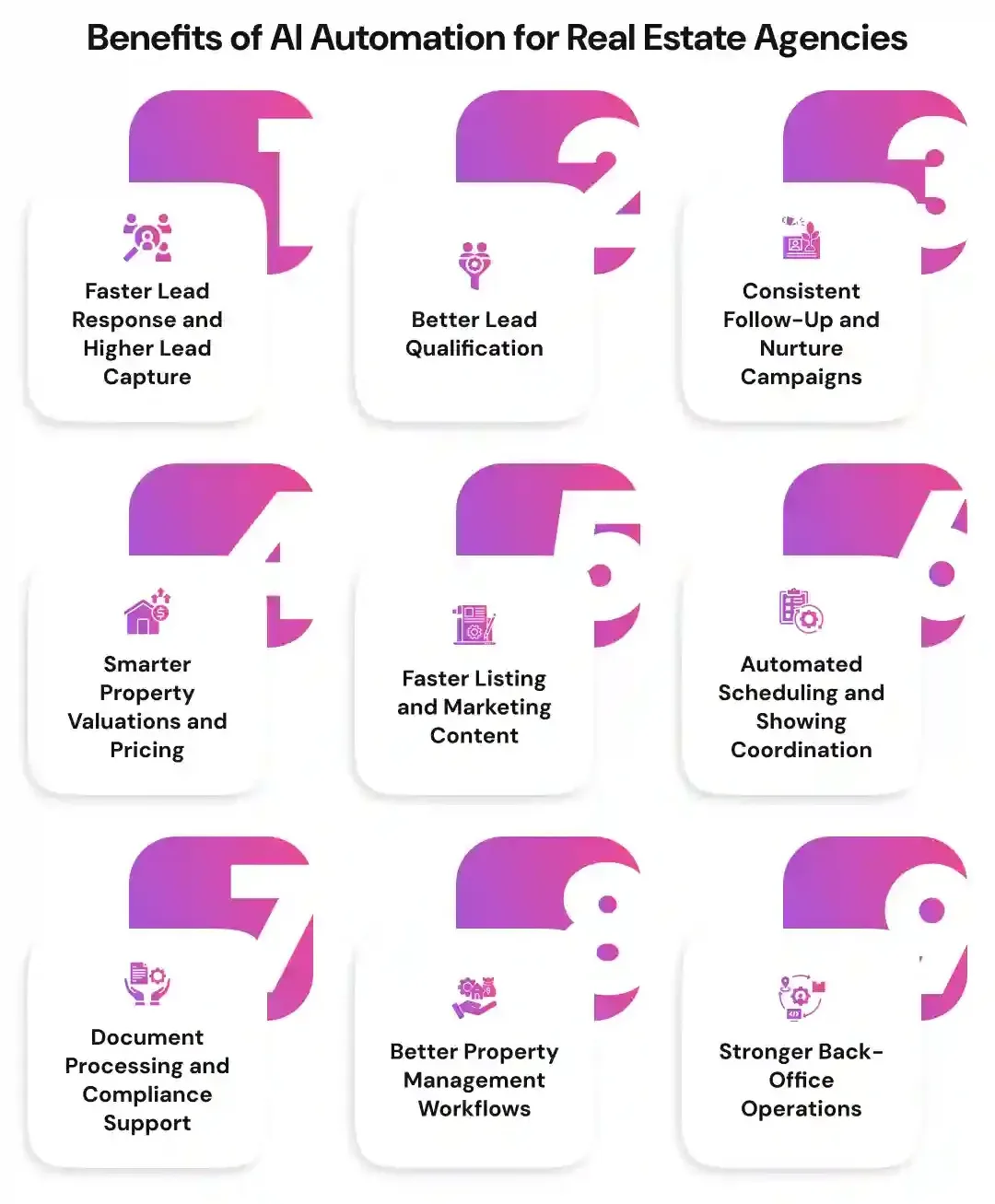
AI automation gives real estate teams more control over the small tasks that often get missed. It helps agents respond faster, follow up better, manage data, and keep leads moving without doing everything by hand.
The biggest benefit is simple: agencies can spend less time chasing tasks and more time working with real buyers, sellers, landlords, tenants, and investors.
1. Faster Lead Response and Higher Lead Capture
AI helps agencies stop leaking leads.
A buyer may submit a form at 10 p.m. A seller may call while the agent is in a showing. A renter may ask a question through WhatsApp or a property portal. If no one replies quickly, that lead can disappear.
AI chatbots, voice agents, and CRM automations can respond 24/7. They can collect basic details, understand what the person wants, and send serious leads to the right agent.
For example, an AI workflow can:
- Answer a missed call with an instant text message
- Ask whether the lead is buying, selling, renting, or investing
- Capture budget, location, and timeline
- Book a viewing or consultation
- Add the lead to the CRM
- Alert the assigned agent
This gives the agency a better chance to capture the lead while the interest is still fresh.
2. Better Lead Qualification
Not every lead is ready to move right away. Some are just browsing. Some are serious. Some need financing first. Some want to sell but are still months away from listing.
AI can help sort this out before an agent spends time chasing the wrong person.
A buyer lead qualification automation can ask simple questions like:
- Are you buying, selling, renting, or investing?
- What location are you interested in?
- What is your budget?
- Are you pre-approved?
- What is your timeline?
- Are you currently working with another agent?
This helps agents understand who needs attention first.
A hot lead can be sent straight to an agent. A colder lead can be added to a nurture campaign. That way, no one gets ignored, but the team still protects its time.
3. Consistent Follow-Up and Nurture Campaigns
Follow-up is where many real estate deals are won or lost.
The problem is that agents are busy. A lead may need five or six touches before they reply, but most teams do not have time to send every message manually.
AI automation keeps the follow-up going after key actions, such as:
| Trigger |
What Automation Can Do |
| New lead submission |
Send an instant welcome text or email |
| Property inquiry |
Share property details and ask qualifying questions |
| Open house visit |
Send a thank-you message and ask for feedback |
| Listing download |
Follow up with similar properties |
| Missed call |
Send a text-back message right away |
| Price reduction |
Alert interested buyers |
| Property viewing |
Send next steps or request feedback |
| Dormant CRM activity |
Restart the conversation with a helpful check-in |
This does not mean every message should sound automated.
Good real estate lead follow-up automation should feel personal, simple, and useful. The goal is to keep the conversation alive until the lead is ready to speak with an agent.
4. Smarter Property Valuations and Pricing
Pricing is one of the most important parts of real estate. If the price is too high, the listing can sit. If it is too low, the seller may lose money.
AI can support pricing decisions by reviewing more data than an agent can check manually in a short time.
It can look at:
- Comparable property sales
- Neighborhood trends
- Local demand
- Days on market
- Price reduction history
- Rental yield
- Market forecasting
- Property condition signals
This does not replace a local agent’s judgment.
An automated valuation model can give a useful starting point, but the agent still needs to consider the street, property condition, upgrades, buyer demand, and seller goals.
Best for:
- Quick property estimates
- Seller lead reports
- Market updates
- Rental yield checks
- Early pricing conversations
Not best for:
- Final listing price without human review
- Unique luxury homes
- Properties with major renovations
- Markets with limited comparable sales
5. Faster Listing and Marketing Content
Real estate marketing takes more time than most people think.
Every listing needs a description, social captions, emails, ads, photos, landing page copy, and sometimes video scripts. Then the team still needs to send updates to buyers, sellers, and past clients.
AI can speed up this work without making the content feel generic, as long as someone reviews and improves it.
For example, AI can help create:
- Listing descriptions
- Social media captions
- Email campaigns
- Video scripts
- Ad copy
- Landing page content
- Neighborhood guides
- Buyer and seller newsletters
A simple workflow could look like this:
The agent uploads property details. AI drafts the listing description. The marketing team reviews it. Automation adds it to the CRM, creates a social post draft, and starts an email campaign for matched buyers.
That saves time, but it still keeps a human in control of the final message.
6. Automated Scheduling and Showing Coordination
Scheduling looks simple until an agent has five buyers, two sellers, three open houses, and a last-minute reschedule.
AI appointment booking for real estate can connect with the team’s calendar, check availability, offer time slots, and send confirmations without the agent going back and forth all day.
It can also handle the small details that usually create friction:
- Showing reminders
- Rescheduling requests
- Directions and access instructions
- Virtual tour links
- Agent availability
- Open-house reminders
- Follow-up messages after the visit
This works especially well for busy teams that receive a lot of property inquiries.
A lead asks to view a home. The system checks the agent’s calendar, offers two available slots, books the appointment, sends a reminder, and updates the CRM. The agent simply shows up prepared.
7. Document Processing and Compliance Support
Real estate paperwork can be slow, detailed, and easy to miss something in.
AI can help review documents and pull out the important parts, but it should be treated as support, not legal advice.
For example, AI can scan:
- Purchase agreements
- Lease agreements
- Disclosures
- Inspection reports
- Title documents
- Addendums
- Closing documents
It can then highlight missing fields, critical dates, unusual clauses, risk flags, and key terms that need human review.
| Document Task |
How AI Can Help |
| Missing fields |
Flags empty names, dates, signatures, or required sections |
| Critical dates |
Pulls out deadlines for inspections, financing, closing, or lease renewal |
| Clause review |
Highlights unusual wording or terms that may need attention |
| Summary sheets |
Creates a simple overview for agents, admins, or managers |
| Handoff |
Sends flagged items to the right person for review |
This is useful because it helps teams move faster without pretending AI should make legal decisions.
The final review still belongs to the agent, broker, lawyer, conveyancer, or compliance manager.
8. Better Property Management Workflows
Property management has a lot of repeat questions and routine tasks.
Tenants ask about repairs. Owners want updates. Vendors need job details. Leases need renewal reminders. Rent needs to be tracked. Inspections need to be booked.
AI automation can help property managers keep these workflows moving.
Common examples include:
- Tenant communication
- Maintenance request routing
- Rent reminders
- Lease renewal reminders
- Vendor updates
- Inspection scheduling
- Predictive maintenance alerts
- Tenant or owner risk scoring
A helpful setup might look like this:
A tenant reports a leaking tap. AI collects the issue, checks the property address, asks for a photo, creates a maintenance ticket, routes it to the right vendor, and updates the property manager.
That does not replace the property manager. It simply removes the first layer of back-and-forth.
Best for:
- High-volume tenant messages
- Simple maintenance triage
- Reminder workflows
- Owner update drafts
- Routine inspection scheduling
Use carefully for:
- Angry tenant complaints
- Legal notices
- Eviction-related communication
- Sensitive owner disputes
- Safety-related maintenance issues
9. Stronger Back-Office Operations
This is where many agencies can get a real advantage.
Most people talk about AI chatbots and listing content, but back-office work is where agencies lose a lot of time. Admin teams often deal with repeated data entry, document checks, invoice reviews, reporting, and compliance tasks.
AI automation can support work such as:
- Lease abstraction
- Invoice processing
- Trust accounting support
- Commission tracking
- CAM reconciliation
- Owner reporting
- Data entry
- CRM hygiene
- Compliance checklists
The value here is not flashy. It is practical.
Cleaner records. Fewer missed steps. Faster reports. Less copy-paste work. Better visibility for managers.
For example, an agency can use automation to pull key terms from lease documents, update internal records, flag missing information, and prepare a summary for review. Or it can help clean old CRM contacts, remove duplicates, and remind agents to update stale opportunities.
This kind of automation may not be as exciting as an AI chatbot, but it can save serious time across the whole business.
15 AI Automation Use Cases for Real Estate Agencies
AI automation works best when it is connected to a real workflow, not used as a random tool on the side.
For a real estate agency, the best use cases usually sit around lead response, follow-up, CRM updates, marketing, appointments, documents, property management, and reporting.
Here are 15 practical ways agencies can use AI automation in daily work:
| Use Case |
What It Automates |
Best For |
Tools/Data Needed |
Human Oversight Needed |
| Website chatbot for buyer and seller inquiries |
Answers common questions, collects lead details, and starts the conversation |
Capturing website leads after hours or when agents are busy |
Website, chatbot tool, CRM, property listings, lead forms |
Review chatbot answers and make sure serious leads are routed correctly |
| AI voice agent for missed calls and booking viewings |
Answers calls, captures intent, sends text follow-ups, and books appointments |
Agencies that miss calls during showings, meetings, or weekends |
Phone system, calendar, CRM, call scripts, showing rules |
Check call quality, lead handoff, and sensitive conversations |
| Lead qualification and scoring |
Asks questions, scores the lead, and marks who is ready to speak with an agent |
Buyer leads, seller leads, renters, and investor inquiries |
CRM, lead source data, qualification questions, scoring rules |
Review scoring rules so good leads are not missed |
| Automated CRM updates |
Adds notes, updates stages, creates tasks, and assigns leads |
Keeping the pipeline clean without manual data entry |
CRM, forms, email, SMS, call logs, automation platform |
Spot-check records and make sure data is going to the right place |
| Drip campaigns and nurture sequences |
Sends follow-up emails, SMS messages, market updates, and reminders |
Long-term buyer and seller nurture |
CRM, email/SMS tool, lead segments, content templates |
Review message tone, timing, and opt-out compliance |
| Listing description generation |
Drafts property descriptions based on listing details and features |
Agents and marketing teams preparing listings faster |
Property details, photos, MLS fields, brand tone guidelines |
Edit for accuracy, local language, and fair housing compliance |
| Social media content repurposing |
Turns listings, blogs, videos, and market updates into social posts |
Real estate marketing automation across multiple channels |
Listing content, blog posts, videos, social media scheduler |
Check claims, tone, image use, and platform fit |
| Automated property valuation reports |
Creates quick value estimates using property and market data |
Seller lead magnets and early pricing conversations |
Property records, comparable sales, market data, valuation model |
Agent must review before using it for pricing advice |
| CMA and market report generation |
Pulls comparable sales, trends, days on market, and pricing insights |
Listing presentations, seller updates, and investor conversations |
MLS data, local sales data, neighborhood trends, templates |
Review comps and adjust based on local market knowledge |
| Showing scheduling and reminders |
Checks availability, books showings, sends reminders, and handles reschedules |
Busy agents managing multiple viewings |
Calendar, CRM, listing availability, SMS/email tool |
Confirm access instructions and special showing requirements |
| Document summarization and deadline extraction |
Summarizes contracts, leases, disclosures, and pulls out key dates |
Transaction coordinators, brokers, and admin teams |
Uploaded documents, OCR/document AI, checklist rules |
Legal, broker, or compliance review is still required |
| Tenant maintenance request routing |
Collects repair details, asks for photos, creates tickets, and routes vendors |
Property managers handling frequent tenant requests |
Property management software, vendor list, tenant portal, rules |
Review urgent, safety-related, or disputed maintenance issues |
| Lease renewal reminders |
Tracks lease end dates and sends renewal reminders to tenants or owners |
Property management teams with many active leases |
Lease data, calendar, property management system, message templates |
Review rent changes, legal terms, and owner approval |
| Review request automation after closing |
Sends review requests after closing, move-in, or completed service |
Building Google reviews and referral trust |
CRM, closing dates, email/SMS tool, review links |
Make sure timing feels natural and avoid over-messaging |
| Agent performance dashboards and call coaching |
Tracks response time, calls, follow-ups, conversions, and conversation quality |
Brokers and team leaders improving sales performance |
CRM, call recordings, email/SMS activity, reporting dashboard |
Managers should review insights before coaching agents |
AI Automation by Real Estate Agency Department
AI automation is not just for one part of a real estate business. It can support almost every department, as long as the workflow is clear and the team knows where human review is needed.
A good way to think about it is simple: each department has repetitive tasks that slow people down. AI automation helps handle those tasks so the team can focus on higher-value work.
Sales Team
The sales team usually feels the biggest impact first because leads need fast attention.
AI can help capture new inquiries, qualify buyers and sellers, score leads, and book appointments before an agent even opens the CRM.
For example, when a buyer asks about a property, an AI chatbot can collect their budget, preferred area, timeline, and financing status. Then real estate CRM automation can assign the lead, create a task, and notify the right agent.
This helps the sales team move faster and avoid missing serious opportunities.
Marketing Team
Marketing teams can use AI automation to create and distribute content faster.
This can include listing copy, ad variations, social media captions, email newsletters, landing pages, market updates, and past-client campaigns.
A simple workflow might look like this: the team adds property details once, AI drafts the listing description, creates short social captions, prepares an email version, and sends everything for review before publishing.
The marketer still controls the final message. AI just helps remove the blank-page problem and speeds up the first draft.
Agents and Brokers
Agents and brokers need support with the work that happens between conversations, showings, and negotiations.
AI can help prepare CMA notes, draft client emails, recommend matching properties, summarize showing feedback, and turn meeting notes into next steps.
For brokers, AI can also make it easier to review team activity, spot slow follow-ups, and understand which leads or deals need attention.
This is useful because agents do not need more apps to check. They need clearer information at the right time.
Property Management Team
Property management teams deal with a lot of repeat communication.
Tenants ask about maintenance. Owners ask for updates. Leases need reminders. Rent follow-ups need to be sent. Vendors need clear job details.
AI automation can help with:
- Tenant support
- Maintenance ticket creation
- Vendor routing
- Rent reminders
- Lease renewal reminders
- Inspection scheduling
- Risk alerts
For example, when a tenant reports a repair issue, AI can collect the details, ask for photos, create a ticket, and send it to the right vendor or property manager.
That saves time and helps requests move faster without losing control of the process.
Admin and Back Office
Admin and back-office teams often carry the hidden workload of a real estate agency.
They deal with document routing, data entry, compliance reminders, reports, invoice matching, transaction coordination, and CRM cleanup.
AI automation can help by moving documents to the right place, flagging missing information, creating reminders for important dates, matching invoices to records, and preparing reports for managers or owners.
This does not remove the need for admin staff. It gives them cleaner workflows and fewer repetitive tasks.
For many agencies, this is where AI automation creates the quietest but most valuable improvement: fewer missed steps, cleaner data, and smoother operations.
AI Automation Workflow Example: From New Lead to Closed Deal
The easiest way to understand AI automation for real estate agencies is to see how it works in a real lead journey.
A lead does not become a client from one message. There are forms, replies, questions, follow-ups, appointments, reminders, CRM updates, and handoffs. When every step is manual, things get missed.
Here is what an AI-powered workflow can look like:
- A lead submits a form on the agency website or a property portal.
- AI responds instantly by SMS, email, or chatbot.
- AI asks basic qualifying questions.
- The lead score is added to the CRM.
- A hot lead is routed to the right agent.
- A calendar link or showing time is offered.
- AI sends reminders before the viewing.
- After the viewing, AI sends a personalized follow-up.
- If the lead is not ready, the CRM starts a nurture campaign.
- The agent receives a short summary, next step, and suggested script.
This kind of workflow helps the team move quickly without making the lead wait.
Here is a simple example.
Sarah is looking for a 3-bedroom home under $650,000 within 45 days. She is pre-approved and clicked three listings in the same suburb.
The AI marks her as a hot buyer, adds her details to the CRM, and books a call for the agent.
The agent does not have to dig through form data or guess what Sarah wants. They can open the CRM and see the important details right away:
- Budget: Under $650,000
- Property type: 3-bedroom home
- Timeline: Within 45 days
- Financing: Pre-approved
- Interest level: High
- Recommended next step: Call and offer two matching properties
This is where AI automation becomes useful in a very practical way.
It does not replace the agent’s relationship with Sarah. It simply makes sure the lead is answered, qualified, organized, and moved to the right next step before the opportunity goes cold.
Best AI Automation Tools for Real Estate Agencies
The best AI automation tools for real estate agencies are not always the flashiest ones. The right tool depends on what you want to fix first.
Some agencies need better lead follow-up. Some need cleaner CRM pipelines. Some need help with listing content, property data, phone calls, documents, or custom workflows.
Here are the main tool categories to understand.
AI CRM and Lead Follow-Up Tools
AI CRM tools help agencies manage leads, track conversations, assign tasks, and keep follow-up moving.
These tools are useful when leads are coming from websites, portals, ads, open houses, referrals, and social media, but the team struggles to respond and follow up consistently.
Common examples include:
- Follow Up Boss
- Lofty
- CINC
- kvCORE
- Real Geeks
- Ylopo
- Structurely-style conversational AI
- HubSpot with automation
- Salesforce with real estate workflows
These tools can help with:
- Lead capture
- Lead routing
- Pipeline updates
- Automated SMS follow-up
- Email nurture campaigns
- Task reminders
- Lead scoring
- Agent activity tracking
This category is usually the best starting point for agencies that want to stop losing leads inside the CRM.
AI Valuation and Property Data Tools
AI valuation and property data tools help agencies understand property values, local trends, comparable sales, rental demand, and investment potential.
They are useful for seller lead reports, pricing conversations, investor research, and market updates.
Common examples include:
- HouseCanary
- CoreLogic
- PropStream
- ATTOM-style property data platforms
- Reonomy-style property intelligence tools
- Local MLS data tools
- Automated valuation model tools
These tools can support:
- Property value estimates
- Comparable property analysis
- Market trend reports
- Seller lead magnets
- Rental yield checks
- Neighborhood insights
- Investor property research
The important thing is to treat these tools as decision support, not final pricing advice.
A local agent still needs to review the property condition, location, upgrades, demand, and seller expectations before giving a serious pricing recommendation.
AI Marketing Tools
AI marketing tools help real estate teams create content faster.
They are useful for agencies that need regular listing copy, social posts, email campaigns, ads, video scripts, newsletters, and landing page content.
Common examples include:
- ChatGPT
- Claude
- Jasper
- Canva
- Mailchimp
- ActiveCampaign
- Buffer
- Hootsuite
- Later
- Listing copy generators
- Social media schedulers
- Email marketing platforms
These tools can help create:
- Listing descriptions
- Social media captions
- Facebook and Google ad copy
- Email newsletters
- Buyer guides
- Seller guides
- Neighborhood posts
- Video scripts
- Review request messages
AI can save a lot of time here, but the content still needs human editing.
Real estate marketing should sound local, accurate, and natural. A listing description that feels too generic will not help the agent or the seller.
AI Voice and Chatbot Tools
AI voice and chatbot tools are built for fast conversations.
They can answer questions, collect lead details, book appointments, and help agencies respond when agents are busy, offline, or out at showings.
Common examples include:
- AI website chatbots
- AI voice agents
- Missed-call text-back tools
- ManyChat
- Intercom-style chat tools
- Drift-style chat tools
- GoHighLevel chat and SMS workflows
- Inbound call answering tools
- Showing booking bots
- Lead qualification bots
These tools can help with:
- Website inquiries
- Missed calls
- Buyer questions
- Seller intake
- Rental inquiries
- Showing requests
- Appointment booking
- After-hours lead capture
This is a good fit for agencies that get leads outside office hours or miss calls during busy periods.
The setup needs care, though. The chatbot or voice agent should know when to stop and hand the conversation to a real person.
AI Document and Transaction Tools
AI document and transaction tools help with paperwork, summaries, deadlines, and deal coordination.
They are useful for agencies that handle a lot of contracts, disclosures, leases, inspection reports, title documents, and closing paperwork.
Common examples include:
- Dotloop
- DocuSign-style transaction tools
- Snapdocs-style closing workflows
- Document extraction tools
- OCR tools
- Contract review assistants
- Lease abstraction tools
- Transaction coordination platforms
These tools can help with:
- Document routing
- Signature tracking
- Deadline extraction
- Missing field detection
- Contract summaries
- Lease summaries
- Disclosure organization
- Transaction checklists
This is one area where human review matters a lot.
AI can summarize and flag issues, but brokers, lawyers, compliance teams, or transaction coordinators should still review anything legal, financial, or high-risk.
Custom AI Automation Platforms
Off-the-shelf tools are a good starting point. But they can become limiting as the agency grows.
This usually happens when the team has specific lead routing rules, multiple locations, different agent teams, custom reporting needs, or too many tools that do not talk to each other properly.
Custom AI automation may be a better fit when the agency needs to connect systems like:
- CRM
- Website forms
- Property portals
- Calendar tools
- Email and SMS platforms
- MLS or property data
- Call tracking software
- Property management software
- Reporting dashboards
- Internal spreadsheets or databases
Custom workflows can help with:
- Advanced lead routing
- Multi-step buyer and seller journeys
- Custom appointment booking logic
- CRM cleanup and enrichment
- Team performance reporting
- Cross-platform data syncing
- Custom AI agents for internal tasks
- Automated owner or seller reports
This is not always the first step for a small agency.
But once a team starts stacking too many separate tools, custom AI automation can make the whole system cleaner and easier to manage. It helps the agency build around its actual workflow instead of forcing the team to work around software limits.
How to Implement AI Automation in a Real Estate Agency
AI automation works best when you start small and build from a real business problem.
Do not begin by asking, “What AI tool should we buy?” Start by asking, “Where are we losing time, leads, or money?”
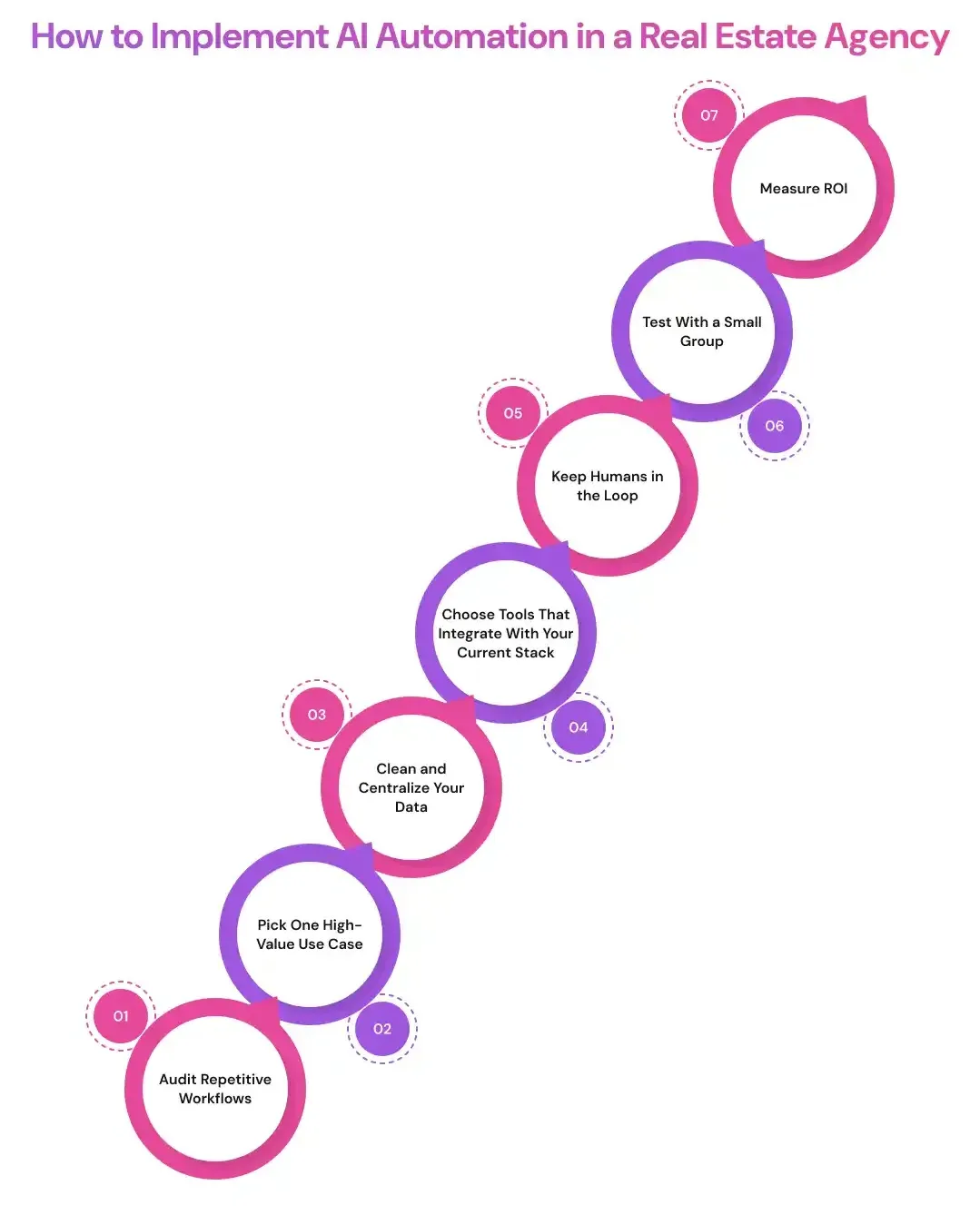
Here is a simple step-by-step way to implement AI automation in a real estate agency.
Step 1: Audit Repetitive Workflows
Look at the tasks your team repeats every day or every week.
These are usually the best places to start because they are easy to spot and easier to improve with automation.
Focus on tasks that are:
- Manual
- Repeated often
- Time-sensitive
- Easy to forget
- Error-prone
- Slowing agents down
Good examples include lead follow-up, CRM updates, appointment reminders, document checks, listing content, reporting, and open house follow-up.
If a task keeps showing up on everyone’s to-do list, it may be a good automation candidate.
Step 2: Pick One High-Value Use Case
Do not automate everything at once.
Pick one workflow that can create a clear result. This keeps the setup simple and makes it easier to measure whether the automation is actually helping.
Good starting points include:
- Lead response
- Follow-up automation
- Scheduling
- Listing content
- CRM cleanup
- Document summaries
For most agencies, lead response is a strong first choice.
If a new inquiry gets an instant reply, the lead is qualified, the CRM is updated, and the agent is notified, the agency can see the value quickly.
Step 3: Clean and Centralize Your Data
AI automation needs clean data to work well.
If your CRM is messy, your contact records are outdated, or your property data is spread across too many places, the automation will struggle.
Start by reviewing data from:
- CRM records
- Website forms
- Property listings
- Transactions
- Emails
- Call notes
- SMS conversations
- Property databases
- Property management software
The goal is not perfection. The goal is to make sure the system has enough accurate information to take the right action.
For example, if a lead source is missing or agent assignment rules are unclear, the automation may route leads to the wrong person.
Step 4: Choose Tools That Integrate With Your Current Stack
A tool is only useful if it works with the systems your team already uses.
Before choosing any AI automation tool, check whether it connects with your current real estate workflow.
Look for integrations with:
- CRM
- Calendar
- Website
- Email
- WhatsApp or SMS
- MLS or listing data
- Property management software
- Phone system
- Reporting dashboards
This matters because disconnected tools create more work.
If your chatbot captures a lead but your CRM does not update, someone still has to copy the details manually. That is not real automation. That is just another inbox to check.
Step 5: Keep Humans in the Loop
AI should support the team, not run the agency without review.
Agents, brokers, admins, or managers should still review anything that affects trust, pricing, compliance, or the client relationship.
Human review is especially important for:
- Pricing recommendations
- Property valuations
- Contracts
- Lease documents
- Legal notices
- Compliance messages
- Client-facing emails
- Sensitive tenant or seller conversations
AI can draft, summarize, flag, and recommend. But the final call should stay with a trained person.
This keeps the workflow useful without creating risk.
Step 6: Test With a Small Group
Before rolling AI automation across the whole agency, test it with one team, one office, or one workflow.
This gives you space to see what works and what needs fixing.
During the test, check:
- Are leads being routed correctly?
- Are messages clear and natural?
- Are agents getting useful notifications?
- Is the CRM updating properly?
- Are clients responding well?
- Are any steps causing confusion?
A small test protects the agency from messy rollouts.
It also helps agents trust the system because they can see it working in a real workflow before it becomes part of everyone’s process.
Step 7: Measure ROI
AI automation should save time, improve follow-up, or help the agency win more business.
Track simple numbers before and after the automation goes live.
Useful metrics include:
- Lead response time
- Appointment booking rate
- Lead-to-client conversion
- Hours saved per week
- No-show rate
- Follow-up completion rate
- Cost per lead
- Time needed to create listings
- Admin workload reduced
- Revenue per agent
You do not need a complicated dashboard at the start.
Even a basic report can show whether the automation is helping. For example, if response time drops from two hours to two minutes, or agents save five hours a week on follow-up, that is a real result.
The best AI automation for real estate agencies is not the one with the most features. It is the one that makes the team faster, cleaner, and more consistent in the work that matters.
AI Automation ROI for Real Estate Agencies
AI automation should not be measured only by how “smart” the tool looks. The real question is simple: does it save time, recover missed leads, improve follow-up, or help the agency close more business?
A good ROI check looks at both money and time. Sometimes the biggest win is not one big sale. It is hundreds of small tasks no longer slowing the team down.
Here are the main areas to measure.
Time Savings
This is usually the easiest ROI to see first.
If one agent saves 5 hours per week on follow-ups, scheduling, CRM updates, and listing content, that is more than 20 hours per month returned to sales activity.
For a team of 5 agents, that could mean 100+ hours per month saved.
That time can go back into:
- More client calls
- More property showings
- More listing appointments
- Better seller updates
- Faster buyer follow-up
Even a 30% reduction in manual admin can make a busy agency feel much lighter.
Lead Recovery
Missed calls and slow replies are expensive.
AI voice agents, chatbots, and missed-call text-back workflows can help capture leads that would normally disappear after hours, during showings, or on weekends.
For example, if an agency receives 100 inquiries per month and misses 20 of them, even recovering half of those missed leads can create a real sales opportunity.
That is the value of faster lead capture.
AI helps the agency respond while the lead is still interested, not after they have already contacted three other agents.
Conversion Lift
Speed-to-lead matters in real estate.
When a buyer or seller gets a fast reply, clear next steps, and consistent follow-up, they are more likely to stay engaged.
AI automation can support conversion by:
- Replying instantly
- Asking the right qualifying questions
- Booking calls or showings faster
- Sending reminders
- Keeping long-term leads warm
- Alerting agents when a lead becomes active again
Even a small improvement can matter.
For example, if an agency improves lead-to-appointment conversion from 10% to 15%, that is a 50% lift in booked appointments from the same lead volume.
The agency does not need more ad spend to see value. It gets more from the leads it already has.
Lower Admin Cost
AI automation can reduce the amount of repetitive work handled by assistants, coordinators, property managers, and admin staff.
This does not mean replacing the team. It means removing the copy-paste work, reminder chasing, manual updates, and repeated messages that take up too much of the day.
AI can help with:
- CRM cleanup
- Email drafts
- Appointment reminders
- Document summaries
- Lead routing
- Reporting
- Tenant request sorting
- Review request follow-ups
If automation reduces routine admin work by 20% to 40%, the team can focus on higher-value tasks without adding more headcount too early.
That can be a big win for growing agencies.
Better Client Experience
ROI is not always only about direct cost savings.
Clients notice when an agency is organized. They notice fast replies, clear reminders, helpful updates, and smooth communication.
AI automation can improve the client experience by helping agencies send:
- Faster answers
- Timely appointment reminders
- Clearer market reports
- Better follow-up after showings
- Regular seller updates
- Consistent tenant communication
- Helpful next-step messages
A better experience can lead to more reviews, more referrals, and stronger repeat business.
For example, if automated review requests help an agency increase positive reviews by 25% over a few months, that can support trust and local visibility.
The best ROI comes when AI automation saves time and improves the way clients feel about working with the agency.
Risks and Challenges of AI Automation in Real Estate
AI automation can help real estate agencies save time, respond faster, and manage more work, but it still needs clear rules and human review. Real estate involves client trust, personal data, pricing, contracts, fair housing rules, and major financial decisions, so agencies should not let AI run without control.
- Bad data creates bad recommendations: AI valuations, lead scores, and market reports are only useful when the data is clean, current, and accurate. Old CRM records, missing property details, or weak market data can lead to poor suggestions.
- Compliance and privacy risks: Agencies need to protect client data, financial details, documents, and communication history. AI workflows should also follow fair housing laws, advertising rules, local real estate regulations, and consent rules for automated SMS or email messages.
- Over-automation can damage trust: Some parts of real estate should stay human. Empathy, negotiation, conflict resolution, pricing advice, and complex client guidance should not feel like they are coming from a bot.
- AI-generated listing images must be transparent: Virtual staging and AI-edited photos should be clearly labeled. Agencies should show real photos too and avoid changing anything that could mislead buyers, such as room size, layout, views, or property condition.
- Human oversight is non-negotiable: AI can draft, summarize, flag, and recommend, but agents, brokers, property managers, marketers, and legal professionals should review sensitive outputs before they are used.
Develop Custom AI Automation Solutions with Prismetric
Managing real estate leads, follow-ups, CRM updates, appointments, and client communication manually can slow down even a strong agency. Prismetric helps real estate businesses build custom AI automation solutions for real estate that match the way their team actually works, instead of forcing them into a one-size-fits-all tool.
Whether you need AI-powered lead follow-up, CRM automation, appointment booking, chatbot workflows, property management automation, or custom reporting, Prismetric can help you design a system that fits your agency’s goals.
We solve your biggest AI automation challenges:
- Lead Management Gaps – AI workflows help capture, qualify, route, and follow up with buyer, seller, rental, and investor leads before they go cold.
- CRM and Data Issues – Smart automation keeps your CRM cleaner by updating contacts, creating tasks, tracking conversations, and reducing manual data entry.
- Follow-Up Delays – Automated SMS, email, and chatbot workflows help your team respond faster across websites, property portals, ads, WhatsApp, and missed calls.
- Tool Integration Problems – Custom AI automation connects your CRM, calendar, website, email, SMS, MLS data, property management software, and reporting dashboards.
- Compliance and Review Needs – Human-in-the-loop workflows make sure sensitive messages, contracts, pricing suggestions, and client data are reviewed before action is taken.
Key Prismetric advantages include:
- Custom AI automation workflows built around your agency’s real sales, marketing, admin, and property management processes
- AI chatbot and voice automation for faster lead response, appointment booking, and buyer or seller qualification
- Real estate CRM automation that improves pipeline visibility, task management, lead scoring, and agent handoffs
- Secure, scalable systems designed for growing real estate teams, brokerages, and property management businesses
Your competitive advantage does not come from adding more random tools. It comes from building an AI automation system that helps your team respond faster, follow up better, and manage work with less friction.
Partner with Prismetric to build AI automation for real estate agencies that saves time, improves lead handling, and supports better client experiences from first inquiry to closed deal.
FAQs About AI Automation for Real Estate Agencies
AI automation for real estate agencies means using AI-powered tools and workflows to handle repetitive tasks like lead follow-up, CRM updates, appointment booking, listing content, tenant messages, document summaries, and reporting.
The goal is not to replace agents. It helps agents and teams save time, respond faster, and manage more leads without doing every small task manually.
AI can help real estate agents with lead qualification, automated SMS follow-up, property recommendations, listing descriptions, email replies, showing reminders, market report drafts, and CRM task updates.
For example, when a buyer asks about a property, AI can collect their budget, location, timeline, and financing status before sending the details to the agent.
No, AI cannot fully replace real estate agents.
Real estate still needs human trust, local market knowledge, negotiation, pricing advice, emotional support, and relationship building. AI is best used for repetitive work, while agents handle the parts that need judgment and personal attention.
Real estate agencies can automate many daily tasks, including:
- Lead capture and qualification
- Missed-call text back
- Buyer and seller follow-up
- Appointment booking
- CRM updates
- Listing descriptions
- Social media posts
- Email campaigns
- Review requests
- Tenant maintenance requests
- Lease renewal reminders
- Document summaries
- Market report drafts
The best tasks to automate first are the ones your team repeats often and struggles to keep up with.
For most agencies, the best place to start is lead response and follow-up.
If a new lead gets an instant reply, is qualified properly, added to the CRM, and routed to the right agent, the agency can see value quickly. After that, agencies can add scheduling, CRM cleanup, listing content, and nurture campaigns.
AI helps by sending timely messages after a lead fills out a form, calls the office, views a property, attends an open house, downloads a listing, or becomes active again in the CRM.
A good real estate lead follow-up automation can send a helpful message, ask the right questions, create a task, and remind the agent to step in when needed.
Yes, AI can qualify buyer and seller leads by asking simple questions.
For buyers, it can ask about budget, location, property type, financing, timeline, and whether they are working with another agent.
For sellers, it can ask about property address, selling timeline, reason for selling, expected price, and whether they want a home valuation.
An AI chatbot for real estate agents is a chat tool that can answer common questions, collect lead details, qualify inquiries, and send serious leads to the right agent.
It can be placed on a website, landing page, or property inquiry form. Some chatbots can also connect with CRM, SMS, email, and calendar tools.
Yes, AI appointment booking for real estate can help schedule buyer consultations, seller calls, property showings, open house visits, and rental viewings.
It can check agent availability, offer time slots, send reminders, handle rescheduling, and update the CRM after the appointment is booked.
AI can help property managers with tenant communication, maintenance requests, vendor routing, rent reminders, lease renewal reminders, inspection scheduling, owner updates, and risk alerts.
For example, if a tenant reports a repair issue, AI can collect the details, ask for photos, create a ticket, and route it to the right person for review.
Yes, AI can help create listing descriptions, social media captions, email campaigns, ad copy, video scripts, landing page content, buyer guides, seller guides, and neighborhood updates.
Still, a human should review the content before publishing. Real estate marketing needs to be accurate, local, and compliant with advertising rules.
AI can support property valuations by reviewing comparable sales, neighborhood trends, property records, days on market, price changes, rental yield, and demand signals.
But AI valuation tools should not replace an agent’s local knowledge. A human should still review the property condition, upgrades, street, market timing, and seller goals.
AI automation can be safe if the agency uses trusted tools, controls access, protects client data, and follows privacy rules.
Agencies should be careful with financial details, contracts, IDs, client contact information, and sensitive transaction data. Not every AI tool should be used for private documents.
The main risks include bad data, incorrect recommendations, privacy issues, compliance problems, robotic communication, over-automation, and misleading AI-edited property images.
The best way to reduce risk is to keep humans in the loop, review sensitive outputs, and use AI for support instead of final decisions.
The cost depends on the tools, number of users, integrations, and workflow complexity.
A small agency may start with affordable CRM automation, chatbot, or email/SMS tools. A larger brokerage may need custom AI automation connected to CRM, website, MLS data, call tracking, property management software, and reporting dashboards.
Common tools include real estate CRMs, chatbot platforms, AI voice agents, SMS and email automation tools, property data platforms, document processing tools, scheduling tools, and custom automation platforms.
Examples include tools like Follow Up Boss, Lofty, kvCORE, HubSpot, GoHighLevel, Zapier, Make, ChatGPT, Claude, Calendly, Mailchimp, and property data tools.
Yes, small agencies can use AI automation, and they often benefit quickly because they have fewer people handling many tasks.
A small team can start with missed-call text back, automated lead follow-up, appointment booking, CRM tasks, review requests, and listing content support.
Agencies should be careful about automating sensitive or high-trust moments.
Do not fully automate:
- Negotiation
- Legal advice
- Final pricing decisions
- Conflict resolution
- Sensitive tenant issues
- Contract approval
- Compliance decisions
- Emotional client conversations
AI can prepare information, but a real person should handle the final response.
AI automation improves client experience by helping agencies reply faster, send timely reminders, provide clearer updates, and avoid missed follow-ups.
Clients do not always know automation is involved. They simply feel that the agency is organized, responsive, and easy to work with.
It depends on your CRM and the automation tool.
Many AI automation systems can connect with CRMs, calendars, websites, email platforms, SMS tools, and lead sources. Before choosing a tool, check whether it integrates with your current stack or whether you need a custom workflow.
People often ask ChatGPT practical questions like:
- What are the best AI tools for real estate agents?
- How can I automate real estate lead follow-up?
- Can AI qualify buyer and seller leads?
- How do I use ChatGPT for real estate marketing?
- What CRM automations should a real estate agency use?
- Can AI answer missed calls from property leads?
- How do I automate open house follow-up?
- Can AI help write listing descriptions?
- Is AI safe for real estate contracts and client data?
- What real estate tasks should I automate first?
These questions show that most agencies are not just looking for “AI.” They want practical workflows that save time, capture more leads, and make daily operations easier.