How to Reduce LLM Inference Costs Without Sacrificing Performance
Key takeaways:
- LLM inference costs depend on model choice, token usage, request volume, retries, and infrastructure efficiency, so teams should measure cost per successful task.
- Using smaller models and model routing can reduce spending without compromising quality.
- Prompt optimization, context compression, RAG tuning, output limits, and caching reduce unnecessary token processing and repeated LLM calls.
- Batch processing and deterministic software lower costs by moving non-urgent workloads away from real-time inference and removing tasks that do not need an LLM.
- Self-hosted deployments can reduce infrastructure costs through quantization, continuous batching, cache reuse, and better GPU utilization when quality and latency are tested.
LLM inference costs can rise quickly once an AI application moves from prototype to production. The most effective way to reduce LLM inference costs is to control four things: which model handles each request, how many tokens the model processes, how often the application calls the model, and how efficiently the underlying inference infrastructure runs.
For most businesses, cost optimization should start before advanced infrastructure changes such as quantization or GPU tuning. Teams can often reduce unnecessary spending by selecting smaller models for simpler tasks, trimming excessive context, limiting outputs, caching repeated workloads, and eliminating LLM calls that traditional software can handle.
The goal, however, should not be to achieve the lowest possible price per request. A cheaper model that produces more errors, triggers additional retries, or requires human correction can ultimately cost more.
A better metric is:
Cost per successful task = Total LLM, retrieval, and inference infrastructure cost ÷ Successfully completed tasks
This approach connects LLM cost optimization with the actual business outcome instead of focusing only on token prices.
What Actually Drives LLM Inference Costs?
LLM inference cost is primarily determined by token usage, model selection, request volume, and infrastructure efficiency. The exact cost drivers depend on whether an application uses a managed LLM API or hosts the model on its own infrastructure.
Understanding these drivers should come before optimization because reducing the wrong cost component may have little effect on the final bill.
Cost Drivers for Managed LLM APIs
When businesses access models through managed APIs, the provider operates the underlying infrastructure. The application team therefore has more control over model usage and token consumption than GPU-level optimization.
The major cost drivers include:
- Input tokens: System prompts, user messages, retrieved documents, conversation history, examples, and tool definitions all increase the amount of text the model must process.
- Output tokens: Longer generated responses generally increase inference spending. Unnecessarily verbose answers can become expensive at scale.
- Model choice: Larger and more capable models typically cost more to run than smaller models designed for simpler workloads.
- Number of LLM calls: Agentic workflows can trigger several model requests to complete one user task. Retries and redundant calls increase costs further.
- Context size: Sending an entire conversation or large document collection with every request repeatedly processes information the model may not need.
- Reasoning requirements: Complex reasoning workloads can consume more computational resources than straightforward extraction, classification, or formatting tasks.
- Failed requests and retries: Poor prompts, invalid structured responses, tool failures, and weak workflow design can cause the application to repeat expensive inference operations.
For businesses estimating these expenses before building a production application, understanding the broader factors behind LLM development cost can help separate initial development expenses from ongoing inference spending.
Cost Drivers for Self-Hosted LLMs
Self-hosting changes the economics of LLM inference optimization because the business directly operates the model and serving infrastructure.
Important cost factors include:
- GPU type and hourly infrastructure cost
- Model size and parameter count
- Model precision, such as FP16, FP8, INT8, or INT4
- Memory required for model weights and the KV cache
- Number of concurrent requests
- Batch size and throughput
- GPU utilization
- Context-window length
- Latency requirements
- Autoscaling efficiency
- Idle compute capacity
A self-hosted deployment can appear inexpensive when evaluated only by hardware price. However, poor GPU utilization can make the actual cost per request significantly higher.
For example, running powerful GPUs continuously for an application that receives sporadic traffic can leave expensive hardware idle for long periods. Conversely, a high-volume workload may benefit from optimized serving because many requests can share infrastructure efficiently.
This is why businesses should evaluate cost per completed workload, not only cost per GPU-hour.
Reduce LLM Costs Without Sacrificing Output Quality
Prismetric helps optimize model selection, token usage, prompts, caching, and LLM workflows to lower the cost of every successful AI task.
Optimize Your LLM Costs
Use the Smallest Model That Meets Your Quality Requirements
One of the fastest ways to reduce LLM inference costs is to stop using the most powerful model for every task. Businesses should benchmark multiple models and choose the smallest model that consistently meets the quality, accuracy, and latency requirements of each workload.
Many production AI applications contain tasks with very different levels of complexity.
A customer-support system, for example, might need to:
- Detect the user’s intent
- Extract an order number
- Retrieve account information
- Summarize a support policy
- Reason through an unusual refund dispute
- Generate the final customer-facing response
These tasks do not necessarily require the same model.
Intent classification and structured data extraction may work reliably with a smaller and cheaper model. Complex reasoning or ambiguous customer disputes may require a more capable model.
Using the most expensive model for both workloads wastes inference resources.
Use Model Routing Instead of One Model for Everything
Model routing sends each request to a model based on the complexity or requirements of the task.
A simple routing architecture might look like this:
User request → classify complexity → select model → generate response → evaluate result
For example:
- Routine classification → small model
- Structured extraction → small model
- Standard summarization → mid-range model
- Complex reasoning → advanced model
- High-risk or uncertain result → escalate to a stronger model
This approach allows businesses to reserve expensive inference for the small percentage of requests that genuinely require it.
The key is to establish a measurable quality threshold before introducing routing. Teams should create a representative evaluation dataset and test candidate models against the same examples.
If a smaller model achieves acceptable accuracy on 80% of requests, those requests can be routed away from the expensive model while difficult cases continue to receive higher-capability inference.
The objective is not to use the cheapest LLM. It is to use the cheapest model that successfully completes each task.
For applications already integrating several LLMs or planning a production architecture, Prismetric’s guide on how to integrate an LLM into an app provides additional context on connecting models with application workflows and business data.
Reduce Input, Context, and Output Token Waste
Reducing unnecessary tokens is one of the most practical ways to lower LLM API costs because every extra token increases the amount of information the model must process or generate. Teams should audit system prompts, conversation history, retrieved documents, tool definitions, and output length instead of focusing only on the price of the model.
A prompt may work perfectly during development but become unnecessarily expensive at production scale.
For example, suppose a support application sends the following information with every request:
- A 2,000-token system prompt
- 4,000 tokens of previous conversation
- 3,000 tokens of retrieved documentation
- 1,000 tokens of tool descriptions
- A response allowance of 1,500 tokens
The model could process more than 10,000 tokens to answer a question that may only require a few hundred relevant tokens.
At thousands or millions of requests, this type of context bloat becomes a major source of LLM inference cost.
Remove Unnecessary Instructions From System Prompts
System prompts often grow as development teams continuously add rules, exceptions, examples, formatting requirements, and safety instructions.
Over time, some instructions become duplicated or obsolete.
Teams should periodically review system prompts and remove:
- Repeated instructions
- Outdated business rules
- Redundant formatting requirements
- Few-shot examples that no longer improve accuracy
- Explanations the model does not need
- Tool instructions unrelated to the current request
Prompt optimization should not mean making every prompt extremely short. The objective is to preserve the instructions that materially improve output quality while removing information that adds cost without improving results.
Compress Long Conversation Histories
Conversational AI applications commonly resend the full chat history with every new message. As a conversation gets longer, each request becomes increasingly expensive.
A better approach is context window optimization.
Older interactions can be converted into a concise summary that preserves important facts, decisions, preferences, and unresolved issues. Recent messages can then remain available in their original form.
Instead of sending 30 previous messages, for example, an application might send:
Conversation summary + last four messages + current request
This approach can significantly reduce repeated input while maintaining conversational continuity.
However, summarization should preserve information the application will need later. Aggressive compression can remove names, numbers, constraints, or decisions that affect subsequent responses.
Send Only the Tools Relevant to the Current Task
AI agents may have access to dozens of tools, but sending every tool definition with every request increases input size.
A more efficient architecture first determines the user’s intent and exposes only the tools relevant to that workflow.
For example, a travel assistant answering a baggage-policy question does not necessarily need schemas for hotel booking, payment processing, itinerary modification, and loyalty-account management in the same model request.
Reducing unnecessary tool definitions improves token optimization while also giving the model fewer irrelevant options to reason about.
Control Output Length
Output tokens can be particularly expensive, depending on the model provider and model selected.
Applications should therefore define how much output each task actually needs.
For example:
- Intent classification → one label
- Sentiment detection → one category
- Entity extraction → structured JSON
- Product description → controlled paragraph length
- Executive summary → predefined word or token range
A classification request rarely needs permission to generate hundreds of tokens.
Structured outputs can also reduce unnecessary verbosity. If the application needs a customer ID, order status, and category, requesting those fields directly is generally more efficient than asking the model to explain its reasoning in several paragraphs.
The principle is simple:
Do not pay the model to generate information the application will immediately discard.
Use Prompt Caching and Semantic Caching for Repeated Work
Caching reduces LLM inference costs by preventing an application from repeatedly processing information or questions it has already handled. Two particularly useful approaches are prompt caching and semantic caching, but they solve different problems.
What Is Prompt Caching?
Prompt caching allows previously processed prompt content to be reused when subsequent requests share the same or similar prefix.
It is particularly useful when an application repeatedly sends large blocks of static information, such as:
- System instructions
- Product documentation
- Policies and procedures
- Large reference documents
- Coding conventions
- Long agent instructions
A practical prompt structure places relatively stable information first and frequently changing user-specific information later.
For example:
System instructions → company policy → tool instructions → conversation → latest user query
When a provider supports prefix or prompt caching, repeated static content may not need to be processed at the same cost on every request.
Prompt caching therefore becomes increasingly valuable when the same large context appears across many calls.
What Is Semantic Caching?
Semantic caching stores previous LLM responses and attempts to reuse them when a new request has essentially the same meaning.
Unlike exact-match caching, semantic caching does not require identical wording.
Consider these questions:
- “How can I reset my account password?”
- “I forgot my password. How do I change it?”
- “What is the process for resetting a password?”
The wording differs, but the intent is nearly identical.
A semantic caching system can convert queries into embeddings, measure similarity against previously answered questions, and return an existing response when the similarity score passes an approved threshold.
This means the application may answer the request without making another expensive LLM call.
| Caching technique |
What it reuses |
Best suited for |
Main consideration |
| Prompt caching |
Previously processed prompt/context |
Repeated system prompts and documents |
Requires reusable prompt structure |
| Semantic caching |
Previously generated answers |
FAQs and repetitive user intents |
Responses can become stale |
When Should Businesses Avoid Semantic Caching?
Semantic caching is not appropriate for every request.
Teams should be careful when responses depend on:
- Real-time pricing
- Current inventory
- Account balances
- Changing regulations
- Live order information
- Personalized user data
- Frequently updated business policies
A cached answer that was correct yesterday may be incorrect today.
For these workflows, applications need clear cache expiration rules, data versioning, and invalidation mechanisms.
Businesses also need tenant isolation when caching responses for enterprise applications. A response generated from one customer’s private information should never be accidentally returned to another customer.
The goal of semantic caching is therefore not to maximize the cache-hit rate at any cost. It is to safely eliminate redundant LLM requests where the answer remains valid.
Combined with model selection and token optimization, caching creates an important second layer of LLM cost optimization: instead of merely making every inference request cheaper, the application begins avoiding unnecessary inference altogether.
Stop Paying Premium Model Prices for Every Request
Use intelligent model routing, leaner prompts, optimized RAG, and caching to reserve expensive inference only for tasks that truly need it.
Talk to Our LLM Experts
Optimize RAG Instead of Sending Entire Documents to the LLM
Retrieval-augmented generation, or RAG, can reduce LLM inference costs by retrieving only the information relevant to a user’s question instead of sending entire documents or knowledge bases to the model. However, RAG lowers costs only when retrieval is designed efficiently.
A poorly configured RAG pipeline can still retrieve large amounts of irrelevant content, increase input tokens, and add embedding, vector-search, and reranking expenses without improving answer quality.
The objective should therefore be:
Retrieve less context, but make that context more relevant.
For example, imagine an enterprise assistant answering questions from a 200-page policy manual. Sending the complete policy document with every request would consume thousands of unnecessary tokens. A well-designed RAG system could instead retrieve three or four passages directly related to the user’s question.
This reduces the context passed to the LLM while helping the model focus on the most relevant evidence.
Improve Document Chunking
Chunking determines how documents are divided before they are stored and retrieved.
Chunks that are too large may contain substantial irrelevant information. Chunks that are too small can lose important context and force the retrieval system to return many fragments.
Instead of splitting documents at arbitrary character counts, teams can use logical boundaries such as:
- Headings and subheadings
- Paragraphs
- Product sections
- Policy clauses
- FAQ entries
- Knowledge-base articles
The correct chunking strategy depends on the type of content and the questions users are expected to ask.
For example, legal policies may need complete clauses, while product documentation may work better when divided by individual features or troubleshooting steps.
Tune the Number of Retrieved Chunks
Retrieving more passages does not automatically produce better responses.
If a RAG system retrieves 20 chunks when the answer exists in the top three, the application pays to process unnecessary tokens on every request.
Teams should test different retrieval settings and determine the smallest top_k that maintains acceptable answer quality.
A good evaluation should measure both:
retrieval quality + final response quality
Reducing retrieved context without testing may lower costs but also increase hallucinations or incomplete answers.
Use Metadata Filtering and Reranking
Metadata filtering can reduce the search space before semantic retrieval occurs.
For example, an enterprise knowledge base might filter documents by:
- Department
- Product
- Country
- Document type
- Language
- Version
- Effective date
- Customer account
If a user asks about a US employee-benefits policy, the system does not need to retrieve policies for every country.
Reranking can then evaluate the initially retrieved passages and prioritize the most relevant ones before sending context to the LLM.
This helps improve context window optimization because the model receives fewer low-value chunks.
Businesses deciding whether retrieval or model adaptation is more appropriate for a use case can also review the differences between RAG and fine-tuning.
Remove Duplicate and Near-Duplicate Context
Enterprise knowledge bases often contain several versions of the same information.
For example, the same refund policy might appear in:
- Help-center documentation
- Internal support instructions
- Product manuals
- Archived policies
- Regional documentation
Returning several nearly identical passages wastes tokens and may confuse the model when the documents contain slightly different wording.
Deduplication and document-version controls can therefore reduce both context size and answer ambiguity.
Consider the Full Cost of RAG
RAG should not be treated as a free optimization.
A RAG request can include:
query embedding → vector search → metadata filtering → reranking → LLM inference
Each component has a cost.
A useful way to evaluate whether RAG is reducing expenses is:
RAG cost benefit = Context-token cost avoided − Retrieval, embedding, and reranking overhead
For large document collections, the avoided inference tokens may considerably outweigh retrieval costs. For very short prompts, however, an overly complex retrieval pipeline may add unnecessary infrastructure.
The best RAG architecture therefore balances retrieval accuracy, context size, latency, and total cost per successful answer.
Batch Non-Urgent Requests and Eliminate Unnecessary LLM Calls
Businesses can reduce LLM inference costs by batching workloads that do not require immediate responses and by removing model calls from tasks that conventional software can perform reliably.
Not every AI workload needs real-time inference.
Tasks such as document processing, data enrichment, evaluation, report generation, and large-scale summarization can often run asynchronously.
Use Batch Processing for Latency-Tolerant Tasks
Batch processing groups multiple requests and processes them asynchronously instead of requiring an immediate response for every operation.
Common use cases include:
- Summarizing thousands of documents
- Extracting information from invoices
- Categorizing support tickets
- Generating product metadata
- Evaluating model responses
- Enriching CRM records
- Creating reports
- Processing archived conversations
Where model providers offer discounted batch inference, moving suitable workloads away from synchronous endpoints can directly reduce LLM API costs.
Batch processing can also improve self-hosted inference efficiency because multiple requests can be processed together, increasing hardware utilization.
However, businesses should not batch tasks where users expect immediate interaction, such as live chat, voice assistants, or real-time decision support.
Do Not Use an LLM for Deterministic Tasks
One of the most overlooked forms of LLM cost optimization is simply avoiding the LLM when it is not required.
Large language models are useful for ambiguous language, reasoning, summarization, generation, and interpretation. They are usually unnecessary for tasks that have a known deterministic solution.
For example, applications generally do not need an LLM to:
- Calculate a tax percentage
- Sort database records
- Validate a date format
- Retrieve a known customer record
- Compare two numeric values
- Apply a fixed discount rule
- Check whether a required field is empty
- Convert structured data between predictable formats
Traditional application code, database queries, rule engines, or APIs can usually perform these operations faster, more consistently, and at a lower cost.
A practical decision rule is:
Use deterministic software when the answer follows fixed rules; use an LLM when the task requires language understanding, ambiguity handling, generation, or probabilistic reasoning.
Control Agentic Workflows
AI agents can become expensive because one user request may trigger several LLM calls.
A single workflow could involve:
planning → tool selection → tool execution → result interpretation → replanning → final response
If the agent enters an unnecessary loop, the cost of one user request can multiply quickly.
Teams should therefore introduce controls such as:
- Maximum LLM calls per task
- Tool-call limits
- Maximum retry counts
- Workflow timeouts
- Duplicate-call detection
- Escalation rules
- Cost budgets per workflow
Agent observability is especially important because the application may appear to receive only one user request while several hidden model calls occur behind the interface.
Monitoring LLM calls per successful task can reveal workflows that require redesign.
Optimize Self-Hosted Inference With Quantization and Efficient Serving
For self-hosted LLMs, inference costs can be reduced by fitting models into less expensive hardware, processing more requests per GPU, and improving utilization through techniques such as quantization and continuous batching.
These optimizations mainly apply when a business controls the model-serving infrastructure. Companies using managed APIs generally cannot directly configure the provider’s GPUs, model precision, or batching engine.
Use Quantization to Reduce Model Memory Requirements
LLM quantization reduces the numerical precision used to represent model weights and, in some implementations, inference-related data.
For example, a model may be converted from higher-precision formats to:
Lower precision can reduce memory requirements and allow the model to run on fewer or less expensive GPUs.
Quantization may also improve inference throughput because less data needs to be moved through memory.
However, more aggressive quantization can affect model quality.
Teams should therefore test the quantized model against the same evaluation dataset used for the original model. The correct question is not simply, “How small can we make the model?”
It is:
What is the lowest precision that maintains the required quality for our workload?
Use Continuous Batching to Improve GPU Utilization
Traditional static batching waits for a predefined group of requests before processing them together.
Continuous batching dynamically adds and removes inference requests as capacity becomes available.
This is particularly useful for LLM serving because generated responses have different lengths. One request may finish after 50 tokens while another continues generating for several hundred tokens.
Continuous batching allows the serving engine to reuse available capacity rather than waiting for the longest request in a fixed batch to finish.
Higher GPU utilization can reduce the infrastructure cost associated with each generated token.
Reuse KV and Prefix Cache Where Appropriate
During generation, transformer models repeatedly reference information from previously processed tokens.
The KV cache, or key-value cache, stores intermediate attention information so the model does not need to recompute everything for every generated token.
Serving systems can further improve efficiency by reusing cached prefixes when multiple requests share the same initial context.
This can be valuable for workloads containing:
- Shared system prompts
- Repeated document context
- Standard agent instructions
- Common few-shot examples
Efficient cache management becomes increasingly important as context windows and concurrent request volumes grow.
Improve Serving Efficiency With Purpose-Built Inference Engines
Self-hosted deployments should also evaluate inference engines designed specifically for high-throughput LLM serving.
Frameworks such as vLLM support capabilities including continuous batching, prefix caching, PagedAttention, quantization options, and other inference optimizations.
The right serving stack depends on the model architecture, hardware environment, workload pattern, latency requirements, and deployment platform.
Prismetric’s guide to the tech stack for LLM application development provides additional context on selecting technologies across the broader LLM application architecture.
Optimize for Throughput, Not Only Lowest Latency
Infrastructure teams sometimes optimize every request for the lowest possible latency, even when the application does not require it.
That can lead to underfilled batches and poor GPU utilization.
For workloads where a slightly longer response time is acceptable, increasing batching or concurrency can improve throughput and lower the cost per request.
The trade-off must be measured carefully:
Higher batching → better hardware utilization → potentially higher latency
For a customer-facing chatbot, latency may be a strict requirement. For overnight document processing, throughput is usually more important.
Self-hosted LLM inference optimization therefore requires balancing quality, latency, throughput, memory usage, and GPU cost rather than maximizing one metric in isolation.
Measure Cost per Successful Task, Not Just Cost per Token
LLM cost optimization should measure whether an application completes useful work at the required quality not simply whether each API request becomes cheaper. Cost per token is useful for comparing models, but it does not show the complete economics of a production AI workflow.
Consider two models.
Model A costs less per request but frequently produces invalid output, requiring retries or escalation to a stronger model. Model B costs more per request but completes the task correctly on the first attempt.
Looking only at token pricing could make Model A appear more economical. Once retries, failed workflows, and human review are included, Model B may actually have a lower cost per successful task.
A practical measurement framework is:
Cost per successful task = Total model + retrieval + infrastructure cost ÷ Number of tasks completed at the required quality level
This connects inference spending directly with business performance.
Track the Metrics That Explain LLM Spending
Teams should monitor metrics that show both cost and quality, including:
- Input tokens per request
- Output tokens per request
- Total requests per business task
- Model used for each request
- Cache-hit rate
- Number of retries
- Failed structured outputs
- RAG context tokens
- Retrieved chunks per request
- Tool calls per workflow
- Model escalation rate
- Average cost per request
- Cost per successful task
- p50 and p95 latency
- Quality or evaluation pass rate
Self-hosted deployments should additionally monitor:
- GPU utilization
- GPU memory usage
- Requests processed per second
- Tokens generated per second
- Batch utilization
- Idle infrastructure
- Cost per GPU-hour
- Cost per completed request
These metrics make it easier to identify where LLM inference costs are actually being created.
For example, rising costs may not result from increased traffic. They could come from longer conversation histories, more agent retries, lower cache-hit rates, or a routing system sending too many requests to an expensive model.
Re-Evaluate Quality After Every Major Optimization
Every meaningful cost-saving change should be tested against the same evaluation dataset.
If a team changes from a larger model to a smaller one, reduces retrieved context, introduces quantization, or shortens system prompts, it should compare the new configuration against the previous quality baseline.
Evaluation can measure factors such as:
- Factual accuracy
- Task completion
- Structured-output validity
- Retrieval faithfulness
- Hallucination rate
- Response relevance
- Safety requirements
- Latency
- Human acceptance
Prismetric’s AI model testing guide provides additional context for evaluating model performance before production changes are deployed.
The central principle is straightforward:
A cost reduction is valuable only when the application continues to meet its required quality threshold.
Managed API vs Self-Hosted LLM: Which Cost Optimizations Apply?
Managed APIs and self-hosted LLMs share several optimization techniques, but infrastructure-level methods such as GPU right-sizing, continuous batching, and model quantization are mainly available when businesses control the serving environment.
The following comparison shows where common techniques apply.
| LLM cost optimization technique |
Managed LLM API |
Self-hosted LLM |
| Model selection |
Yes |
Yes |
| Model routing |
Yes |
Yes |
| Prompt optimization |
Yes |
Yes |
| Output token control |
Yes |
Yes |
| Conversation summarization |
Yes |
Yes |
| Semantic caching |
Yes |
Yes |
| RAG optimization |
Yes |
Yes |
| Provider prompt caching |
Provider-dependent |
Not applicable in the same form |
| Batch processing |
Provider-dependent |
Yes |
| Quantization |
Provider controlled |
Yes |
| Continuous batching |
Provider controlled |
Yes |
| GPU right-sizing |
Provider controlled |
Yes |
| GPU utilization optimization |
Provider controlled |
Yes |
| KV/prefix cache configuration |
Limited/provider-specific |
Yes |
Managed APIs are usually attractive when businesses value operational simplicity, fast experimentation, variable traffic, and access to multiple frontier models without maintaining inference infrastructure.
Self-hosting gives engineering teams greater control over model precision, batching, caching, hardware selection, and serving architecture. However, businesses must also manage deployment, scaling, monitoring, security, upgrades, and GPU utilization.
Self-hosting therefore does not automatically mean lower inference cost.
A self-hosted model running on expensive underutilized GPUs can cost more than an API-based deployment. The decision should be based on workload volume, latency requirements, security needs, model availability, engineering capability, and total cost of ownership.
In What Order Should You Optimize LLM Inference Costs?
Businesses should optimize LLM inference costs from the application layer outward: first measure current performance, remove unnecessary calls, right-size models, reduce token waste, and add caching before investing in complex infrastructure optimization.
A practical sequence looks like this:
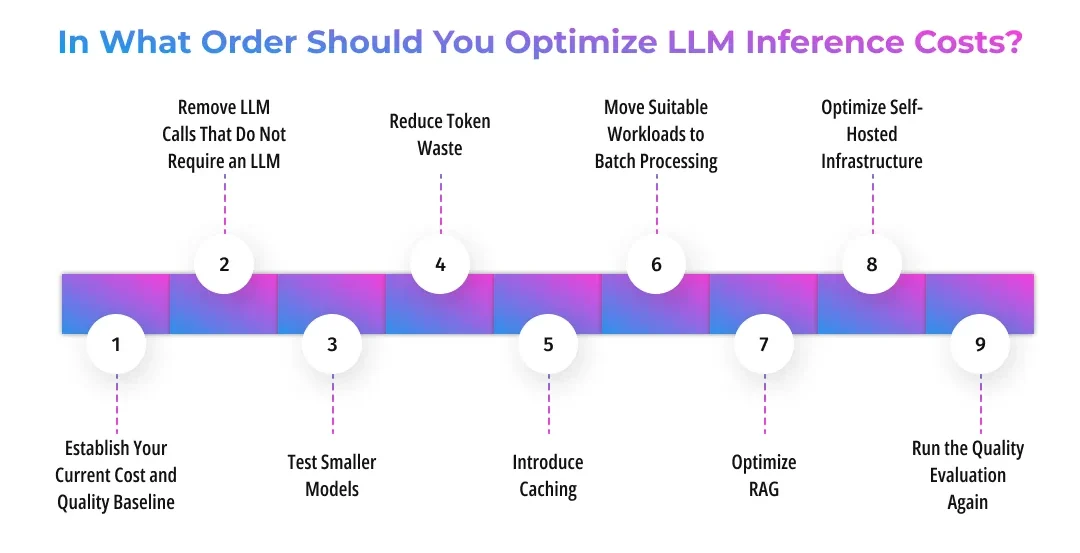
1. Establish Your Current Cost and Quality Baseline
Measure current token usage, request volume, model distribution, retries, latency, and cost per successful task.
Without a baseline, teams cannot accurately determine whether an optimization produced meaningful savings.
2. Remove LLM Calls That Do Not Require an LLM
Identify calculations, lookups, validations, sorting, formatting, and rule-based workflows that conventional software can perform reliably.
Eliminating an unnecessary model request generally saves more than making that request slightly cheaper.
3. Test Smaller Models
Benchmark lower-cost models on real application tasks.
If a smaller model meets the quality threshold, use it directly or introduce model routing so expensive models handle only difficult requests.
4. Reduce Token Waste
Audit:
- System prompts
- Conversation history
- Few-shot examples
- Tool schemas
- Retrieved context
- Output length
This is often one of the easiest forms of token optimization to implement.
5. Introduce Caching
Use prompt caching where large prefixes repeat and semantic caching where users frequently ask equivalent questions.
Measure cache-hit rates and establish appropriate invalidation rules.
6. Move Suitable Workloads to Batch Processing
Document processing, bulk extraction, evaluations, enrichment jobs, and scheduled summarization usually do not need interactive response times.
7. Optimize RAG
Tune chunking, retrieval count, filtering, reranking, and context compression so only the most useful evidence reaches the model.
8. Optimize Self-Hosted Infrastructure
If the business controls model serving, evaluate:
- Quantization
- Continuous batching
- Prefix and KV caching
- GPU right-sizing
- Autoscaling
- Serving-engine configuration
9. Run the Quality Evaluation Again
Compare the optimized system against the original baseline.
A useful way to categorize these actions is:
Fast wins: model selection, token limits, prompt cleanup, caching.
Structural wins: model routing, workflow redesign, RAG optimization, elimination of unnecessary calls.
Infrastructure wins: quantization, continuous batching, serving optimization, and improved GPU utilization.
This order prevents teams from spending weeks optimizing GPU kernels while the application is still wasting thousands of tokens or making unnecessary model calls.
Common LLM Cost Optimization Mistakes to Avoid
The biggest LLM cost optimization mistake is reducing cost without measuring what happens to quality, reliability, and task completion.
Teams should avoid the following problems:
- Using the cheapest model for every request: A weak model may increase retries and human corrections.
- Using the most expensive model for every request: Simple tasks rarely require maximum reasoning capability.
- Removing too much context: Aggressive context compression can leave the model without evidence needed to answer correctly.
- Caching frequently changing information: Cached prices, policies, inventory, or account data can quickly become inaccurate.
- Ignoring agent loops: One user request may trigger many hidden LLM calls.
- Retrieving too many RAG chunks: More context can increase costs without improving response quality.
- Batching latency-sensitive workloads: Lower cost is not useful if users experience unacceptable delays.
- Quantizing without regression testing: Lower precision can affect certain models or tasks differently.
- Self-hosting before there is enough workload: Poor GPU utilization can erase expected infrastructure savings.
- Tracking spend without tracking outcomes: Lower token cost means little if task completion falls.
The objective should therefore be minimum cost per successful business outcome, not simply minimum cost per inference request.
Make Your Production LLM Faster, Leaner, and More Cost-Efficient
Prismetric can analyze your inference architecture and optimize API usage, agent workflows, context windows, batching, and self-hosted infrastructure.
Get an LLM Optimization Assessment
How Can Prismetric Help Reduce LLM Inference Costs?
Prismetric can help businesses design and optimize LLM applications with cost, performance, and scalability considered from the architecture stage. Its LLM development capabilities include custom model development, fine-tuning, integration, and performance optimization.
The team can identify where inference spend is being created and implement suitable optimization strategies, such as:
- Model selection and routing for different task complexities
- Prompt, RAG, and context optimization to reduce unnecessary tokens
- Caching and workflow optimization to avoid redundant LLM calls
- Fine-tuning and scalable LLM integration for production workloads
Rather than reducing costs at the expense of output quality, Prismetric can help businesses evaluate the complete LLM workflow and build an architecture that balances inference cost, accuracy, latency, and scalability.
Businesses looking to optimize an existing solution or build a new one can work with Prismetric’s LLM development services team.
Conclusion
Reducing LLM inference costs requires more than choosing a cheaper model. Businesses should first measure cost per successful task, eliminate unnecessary LLM calls, use the smallest model that meets quality requirements, reduce token waste, and apply caching, batching, and RAG optimization where appropriate.
For self-hosted systems, techniques such as quantization, continuous batching, cache reuse, and GPU optimization can reduce infrastructure costs further.
The most effective strategy is to optimize cost and quality together. A production LLM system creates real savings only when it becomes cheaper without making the business outcome worse.
Businesses planning to build or optimize production-grade LLM applications can also explore Prismetric’s Large Language Model Development Services to design scalable AI systems around the right models, retrieval architecture, integrations, and inference strategy.
Frequently Asked Questions About Reducing LLM Inference Costs
The fastest approach is usually to test smaller models, reduce unnecessary input and output tokens, and cache repeated workloads. Teams should also check whether some model calls can be replaced with deterministic software. These changes can often be implemented before more complex techniques such as quantization or infrastructure redesign.
RAG can reduce LLM inference costs when it replaces large prompt contexts with a small number of relevant retrieved passages. However, RAG also introduces embedding, retrieval, vector database, and possibly reranking costs. Teams should compare the tokens avoided against the additional retrieval overhead rather than assuming RAG is automatically cheaper.
Prompt caching reuses previously processed prompt content, while semantic caching reuses previously generated answers for requests with similar meaning. Prompt caching is useful for repeated system instructions or documents. Semantic caching works well for repetitive questions, but it requires careful similarity thresholds and cache invalidation.
There is no universal traffic threshold at which self-hosting becomes cheaper. The break-even point depends on model size, GPU cost, utilization, concurrency, latency requirements, engineering overhead, and API pricing. Businesses should compare total cost per successful task under realistic production traffic before choosing either deployment model.
Quantization can reduce memory requirements and improve inference efficiency while preserving acceptable model quality, but the result depends on the model, precision level, and task. Teams should benchmark FP8, INT8, INT4, or other supported configurations against a representative evaluation dataset before deploying a quantized model in production.