How to Integrate Generative AI With Your CRM?
Key Takeaways
- Generative AI transforms CRM from a static system into a smart engine by automating emails, summaries, and lead scoring in real time.
- Clean data matters because AI performs best when CRM records are accurate, de-duplicated, and structured consistently.
- Businesses using Generative AI in CRM report up to 40 percent fewer admin tasks and a 3 to 5 percent boost in sales productivity.
- Tools like Salesforce Einstein GPT, HubSpot AI, and OpenAI APIs make AI and CRM integration faster, scalable, and easier to deploy.
Unlock smarter sales, deeper customer insights, and personalized experiences at scale.
Every business generates massive amounts of customer data. But most CRM systems fall short when it comes to turning that data into meaningful action. Sales teams chase cold leads. Marketing misses the mark. Customer service stays reactive instead of proactive.
Generative AI changes the game. It can analyze your CRM data in real time, generate tailored recommendations, and automate tasks like email writing, meeting summaries, and lead scoring. What once took hours can now happen in seconds.
By integrating Generative AI into your CRM, you unlock smarter workflows, faster decisions, and highly personalized customer journeys. In short, you move from managing data to using it intelligently.
According to McKinsey, Generative AI can increase global sales productivity by 3 to 5 percent. That’s not just an improvement, it’s a competitive advantage.
This guide walks you through how to integrate Generative AI into your CRM system, the use cases that drive real impact, and the steps to get started. Let’s dive in. 
How Generative AI is Transforming CRM
Generative AI is changing how businesses use their CRM systems. It’s no longer just a tool for storing contact details or tracking deals. It has become a dynamic engine that thinks, learns, and acts.
With Generative AI, your CRM can draft personalized emails, summarize meeting notes, and even suggest the next best action for every lead. It can prioritize sales opportunities, automate follow-ups, and help your team close deals faster.
Leading platforms like Salesforce, HubSpot, and Microsoft Dynamics 365 already offer built-in AI features. These tools simplify complex workflows, scale one-to-one engagement, and make customer data truly actionable.
Gartner predicts that by 2027, AI-powered CRM will drive over 70 percent of all marketing software investments. Companies that adopt Generative AI report measurable gains in lead scoring accuracy, sales productivity, and customer engagement.
In short, Generative AI is no longer a nice-to-have. It’s essential for business. Teams that integrate AI into their CRM workflows gain speed, insight, and a stronger connection with every customer.
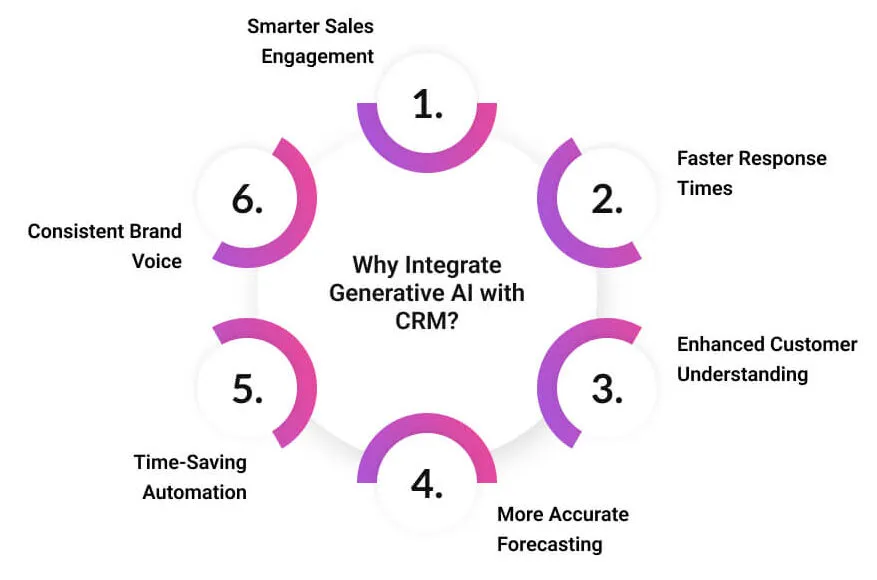
Why Integrate Generative AI with CRM?
Most CRMs are powerful, but they rely on human input to deliver value. Generative AI flips that model. It turns raw customer data into intelligent, real-time action.
Here’s why integration matters now more than ever:
1. Smarter Sales Engagement
Generative AI can analyze lead behavior, identify buying intent, and suggest the right message at the right time. Sales reps don’t waste time guessing they focus on high-impact conversations.
2. Faster Response Times
AI can instantly generate personalized emails, follow-ups, or support replies. This improves customer satisfaction and keeps your brand responsive, even at scale.
3. Enhanced Customer Understanding
AI helps in customer acquisition, AI uncovers hidden patterns in CRM data, helping you anticipate customer needs before they express them. It’s like giving your team a sixth sense for client behavior.
4. More Accurate Forecasting
With AI-generated insights, your sales forecasts become more precise. You spot trends early and make decisions with confidence.
5. Time-Saving Automation
Reps spend less time on admin and more time building relationships. From meeting summaries to data entry, Generative AI automates the busywork.
6. Consistent Brand Voice
AI tools help maintain tone and quality across all customer communications. Whether it’s a sales pitch or a support reply, your messaging stays sharp and on-brand.
6 Steps to Successfully Integrate Generative AI into Your CRM
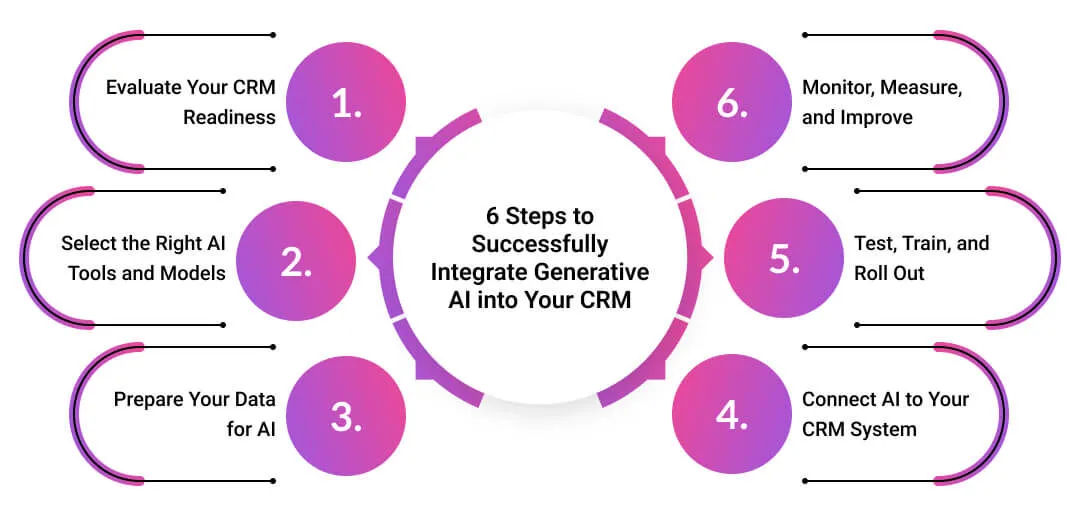
Integrating Generative AI into your CRM doesn’t have to be complicated. Here’s a clear, six-step approach to help you plan and execute a successful rollout.
1. Evaluate Your CRM Readiness
Before anything else, assess how your current CRM is performing. Review data quality, user adoption, and which tasks take up the most time. Look for inefficiencies in areas like lead scoring, reporting, or follow-up communication. This helps you pinpoint where AI can deliver the most impact and ensures the integration aligns with real business needs.
2. Select the Right AI Tools and Models
Choose a Generative AI platform that fits your use case.
You might use:
- OpenAI’s GPT models for natural language generation
- Salesforce Einstein GPT for built-in CRM functionality
- Microsoft Copilot for seamless integration with Dynamics 365
- Custom APIs for unique business needs
The key is to pick tools that are flexible, secure, and scalable within your CRM environment.
3. Prepare Your Data for AI
Data is the foundation of any AI solution. Make sure your CRM data is accurate, consistent, and well-organized. Clean out duplicates, correct errors, and categorize records properly. Also, check that your data collection processes comply with privacy regulations like GDPR or CCPA. The cleaner your data, the better your AI will perform.
4. Connect AI to Your CRM System
There are a few ways to bring AI into your CRM workflows:
- APIs: Build secure connections between your CRM and AI platform using APIs
- Native Integrations: Use AI features already available in tools like Salesforce, HubSpot, or Zoho
- Middleware Platforms: Use third-party tools to bridge your CRM and AI systems without heavy coding
Choose the option that aligns with your technical capabilities and business needs.
5. Test, Train, and Roll Out
Start with a pilot project focused on one high-impact use case. Monitor how well the AI performs and gather feedback from your team. Use this feedback to fine-tune your setup before expanding. Also, train users on how to use the AI-powered features effectively. A well-trained team will make adoption smoother and outcomes stronger.
6. Monitor, Measure, and Improve
Once your integration is live, keep a close eye on key performance metrics like lead conversion rates, email engagement, and time saved per task. Use these insights to improve both your AI model and your CRM processes. Regular reviews and refinements ensure your AI for business strategy continues to deliver value as your company evolves.
Also Read:
Top Generative AI Development Companies
Best Practices for Successful Generative AI Integration in CRM
Integrating Generative AI into your CRM can deliver huge value but only if done right. These best practices will help you maximize results, reduce risk, and keep your AI-powered CRM aligned with your business goals.
1. Prioritize Data Quality
Generative AI thrives on clean, reliable data. Ensure your CRM records are accurate, up-to-date, and properly categorized. Remove duplicates, fill in missing fields, and standardize formats. Good input leads to smart, trustworthy output.
2. Ensure Security and Compliance
Customer data is sensitive. Use AI tools that offer enterprise-grade security and support privacy regulations like GDPR and CCPA. Build in consent management and limit access based on user roles. Security should be part of the system, not an afterthought.
Also Read: How GenAI Can Transform Regulatory Compliance
3. Train Your Teams
Even the best AI tools are only as good as the people using them. Provide hands-on training so your team understands how to work with AI features, interpret its suggestions, and avoid misuse. Focus on both technical skills and ethical awareness.
4. Keep Humans in the Loop
Don’t let AI operate unchecked. Always have human oversight, especially for content sent to customers or decisions that affect deals. Use AI to assist, not replace. The goal is smarter decisions, not blind automation.
5. Use Industry-Specific AI Solutions
Choose tools that understand your domain. A CRM in real estate has different needs than one in healthcare or manufacturing. AI solutions services tailored to specific industries can provide more relevant insights, better language understanding, and faster results.
6. Adopt Ethical AI Practices
Build trust by using AI responsibly. Train models on diverse, unbiased datasets and run regular audits to check for fairness. Make sure your AI outputs are explainable, especially when used in customer-facing roles.
Real‑World Examples of Generative AI in CRM
Generative AI is already making a measurable impact in CRM systems across industries. Here are three real-world examples showing how companies are using it to drive results.
1. Salesforce: AI-Driven Sales and Support Efficiency
Salesforce has integrated Generative AI into its CRM platform through tools like Einstein and Agentforce. These AI features help sales and support teams draft responses, summarize customer cases, and suggest next-best actions.
Impact:
- AI handles a high volume of customer responses with strong accuracy
- Sales reps save time on messaging and focus more on strategic outreach
- Intelligent prompts powered by conversational AI improve deal conversions and customer satisfaction
Embedding AI directly into the CRM streamlines workflows and boosts productivity without disrupting user experience.
2. Verizon: Predictive Support to Reduce Churn
Verizon uses Generative AI to predict why customers are reaching out and connects them with the right support agent before the conversation even begins. The system analyzes past interactions and behavior to route inquiries more effectively.
Impact:
- Significant reduction in customer churn
- Faster service through smarter agent matching
- Improved customer loyalty through personalized support
Predictive AI capabilities in CRM systems can drive retention by making support faster and more relevant.
3. Capgemini: Smarter Sales Targeting with AI Insights
Capgemini uses an AI-powered buyer intent platform integrated with its CRM to identify hidden sales opportunities. The AI scans digital signals to uncover leads that are more likely to convert and helps align sales and marketing efforts.
Impact:
- More accurate lead prioritization
- Better sales and marketing alignment
- Increased conversion rates from high-intent prospects
When paired with intent data, Generative AI can turn CRM from a tracking tool into a proactive revenue engine.
Top Tools and Platforms for Integrating Generative AI with CRM
Choosing the right tools is key to making your AI‑CRM integration practical, scalable, and secure. Below are some of the most powerful and proven platforms that teams use today.
1. Salesforce Einstein / Einstein GPT
Salesforce embeds AI natively through Einstein and Einstein GPT, offering features like predictive lead scoring, response drafts, and opportunity insights. Because it’s built into the platform, integration friction is low and user adoption is smooth.
2. HubSpot AI / ChatSpot
HubSpot offers AI tools such as ChatSpot and other built-in assistants that help with conversational engagement, content drafting, and lead qualification. These features are designed for inbound marketing and work seamlessly with its CRM functions.
3. OpenAI / GPT APIs
For flexibility and control, many teams use OpenAI’s API (or similar LLM APIs) to plug generative AI into custom workflows inside their CRM. You can tailor prompts, model behavior, and how AI interacts with your data. This approach works well when your use cases don’t map neatly to off-the-shelf tools — a scenario where ChatGPT development services can offer the customization and scalability you need.
4. Middleware & Integration Platforms (iPaaS)
When you don’t want to build direct connections, middleware tools act as bridges. They help you connect your CRM with AI platforms, sync data, and manage flows without heavy coding. These platforms often support triggers, transformation logic, and error handling.
5. Industry / Domain-Specific AI Models
Some platforms offer AI tuned to particular domains (e.g. real estate, finance, healthcare). These domain‑aware models interpret data more accurately in your context. Choosing one of these helps your CRM generate more relevant recommendations, messages, and predictions.
What to Consider When Choosing Tools
Here is a short and to the point guide while choosing the right tool
- Compatibility & API support — The tool should work smoothly with your CRM’s architecture
- Security & governance — It must support data privacy, role‑based access, and audit logs
- Scalability & cost — Make sure costs grow predictably as usage expands
- Model flexibility — Ability to adjust prompts, fine tune, or switch models
- User experience — The integration should feel natural and helpful to CRM users

Conclusion
Integrating Generative AI into your CRM is more than a tech upgrade. It’s a smarter way to manage customer relationships, boost team productivity, and create personalized experiences at scale.
From drafting emails to predicting customer needs, AI helps your CRM move from passive data storage to active decision-making. With the right tools, clean data, and human oversight, the transformation can be fast, measurable, and future-ready.
Prismetric is a leading company in generative AI development. Our team specializes in building tailored Generative AI solutions that align with your business goals. We bring deep expertise in AI model integration, data governance, and CRM workflows to ensure seamless implementation and lasting impact.
Ready to make your CRM smarter? Let’s talk.
Frequently Asked Questions
Generative AI in CRM refers to the use of AI models that can generate text, insights, or actions based on customer data. It helps automate tasks like writing emails, suggesting next steps, or summarizing conversations. The AI learns from patterns in your CRM to provide useful outputs in real time.
No. Most modern CRMs like Salesforce, HubSpot, and Dynamics 365 already support AI features or allow integrations with external AI tools. You can enhance your current system without replacing it, as long as it has API access and clean data.
AI can help with lead scoring, email generation, follow-up reminders, meeting summaries, customer insights, and forecasting. It reduces manual effort and makes every interaction faster and more personalized.
Yes if implemented correctly. Make sure you use secure AI models, encrypt your data, and follow regulations like GDPR or CCPA. Always choose tools that offer strong privacy controls and role-based access.
It depends on your CRM setup and the complexity of the use cases. A basic pilot can be up and running in a few weeks. Full integration, including testing and training, may take one to three months.
No. AI is meant to assist, not replace. It handles repetitive tasks and provides helpful suggestions, but human oversight is still essential for decisions, relationship-building, and complex cases.
Companies often see faster response times, higher conversion rates, and better customer engagement. According to industry reports, AI can boost sales productivity by 3–5% and reduce time spent on admin tasks by up to 40%.