Generative AI for Marketing: Use Cases, Benefits, Implementation and Tools
Key Takeaways
- About 62 percent of marketing tech budgets now go to Generative AI, with 70 percent of companies using it to accelerate content and targeting.
- Generative AI produces blogs, videos, emails, and visuals quickly while maintaining brand consistency.
- Marketers rely on GenAI for content creation, SEO, audience segmentation, ad copy, and real-time personalization at scale.
- Starting with tools like ChatGPT or Jasper allows brands to move from pilot use to fully AI-driven marketing workflows.
- GenAI increases speed, lowers costs, and supports more data-driven and responsive creative strategies.
- Prismetric helps brands build custom GenAI solutions, integrate tools, and scale campaigns with privacy and brand safety controls.
Marketing is evolving fast. With customers expecting personalized experiences at every touchpoint, traditional strategies are struggling to keep up. Generative AI (GenAI) is stepping in as a game changer, helping marketers create smarter, faster, and more targeted campaigns.
The numbers speak for themselves. According to Capgemini, 62% of marketing tech budgets now go toward generative AI. A BCG report shows that 70% of companies already use GenAI, with another 19% currently testing it. From automating content creation to optimizing campaigns, the shift is happening at scale and picking up speed.
What is driving the momentum? GenAI helps teams generate content in seconds, refine audience targeting, and personalize messages with precision. Nearly half of marketers (49%) use it for content creation, while 41% use it to improve market segmentation. That is not just automation. It is innovation in action.
This article breaks down how generative AI is reshaping modern marketing. We will explore real use cases of Generative AI and give you clear steps to apply GenAI in your strategy. Whether you are optimizing content, boosting engagement, or scaling campaigns, this guide will help you stay ahead.
How Does Generative AI Work for Marketing?
Generative AI acts like a creative assistant powered by data. It learns from massive datasets that include text, images, audio, and video. By identifying patterns in this content, it can generate new material that closely mirrors human creativity.
In marketing, this means AI can write blog posts, create ad visuals, suggest SEO keywords, and personalize messaging across channels. It doesn’t work in isolation. Often, generative AI is used alongside traditional AI. While generative AI handles content creation, machine learning helps determine who should see it, when to deliver it, and how to optimize it for results.
Most tools run on large, pre-trained foundation models like GPT-4 or Google’s Gemini. These models are trained on publicly available data. Marketers can start using them out of the box or enhance them using brand-specific data, such as customer feedback, sales history, or past campaign performance. This makes the output more relevant and aligned with the brand’s tone and audience.
Generative AI also learns over time. When connected to your internal systems or paired with marketing automation platforms, it becomes smarter with every interaction. This continuous learning helps you refine targeting, boost performance, and deliver more personalized experiences at scale.
Levels of GenAI Adoption in Marketing
Businesses adopt generative AI in different ways, based on their size, needs, and strategy. Here are the three most common approaches:
1. Prebuilt Models
Many small teams start with tools like ChatGPT or Adobe Firefly. These models are ready to use and require no setup. Marketers can quickly generate content ideas, social posts, email drafts, and image edits using natural language prompts. This improves daily efficiency and speeds up content production.
2. Customized Models
As teams grow, they often need more control and brand consistency. Customized models are lightly trained on proprietary data, such as customer profiles, brand guidelines, or industry-specific content. These models produce more relevant output while maintaining the company’s unique voice. They are often used for tasks like keyword planning, segmentation, and campaign optimization.
3. Full-Scale AI Transformation
Large organizations may integrate generative AI into their entire marketing workflow. These businesses use AI not just for content, but to shape strategy, enhance customer journeys, and create dynamic, data-driven campaigns. For example, AI might analyze real-time customer feedback to personalize offers or guide product development.
Use Cases of Gen AI in Marketing
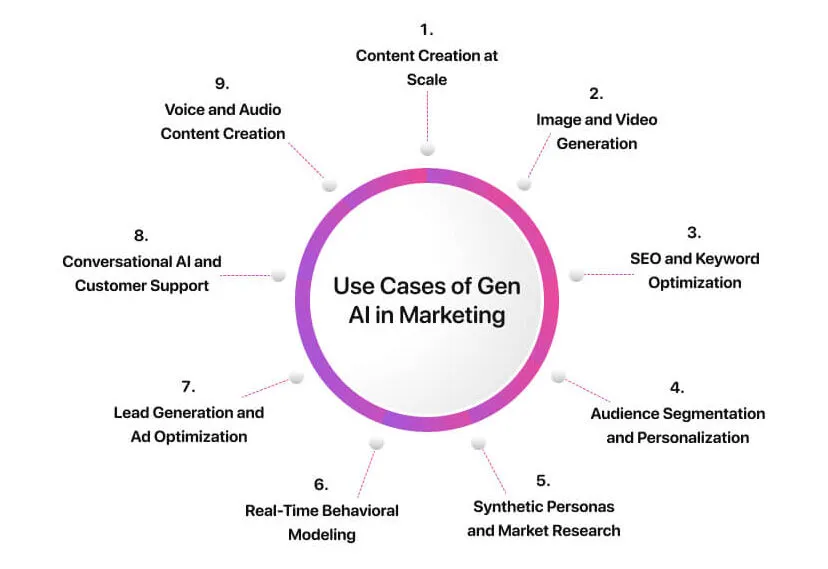
1. Content Creation at Scale
Generative AI helps marketers produce content faster without sacrificing quality. It can generate blog posts, social media updates, product descriptions, and email campaigns in seconds. This frees up time for your team to focus on strategy while maintaining a consistent content pipeline.
2. Image and Video Generation
With just a simple prompt, Gen AI tools can create custom images, promotional graphics, or even short videos. This is especially useful for teams without in-house designers, allowing them to build visual content quickly and match creative assets to campaign goals.
3. SEO and Keyword Optimization
AI tools can analyze search trends, suggest long-tail keywords, and rewrite content to improve SEO rankings. Marketers use these insights to optimize blog posts, landing pages, and metadata, driving more organic traffic to their websites with less manual effort.
4. Audience Segmentation and Personalization
Gen AI can segment audiences based on browsing behavior, preferences, or demographics, and generate personalized content for each group. This leads to more targeted marketing, better engagement, and higher conversion rates without having to manually build every campaign.
5. Synthetic Personas and Market Research
Instead of relying solely on surveys or interviews, marketers can use AI to build synthetic customer personas based on existing data. These personas help test messaging, improve targeting, and speed up campaign planning with deeper customer insight.
6. Real-Time Behavioral Modeling
Generative AI can model user behavior in real time, creating digital profiles that adjust with every interaction. This allows marketers to predict customer needs, personalize journeys, and deliver more relevant content as behavior changes.
7. Lead Generation and Ad Optimization
Marketers use Gen AI to write high-performing ad copy, test different versions, and target the right audiences based on predictive analytics. It also helps qualify leads by scoring them based on behavior, making it easier to prioritize outreach.
8. Conversational AI and Customer Support
AI-powered chatbots and virtual assistants handle customer queries instantly, reducing response times and support costs. These tools can understand intent, adapt tone, and escalate issues when needed, delivering a better experience around the clock.
9. Voice and Audio Content Creation
Gen AI can convert blog posts into podcasts or create voiceovers for videos using synthetic voices. This allows brands to repurpose content in audio formats, reach new audiences, and localize content without hiring voice talent.
Benefits of Generative AI for Marketing
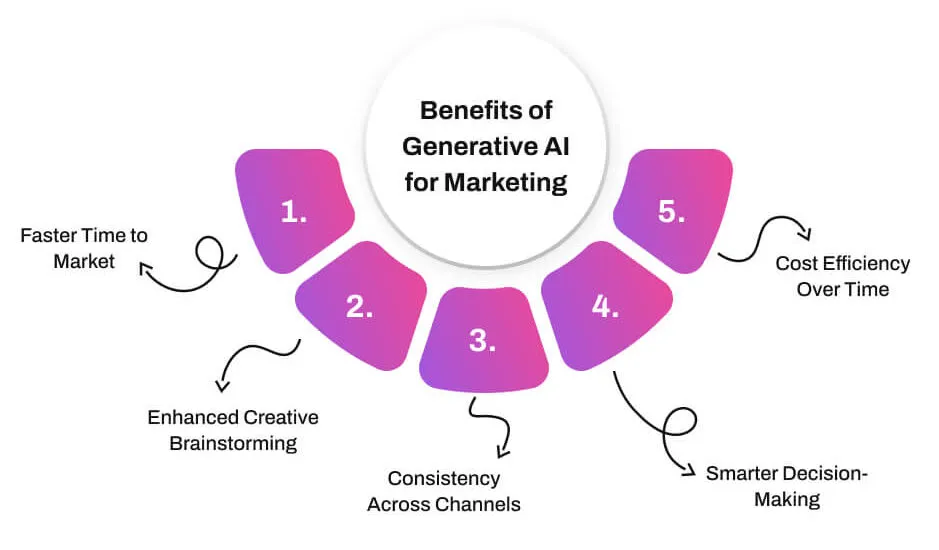
1. Faster Time to Market
Generative AI dramatically reduces the time it takes to go from idea to execution. Whether it’s creating campaign assets or analyzing trends, AI helps teams move faster and respond to market demands in real time.
- Launch campaigns quicker with ready-to-use content
- Reduce creative bottlenecks across teams
- Shorten feedback and revision cycles
2. Enhanced Creative Brainstorming
AI doesn’t just execute it helps you think. Gen AI tools can generate fresh ideas, alternative headlines, new angles, or campaign concepts, acting like a digital brainstorming partner that never runs out of steam.
- Generate multiple content variations instantly
- Discover new messaging angles you may overlook
- Break creative blocks with prompt-based ideation
3. Consistency Across Channels
Maintaining a consistent brand voice is tough, especially across teams and platforms. Gen AI helps enforce tone, messaging, and design guidelines by generating content that sticks to brand standards.
- Align messaging across email, social, ads, and more
- Reduce manual editing and brand compliance issues
- Scale content production without losing brand identity
4. Smarter Decision-Making
AI-powered tools can analyze campaign performance, audience behavior, and competitive benchmarks to help marketers make better decisions. Instead of relying on guesswork, teams can act on real-time data insights.
- Get instant feedback on what’s working and what’s not
- Optimize campaigns with performance-based suggestions
- Reduce risk by testing before full-scale launch
5. Cost Efficiency Over Time
While AI adoption may require initial investment, it pays off quickly. Automating repetitive tasks, reducing manual errors, and speeding up output all lead to long-term savings in both time and money.
- Lower production costs for content and creative assets
- Reduce the need for multiple tools or outside agencies
- Free up team resources for higher-impact work
Top Generative AI Tools for Marketing
ChatGPT (Text / Copy / Strategy)
ChatGPT lets marketers generate high‑quality text content fast. Whether you need blog drafts, campaign ideas, subject lines, or social media posts, this tool adapts to your style and tone. You can also ask it to analyze your text, suggest improvements, or brainstorm fresh angles when you feel stuck. It works great for teams and solo users alike because it covers many writing needs in one place.
Midjourney (Image / Creative Visuals)
Midjourney excels at creating artistic, visually striking images from text prompts. If you want custom illustrations, concept art, or social media graphics, this tool helps explore creative directions quickly. It is especially useful when you need visuals that catch the eye of your audience and are style‑rich rather than purely photorealistic.
Semrush AIO (SEO + Full Stack Marketing)
Semrush AIO isn’t just about keywords. It combines SEO, content insights, competitor analysis, and workflow tools. Marketers use it to uncover topics users care about, find gaps in competitors’ content, and optimize strategy. It helps you plan content with search intent in mind and keeps you ahead of what your audience is searching for.
Synthesia (Video Creation / Ads / Tutorials)
Synthesia makes video creation simple by using AI avatars, voiceovers, and templates. You no longer always need to film or hire actors for explainer videos or ads. Input your script, pick the avatar, choose style, and you have a polished video in less time. It works especially well for product demos, onboarding content, or social video ads.
Murf AI (Audio / Voice‑overs / Podcasts)
Murf AI converts written text into natural‑sounding voiceovers. It offers many voices, accents, and speaking styles so you can adapt audio to match your brand voice. This tool is ideal for podcast scripts, video narration, or audio intros. It helps you add audio content to your marketing mix without hiring voice talent.
Omneky (Creative Ads / Campaign Generation)
Omneky helps brands generate ad creatives and campaign content at scale. It can suggest creatives, test variants, and optimize ad copy and visuals across multiple channels. For businesses running many ad campaigns, Omneky makes it faster to launch and iterate while keeping consistency in style and messaging.
Runway (Video / Ad Creation / Visual FX)
Runway is a powerful AI tool that lets you generate and edit videos using simple text prompts. Marketers use it to create product videos, ad clips, and short-form content without heavy editing skills. Its Gen‑2 model also supports features like motion tracking and background editing, making it ideal for visually rich campaigns.
Claude (Text / Summarization / Human-like Writing)
Claude, by Anthropic, is gaining popularity for its conversational tone and clean writing. Marketers use it for writing blog drafts, summarizing research, and even generating multilingual content. It’s especially helpful for content that needs a human touch without feeling overly robotic or formulaic.
Adobe Firefly (Images / Design Assets / Brand Visuals)
Adobe Firefly helps marketers generate brand visuals, social posts, and creative graphics using natural language prompts. Integrated with other Adobe tools like Photoshop and Illustrator, it allows seamless editing and design control. It’s perfect for creating marketing visuals that follow your brand identity and style guides.
Google Gemini (Text / Brainstorming / Multilingual)
Gemini is Google’s AI chatbot built for writing, ideation, and research. It helps marketers brainstorm blog ideas, refine messaging, and translate content across multiple languages. The tool also integrates with Google Search, giving it real-time access to current information, which adds value for trend-based content creation.
Soundraw (Audio / Music for Videos and Ads)
Soundraw uses AI to create original, royalty-free background music tailored to your video length, mood, and style. It’s perfect for marketers who produce YouTube videos, Instagram reels, or product trailers and want a professional sound without dealing with licensing issues.
Jasper AI (Text / Copywriting / Team Collaboration)
Jasper AI is a favorite among marketing teams for its collaborative content creation features. It provides templates for emails, product descriptions, ads, and blog posts. You can also train it on your brand voice, making it easy to produce consistent messaging across platforms.
Copy.ai (Text / Email / Product Pages)
Copy.ai is built to help marketers generate persuasive, conversion-focused copy for landing pages, emails, and product descriptions. It comes with built-in tools for tone adjustment, content outlines, and even cold outreach templates, making it ideal for both inbound and outbound strategies.
Descript (Audio + Video / Podcasting / Editing)
Descript is an all-in-one audio and video editing tool powered by AI. It allows you to edit video by editing the transcript, remove filler words automatically, and even clone your voice for consistency. Great for marketers creating podcasts, video interviews, or YouTube content on a regular basis.
Mailchimp + AI (Automation / Email Marketing)
Mailchimp’s AI tools help with subject line suggestions, send time optimization, customer segmentation, and predictive analytics. It’s perfect for small businesses or growing brands looking to automate email marketing while still keeping things personal and effective.
How to Implement Generative AI in Marketing
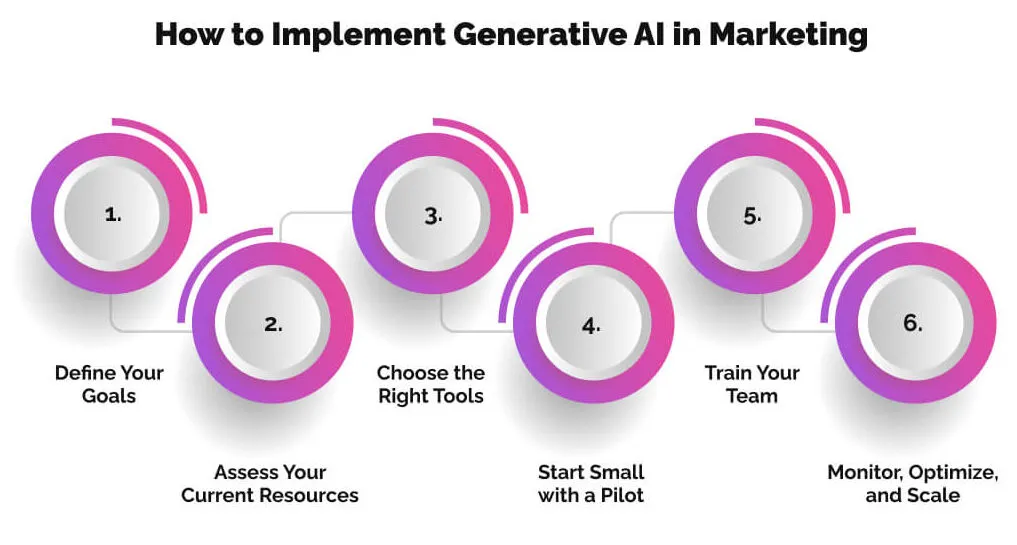
Getting started with generative AI doesn’t need to be overwhelming. Follow these simple, strategic steps to implement GenAI into your marketing workflow and unlock its full potential.
Step 1: Define Your Goals
Start by identifying what you want to improve. Whether it’s faster content creation, better targeting, or more personalized campaigns, clear goals help you focus your efforts and track your results effectively.
Step 2: Assess Your Current Resources
Review your existing tools, team capabilities, and data quality. This helps you understand where AI can add value and whether your current systems are ready for integration.
Step 3: Choose the Right Tools
Pick AI tools that match your goals and are easy for your team to adopt. Start with trusted platforms like ChatGPT, Jasper, or built-in AI features from tools you already use, such as HubSpot or Canva.
Step 4: Start Small with a Pilot
Test AI on one small project first. You might use it to generate blog drafts, write email copy, or create product descriptions. A focused pilot allows you to measure impact without overwhelming your team.
Step 5: Train Your Team
Even the smartest AI needs human guidance. Provide basic training on prompt writing, content editing, and ethical use. A well-prepared team will get better results and avoid common mistakes.
Step 6: Monitor, Optimize, and Scale
Once the pilot is successful, expand AI to other parts of your workflow. Track key metrics, collect team feedback, and keep refining your process to get the most value over time.
Best Practices When Implementing Generative AI in Marketing
Implementing generative AI isn’t just about plugging in a tool. To get real results, you need to follow smart, strategic practices that keep quality high and workflows smooth.
1. Start Small and Scale Gradually
Avoid the temptation to overhaul your entire marketing strategy with AI from day one. Begin with a small, low-risk use case like writing product descriptions or generating social captions. This allows your team to experiment, understand the tool’s capabilities, and learn how to integrate it into your workflow. Once you see consistent results, you can scale up and apply AI to broader campaigns or processes.
2. Keep the Human in the Loop
Generative AI can create impressive content, but it lacks the judgment and nuance of a human. Always review AI-generated content before publishing to ensure it aligns with your tone, is factually accurate, and reflects your brand values. Human oversight helps avoid embarrassing mistakes, protects your credibility, and makes the final product feel more authentic.
3. Maintain Brand Voice and Guidelines
One major risk of using AI is losing your brand’s unique voice. To prevent this, feed your AI tools clear instructions about your tone, preferred language, and formatting. Some platforms allow you to fine-tune or “train” the model using past content, which helps it generate output that sounds like you. Consistency builds trust, so make sure AI supports, not erases, your brand identity.
4. Prioritize Data Privacy and Compliance
If you’re using customer data to personalize AI-generated content, data protection should be a top priority. Only use tools that are transparent about how they handle data, and make sure they comply with privacy laws like GDPR or CCPA. Avoid uploading sensitive information to public AI platforms, and choose enterprise-level solutions when security is essential.
5. Focus on Quality Over Quantity
AI makes it easy to generate large volumes of content, but that doesn’t always mean better results. Don’t publish everything it produces. Focus on reviewing, refining, and testing content to ensure it meets your quality standards. A few high-performing pieces will deliver more value than dozens of generic ones. Let AI speed things up, but never compromise on relevance or impact.
How Prismetric Helps You Power Your Marketing with Generative AI
Prismetric is more than a technology partner. It brings together deep AI expertise, a seasoned engineering team, and tailored marketing solutions to help businesses adopt generative AI services in ways that actually drive results.
Strategic AI Guidance and Consulting
Prismetric begins by understanding your business goals. Whether you’re looking to increase leads, improve content personalization, or reduce campaign costs, they help you design the right generative AI approach. This ensures you invest in the right tools and avoid wasting time on generic strategies.
Custom Generative AI Solutions
One size doesn’t fit all in marketing. Prismetric develops custom AI solutions fine-tuned with your brand voice, customer data, and product details. This helps you create highly targeted content that connects with your audience and performs better across channels.
AI Integration and Intelligent Automation
Beyond building AI models, Prismetric helps integrate generative AI into your existing marketing systems. This includes AI agents, chatbots, and automated content flows that work inside your CRM or content platforms. As a result, your team gets faster insights and streamlined workflows.
Cross-Industry Experience
From healthcare and fintech to retail and logistics, Prismetric has worked with clients across a wide range of industries. This experience helps them understand your specific compliance needs, audience behaviors, and marketing challenges, which reduces your learning curve and speeds up results.
End-to-End Support
Prismetric handles the entire AI lifecycle from data management and model development to deployment and optimization. Their full-stack engineering support ensures that your generative AI tools remain accurate, efficient, and aligned with your evolving business goals.
Ethical and Transparent AI Practices
Trust matters when it comes to AI. Prismetric follows strict ethical guidelines and transparent workflows, ensuring your AI systems respect privacy rules, minimize bias, and stay aligned with your brand values.
You May Find This Insightful:
Top Generative AI Development Companies
Top Generative AI Consulting Companies
What You Gain with Prismetric
- Personalized content that speaks directly to your target audience
- Faster turnaround times for campaigns and creative production
- AI-powered personalization that boosts engagement and ROI
- Scalable automation that frees up your team for strategic work
- A reliable tech partner that keeps your AI efforts on track and compliant

Conclusion
Generative AI is no longer just a buzzword. It’s a practical, powerful tool that helps marketers move faster, create smarter, and connect deeper with their audiences. From content creation and personalization to campaign optimization and automation, GenAI is transforming how marketing teams operate and deliver results.
But success doesn’t come from using AI alone. It comes from using it wisely. By starting small, choosing the right tools, and partnering with experts like Prismetric, businesses can harness the full potential of generative AI and stay ahead in an increasingly competitive market.