Generative AI for IT: Integration, Benefits, use cases and challenges
Key Takeaways
- Generative AI helps IT teams code, debug, and automate faster by reducing manual tasks and boosting daily developer output.
- Tools like GitHub Copilot can increase developer productivity by 30 to 50 percent, changing how IT projects are delivered.
- Common GenAI use cases include code generation, help desk automation, network configuration, cybersecurity modeling, and incident response.
- GenAI reduces costs, speeds issue resolution, improves accuracy, and helps teams scale without adding headcount.
- BCG reports GenAI can cut IT operational costs by up to 10 percent, making it a strategic investment for lean operations.
- Risks such as flawed code and data leaks require strong governance, secure practices, and consistent human oversight.
The IT industry is evolving fast. At the center of this change is Generative AI, a powerful technology that is shifting how teams build, manage, and secure digital systems.
This is not just another buzzword. According to BCG, GenAI could reduce IT costs by up to 10%. That is not a minor tweak. It is a game-changer. For IT leaders under pressure to do more with less, this level of savings opens the door to real innovation.
We are already seeing the impact. Tools like GitHub Copilot and Amazon CodeWhisperer are boosting developer productivity by 30% to 50%. That kind of lift reshapes entire workflows, from software development to infrastructure maintenance.
But this shift is not just about speed or cost. It is about possibility. GenAI is enabling teams to build smarter apps, automate repetitive tasks, and respond faster to threats, all while simplifying the complexity that often slows IT down.
So what does this mean for your organization?
In this guide, we will explore how Generative AI is transforming IT across core areas like app development, data management, infrastructure, and security. We will also show you how to spot real opportunities, avoid common pitfalls, and build a GenAI strategy that delivers value from day one.
Let’s dive in and see how you can lead this next wave of IT innovation.
What is Generative AI in IT?
Generative AI in IT is the application of artificial intelligence models that create new outputs such as code, system configurations, software designs, or network models. Instead of simply analyzing data, these models produce original content tailored to specific IT needs.
In the IT environment, generative AI supports a wide range of activities, including:
- Developing and debugging code
- Designing or modeling complex network structures
- Automating help desk responses and documentation
- Simulating cybersecurity vulnerabilities to improve security protocols
By generating these outputs, generative AI enables IT teams to streamline workflows, reduce manual effort, and increase operational efficiency across multiple functions such as software development, infrastructure management, and cybersecurity.
How Does Generative AI in IT Work?
Generative AI in IT works by using machine learning models trained on massive datasets that include programming languages, IT documentation, system logs, and technical guides. These models learn patterns, structures, and context so they can generate relevant outputs like code snippets, configurations, or system responses.
At the core of these systems are large language models (LLMs), such as OpenAI’s Codex. These models understand prompts written in natural language and respond with precise technical outputs.
For example:
- A developer types: “Create a Python script to sort login records by date.”
- The model instantly generates clean, working code based on best practices.
These Generative AI models support multiple languages and formats, allowing them to assist with scripting, system configurations, automation commands, or even email drafts for IT support.
Generative AI also works through fine-tuning and contextual learning. It adapts to the organization’s specific data and systems, becoming more useful over time. The more it’s used, the better it understands what each IT team needs.
Why Is Generative AI in IT Important?
Generative AI is important in IT because it helps teams work smarter, faster, and with fewer errors. It automates routine tasks, accelerates development cycles, and enhances system reliability all while freeing up human talent for more strategic work.
Modern IT teams face growing pressure to reduce costs, improve uptime, and deliver faster results. Generative AI directly supports these goals by:
- Boosting productivity
Developers and engineers can generate code, scripts, or responses in seconds, reducing manual effort and speeding up delivery timelines.
- Reducing human error
Automating repetitive tasks lowers the risk of mistakes in configurations, documentation, or troubleshooting.
- Enhancing decision-making
AI-generated insights and suggestions support faster, more accurate responses to incidents, change requests, or performance issues.
- Improving scalability
As systems grow, GenAI helps manage complexity without needing to scale human resources at the same rate.
This technology is not just a tool it is a strategic enabler. It helps IT leaders align their operations with the speed of innovation, allowing them to keep pace with evolving business needs and user expectations.
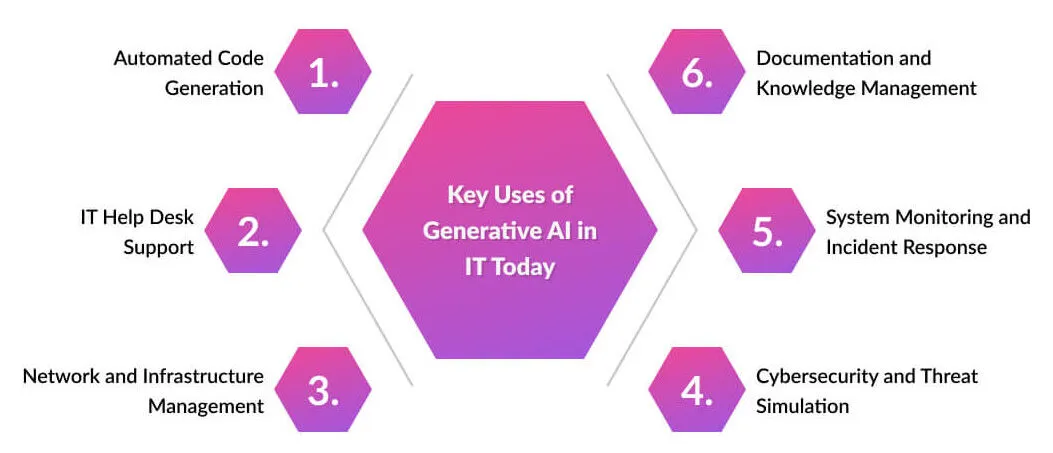
Key Uses of Generative AI in IT Today
1. Automated Code Generation
Generative AI tools can instantly produce code based on natural language prompts, helping developers create scripts, functions, and test cases in seconds. This reduces repetitive work, accelerates delivery, and minimizes bugs by generating clean, consistent code structures.
2. IT Help Desk Support
AI-powered virtual agents assist help desk teams by drafting responses, generating step-by-step troubleshooting guides, and auto-resolving common user issues. This boosts response times, reduces ticket volume, and ensures consistent support quality across the board.
3. Network and Infrastructure Management
Generative AI helps IT teams design, configure, and document complex network environments by automatically generating setup scripts, topology diagrams, and configuration templates. It speeds up deployment while reducing manual configuration errors.
4. Cybersecurity and Threat Simulation
Generative AI enhances security by simulating attack scenarios, identifying potential vulnerabilities, and drafting security policies. It enables proactive threat modeling, helping IT teams stay ahead of evolving risks without the need for manual threat scenario creation.
5. System Monitoring and Incident Response
AI tools analyze logs and system data to generate summaries, suggest root causes, and create incident reports. This allows IT teams to act faster during outages or performance issues while reducing time spent on post-incident documentation.
6. Documentation and Knowledge Management
Generative AI simplifies documentation by creating standard operating procedures, API references, and internal manuals with minimal human input. It keeps knowledge up to date and accessible, especially in fast-changing IT environments.
Most Important Benefits of Generative AI for IT
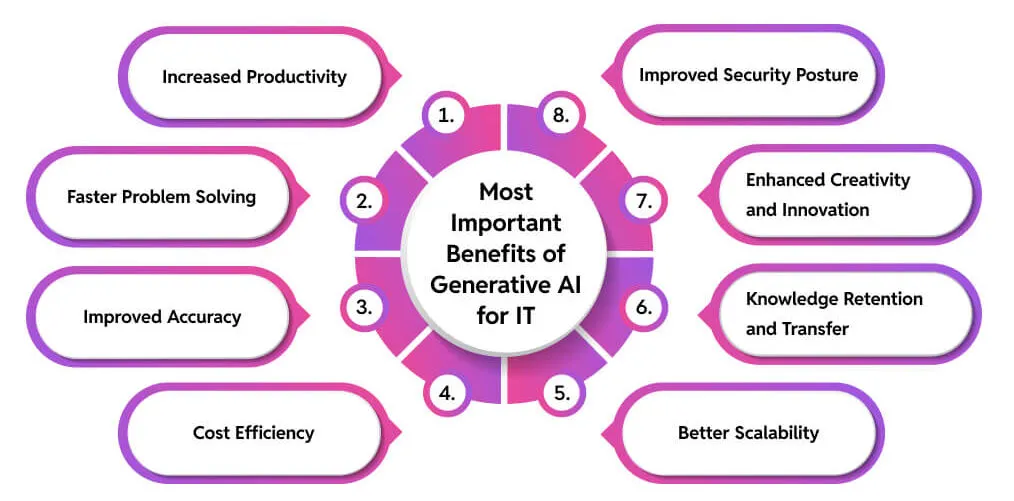
Generative AI is delivering measurable gains across IT operations, from productivity to security. Below are the key benefits organizations are experiencing as they adopt this transformative technology.
1. Increased Productivity
Generative AI reduces time spent on repetitive tasks like coding, documentation, and ticket resolution. This gives IT teams more time to focus on innovation, strategic projects, and system improvements.
2. Faster Problem Solving
AI can quickly analyze logs, identify patterns, and suggest solutions, helping teams resolve incidents faster. This leads to shorter downtimes, better user experience, and less pressure during high-impact issues.
3. Improved Accuracy
By generating consistent and standardized outputs, GenAI reduces human errors in code, configurations, and documentation. This leads to more stable systems and fewer rollbacks or rework.
4. Cost Efficiency
By automating routine tasks and speeding up development cycles, generative AI helps reduce labor costs and operational overhead. Teams can do more with fewer resources, making IT budgets stretch further.
5. Better Scalability
As IT environments grow, GenAI allows teams to handle more complexity without needing to scale headcount at the same rate. It supports faster onboarding, streamlined processes, and consistent output across teams.
6. Knowledge Retention and Transfer
Generative AI captures and repurposes internal knowledge by creating documentation, tutorials, and responses based on historical data. This helps preserve institutional knowledge and makes it easier for new team members to get up to speed.
7. Enhanced Creativity and Innovation
Generative AI automates routine content and design tasks, freeing IT professionals to focus on high-level problem-solving and innovation. This shift encourages the creation of new solutions, services, and approaches, fostering a culture of continuous improvement.
8. Improved Security Posture
By simulating cyber threats and identifying anomalies before they occur, generative AI strengthens an organization’s cybersecurity defenses. It helps teams proactively discover vulnerabilities, reduce risks, and enhance overall system resilience.
Must Read:
Top Generative AI Development Companies
Top Generative AI Consulting Companies
⚠️ Challenges and Risks of Generative AI in IT
While generative AI brings powerful advantages, it also introduces new risks that IT teams must manage carefully. One major concern is accuracy and reliability. AI-generated outputs can be incorrect, outdated, or based on flawed assumptions, especially when models are trained on public data. If not properly reviewed, these outputs can lead to faulty code, misconfigurations, or misleading documentation.
Another key risk is security and data exposure. Generative AI tools may unintentionally leak sensitive information if prompts or training data include confidential content. There are also concerns about model misuse, such as generating scripts that could be exploited by bad actors. To safely adopt GenAI, organizations need strong governance, access controls, and human oversight at every stage.
🔮 What Is the Future of Generative AI in the IT Sector?
As generative AI continues to evolve, its role in IT will shift from supportive to strategic. Here’s what the future may look like for IT teams embracing this transformation:
- Autonomous IT Operations
Generative AI will evolve from supporting tasks to fully managing workflows, including self-healing systems, automated incident resolution, and real-time optimization.
- Domain-Specific AI Agents
Specialized AI models will emerge for functions like cybersecurity, DevOps, and network management, offering targeted support with deeper contextual understanding.
- Predictive and Preventive Capabilities
AI will increasingly anticipate issues before they happen, using historical data and pattern recognition to reduce downtime and prevent failures.
- Deeper Integration with IT Tools
GenAI will be embedded directly into platforms like CI/CD pipelines, cloud dashboards, and monitoring tools, making AI-driven decisions part of daily IT operations.
- Smarter Collaboration Between Humans and AI
Human-AI teams will become the norm, with AI handling repetitive tasks and humans focusing on strategy, oversight, and innovation.
How Prismetric Can Help You Integrate Generative AI in Your Business
Prismetric helps businesses turn the promise of generative AI into practical results. Through our generative AI development services, we help organizations build smart solutions that automate processes, improve productivity, and solve real-world problems. Whether you need AI for software development, IT operations, or customer support, we tailor every solution to fit your unique needs.
We take a hands-on approach to implementation with reliable AI integration services. Our team works closely with your existing systems, ensuring smooth adoption without disrupting operations. From choosing the right models to setting up workflows and security, we make sure everything is aligned with your goals.
If you’re considering hiring generative AI developers, Prismetric offers experienced professionals who understand both the technology and its practical business use. We don’t just build AI tools, we help you use them effectively to drive long-term growth and innovation.
Conclusion
Generative AI is not just enhancing IT; it is redefining it. From automating routine tasks to enabling faster, smarter decision-making, it is helping IT teams work with greater speed, accuracy, and innovation. The organizations that adopt it early are already seeing real results in productivity, cost savings, and operational agility.
As the technology matures, its role in IT will only grow. Now is the time to explore how generative AI fits into your IT strategy. Start small, choose the right use cases, and build the foundation for long-term transformation. The future of IT is not just digital. It is generative.
❓ FAQs About Generative AI in IT
Generative AI in IT refers to the use of AI models that can create outputs like code, system configurations, network models, and documentation. These tools help automate tasks, improve accuracy, and support faster development and operations.
Generative AI automates repetitive and time-consuming IT tasks such as coding, troubleshooting, and documentation. This reduces manual effort, shortens project timelines, and cuts down on staffing costs, leading to significant savings.
Key use cases include automated code generation, AI-powered help desks, network configuration, cybersecurity threat modeling, and system monitoring. These applications improve efficiency and free up IT teams for higher-value work.
Yes, but safety depends on proper implementation. With the right access controls, data governance, and human oversight, generative AI can be securely integrated into IT systems without exposing sensitive information or creating risks.
Generative AI can simulate cyberattacks, analyze vulnerabilities, and help teams develop better incident response strategies. It enhances threat detection and prevention by generating security scenarios that test system defenses.
Absolutely. Generative AI tools are especially valuable for small teams because they help automate complex tasks without needing to scale headcount. Even basic use cases like documentation or ticketing can deliver strong ROI.
Look for developers with experience in machine learning, natural language processing, and real-world IT applications. They should also understand your business goals and how to build AI systems that solve practical problems.
Start with a specific problem or task that’s repetitive or resource-heavy. Pilot a small GenAI solution, measure its impact, and expand from there. Partnering with a team that offers AI integration services can make this process easier and more efficient.