How GenAI Can Transform Regulatory Compliance

Key Takeaways
- About 67 percent of organizations are investing in Generative AI to automate compliance, reduce risk, and strengthen decision-making.
- GenAI accelerates document analysis, real-time monitoring, and risk reporting with higher accuracy and less manual effort.
- LLMs and RAG improve compliance by summarizing regulations, retrieving live updates, and generating tailored reports.
- Generative AI helps scale compliance across regions and regulations, supporting businesses operating globally.
- Prismetric’s GenAI services automate workflows, unify compliance data, and enable smarter decisions using scalable low-code tools.
Regulatory compliance is essential for maintaining an organization’s legal and ethical integrity. However, as regulations become more complex, compliance teams are struggling to manage vast amounts of data and stay updated with evolving rules. Traditional methods are slow, error-prone, and often inefficient.
Generative AI is emerging as a powerful solution to these challenges. A recent Deloitte survey found that 67% of organizations are increasing investments in AI to automate processes and enhance decision-making. As AI continues to evolve, businesses are using it to streamline compliance tasks and improve accuracy.
Generative AI enables organizations to automate routine tasks, analyze large datasets, and gain real-time insights. This helps teams stay ahead of regulatory changes and reduce the risk of compliance failures. In this article, we’ll explore how generative AI is transforming regulatory compliance and what the future holds.
What is Generative AI?
Generative AI refers to artificial intelligence that can create new content, such as text, images, or data, by learning patterns from existing information. Unlike traditional AI that follows specific instructions, generative AI uses vast datasets to generate creative solutions or insights. It can automate tasks like writing reports, drafting emails, or analyzing complex documents, making it a powerful tool in various fields, including regulatory compliance.
What is Generative AI for Regulatory Compliance?
Generative AI refers to artificial intelligence models that can create, process, and generate new content based on patterns in data. In the context of regulatory compliance, it helps organizations automate tasks like analyzing regulations, monitoring changes, and generating reports. These AI models learn from vast amounts of data to provide real-time insights, making it easier for compliance teams to stay updated and make informed decisions.
For example, generative AI can analyze complex regulatory documents and extract key information, reducing the time and effort required for manual reviews. It can also track updates in laws and regulations across different regions, alerting businesses about changes that could impact their compliance requirements. This allows companies to react quickly, ensuring they meet all regulatory demands efficiently.
How LLMs and RAG Improve Compliance Workflows
Large Language Models (LLMs) are a cornerstone of generative AI, driving much of its success in regulatory compliance. These models are designed to understand and generate human-like text by analyzing vast amounts of data. LLMs can read and interpret regulatory documents, legal language, and complex compliance texts with a high degree of accuracy. This ability helps compliance teams quickly process and extract essential information from large volumes of documents, saving time and reducing human error.
Retrieval-Augmented Generation (RAG) takes this further by combining the power of LLMs with advanced information retrieval systems. RAG allows AI to pull relevant data from external sources, such as databases or previous reports, before generating text. This enables a more contextually accurate and informed response. For regulatory compliance, RAG can be used to track regulatory changes in real-time, automatically pull the latest compliance guidelines, and generate tailored reports or risk assessments. By enhancing the speed and precision of compliance workflows, both LLMs and RAG significantly improve an organization’s ability to stay compliant with evolving regulations.
Key Applications of GenAI in Regulatory Compliance
Automated Document Analysis
Generative AI can quickly analyze complex regulatory documents. It extracts important information, identifies key clauses, and summarizes lengthy regulations. This speeds up the review process and reduces errors, allowing compliance teams to work more efficiently.
Real-Time Regulatory Monitoring
AI can monitor regulatory changes in real time. It tracks updates from different regions and alerts organizations when new laws or changes are introduced. This helps businesses stay on top of evolving regulations and remain compliant without delays.
Risk Assessment and Reporting
Generative AI can assess compliance risks and generate reports automatically. It analyzes data and highlights areas where the business may be at risk of non-compliance. This allows teams to focus on managing risks and ensures reports are accurate and delivered on time.
Benefits of Integrating GenAI into Compliance Strategies
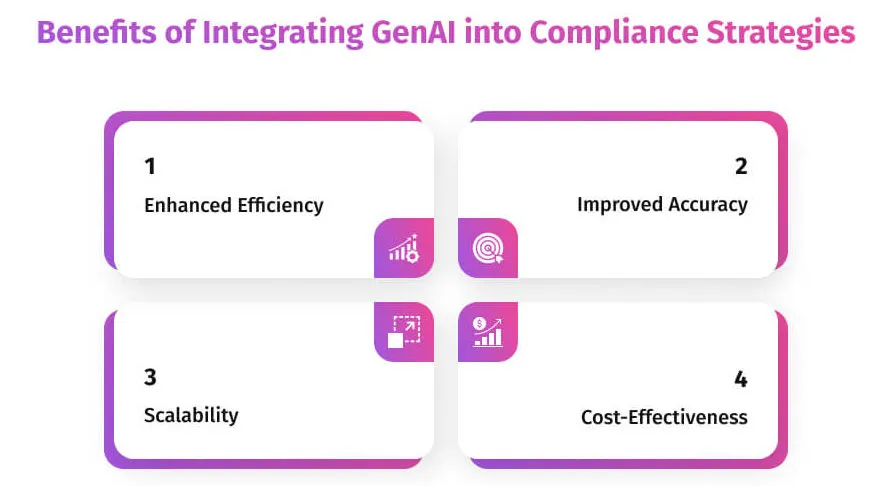
Enhanced Efficiency
Generative AI significantly reduces manual effort in compliance tasks. It automates time-consuming processes like document analysis and report generation, speeding up workflows. This allows compliance teams to focus on more strategic tasks, improving overall productivity.
Improved Accuracy
AI minimizes the risk of human error when interpreting complex regulations. By relying on AI to process and analyze data, organizations can ensure greater accuracy in compliance tasks. This helps avoid costly mistakes and ensures that compliance efforts are always aligned with the latest regulations.
Scalability
As regulatory requirements grow, GenAI allows businesses to scale their compliance efforts without needing to hire additional staff. AI systems can handle larger volumes of data and keep up with more regulations, ensuring that compliance remains manageable as the business expands.
Cost-Effectiveness
Generative AI helps organizations achieve compliance goals while staying within budget. By automating repetitive tasks and improving efficiency, businesses can reduce the need for manual labor and costly compliance errors. This makes it a more affordable solution for maintaining high standards of regulatory adherence.
Also Read:
Top Generative AI Development Companies
Challenges and Considerations
Data Privacy and Security
One of the main concerns with using generative AI for regulatory compliance is handling sensitive information. Businesses must ensure that AI systems comply with data privacy laws and securely store and process data. Implementing robust security protocols and encryption is critical to protecting sensitive customer and company information.
Model Transparency and Explainability
Generative AI models can sometimes act as “black boxes,” making it difficult to understand how they arrive at decisions. It’s important to ensure that AI systems used in compliance are transparent and their decisions can be explained. This helps build trust with stakeholders and ensures that AI-generated outcomes are justifiable, especially in high-stakes compliance scenarios.
Regulatory Acceptance
As AI technology continues to evolve, the regulatory landscape surrounding its use is also changing. Organizations must stay updated on emerging regulations regarding AI applications and ensure their AI systems are compliant. This requires navigating a constantly shifting environment and adapting to new standards for AI deployment in compliance processes.
Best Practices for Implementing GenAI in Compliance
Establish Clear Governance Frameworks
Set clear policies and guidelines for AI use in compliance. Define roles and responsibilities to ensure proper oversight. A strong governance framework helps align AI with legal and ethical standards.
Continuous Training and Adaptation
Regularly update AI models to reflect the latest regulatory changes. This keeps the system accurate and aligned with evolving laws. Continuous training ensures AI stays effective and reduces the risk of non-compliance.
Stakeholder Engagement
Involve legal, IT, and compliance teams in the AI implementation process. Collaboration ensures that all departments are aligned and the system meets business needs. Engaging key stakeholders helps smooth integration into existing workflows.
Test AI Systems Regularly
Conduct regular testing of AI models to ensure they are performing as expected. This helps identify any issues or inaccuracies early, allowing for quick adjustments to maintain compliance effectiveness.
Ensure Data Quality
The accuracy of AI-generated insights depends on the quality of data fed into the system. Ensure that the data used for training AI models is accurate, up-to-date, and relevant to your regulatory needs.
Monitor AI Performance
Track the performance of AI systems over time. Monitoring helps you assess whether the AI is consistently delivering accurate and reliable results, and provides the opportunity to make improvements where necessary.
Promote Transparency and Communication
Maintain open communication with all stakeholders about how AI is being used in compliance processes. Transparency ensures that everyone understands the system’s role and builds trust in its decisions.
What is the Future of GenAI in Regulatory Compliance?
The future of generative AI in regulatory compliance is promising, with technology advancing to handle more complex tasks. AI will continue to automate routine processes, making compliance more efficient and less prone to human error. As AI models become more sophisticated, they will be able to adapt to changing regulations in real-time, offering proactive compliance solutions. The integration of AI will not only improve efficiency but also help businesses better manage risks and stay ahead of regulatory demands.
Prismetric GenAI Services for Next-Level Compliance Management
Prismetric is transforming regulatory compliance through its advanced GenAI services, offering organizations a smarter, more efficient way to navigate complex regulatory landscapes. Here’s how Prismetric’s solutions enhance compliance capabilities:
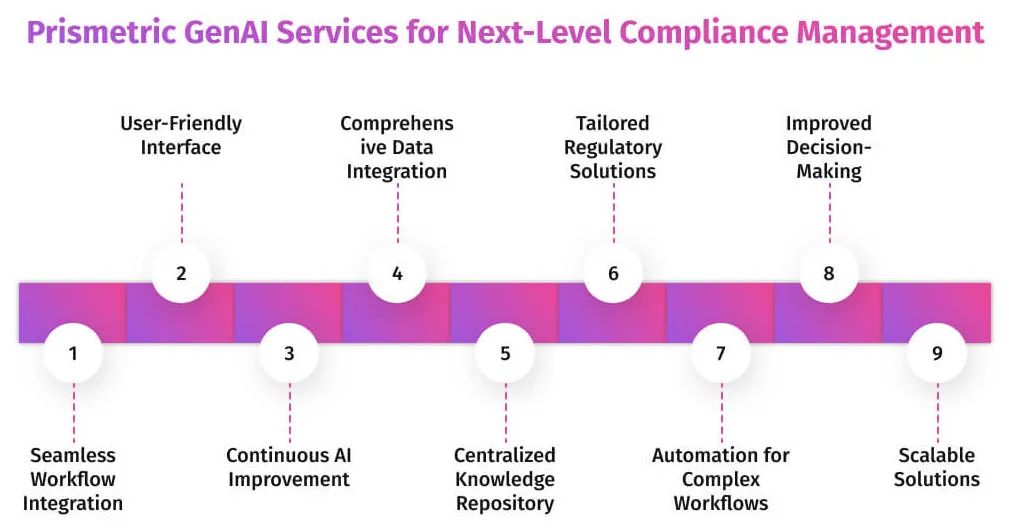
Seamless Workflow Integration
Prismetric’s GenAI services integrate effortlessly with existing systems like Slack, Microsoft Teams, APIs, and more. This enables compliance teams to streamline workflows, improve collaboration, and enhance cross-departmental communication. By unifying technology ecosystems, Prismetric helps speed up operations, reduce response times, and optimize compliance management.
User-Friendly Interface
Prismetric’s low-code interface makes it easy for compliance teams to customize workflows to meet specific regulatory needs. These workflows guide teams through multi-layered compliance scenarios, ensuring that each phase is handled efficiently with precision and flexibility, without requiring deep technical expertise.
Continuous AI Improvement
Prismetric’s GenAI platform incorporates human feedback to continuously improve its models, increasing accuracy and effectiveness over time. This feature allows compliance teams to benefit from more refined pattern recognition, automated checks, and data-driven decision-making, leading to enhanced regulatory adherence and minimized risk.
Comprehensive Data Integration
Prismetric’s GenAI services pull data from multiple sources like databases, cloud services, and APIs, ensuring that no critical information is overlooked. This integration gives compliance teams a holistic view of regulatory data, empowering them to perform thorough risk assessments and make informed decisions.
Centralized Knowledge Repository
With Prismetric, compliance teams have access to a robust knowledge repository that stores regulations, policies, and controls in one place. This centralized database simplifies regulatory analysis and compliance checks, enabling teams to work more efficiently and accurately.
Tailored Regulatory Solutions
Prismetric’s solutions are customizable to fit the specific needs of each organization. Compliance teams can build applications that tackle unique regulatory challenges, helping them resolve complex compliance issues effectively.
Automation for Complex Workflows
Prismetric automates critical compliance processes, including data collection and regulatory reporting. This reduces manual workload and enables compliance teams to focus on higher-level strategic decision-making, improving overall efficiency.
Improved Decision-Making
Prismetric’s data processing capabilities support rapid analysis, allowing teams to make informed decisions around regulatory requirements and risk management. This enhances decision-making speed and accuracy, driving better compliance outcomes.
Scalable Solutions
Prismetric’s GenAI services grow with your organization. As regulatory demands increase, Prismetric’s scalable solutions allow compliance teams to expand their operations without compromising on accuracy or standards.
By leveraging Prismetric’s GenAI services, organizations can automate key compliance functions, improve operational efficiency, and meet evolving regulatory challenges head-on. With Prismetric, businesses are empowered to stay ahead in an increasingly complex regulatory environment.

Conclusion
Generative AI is reshaping the landscape of regulatory compliance, offering businesses a more efficient, accurate, and scalable solution to meet evolving regulatory demands. By integrating AI into compliance workflows, organizations can streamline operations, reduce risks, and ensure better adherence to regulations.
As compliance requirements grow more complex, adopting AI-powered solutions like Prismetric’s GenAI services will be essential for staying ahead. Embracing these technologies enables businesses to navigate the future of compliance with confidence and agility.
Generative AI refers to AI systems that create, analyze, and process regulatory data to help businesses stay compliant. It automates tasks like document analysis, monitoring regulatory changes, and generating reports.
GenAI streamlines compliance workflows by automating repetitive tasks, reducing human error, and speeding up processes. It integrates with existing tools, making collaboration easier and ensuring real-time updates on regulatory changes.
- Using GenAI for compliance offers several key benefits that help organizations manage regulatory requirements more efficiently. Here are the main advantages:
- Enhanced Efficiency: Automates repetitive tasks, speeding up compliance workflows.
- Improved Accuracy: Reduces human errors in interpreting complex regulations.
- Scalability: Enables businesses to handle growing regulatory demands without extra resources.
- Cost-Effectiveness: Reduces the need for manual labor, cutting down compliance costs.
- Faster Compliance: Helps organizations stay on top of evolving regulatory requirements.
Prismetric’s GenAI services help compliance teams automate complex workflows, integrate data from multiple sources, and make informed decisions. It offers a low-code interface for customization and scalability, tailored to your specific compliance needs.
- Implementing GenAI in compliance comes with several challenges that need to be addressed to ensure successful deployment. Here are the key challenges to consider:
- Data Privacy and Security: Protect sensitive information and ensure compliance with data protection laws.
- Model Transparency: Ensure AI decisions are understandable and justifiable to stakeholders.
- Evolving Regulations: Keep up with changing laws and adjust AI systems accordingly.
- Clear Governance Frameworks: Establish policies to oversee AI usage and ensure accountability.
- Continuous Model Updates: Regularly update AI models to reflect the latest regulatory changes.
AI models improve by incorporating human feedback and refining their algorithms. As they analyze more data and learn from real-world applications, their accuracy in recognizing patterns and managing risks increases.
Yes, GenAI can manage compliance across various regions by tracking regulatory changes in real time and providing insights tailored to local or global requirements. This makes it ideal for businesses operating in multiple markets.