“Working with Prismetric was a straightforward experience from day one. Their staff understood what we wanted to create and helped turn our idea into a practical AI product. They kept us informed, responded promptly, and handled every stage professionally. The solution matched our business needs well, and I would happily work with their team again.”
Marc De Chellis
Product Director- Launchpad Apps
“We had a positive experience with Prismetric while developing our AI product. Their team was professional, responsive, and willing to share ideas that improved the outcome. Communication was clear, deadlines were handled well, and the project stayed on track. They made things easy for our team, and we would gladly work with Prismetric on projects.”
Richard Tellier
President TellAText LLC
“Prismetric did a great job from planning through delivery. Their team understood the project, communicated well, and kept things moving without making the process complicated. They were reliable, easy to work with, and paid attention to the details. I would recommend them to anyone looking for a dependable team for AI development and product work.”
Curt Hayes
President Audio Design Inc
“Prismetric made the development process easy to understand from the beginning. Their team kept us updated, answered questions quickly, and handled changes without confusion. They were professional, helpful, and focused on making sure it worked properly. I was happy with how the AI project turned out and would gladly work with them again in future.”
Business automation enables enterprises to enhance productivity and engage with prospective clients in an efficient way. While the first step is that you hire developers from a renowned IT company, it is not uncommon to have lots of technology initiatives that observe overrunning of the costs. Ultimately, the result is a big crack in the entire planning which, at times, is irreparable.
The estimation of software development costs is a daunting task as companies need to consider a myriad of factors such as the total number of manhours (and also manpower) required, user requirements, app facilities, app features, IT infrastructure, cost of developers, cost of coding and licensing software, and the like.
Table of Contents
What is the IT engagement or hiring-developers model?
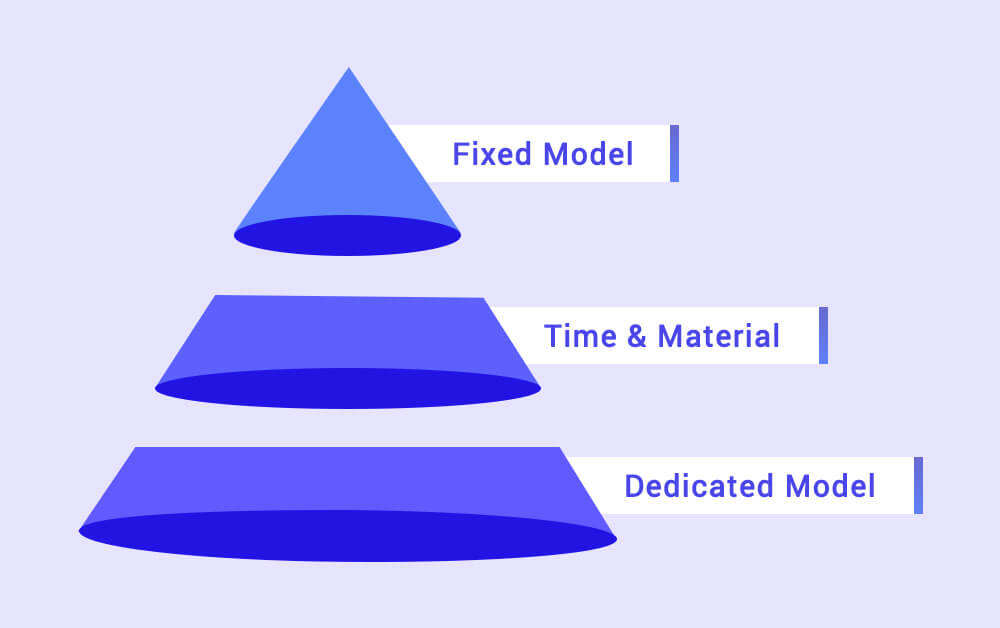
Simply put, an information technology company has several hiring models to engage software programmers or developers. The engagement models in the IT industry are the guidelines that outline the business bond between the service providers and clients.
These models set responsibilities, roles, rules, tasks, payment terms, and regulations along with milestones on both sides. Such factors are finely described in service-level agreements (SLAs).
While for new businesspersons it’s always a question of how to hire remote developers, for seasoned entrepreneurs, engagement models in the IT industry are the best ways to hire software developers for their projects. In other words, it is the budget or expense of the final product including the entire software development life cycle and the time it takes.
Why do engagement models exist?
Business deals cracked verbally don’t carry any value. While it may still work for a very small project and local service provider, if the project is bigger and enterprise-level, it is mandatory to carry out the business deals in a standard way.
That said, top software development company draft various engagement models as per the project types and budgets of their clients. The ultimate aim is to provide the best software application development services at the best prices -whether a small, medium-sized, or large project, the software company shall offer different engagement models so that buyers don’t turn down the deal.
The hiring models offered by a software development company
Another set of software development engagement models depends on various factors such as the time software development takes, the number of software developers needed (or the teams), and the size of the project. In addition to this, the cost to hire remote developers also depends on the engagement model selected, though the amount will be a tentative one based on the skills and experiences of the developers, it will help you have a better idea about the budget required. While buyers can always choose the best model that suits their project, you can always ask the software development outsourcing companies to help you out.
Fixed model
What is a fixed hiring model?
The fixed model is defined according to the time and cost estimates which are again based on the project scope defined by the buyer. This type of project engagement model has defined milestones and the time to deliver them. The specification of the project is defined and the scope is fixed with no chance to change, add, or edit any feature or functionalities whatsoever. The cost and time are fixed and so are the project deliverables.
How does the fixed model work?
When the buyer comes up with RFP documentation that contains specific project scope and defined project objectives, the idea and the concept along with the requirements are then sent to the service provider i.e., the software development company. The business and technology specialists at the software company evaluate and work on the feasibility of the project. Ultimately, they carry out the time and cost estimation that is as accurate as possible. The quote is then sent to the client and upon approval, the project kick-starts.
What are the business benefits of a fixed hiring model?
A fixed hiring model comes with some benefits to business owners. Though the model is not suitable for most projects and is not recommended for long-term and complex project that would require multiple changes while being built, there are still some cases where the fixed model is proposed to buyers. Here are a few benefits –
Minimized risk
No extra expenses
Fixed time and cost
Clear estimation
What are the Disadvantages of a fixed-cost model?
Lack of flexibility
Risk of financial strain
Reduced adaptability
Potential constraints
Difficulty in cutting fixed costs
When is the fixed hiring model the best choice?
You should consider getting a fixed model for your project requirement in these circumstances –
The project scope is defined
Business objectives are specified and clear
No change is expected in features and project scope
Clear deadlines
Limited budget
Technical documents are proper and in place
Time and material model
What is the time and material hiring model?
The time and material model considers the billing based on actual hours spent on software development (manhours that are put into building software products) and the real cost of tools, materials, and equipment used in building a software. Hence, you will be billed utterly for the human hours used exclusively for your project. The hourly rates are applied and all tasks are clearly delivered as per the milestones defined and decided. This model helps you remain flexible in changing the project requirements with time and resources.
How do the time and material engagement model work?
The time and material model is said to work excellently in developing projects on standard technologies such as Ruby on Rails, PHP, .Net, and so on. Especially, when you require to scale up the team for a specific period (generally 3 months) and you don’t have detailed specifications, to begin with, this model suits the best. The size of the team can be changed as per the needs of the work.
What are the business benefits of the time and material model for hiring?
This type of hiring model is a bit higher than the fixed model and hence comes with some more benefits. Here are the benefits that you can expect with the T&M model –
Low cost of software development
Agility of workflow
Flexibility in time and deliverables
Reduced risk of escalation
Flexibility to change or scale the team
Budget-friendly project development
Clear billing – pay as per the use of resources
What are the disadvantages of a time and material model?
Limited cost predictability
Potential for project cost overruns
Less incentive for efficiency and speed
Risk of disputes over billed hours
Complex budget tracking and management
When is the time and material model the best choice?
One should consider the Time & Material engagement model of hiring for the following circumstances –
No detailed project documentation
Insufficient documents and clarity
The project needs constantly evolve or change
Gradual progress is expected
Deadlines are not fixed or expected
Unsure about project scope and features (may change at any time)
Dedicated developer model
What is a dedicated developer or team model for hiring?
If you are confused about when to hire remote developers for a complex project, look no further and go for the dedicated model. The dedicated team model is an offshore software development company’s flagship model. In other words, a dedicated hiring model for developers is the top hiring model that most businesses prefer for their projects.
In this hiring model, specialists and experts from particular technologies become an exclusive part of your project and they work only on it. The billing happens based on the hourly rates of software developers involved in the project. You’ll be billed monthly and for every team member considering the average working hours. Though this is a standard billing type and cycle, different offshore software development companies may have different billing patterns. You need to clarify it before you hire a dedicated developer team.
How does the dedicated team engagement model work?
You need to provide a general idea of your project with preferably the expectations you have from the digital product at the end. The project requirements are roughly said and the service providers shall work on each of your concerns. Software development companies put their hearts and souls into the project by deploying the best resources at the beginning who are experts in the niche or type of project.
Once the feasibility is carried out by the experts at the offshore software development company, the buyers (you) are asked to choose the best talent they want on the floor. Alternatively, you can also have faith in your IT partner and ask them to put their best programmers and designers to do the job. The dedicated team model shall have a supervisor or a team lead and a project manager who serves as one point of contact for you.
What are the business benefits of a dedicated team hiring model?
Several benefits come with a dedicated team engagement model as it is considered the top model for any outsourcing project. You can easily manage a remote development team when you have a dedicated group of tech experts exclusively working on your project.
Total control over the team; in fact, you can build your own team
Scaling up and down the team is possible
No need to observe and worry about the product development process
Flexibility to add, edit, and remove features of the software
You get the cream of the talents on the floor
What are the disadvantages of a dedicated team model?
Continuous fixed resource costs
May lead to the underutilization of resources
Limited flexibility for project scaling
Challenges in managing team dynamics
Dependency on team availability
When is the dedicated team model the best choice?
The dedicated model gives you the best choice to get ultimate talent working on your project, exclusively on your project. You can build an effective software development team as per your choice of remote developers. Here are some circumstances you must consider before going for this model –
The project is well defined
All the project requirements are clear and, on paper
When you want to control the entire team
When you have some technical knowledge and want to drive the project your way
When the project is big, complex, and shouldn’t be having any flaw
When intense research is required, and market impact shall affect your project
Let’s schedule a call to discuss right engagement model for you!
How to select the best hiring model for your project as a business owner?
It is of the utmost importance to select the right engagement model. So, to help you in the quest here are some essential tips to help you select the best engagement model for your development project.
Define Project Goals: Clearly outline your project’s objectives, scope, and expected outcomes.
Assess Project Complexity: Evaluate the complexity of the project, including its size, duration, and technical requirements.
Analyze Budget Constraints: Determine your budget limitations and constraints for the project.
Consider Timeline: Assess the project timeline and delivery deadlines.
Evaluate Resource Needs: Identify the skills and resources required for successful project execution.
Understand Risk Tolerance: Gauge your tolerance for project risks, including cost overruns or delays.
Explore Available Models: Research and understand different project engagement models, such as fixed cost, time and material, dedicated team, or others.
Match Model to Project: Match the project’s characteristics to the most suitable engagement model.
For example:
Choose a fixed-cost model for well-defined, smaller projects with limited budget flexibility.
Opt for time and material for complex, evolving projects with variable scope.
Consider a dedicated team for long-term projects with changing requirements.
Seek Expert Advice: Consult with project management experts or consultants for guidance on model selection.
Review Vendor Experience: Assess vendors’ experience with the chosen model.
Negotiate Terms: Discuss the terms, including pricing and project milestones, with the chosen model in mind.
In a nutshell
Here is a quick view of all the models to refer to. You can decide yourself or can take the help of your IT partner in choosing the model that suits your project and budget.
Particulars
Fixed Price Model
Time and Material
Dedicated Team
Project scope
Small
Medium and large
Large
Project budget and timeframe
Fixed
Flexible
Flexible
Control over the process
Little
Significant
Complete
Requirements
Defined
Evolving
Evolving
Methodology
Waterfall
Agile
Agile/Waterfall
Choose the model wisely, and you are good to go for your final product.
With a deep interest in new technologies, analyzing mobile application trends and impressive technical concoctions keep him inquisitive. In addition to managing the Operations and Delivery of projects at Prismetric, he likes to read and write a lot about the latest in technology. New app technologies, gadget fascinations, and big technology announcements kindle the writer in him spontaneously. His articles are his passion for innovative technologies.