Fine-Tuning vs Prompt Engineering vs RAG: Which Approach Should You Choose for Your LLM?
Key takeaways:
- Prompt engineering improves LLM responses by changing instructions and context without modifying the model’s underlying weights.
- RAG connects an LLM to external knowledge sources, making it suitable for private, frequently updated, or source-backed information.
- Fine-tuning changes model behavior through additional training and works best for consistent outputs, specialized tasks, terminology, and response patterns.
- Most organizations should start with prompt engineering, add RAG when the model lacks necessary knowledge, and consider fine-tuning when behavior remains inconsistent.
- Prompt engineering, RAG, and fine-tuning can also work together in enterprise AI systems that require clear instructions, current knowledge, and specialized behavior.
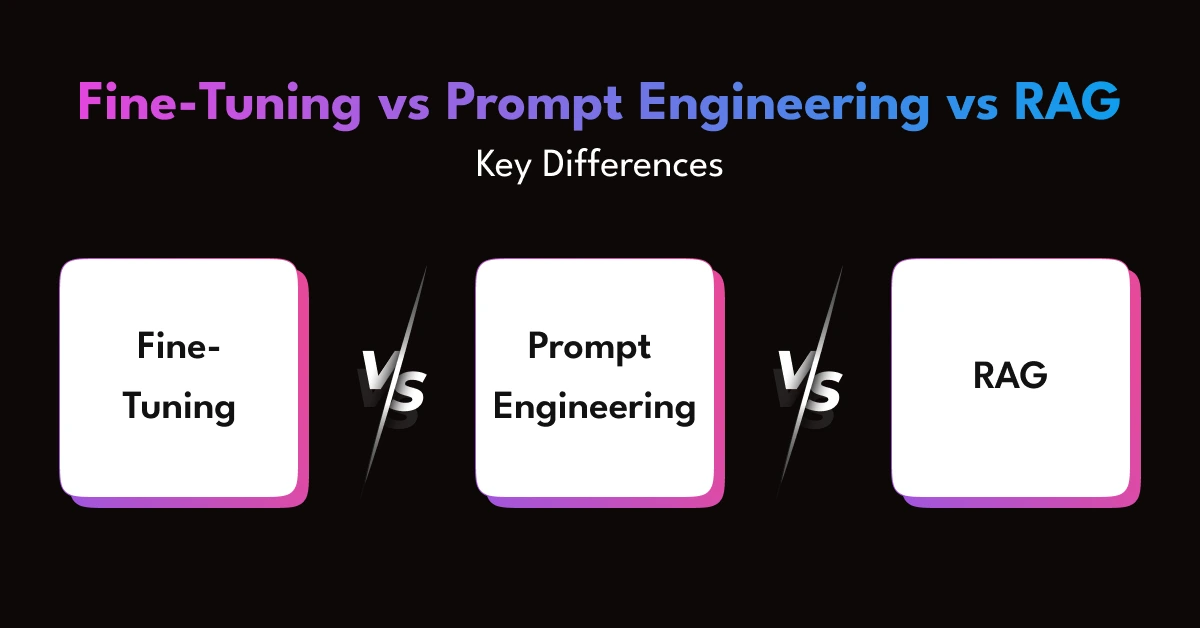
Fine-tuning, prompt engineering, and retrieval-augmented generation (RAG) solve different LLM performance problems. Prompt engineering changes the instructions sent to a model, RAG supplies external knowledge at inference time, and fine-tuning changes the model’s learned behavior by updating its parameters with additional training data.
For most AI applications, prompt engineering is the practical starting point because it requires no model training. RAG becomes useful when an application needs private, frequently changing, or source-backed information. Fine-tuning makes more sense when a model needs consistent behavior, specialized task performance, terminology, style, or output patterns across repeated interactions.
The key question is not simply which technique is better. It is what exactly needs to change: the instructions, the available knowledge, or the model’s behavior?
Fine-Tuning vs Prompt Engineering vs RAG: Quick Comparison
The easiest way to understand fine-tuning vs prompt engineering vs RAG is through an Instructions–Knowledge–Behavior framework:
- Prompt engineering changes instructions: Tell the LLM what task to perform and how the response should look.
- RAG changes available knowledge: Retrieve relevant information from external data sources before the LLM generates an answer.
- Fine-tuning changes learned behavior: Train the model on specialized examples so it becomes more consistent at a particular task.
Here is how the three LLM optimization techniques compare:
| Comparison Factor |
Prompt Engineering |
RAG |
Fine-Tuning |
| What changes? |
Prompt and context |
Information supplied to the model |
Model parameters or selected trainable parameters |
| Model training required? |
No |
No model retraining |
Yes |
| External knowledge access |
Limited to supplied context |
Yes |
Not inherently |
| Best for changing information |
Limited |
Strong fit |
Poor fit for frequently changing facts |
| Implementation effort |
Low |
Medium to high |
Medium to high |
| Output consistency |
Moderate |
Depends on retrieval and prompting |
Can be high for trained behaviors |
| Source citations |
Only when sources are provided |
Can support source-backed answers |
Not inherently |
| Typical use cases |
Formatting, instructions, simple workflows |
Enterprise search, knowledge assistants, document Q&A |
Classification, extraction, style, specialized repetitive tasks |
These approaches are also not mutually exclusive. An enterprise application might use prompt engineering to define the task, RAG to retrieve current company information, and fine-tuning to make model behavior more consistent.
For a deeper two-way evaluation of the knowledge and behavior approaches, see our guide on RAG vs fine-tuning.
Not Sure Whether You Need RAG, Fine-Tuning, or Better Prompts?
Prismetric helps identify whether your AI challenge comes from instructions, missing knowledge, or inconsistent model behavior before you invest in a more complex solution.
Discuss Your LLM Use Case
What Is Prompt Engineering and When Should You Use It?
Prompt engineering is the process of designing instructions, context, examples, and constraints that guide a large language model toward the required output. It changes what the model receives during inference without changing the model’s underlying weights.
A prompt may specify the task, audience, response format, rules, available context, or examples of desired outputs. Techniques such as few-shot prompting can show the model several input-output examples before asking it to complete a similar task.
For example, an organization could instruct an LLM to analyze a customer-support message, classify its intent, return the result as JSON, and follow a predefined output schema. The organization can test and modify that behavior quickly without creating a new training pipeline.
Prompt engineering works particularly well when you need to:
- control response tone, length, structure, or format;
- prototype an AI workflow before investing in more complex architecture;
- provide temporary instructions or task-specific context;
- improve an existing prompt that produces inconsistent or unclear responses;
- generate structured outputs for relatively straightforward tasks.
Prompt engineering has limits. It cannot reliably provide knowledge the model does not have and that you have not supplied in the context. Large, complex prompts can also become difficult to maintain, and instruction quality alone does not guarantee factual accuracy.
Organizations building complex production prompts may therefore need systematic prompt design, testing, evaluation, and guardrails rather than one-time prompt writing.
Working with complex LLM instructions?
Explore how Prismetric’s prompt engineers can help structure, test, and optimize prompts for production AI applications.
What Is RAG and When Should You Use It?
Retrieval-augmented generation, or RAG, allows an LLM to retrieve relevant information from external data sources before generating a response. Instead of relying only on knowledge learned during model training, a RAG system gives the model access to business documents, databases, knowledge bases, policies, product information, or other approved sources at inference time.
A typical RAG workflow follows four steps:
- A user submits a question or request.
- The system searches connected data sources for relevant information.
- The retrieved content is added to the model’s context.
- The LLM generates an answer using both the user query and retrieved information.
Enterprise RAG systems commonly use document processing, embeddings, vector or semantic search, metadata filtering, reranking, and access controls to improve retrieval quality. Organizations can also connect RAG applications with enterprise databases when information is distributed across operational systems. Our guide to integrating LLMs with enterprise databases explains this architecture in more detail.
When should you use RAG?
RAG is generally a strong fit when an AI application must work with private, frequently updated, or source-specific information.
Common use cases include:
- internal employee knowledge assistants;
- customer-support systems using current product documentation;
- document search across policies, contracts, and technical manuals;
- research assistants that need source-backed responses;
- enterprise applications using information that changes more frequently than a model can be retrained.
The main advantage of RAG is that organizations can update the underlying knowledge source without retraining the LLM. RAG can also support citations and traceability when the application retains information about the documents used to produce an answer.
However, RAG introduces its own challenges. Poor retrieval can supply irrelevant or incomplete context, while additional search and reranking steps can increase system latency. Production deployments also need appropriate data pipelines, permissions, monitoring, and evaluation.
Need your LLM to answer using current enterprise information?
Explore Prismetric’s RAG as a Service capabilities for building retrieval-based AI applications.
What Is Fine-Tuning and When Should You Use It?
LLM fine-tuning is the process of training a pre-trained language model on additional examples so it performs a particular task or produces a desired type of response more consistently. Unlike prompt engineering or RAG, fine-tuning changes the model itself by updating its weights or a smaller set of trainable parameters.
A fine-tuning dataset typically contains examples that demonstrate the behavior the organization wants the model to learn. These examples might show how to classify requests, extract specific fields, follow a particular response structure, use specialized terminology, or produce outputs in a consistent style.
Depending on the model and deployment requirements, teams may use full fine-tuning or parameter-efficient fine-tuning techniques such as LoRA, which update a smaller portion of the model rather than retraining every parameter.
When should you fine-tune an LLM?
Fine-tuning is most useful when the challenge involves model behavior rather than access to changing knowledge.
Organizations may consider fine-tuning for:
- repeatable classification or information-extraction tasks;
- specialized terminology and domain-specific language patterns;
- highly consistent output structures;
- recurring task logic demonstrated through high-quality examples;
- applications where smaller specialized models may meet performance requirements.
Fine-tuning is generally not the best solution for keeping an LLM updated with frequently changing facts. Updating policies, inventory, prices, research, or company information through repeated retraining creates unnecessary maintenance. RAG is usually better suited to dynamic knowledge because the data source can change independently of the model.
Fine-tuning also requires carefully prepared training data, model evaluation, infrastructure, and ongoing monitoring. Poor-quality examples can teach undesirable behaviors, which makes dataset quality as important as the training technique itself.
If consistent model behavior is the bigger challenge
explore Prismetric’s LLM fine-tuning services for task-specific model customization.
Fine-Tuning vs Prompt Engineering vs RAG: 10 Key Differences
The main difference between prompt engineering, RAG, and fine-tuning is what each approach changes. Prompt engineering changes the instructions given to the model, RAG changes the information available during inference, and fine-tuning changes the model’s learned behavior. That distinction affects cost, data requirements, latency, maintenance, accuracy, and enterprise suitability.
| Factor |
Prompt Engineering |
RAG |
Fine-Tuning |
| What changes |
Instructions and context |
Retrieved knowledge |
Model weights or trainable parameters |
| Current knowledge |
Only what is placed in the prompt |
Can retrieve updated information |
Requires new training to incorporate changes reliably |
| Training data |
Usually not required |
Requires accessible knowledge sources |
Requires curated training examples |
| Implementation effort |
Lowest |
Requires retrieval infrastructure |
Requires training and evaluation pipelines |
| Output consistency |
Depends heavily on prompt quality |
Depends on prompting and retrieved context |
Can improve consistency for trained behaviors |
| Citations |
Possible when sources are supplied |
Well suited to source-backed responses |
Does not inherently provide sources |
| Latency |
Usually lowest |
Retrieval can add response time |
Depends on the deployed model |
| Updating the system |
Modify the prompt |
Update documents or databases |
Retrain or fine-tune again |
| Best problem to solve |
Instruction problem |
Knowledge problem |
Behavior problem |
| Enterprise complexity |
Relatively low |
Data, access, retrieval, and monitoring layers |
Dataset preparation, training, evaluation, and deployment |
Cost also differs by architecture. Prompt engineering generally requires the least initial engineering effort, while RAG introduces retrieval and data infrastructure. Fine-tuning adds dataset preparation and training costs. Actual expenditure depends on model choice, traffic, context size, infrastructure, and deployment strategy, so organizations should evaluate total lifecycle cost rather than comparing training expense alone.
For teams planning a broader LLM architecture, understanding the appropriate tech stack for LLM application development can help clarify how retrieval, model serving, databases, evaluation, and application layers work together.
Build the Right LLM Architecture for Your Business
Combine prompt engineering, RAG, and fine-tuning where needed to create AI systems with current knowledge, consistent behavior, and reliable outputs.
Talk to Our LLM Experts
How Do You Choose Between Prompt Engineering, RAG, and Fine-Tuning?
Choose the least complex approach that solves the measured problem. Start with prompt engineering when better instructions can produce the required result. Add RAG when the model lacks necessary information. Consider fine-tuning when repeated evaluations show that the model’s behavior remains inconsistent even with well-designed prompts and sufficient context.
A practical decision framework looks like this:
Choose prompt engineering when the model knows enough but needs clearer instructions
Use prompt engineering when you need to change how the model responds, such as response structure, tone, task steps, or output format.
Before building additional infrastructure, test whether stronger prompts, examples, constraints, and evaluation criteria solve the problem.
Choose RAG when the model needs information it does not reliably have
Use RAG when answers depend on private, current, frequently changing, or source-specific knowledge.
Examples include employee policies, product documentation, customer records, technical manuals, research libraries, and enterprise databases.
When planning retrieval architecture, teams should also consider data permissions, ingestion pipelines, retrieval quality, and system integration. These requirements often make AI integration services relevant to production deployment.
Choose fine-tuning when the behavior needs to become more specialized
Fine-tuning is appropriate when high-quality examples can demonstrate the behavior you repeatedly need, such as classification patterns, specialized extraction, structured responses, or domain-specific communication.
Do not fine-tune simply because an initial prompt performs poorly. First determine whether the problem comes from instructions, missing knowledge, model capability, or behavior. An AI model testing process can help teams measure these differences before choosing a customization strategy.
For more complex enterprise applications, AI consulting services can also help evaluate whether prompt engineering, RAG, fine-tuning, or a combination provides the most practical architecture.
Can You Combine Prompt Engineering, RAG, and Fine-Tuning?
Yes. Prompt engineering, RAG, and fine-tuning can work together because they solve different problems. Prompt engineering controls instructions, RAG supplies external knowledge, and fine-tuning improves recurring model behavior. A production AI system may use all three when one method alone cannot meet requirements.
For example, an enterprise support assistant could use RAG to retrieve current policies, a fine-tuned model to follow a consistent response pattern, and prompts to define the task and output format.
Common combinations include:
- Prompt engineering + RAG: For clear instructions plus current enterprise knowledge.
- Prompt engineering + fine-tuning: For specialized behavior without external retrieval.
- RAG + fine-tuning + prompting: For grounded knowledge and consistent task behavior.
Organizations building such architectures may use generative AI development services to connect models, retrieval systems, applications, evaluation, and governance controls.
Which Approach Fits Common Enterprise AI Use Cases?
The right approach depends on whether the requirement is better instructions, knowledge access, or model behavior.
| Enterprise Use Case |
Recommended Approach |
| Content drafting and formatting |
Prompt engineering |
| Internal knowledge assistant |
RAG + prompt engineering |
| Document classification or extraction |
Fine-tuning or prompting |
| Customer support assistant |
RAG + prompting; fine-tuning when needed |
| Policy or compliance assistant |
RAG with citations and human review |
| Specialized repetitive workflow |
Fine-tuning + prompt engineering |
For production deployment, AI implementation services can help connect the selected approach with existing systems, security, monitoring, and operational workflows.
Validate Your LLM Approach Before Full-Scale Development
Prismetric can build a focused AI PoC to test prompts, retrieval quality, fine-tuning needs, accuracy, cost, and production feasibility.
Start Your AI PoC
How Can Prismetric Help You Choose and Implement the Right LLM Approach?
Prismetric helps businesses evaluate whether prompt engineering, RAG, fine-tuning, or a hybrid approach fits their AI use case. Its AI portfolio includes LLM development, RAG, LLM fine-tuning, AI consulting, data engineering, and AI integration services.
The team can support the implementation journey from defining requirements and preparing enterprise data to designing prompts, building retrieval pipelines, fine-tuning models, integrating AI with existing systems, and preparing solutions for production.
For enterprises, the right architecture depends on factors such as data freshness, response consistency, security, integration requirements, scalability, and operating cost. Prismetric can help teams assess these trade-offs before committing to a more complex approach.
Prismetric also provides AI PoC, AI MVP, and AI implementation services, helping organizations move from early validation to deployment.
FAQs About RAG, Fine-Tuning, and Prompt Engineering
No. RAG is generally better for changing or private knowledge, while fine-tuning is better for specialized, repeatable behavior. The choice depends on why the model is underperforming.
Not always. RAG supplies missing knowledge but does not retrain model behavior. Fine-tuning may still help when classification, extraction, style, or task patterns require greater consistency.
Usually, yes. Prompt engineering is faster to test and requires no model training. If strong prompts and sufficient context still produce inconsistent behavior, fine-tuning becomes easier to justify.
Yes. RAG can supply current knowledge while fine-tuning improves task behavior, making the combination useful when applications need both grounded information and consistency.