“Working with Prismetric was a straightforward experience from day one. Their staff understood what we wanted to create and helped turn our idea into a practical AI product. They kept us informed, responded promptly, and handled every stage professionally. The solution matched our business needs well, and I would happily work with their team again.”
Marc De Chellis
Product Director- Launchpad Apps
“We had a positive experience with Prismetric while developing our AI product. Their team was professional, responsive, and willing to share ideas that improved the outcome. Communication was clear, deadlines were handled well, and the project stayed on track. They made things easy for our team, and we would gladly work with Prismetric on projects.”
Richard Tellier
President TellAText LLC
“Prismetric did a great job from planning through delivery. Their team understood the project, communicated well, and kept things moving without making the process complicated. They were reliable, easy to work with, and paid attention to the details. I would recommend them to anyone looking for a dependable team for AI development and product work.”
Curt Hayes
President Audio Design Inc
“Prismetric made the development process easy to understand from the beginning. Their team kept us updated, answered questions quickly, and handled changes without confusion. They were professional, helpful, and focused on making sure it worked properly. I was happy with how the AI project turned out and would gladly work with them again in future.”
Table of Contents
LLM Development Cost in 2026: Custom LLM Pricing Guide
Large language models are changing how businesses build software, automate work, serve customers, analyze documents, and use internal knowledge. But one question still controls every serious AI conversation: how much does LLM development cost in 2026?
Let’s get straight to the point.
The cost to develop an LLM solution in 2026 usually ranges from $15,000 to $500,000+, depending on what you want to build, how much customization you need, the model approach you choose, the quality of your data, and the level of security, integration, and scalability your business requires.
A basic LLM-powered chatbot or API-based assistant can start from $15,000 to $50,000. A custom RAG-based knowledge assistant can cost between $50,000 and $150,000. A fine-tuned enterprise LLM application can move from $100,000 to $300,000+. A fully custom-trained proprietary LLM can go beyond $500,000, especially when the project needs large-scale data preparation, GPU infrastructure, AI research, privacy controls, compliance, and long-term model operations.
That is a wide range. And there is a reason behind it.
Building an LLM solution is not like buying a fixed software package. It is more like building an intelligent business engine. A simple customer support chatbot and a private enterprise LLM trained for legal, healthcare, finance, or logistics workflows may both use large language models, but their development effort, risk, infrastructure, and cost are completely different.
The real LLM development cost depends on the answer to a few important questions.
Do you want to use an existing model through an API?
Do you want to fine-tune an open-source model on your business data?
Do you need a RAG system connected to your documents, CRM, ERP, or internal tools?
Do you need a private deployment because your data cannot leave your environment?
Do you need compliance with HIPAA, GDPR, SOC 2, PCI-DSS, or industry-specific regulations?
Do you want a simple AI assistant, a full LLM-powered product, or an enterprise-grade AI platform?
Each choice changes the cost.
This guide breaks down the LLM development cost in 2026 with practical pricing ranges, cost-driving factors, hidden expenses, development stages, optimization strategies, monetization models, and examples of what different LLM solutions may cost.
The average LLM development cost in 2026 ranges from $15,000 to $500,000+, depending on model approach, features, data requirements, integrations, compliance, and deployment complexity.
A basic API-based LLM application costs less because it uses existing models like GPT, Claude, Gemini, DeepSeek, or Llama through API integration.
A custom RAG-based LLM application costs more because it connects the model with business documents, databases, knowledge bases, CRMs, ERPs, and other internal systems.
Fine-tuning an open-source LLM can cost between $80,000 and $300,000+, mainly because of data preparation, model training, testing, evaluation, deployment, and LLMOps.
Training a proprietary LLM from scratch is the most expensive option and usually makes sense only for large enterprises, AI-first companies, research teams, or businesses with massive proprietary datasets.
Data preparation can take a major share of the total budget because raw business data often needs cleaning, labeling, formatting, deduplication, validation, and governance before it can be used in an LLM system.
Monthly running costs are just as important as development costs. API usage, vector database storage, cloud hosting, monitoring, retraining, prompt optimization, and model updates can add $500 to $50,000+ per month, depending on scale.
The right LLM development partner helps you choose the most cost-effective path instead of overbuilding from day one.
Prismetric helps businesses build practical LLM solutions that move beyond AI experiments and work inside real business workflows, from strategy and MVP development to integration, deployment, and post-launch optimization.
Table of Contents
How Much Does LLM Development Cost in 2026?
The cost to develop an LLM solution in 2026 can range from $15,000 for a basic AI assistant to $500,000+ for a custom enterprise-grade LLM system.
Most businesses do not need to train a large language model from scratch. They need a smart, secure, and scalable application built around an existing model. This may include API integration, prompt engineering, retrieval augmented generation, workflow automation, user interface development, backend architecture, analytics, access control, and third-party integrations.
That is why the cost of LLM development depends more on the business use case than the model alone.
Here is a quick cost overview.
LLM Solution Type
Estimated Development Cost
Estimated Timeline
Best For
Basic API-Based LLM Chatbot
$15,000 – $50,000
4 – 8 weeks
FAQs, simple support automation, basic internal assistant
LLM-Powered MVP
$30,000 – $80,000
6 – 12 weeks
Startups testing AI product ideas
RAG-Based Knowledge Assistant
$50,000 – $150,000
8 – 16 weeks
Internal document search, enterprise knowledge tools, support copilots
LLM App with Workflow Automation
$80,000 – $200,000
3 – 5 months
Business process automation, CRM/ERP-connected AI tools
AI agents, task automation, decision support, enterprise copilots
Custom-Trained Proprietary LLM
$500,000 – $1,500,000+
9 – 18+ months
Large enterprises, AI labs, highly specialized proprietary models
These are practical market ranges. Your actual custom LLM development cost can be lower or higher based on the scope, data quality, required accuracy, number of users, model hosting method, infrastructure, security needs, and ongoing support plan.
Think of LLM development like building a digital brain for your business.
A small assistant that answers FAQs is like a single-purpose tool. It needs a clean interface, model API integration, prompt design, and basic deployment.
A RAG-based enterprise assistant is more advanced. It needs document ingestion, vector search, user authentication, role-based permissions, source citation, feedback loops, and integration with company systems.
A fine-tuned LLM solution is even deeper. It needs training data, labeling, model adaptation, evaluation, performance testing, hosting, monitoring, and retraining workflows.
A custom-trained LLM is a serious AI infrastructure project. It needs data pipelines, AI researchers, ML engineers, GPU clusters, governance frameworks, security controls, and long-term operational investment.
That is why one LLM application may cost $25,000 while another may cross $500,000.
Quick Formula to Estimate LLM Development Cost
A simple way to estimate LLM development cost is:
LLM Development Cost = Development Hours × Hourly Rate + Infrastructure Cost + Model Usage Cost + Data Preparation Cost + Maintenance Cost
For example, if your LLM project needs 1,200 development hours and your development partner charges $40 per hour, the engineering cost alone will be:
1,200 × $40 = $48,000
But that is not your final project cost.
You also need to add:
Data cleaning and preparation
UI/UX design
Backend development
LLM API usage or model hosting
Vector database setup
Cloud infrastructure
Security and access control
Testing and quality assurance
Deployment
Monitoring and maintenance
So, a project that looks like a $48,000 engineering build can easily become a $70,000 to $120,000 production-ready LLM application once the full scope is included.
That is why businesses should not look at LLM pricing only through hourly development cost. They should look at the full cost of ownership.
LLM Development Cost by Approach
The biggest cost decision is not the design. It is not even the number of screens.
The biggest cost decision is the LLM approach.
You can build an LLM solution in four common ways: API integration, RAG implementation, fine-tuning, or custom model training.
Each approach has a different budget, timeline, risk level, and business fit.
LLM Development Approach
What It Means
Estimated Cost
Best Fit
API-Based LLM Development
You use an existing hosted model through APIs and build custom workflows around it.
$15,000 – $80,000
Startups, MVPs, chatbots, fast launches
RAG-Based LLM Development
You connect the LLM with your business documents, databases, and knowledge sources.
$50,000 – $150,000
Internal knowledge assistants, support tools, enterprise search
Fine-Tuned LLM Development
You adapt an open-source or existing model using your domain-specific data.
You train a proprietary model from scratch or near-scratch using large datasets.
$500,000 – $1,500,000+
AI-first enterprises, research-heavy products, proprietary model ownership
1. API-Based LLM Development Cost
API-based LLM development is the fastest and most affordable way to build an LLM-powered application.
In this approach, your application connects with a hosted model such as GPT, Claude, Gemini, Llama, Mistral, or DeepSeek through APIs. You do not train the model. You build the product layer around it.
This product layer may include:
User interface
Chat workflow
Prompt engineering
Authentication
Admin dashboard
Usage analytics
Payment integration
Basic memory
Business logic
API integration
Cloud deployment
The cost of API-based LLM development usually ranges from $15,000 to $80,000.
This approach works best when you want to launch quickly, test an AI product idea, build a chatbot, automate simple support tasks, or add generative AI features to an existing product.
It reduces upfront cost because the model provider handles the training, hosting, scaling, and model updates. But you still need to plan for monthly API usage costs. The more users and queries your app handles, the higher your token usage becomes.
2. RAG-Based LLM Development Cost
RAG-based LLM development costs more than basic API integration because the model does not answer from general knowledge alone. It retrieves information from your business data before generating a response.
RAG stands for retrieval augmented generation.
In simple words, it helps the LLM answer questions using your documents, files, manuals, policies, product catalogs, support tickets, contracts, reports, or internal knowledge base.
A RAG-based LLM system usually includes:
Document ingestion
Data parsing and chunking
Vector database setup
Embedding model integration
Search and retrieval pipeline
Source-based response generation
User access control
Feedback system
Admin panel
Monitoring and optimization
The cost of RAG-based LLM development usually ranges from $50,000 to $150,000.
This approach is ideal for businesses that want to build internal knowledge assistants, enterprise search tools, customer support copilots, legal document assistants, healthcare knowledge tools, HR policy bots, or product documentation assistants.
RAG often gives businesses the best balance between cost, accuracy, and control. You do not have to train a model from scratch, but you can still make the LLM work with your private business knowledge.
3. Fine-Tuned LLM Development Cost
Fine-tuning means taking an existing model and training it further on your business-specific or industry-specific data.
This approach helps when a general-purpose model cannot understand your domain language, output format, tone, terminology, or task requirements with enough accuracy.
The cost goes up because fine-tuning needs more than model access. It needs clean training data, annotation, model selection, training runs, evaluation, prompt testing, safety checks, deployment, and ongoing monitoring.
Fine-tuning can reduce long-term inference cost in some cases because smaller specialized models may perform well on narrow tasks. But it is not always the right first step.
For many businesses, the smarter path is to start with API integration or RAG, test real usage, measure accuracy, and then fine-tune when the ROI becomes clear.
4. Custom-Trained LLM Development Cost
Custom-trained LLM development is the most expensive path.
In this approach, you build or train a proprietary language model using large-scale data, advanced infrastructure, and a specialized AI team. This option gives the highest level of control, but it also demands the highest investment.
A custom-trained LLM may require:
Massive datasets
Data licensing
Data cleaning and deduplication
Tokenization
Model architecture planning
GPU clusters
Distributed training
AI research expertise
Model evaluation
Safety testing
Bias testing
Security governance
Deployment infrastructure
LLMOps and monitoring
The cost can start from $500,000 and move beyond $1.5 million, depending on model size, training data, infrastructure, research effort, and production requirements.
Most startups and mid-sized businesses do not need this approach. It usually fits large enterprises, AI-first platforms, research-driven companies, or organizations that need full model ownership for strategic, regulatory, or competitive reasons.
For most business use cases, a well-designed RAG system or fine-tuned open-source model delivers better value at a lower cost.
Want a More Accurate LLM Development Cost Estimate?
Every LLM idea has a different cost path.
A customer support chatbot, a legal AI assistant, a healthcare documentation tool, an internal knowledge copilot, and a multi-agent enterprise automation platform all need different architecture, data pipelines, integrations, security layers, and maintenance plans.
Prismetric helps businesses estimate the right LLM development budget by studying the use case, users, data readiness, workflows, compliance needs, and long-term scaling plan.
Share your LLM idea with our AI experts and get a practical development roadmap with cost, timeline, team, and technology recommendations.
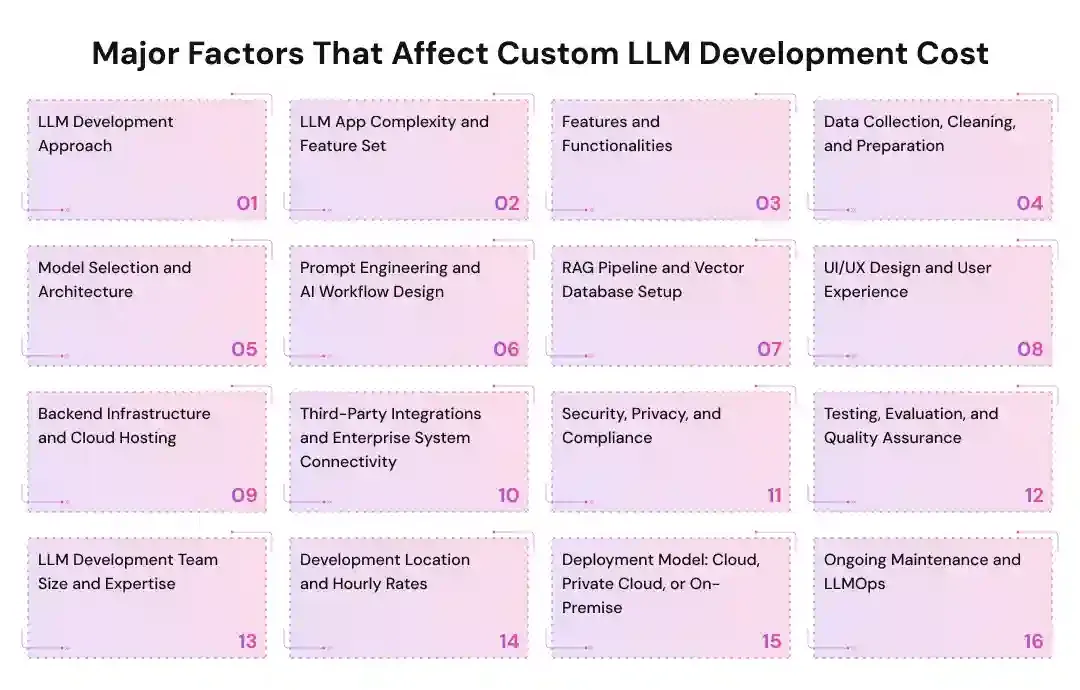
Major Factors That Affect Custom LLM Development Cost
The custom LLM development cost does not depend on one single factor. It depends on a combination of model choice, business logic, data quality, app complexity, infrastructure, integrations, security, and long-term usage.
Two businesses may ask for an “LLM chatbot,” but their final cost can be completely different.
One may need a basic website chatbot that answers FAQs using a hosted model API. Another may need a secure enterprise assistant that reads internal documents, connects with CRM and ERP systems, follows role-based access rules, generates reports, supports multiple departments, and runs inside a private cloud environment.
Both are LLM-powered applications. But they do not need the same budget.
That is why every accurate LLM pricing estimate starts with the scope.
Here are the key factors that affect LLM development cost in 2026.
1. LLM Development Approach
The approach you choose has the biggest impact on your LLM development cost.
You can build an LLM solution in different ways. You can integrate an existing model API. You can build a RAG-based system. You can fine-tune an open-source model. Or you can train a custom LLM from scratch.
Each path gives you a different level of speed, control, accuracy, scalability, and cost.
LLM Development Approach
Cost Impact
Estimated Cost Range
Best For
API-Based LLM Integration
Low to Moderate
$15,000 – $80,000
MVPs, chatbots, AI assistants, quick product launches
Proprietary AI models, AI-first platforms, large enterprises
API integration costs less because you do not train or host the base model. You build the app layer, connect the model, design prompts, create workflows, and manage user experience.
RAG development costs more because your app needs a retrieval pipeline. It must collect, process, embed, store, retrieve, and pass relevant business data to the model before generating a response.
Fine-tuning costs even more because your team must prepare training data, run model training, test output quality, monitor performance, and deploy the tuned model.
Custom LLM training is the most expensive because you need huge datasets, AI researchers, ML engineers, GPU clusters, safety testing, and long-term LLMOps.
So, before you ask, “What is the cost to build an LLM application?” ask a better question first:
Which LLM development approach does my business actually need?
For most startups and mid-sized businesses, API-based LLM development or RAG-based LLM development gives the best balance between budget and value.
For businesses with strict domain needs, fine-tuning can be a smart next step.
For enterprises with massive proprietary data and long-term AI ownership goals, custom LLM training may make sense.
2. LLM App Complexity and Feature Set
Complexity is the heart of LLM app development cost.
A simple LLM app may only need one chat interface and one model API. A complex LLM platform may need multi-user access, document upload, RAG, workflow automation, analytics, admin controls, human review, API integrations, and compliance-ready logs.
The more your LLM application has to do, the more time your team needs to design, develop, test, and deploy it.
Here is how complexity affects the custom LLM development cost.
Complexity Level
What It Includes
Estimated Cost
Estimated Timeline
Basic LLM App
Chat interface, API integration, simple prompts, basic admin, cloud deployment
$15,000 – $50,000
4 – 8 weeks
Moderate LLM App
User login, role-based access, RAG, document upload, analytics, dashboard
An enterprise-grade LLM platform needs the highest budget.
It may include:
Fine-tuned model
Private deployment
Multi-agent architecture
High-volume usage support
Enterprise security
Compliance workflows
Audit trails
Monitoring and retraining
SLA-based support
The rule is simple.
The more intelligence, automation, privacy, and scale you want, the higher your LLM development cost becomes.
3. Features and Functionalities
Features decide how useful your LLM solution becomes. They also decide how much effort your development team needs.
A basic chatbot with predefined prompts costs much less than an LLM-powered enterprise copilot that summarizes documents, retrieves knowledge, drafts emails, updates CRM records, creates reports, and triggers workflows.
Every feature adds design time, backend logic, testing, and integration effort.
Here is a quick feature-wise LLM app development cost breakdown.
Feature Type
Examples
Estimated Cost Range
Basic Features
Chat UI, prompt templates, login, simple dashboard, conversation history
$5,000 – $25,000
RAG Features
Document upload, vector search, embeddings, source citation, knowledge base sync
Some features look simple from the outside but need deep engineering behind the scenes.
For example, “upload documents and ask questions” may sound easy. But a production-ready document intelligence system needs file parsing, text extraction, chunking, embedding, vector indexing, retrieval logic, source tracking, access control, and response validation.
That is why feature planning matters.
Start with the features your users need immediately. Then add advanced features after your first version proves value.
This approach keeps your LLM pricing realistic and protects your budget from unnecessary scope expansion.
4. Data Collection, Cleaning, and Preparation
Data can make or break your LLM project.
A large language model can only perform well when it receives the right context, clean data, and clear instructions. If your business data is messy, outdated, duplicated, scattered, or poorly structured, your LLM application will produce weak results.
That is why data preparation is one of the biggest cost drivers in custom LLM development.
Your team may need to collect, clean, label, structure, and validate data before using it in a RAG system, fine-tuned model, or custom-trained LLM.
Data preparation may include:
Collecting business documents
Removing duplicate files
Cleaning incomplete records
Converting PDFs, images, and scanned documents into usable text
Labeling data
Structuring data into categories
Removing sensitive information
Creating training datasets
Creating test datasets
Checking data quality
Preparing domain-specific examples
Building knowledge graphs or metadata layers
Here is how data complexity affects LLM development cost.
Data Readiness Level
What It Means
Cost Impact
Clean and Structured Data
Data is ready in organized files, databases, or APIs
Low
Semi-Structured Data
Data exists in PDFs, spreadsheets, docs, emails, tickets, and reports
Moderate
Unstructured Data
Data is scattered, messy, duplicated, incomplete, or inconsistent
High
Regulated or Sensitive Data
Data includes healthcare, finance, legal, insurance, or personal information
Very High
Large-Scale Training Data
Data needs labeling, validation, filtering, and preparation for model training
Very High
For a basic API-based LLM app, data preparation may cost $2,000 to $10,000.
For a RAG-based LLM application, it may cost $10,000 to $60,000.
For a fine-tuned or enterprise LLM solution, data preparation can cost $50,000 to $200,000+, depending on quality, volume, domain, and compliance.
Businesses often underestimate this part.
They assume the model will understand everything once they connect it to their documents. But that rarely happens in production.
Your LLM needs clean context. It needs the right chunk size. It needs metadata. It needs retrieval rules. It needs access permissions. It needs evaluation data. It needs continuous updates.
If you skip data preparation, you may save money in the beginning but lose far more later through inaccurate answers, poor adoption, compliance risks, and rework.
5. Model Selection and Architecture
The model you choose directly affects LLM development cost, performance, privacy, and long-term scalability.
You can choose a closed-source hosted model, an open-source model, a small language model, a multimodal model, or a custom architecture.
Each option has trade-offs.
Model Option
Cost Impact
Pros
Cons
Hosted API Model
Low upfront cost
Fast setup, high performance, no hosting burden
Ongoing token cost, vendor dependency
Open-Source Model
Moderate to High
More control, private hosting, customization
Needs infrastructure and ML expertise
Fine-Tuned Model
High
Better domain accuracy, custom behavior
Needs training data and evaluation
Small Language Model
Moderate
Lower hosting cost, faster inference
Limited reasoning capability
Multimodal Model
High
Handles text, image, audio, or video inputs
Higher integration and processing cost
Custom-Trained Model
Very High
Full ownership and control
Expensive, complex, resource-heavy
Hosted models are best when speed matters. They help you launch faster and reduce upfront investment.
Open-source models are useful when you want more control over data, deployment, and cost. They also help when you need private infrastructure.
Fine-tuned models work well when your business needs domain-specific accuracy.
Small language models can reduce inference cost when your use case is narrow and repetitive.
Multimodal models cost more because they process different types of input such as text, images, audio, scanned documents, forms, or video.
Custom-trained models need the biggest investment but give full ownership.
Choosing the wrong model can increase both development and operating costs. A powerful model may look attractive, but you may not need it for every task. A smaller model with a strong RAG pipeline may deliver better value for many enterprise use cases.
That is why Prismetric focuses on matching the model with the business goal, not just choosing the most popular LLM.
6. Prompt Engineering and AI Workflow Design
Prompt engineering is not just writing a few instructions.
In production LLM applications, prompt engineering controls how the model behaves, what tone it uses, what information it considers, what format it follows, and when it should avoid answering.
A simple prompt may work for a demo. A business-ready LLM system needs tested, versioned, and optimized prompts.
Prompt engineering may include:
System prompts
User prompts
Prompt templates
Few-shot examples
Role-based prompts
Guardrail prompts
Output formatting
Function calling instructions
Retrieval prompts
Error-handling prompts
Escalation instructions
Safety instructions
The cost of prompt engineering depends on how complex the workflow is.
Prompt and Workflow Complexity
Estimated Cost
Basic prompt setup
$1,000 – $5,000
Structured prompt templates
$5,000 – $15,000
Role-based prompt flows
$10,000 – $30,000
RAG prompt optimization
$15,000 – $50,000
Multi-agent workflow design
$30,000 – $100,000+
Prompt engineering becomes more expensive when the LLM has to follow business rules, use tools, call APIs, retrieve documents, generate structured outputs, or work across multiple steps.
For example, a sales assistant may need to qualify leads, check CRM data, draft follow-up emails, assign lead scores, and update the pipeline.
That is not a single prompt. That is an AI workflow.
Good workflow design reduces hallucination, improves reliability, and makes your LLM application useful in real operations.
7. RAG Pipeline and Vector Database Setup
RAG development cost is one of the most important parts of modern LLM pricing.
RAG helps your LLM answer using your business knowledge instead of relying only on general training data. This improves accuracy, reduces hallucination, and helps users trust the output.
But a strong RAG system needs more than document upload.
It needs a complete retrieval pipeline.
A RAG pipeline may include:
Data ingestion
File parsing
Text extraction
Chunking strategy
Embedding model setup
Vector database setup
Metadata tagging
Hybrid search
Reranking
Context retrieval
Source citation
Permission-based access
Feedback loop
Retrieval performance monitoring
Here is a quick RAG development cost breakdown.
RAG Component
Estimated Cost Range
Basic document ingestion
$5,000 – $15,000
Vector database setup
$5,000 – $20,000
Embedding and retrieval pipeline
$10,000 – $40,000
Source citation and answer grounding
$8,000 – $25,000
Role-based document access
$15,000 – $50,000
Advanced search and reranking
$20,000 – $70,000
RAG monitoring and optimization
$10,000 – $40,000
A simple RAG system can work well for small knowledge bases.
But enterprise RAG systems need more control. They need to understand who can access which documents. They need to update knowledge automatically. They need to show sources. They need to handle conflicting information. They need to reject questions outside the approved knowledge base.
That is why RAG is often the best middle path between basic API integration and expensive fine-tuning.
It gives businesses more accurate answers without the heavy cost of training a custom model.
8. UI/UX Design and User Experience
The user interface also affects LLM application development cost.
A basic chat window costs less. A full AI product with dashboards, document management, team workspaces, analytics, admin controls, and workflow screens costs more.
Good UI/UX design matters because users do not interact with the model directly. They interact with the product experience around the model.
A strong LLM interface helps users:
Ask better questions
Upload files easily
See cited sources
Review AI responses
Approve or reject outputs
Edit generated content
Track history
Share results
Manage settings
Understand confidence levels
Here is how UI/UX complexity affects the cost to build an LLM application.
UI/UX Complexity
What It Includes
Estimated Cost
Basic Chat UI
Simple chat screen, input box, response area, conversation history
$3,000 – $10,000
Product-Level UI
Dashboard, user profiles, saved chats, file upload, settings
$10,000 – $35,000
Enterprise UI
Admin panel, permissions, analytics, team spaces, audit views
$35,000 – $80,000
Advanced AI Interface
Human review, source comparison, workflow builder, multi-agent task view
$60,000 – $150,000+
A polished interface is especially important for enterprise users.
If the app looks confusing, users will not trust it. If responses lack context, users will not adopt it. If the workflow slows them down, they will return to old tools.
That is why UI/UX is not just a design cost. It is an adoption cost.
A well-designed LLM application makes AI easier to use, easier to trust, and easier to scale across teams.
9. Backend Infrastructure and Cloud Hosting
The backend is where your LLM application becomes production-ready.
A demo can run with basic infrastructure. A business-ready LLM application needs secure APIs, databases, user management, model orchestration, logging, monitoring, analytics, and scalable cloud deployment.
Backend development may include:
Application server
User authentication
Role-based access
Database setup
API gateway
Model orchestration layer
Prompt management
Conversation memory
File storage
Vector database
Queue management
Logging
Analytics
Monitoring
Deployment pipeline
Backup and recovery
The more users, data, workflows, and integrations your app needs, the higher your backend cost becomes.
Backend Complexity
Estimated Development Cost
Monthly Infrastructure Cost
Basic Backend
$10,000 – $30,000
$300 – $2,000
Moderate Backend
$30,000 – $80,000
$1,000 – $7,000
Advanced Backend
$80,000 – $180,000
$5,000 – $20,000
Enterprise Backend
$180,000 – $400,000+
$15,000 – $50,000+
Monthly infrastructure cost depends on model choice, traffic, storage, token usage, vector database size, hosting method, and monitoring requirements.
If you use a hosted LLM API, your monthly cost may depend on token consumption.
If you host an open-source model, your monthly cost may include GPU servers, inference optimization, storage, monitoring, and DevOps support.
If you need high availability, disaster recovery, private cloud, or multi-region deployment, your infrastructure cost increases further.
This is why businesses should estimate both upfront development cost and ongoing operational cost before starting an LLM project.
10. Third-Party Integrations and Enterprise System Connectivity
LLM applications become more valuable when they connect with real business systems.
A standalone chatbot can answer questions. An integrated LLM assistant can perform work.
It can fetch customer records from a CRM. It can create support tickets. It can summarize meetings. It can check inventory. It can update project tasks. It can draft reports from ERP data. It can trigger workflows across departments.
But every integration adds cost.
Common LLM integrations include:
CRM systems
ERP systems
HRMS platforms
LMS platforms
Ticketing tools
Email systems
Calendar tools
Payment gateways
Document management systems
Cloud storage
Data warehouses
BI tools
Communication platforms
Internal APIs
Here is how integrations affect LLM development pricing.
Integration Type
Examples
Estimated Cost
Basic API Integration
Email, calendar, payment, simple third-party APIs
$5,000 – $20,000
Business Tool Integration
CRM, HRMS, LMS, support desk, project tools
$15,000 – $60,000
Enterprise System Integration
ERP, data warehouse, legacy systems, private APIs
$50,000 – $150,000+
Multi-System Workflow Integration
Cross-platform automation, AI agents, approval flows
$100,000 – $300,000+
Integrations become expensive when systems are old, poorly documented, or heavily customized.
Legacy systems often need special connectors, middleware, data mapping, error handling, and security checks.
AI agents also increase integration complexity because they do not just retrieve data. They take actions. That means the development team must build safeguards, permissions, approvals, rollback logic, and audit trails.
The more your LLM application connects with the business, the more valuable it becomes.
But the more it connects, the more carefully it must be engineered.
11. Security, Privacy, and Compliance
Security is not optional in LLM development.
LLM applications often work with sensitive business data, customer records, employee information, financial documents, legal files, medical data, or proprietary knowledge. If your AI system exposes the wrong information, the business risk can be serious.
That is why security and compliance can significantly increase the cost of custom LLM development.
FinTech products may need PCI-DSS, SOC 2, data encryption, access control, and audit logs.
Legal tech platforms may need strict document confidentiality.
Enterprise SaaS platforms may need GDPR, SOC 2, ISO, or internal governance support.
Here is a quick cost overview.
Security and Compliance Level
Estimated Cost Impact
Basic Security
$5,000 – $20,000
Role-Based Access and Audit Logs
$20,000 – $60,000
Data Privacy and PII Protection
$30,000 – $100,000
Regulated Industry Compliance
$75,000 – $250,000+
Private Cloud or On-Premise Deployment
$100,000 – $400,000+
Compliance does not only add development effort. It adds documentation, testing, audits, monitoring, legal review, and process controls.
It also affects model selection.
Some businesses cannot send data to public model APIs. They may need private deployment, open-source models, secure cloud infrastructure, or on-premise hosting.
This increases LLM development cost, but it protects the business from data leakage, regulatory penalties, and reputational damage.
12. Testing, Evaluation, and Quality Assurance
LLM testing is different from regular software testing.
In traditional software, you test if a button works or an API returns the right response. In LLM applications, you also test whether the answer is accurate, safe, useful, relevant, and grounded in the right data.
That makes QA more complex.
LLM testing may include:
Functional testing
Prompt testing
Response accuracy testing
Hallucination testing
RAG retrieval testing
Source citation testing
Bias testing
Safety testing
Red teaming
Load testing
Security testing
Integration testing
User acceptance testing
Model evaluation
Regression testing after prompt or model updates
Here is how testing affects LLM app development cost.
Testing Scope
Estimated Cost
Basic Functional Testing
$5,000 – $15,000
Prompt and Response Testing
$10,000 – $35,000
RAG Accuracy Testing
$20,000 – $60,000
Security and Red Team Testing
$30,000 – $100,000
Enterprise QA and Evaluation Framework
$75,000 – $200,000+
Testing becomes more expensive when your LLM application handles sensitive decisions, regulated data, financial workflows, healthcare information, or automated actions.
A customer support assistant that gives a weak answer may create frustration.
A healthcare or finance assistant that gives a wrong answer can create legal and business risk.
That is why quality assurance must be built into the LLM development process from the beginning.
A reliable LLM application needs continuous evaluation, not one-time testing.
13. LLM Development Team Size and Expertise
The team you hire plays a major role in the final LLM development cost.
A basic LLM app may need a small team. An enterprise LLM platform needs AI engineers, backend developers, data engineers, DevOps experts, QA engineers, UI/UX designers, solution architects, and project managers.
Here is a typical LLM development team structure.
“`html
Team Role
Responsibility
Cost Impact
AI Consultant / Solution Architect
Defines AI strategy, architecture, model approach, and roadmap
High
LLM Engineer
Handles prompt engineering, model integration, RAG, fine-tuning, evaluation
High
Data Engineer
Prepares pipelines, data cleaning, ingestion, transformation, vectorization
High
Backend Developer
Builds APIs, databases, business logic, authentication, orchestration
Moderate to High
Frontend Developer
Builds user interface, dashboards, admin panels, workflow screens
Moderate
UI/UX Designer
Designs product flows, chat interface, dashboard, user experience
Tests functionality, accuracy, security, and performance
Moderate
Project Manager
Coordinates scope, timeline, delivery, communication, and risk
Moderate
A small LLM MVP team may include:
1 AI engineer
1 full-stack developer
1 UI/UX designer
1 QA engineer
1 project manager
A complex enterprise LLM team may include:
AI architect
LLM engineers
ML engineers
Data engineers
Backend developers
Frontend developers
DevOps/MLOps engineers
Security experts
QA engineers
Business analyst
Project manager
Here is how team size affects cost.
Team Type
Typical Team Size
Estimated Monthly Cost
Small MVP Team
3 – 5 experts
$20,000 – $50,000
Mid-Level Product Team
5 – 8 experts
$50,000 – $120,000
Advanced AI Team
8 – 12 experts
$120,000 – $250,000
Enterprise AI Team
12+ experts
$250,000+
LLM expertise costs more than traditional software development because the work requires AI architecture, data pipelines, model behavior testing, prompt optimization, and production AI monitoring.
But the right team can also reduce total cost.
An experienced team helps you avoid overengineering, wrong model choices, weak architecture, poor data preparation, and expensive rework.
14. Development Location and Hourly Rates
The location of your LLM development team also affects the cost.
Hourly rates vary across regions. A team in the US, UK, or Western Europe usually charges more than a team in India, Eastern Europe, or Southeast Asia.
However, the lowest hourly rate does not always mean the lowest project cost.
LLM development needs strong technical skill. A low-cost team without AI experience may take longer, build weak architecture, or create quality issues that cost more later.
You get access to AI engineers, data engineers, backend developers, UI/UX designers, QA experts, and DevOps professionals at a more cost-effective rate.
That is one reason many startups, SMBs, and enterprises outsource LLM development to skilled offshore teams.
But cost should not be the only deciding factor.
You should also check:
LLM development experience
RAG implementation expertise
AI agent development capability
Cloud and DevOps knowledge
Data security practices
Industry experience
Communication process
Post-launch support
Ability to scale the team
A reliable LLM development partner does not just write code. It helps you choose the right model, control cost, reduce risk, and launch a production-ready AI solution.
15. Deployment Model: Cloud, Private Cloud, or On-Premise
Where your LLM application runs also changes the cost.
Some businesses can use public cloud and hosted model APIs. Others need private cloud or on-premise deployment because of security, compliance, or data privacy needs.
Each deployment model has a different cost profile.
Deployment Model
Estimated Cost Impact
Best For
Public Cloud with Hosted LLM API
Low to Moderate
MVPs, startups, general business apps
Public Cloud with Open-Source Model Hosting
Moderate to High
Businesses needing more control
Private Cloud Deployment
High
Enterprises with sensitive data
On-Premise Deployment
Very High
Regulated industries, strict data residency needs
Hybrid Deployment
High
Businesses balancing privacy and scalability
Public cloud deployment is faster and more affordable. It works well when your app can safely use hosted APIs and managed services.
Private cloud deployment gives more control over data and infrastructure. It costs more because your team must configure secure environments, access policies, monitoring, backups, and scalability.
On-premise deployment gives maximum control but needs heavy infrastructure planning. It may require dedicated servers, GPU resources, networking, security, maintenance, and internal IT support.
Hybrid deployment combines different environments. For example, sensitive data may stay in a private environment while non-sensitive tasks use hosted APIs.
This model can reduce risk, but it adds architectural complexity.
The right deployment model depends on your business risk, data sensitivity, compliance needs, and long-term AI strategy.
16. Ongoing Maintenance and LLMOps
LLM development does not end after launch.
Once your LLM application goes live, you need ongoing monitoring, optimization, updates, bug fixes, security checks, usage tracking, and model performance improvement.
This is where LLMOps comes in.
LLMOps helps you manage the lifecycle of your LLM application after deployment.
It may include:
Prompt monitoring
Model response tracking
Hallucination monitoring
Token usage optimization
Infrastructure scaling
Cost monitoring
Security updates
Retrieval quality checks
Data refresh
Model version updates
User feedback analysis
Fine-tuning updates
Performance reporting
Ongoing maintenance cost depends on app complexity and usage volume.
LLM Maintenance Level
Monthly Cost Range
Basic Support
$500 – $3,000/month
Standard Maintenance
$3,000 – $10,000/month
Advanced LLMOps
$10,000 – $30,000/month
Enterprise LLMOps
$30,000 – $100,000+/month
A basic chatbot may only need bug fixes, API monitoring, and occasional prompt updates.
A RAG-based system needs document updates, retrieval testing, vector database monitoring, and response quality checks.
A fine-tuned model needs performance tracking, retraining, evaluation, and infrastructure maintenance.
An enterprise LLM platform needs continuous monitoring across users, systems, workflows, data pipelines, and compliance controls.
Ignoring maintenance can make your LLM app unreliable over time.
Business data changes. User behavior changes. Model APIs change. Costs change. Security risks change.
A strong maintenance plan keeps your LLM solution accurate, secure, scalable, and cost-efficient.
Cost Factor Summary: What Impacts LLM Pricing the Most?
Here is a quick view of the biggest custom LLM development cost drivers.
Cost Factor
Impact on Budget
Why It Matters
LLM Approach
Very High
API, RAG, fine-tuning, and custom training have different cost structures
Data Preparation
Very High
Clean, structured, and compliant data improves model performance
App Complexity
High
More features, workflows, and automation increase development effort
Model Selection
High
Hosted, open-source, fine-tuned, and custom models have different costs
RAG Pipeline
High
Retrieval, embeddings, vector search, and source grounding add complexity
Integrations
High
CRM, ERP, HRMS, and legacy systems require custom connectors
Security and Compliance
High
Regulated industries need stronger controls, audits, and governance
Backend Infrastructure
Moderate to High
Scaling, hosting, storage, monitoring, and APIs affect both upfront and monthly cost
UI/UX Design
Moderate
Better interfaces improve adoption and trust
Testing and Evaluation
High
LLM quality, safety, and accuracy need continuous validation
Team Expertise
High
Skilled AI teams cost more but reduce rework and risk
Maintenance and LLMOps
High
Ongoing monitoring and optimization protect long-term performance
Need Help Choosing the Right LLM Development Approach?
The biggest mistake businesses make is choosing the most advanced option before validating the use case.
You may not need custom LLM training.
You may not need fine-tuning from day one.
You may only need a secure RAG system, a well-designed LLM integration, or a workflow-specific AI assistant that solves one high-value business problem.
Prismetric helps you identify the most practical path for your budget, data, and business goals.
Our AI development team can help you plan the architecture, select the right model, build the right features, integrate your systems, and launch an LLM solution that works in real business environments.
Talk to Prismetric’s LLM Development Experts
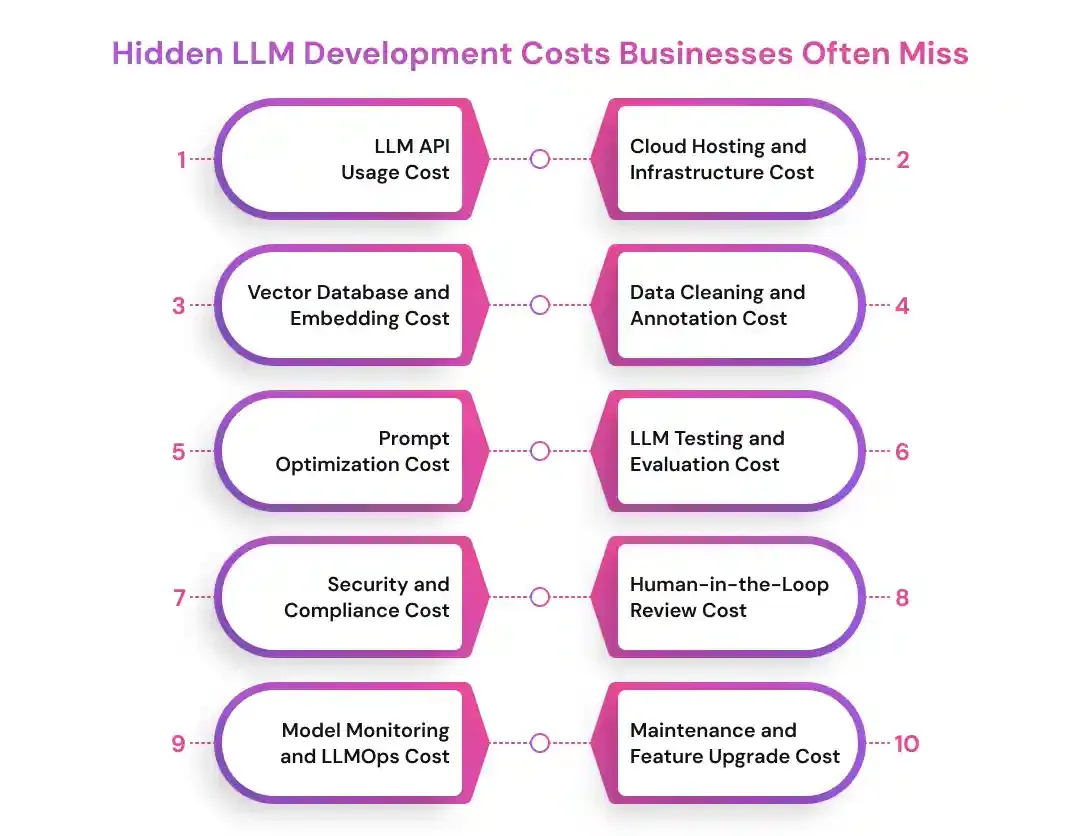
Hidden LLM Development Costs Businesses Often Miss
The visible cost of LLM development is only one part of the budget.
Most businesses calculate the cost of design, development, model integration, and deployment. But they often miss the costs that appear after the first estimate. These hidden costs can affect your total LLM pricing, monthly operating budget, and long-term return on investment.
A basic LLM demo may look affordable. But a production-ready LLM solution needs data, hosting, monitoring, security, testing, updates, and ongoing optimization.
That is why you should plan the full cost of ownership before starting the project.
Here are the hidden LLM development costs you should not ignore.
1. LLM API Usage Cost
If you use hosted LLM APIs, your monthly cost depends on tokens.
Every user query, system prompt, retrieved document, conversation history, and model response consumes tokens. The more users your app serves, the higher your token usage becomes.
API usage cost may include:
Input tokens
Output tokens
Embedding tokens
Context window usage
Image, audio, or multimodal processing
Model-specific pricing
High-volume API requests
Premium model usage
For a small LLM chatbot, API usage may cost $100 to $1,000 per month.
For a growing SaaS product or internal enterprise assistant, monthly API usage can move from $1,000 to $10,000+.
For a high-traffic LLM platform, token costs can cross $25,000 to $100,000+ per month, especially when the app uses long context, advanced models, or large user volumes.
This is why token optimization matters.
Your development team can reduce API costs by using prompt compression, caching, smaller models for simple tasks, RAG optimization, output limits, and smart routing between different models.
2. Cloud Hosting and Infrastructure Cost
Every LLM application needs infrastructure.
Even if you use a hosted model API, your app still needs servers, databases, storage, file processing, vector search, monitoring, and deployment pipelines.
If you host an open-source model, your infrastructure cost can increase further because you may need GPU servers or optimized inference infrastructure.
Cloud infrastructure cost may include:
App server hosting
Database hosting
Vector database storage
File storage
GPU servers
Load balancing
CDN
Monitoring tools
Backup systems
Logging infrastructure
Queue management
Security tools
A small API-based LLM app may need $300 to $2,000 per month in infrastructure.
A moderate RAG-based LLM app may need $2,000 to $10,000 per month.
An enterprise-grade LLM platform with private hosting, high traffic, and advanced monitoring may need $15,000 to $50,000+ per month.
If you build a private LLM deployment, you should plan infrastructure from day one. Hosting a model is not just about renting a GPU. It also needs DevOps, security, scaling, backups, latency optimization, and monitoring.
3. Vector Database and Embedding Cost
RAG-based LLM applications need vector databases and embeddings.
This cost is easy to miss because many businesses focus only on the model. But if your LLM needs to answer from private documents, internal data, support tickets, contracts, product manuals, or knowledge bases, you need a retrieval system.
Vector database cost depends on:
Number of documents
Size of knowledge base
Embedding model
Frequency of data updates
Search volume
Metadata complexity
Storage requirements
Query speed
Redundancy and backups
A small vector database setup may cost $500 to $2,000 per month.
A larger enterprise RAG system may cost $3,000 to $15,000+ per month.
The development cost to set up embeddings, retrieval, chunking, and vector search can range from $10,000 to $70,000+, depending on complexity.
If your documents change often, you also need a data refresh pipeline. This adds more cost because the system must keep your knowledge base updated without breaking retrieval accuracy.
4. Data Cleaning and Annotation Cost
Data preparation is one of the most underestimated costs in LLM development.
Most companies have useful data. But useful data is not always usable data.
Your files may be scattered across folders, emails, CRMs, ERPs, PDFs, spreadsheets, scanned documents, support tickets, product pages, and knowledge bases. Some documents may be outdated. Some may have duplicate content. Some may include sensitive information. Some may not follow any structure.
Before your LLM can use this data, your team may need to clean, format, tag, label, and validate it.
Data cleaning and annotation cost may include:
Removing duplicates
Converting files into usable formats
Extracting text from PDFs and scanned files
Cleaning corrupted records
Creating metadata
Labeling examples
Preparing training datasets
Preparing evaluation datasets
Removing sensitive information
Validating accuracy
Structuring domain knowledge
For a basic chatbot, this may cost $2,000 to $10,000.
For a RAG-based knowledge assistant, it may cost $10,000 to $60,000.
For fine-tuning or enterprise LLM development, data preparation may cost $50,000 to $200,000+.
Clean data improves answer quality. Poor data creates poor output.
If your LLM gives wrong, outdated, or incomplete answers, the issue may not be the model. It may be the data behind the model.
5. Prompt Optimization Cost
Prompt engineering does not end when the first version goes live.
Real users ask unpredictable questions. They use incomplete sentences. They ask follow-up questions. They mix topics. They upload messy files. They expect accurate, useful, and safe answers.
This means your prompts need continuous improvement.
Prompt optimization may include:
Testing prompt variations
Reducing hallucinations
Improving output format
Creating role-based prompts
Adding safety instructions
Improving retrieval prompts
Controlling tone and style
Reducing token usage
Handling edge cases
Creating fallback responses
Basic prompt optimization may cost $1,000 to $5,000.
Ongoing prompt improvement for a production LLM app may cost $2,000 to $15,000 per month.
For advanced AI agents, RAG systems, or regulated workflows, prompt optimization can cost more because every output must follow business rules, safety guidelines, and compliance boundaries.
A weak prompt can make a strong model look bad.
A well-tested prompt system can improve accuracy, reduce cost, and increase user trust.
6. LLM Testing and Evaluation Cost
LLM testing is not a one-time checklist.
You need to test the product, the model, the prompts, the retrieval system, the integrations, the security, and the output quality.
A traditional app test checks whether a button works. An LLM test checks whether the answer makes sense.
Testing cost may include:
Functional testing
Prompt testing
Hallucination testing
Retrieval testing
Source citation testing
Bias testing
Security testing
Load testing
Red-team testing
User acceptance testing
Regression testing
Model evaluation
Compliance testing
A basic LLM app may need $5,000 to $15,000 for testing.
A RAG-based LLM app may need $20,000 to $60,000.
A regulated enterprise LLM platform may need $75,000 to $200,000+ for testing and evaluation.
Testing becomes more expensive when your app handles legal, healthcare, finance, insurance, HR, or customer data.
The more sensitive the use case, the more carefully you must test the system.
7. Security and Compliance Cost
Security can significantly increase LLM development cost.
LLM applications often work with confidential business data. If your system exposes private information, gives access to the wrong user, or leaks sensitive documents into model prompts, the damage can be serious.
Security cost may include:
Data encryption
Role-based access
Single sign-on
Secure APIs
PII masking
Data anonymization
Prompt injection protection
Audit logs
Compliance documentation
Access monitoring
Private deployment
Penetration testing
Legal review
Vendor risk assessment
Basic security may cost $5,000 to $20,000.
Enterprise security with role-based permissions, audit logs, and data protection may cost $30,000 to $100,000+.
Regulated industry compliance can add $75,000 to $250,000+ to the total LLM development budget.
If your business works in healthcare, finance, legal, insurance, government, or enterprise SaaS, security should not be treated as an add-on. It should be part of the architecture from the beginning.
8. Human-in-the-Loop Review Cost
Some LLM applications need human review before the AI output reaches the final user or triggers an action.
This is common in legal, healthcare, finance, insurance, HR, recruitment, publishing, and enterprise decision-making workflows.
Human-in-the-loop systems may include:
Review dashboards
Approval workflows
Edit and comment features
Confidence scoring
Escalation rules
Audit trails
Feedback collection
Quality review queues
Reviewer assignment
Output comparison
The cost to build human review workflows can range from $15,000 to $80,000+.
This cost increases when the app needs multiple reviewer roles, compliance logs, version history, or automated escalation.
Human review may add development cost, but it reduces business risk.
It helps teams use AI faster without giving the model complete control over sensitive decisions.
9. Model Monitoring and LLMOps Cost
An LLM application changes after launch.
Users ask new questions. Business data changes. Model providers update APIs. Costs fluctuate. Prompts degrade. Retrieval quality may drop. New security risks appear.
This is why LLMOps is important.
LLMOps cost may include:
Model monitoring
Prompt versioning
Response quality tracking
Token usage tracking
Cost optimization
Feedback analysis
Hallucination monitoring
Retrieval performance checks
Model updates
Data pipeline monitoring
Incident response
Performance reports
Basic LLMOps may cost $1,000 to $5,000 per month.
Standard LLMOps may cost $5,000 to $20,000 per month.
Enterprise LLMOps may cost $30,000 to $100,000+ per month, depending on scale and complexity.
Without LLMOps, your LLM solution may become less accurate, more expensive, and harder to trust over time.
10. Maintenance and Feature Upgrade Cost
LLM apps need maintenance just like any other software product.
After launch, you may need to fix bugs, improve prompts, update integrations, optimize retrieval, add new features, enhance dashboards, or support more users.
Common maintenance tasks include:
Bug fixes
API updates
Security patches
UI improvements
Prompt updates
Model upgrades
New data source connections
Performance tuning
Infrastructure scaling
Analytics improvements
User feedback implementation
Compliance updates
A practical maintenance budget is usually 15% to 30% of the initial development cost annually.
So, if your LLM application costs $100,000 to build, you may need $15,000 to $30,000 per year for maintenance.
Enterprise platforms may need more because they require SLAs, advanced monitoring, regular security reviews, and ongoing model optimization.
Estimated Cost to Build Different Types of LLM Solutions
LLM development cost changes based on the type of solution you want to build.
A support chatbot, document assistant, AI agent, legal copilot, healthcare assistant, and enterprise knowledge platform all need different levels of data, integrations, security, and intelligence.
Here is a practical cost breakdown by LLM solution type.
LLM Solution Type
Estimated Cost
Estimated Timeline
Main Cost Drivers
AI FAQ Chatbot
$15,000 – $40,000
4 – 7 weeks
Chat UI, model API, basic prompts, simple admin
Customer Support LLM Chatbot
$30,000 – $90,000
6 – 12 weeks
Support workflows, ticketing integration, analytics, escalation
Internal Knowledge Assistant
$50,000 – $150,000
8 – 16 weeks
RAG, document ingestion, vector database, access control
HIPAA-ready flows, medical data, privacy, accuracy testing
Financial LLM Assistant
$120,000 – $400,000+
5 – 10 months
Compliance, financial data, audit logs, security
Multi-Agent AI Platform
$150,000 – $500,000+
6 – 12 months
AI agents, tool use, integrations, orchestration, monitoring
Custom-Trained Enterprise LLM
$500,000 – $1,500,000+
9 – 18+ months
Data pipelines, GPU training, AI research, LLMOps
These ranges help you understand the starting budget. Your final cost may change based on user roles, data quality, model choice, integrations, deployment, and compliance.
Let’s look at some common LLM solution types in detail.
1. AI FAQ Chatbot Development Cost
An AI FAQ chatbot is the simplest LLM-powered solution.
It answers common questions about your business, product, service, pricing, policies, or support process. It can work on your website, mobile app, help center, or internal portal.
A basic AI FAQ chatbot may include:
Chat interface
LLM API integration
Basic prompt setup
FAQ knowledge input
Simple analytics
Admin panel
Cloud deployment
The cost to build an AI FAQ chatbot usually ranges from $15,000 to $40,000.
This solution works well for small businesses, startups, SaaS companies, service providers, and eCommerce brands that want to automate basic support without building a complex AI platform.
The cost can increase if you need multilingual support, CRM integration, support ticket creation, live agent handoff, or advanced analytics.
2. Customer Support LLM Chatbot Development Cost
A customer support LLM chatbot is more advanced than a basic FAQ bot.
It does not only answer questions. It can understand customer intent, retrieve support articles, check order status, create tickets, summarize conversations, and escalate complex issues to human agents.
A customer support LLM chatbot may include:
User authentication
Knowledge base integration
Ticketing system integration
CRM integration
Conversation history
Sentiment detection
Escalation workflow
Agent dashboard
Analytics
Feedback loop
The cost to build a customer support LLM chatbot usually ranges from $30,000 to $90,000.
If the chatbot needs voice support, omnichannel deployment, multilingual capability, or complex workflow automation, the cost can reach $150,000+.
This type of LLM solution is useful for eCommerce, SaaS, travel, healthcare, banking, telecom, logistics, and service-based businesses.
3. Internal Knowledge Assistant Development Cost
An internal knowledge assistant helps employees find answers from company documents, policies, reports, manuals, SOPs, tickets, contracts, and internal databases.
This is one of the most popular RAG-based LLM use cases.
An internal knowledge assistant may include:
Document upload
Knowledge base sync
RAG pipeline
Vector database
Source citations
Role-based access
Department-wise permissions
Employee login
Feedback system
Admin dashboard
Analytics
The cost to build an internal knowledge assistant usually ranges from $50,000 to $150,000.
The cost depends heavily on the number of documents, data formats, access rules, update frequency, and retrieval accuracy requirements.
A small knowledge assistant for one department may cost less.
A company-wide enterprise knowledge copilot with multiple departments, permission layers, and system integrations will cost more.
4. Document Intelligence Platform Development Cost
A document intelligence platform uses LLMs to read, summarize, classify, extract, compare, and analyze documents.
It can work with contracts, invoices, medical records, insurance claims, financial reports, legal files, research papers, HR documents, or compliance documents.
A document intelligence platform may include:
File upload
OCR
PDF parsing
Document classification
Data extraction
Summarization
Clause detection
Risk flagging
Source citation
Review workflow
Export options
Audit trail
The cost to build a document intelligence platform usually ranges from $75,000 to $200,000.
The cost increases when the documents are complex, scanned, handwritten, multilingual, regulated, or highly domain-specific.
If your platform needs legal-grade accuracy, medical-grade privacy, or finance-grade compliance, you should plan a higher budget.
5. LLM-Powered SaaS Product Development Cost
An LLM-powered SaaS product is more expensive than a single-purpose internal tool because it needs a complete commercial product layer.
It must support users, teams, subscriptions, billing, dashboards, analytics, onboarding, permissions, security, and scalable infrastructure.
An LLM-powered SaaS product may include:
User onboarding
Team accounts
Subscription plans
Usage-based billing
Admin dashboard
AI feature limits
Model API integration
RAG or fine-tuning
Analytics
Payment gateway
Role-based access
Multi-tenant architecture
Customer support tools
The cost to build an LLM-powered SaaS product usually ranges from $100,000 to $300,000+.
A simple AI writing tool or assistant can cost less.
A full AI SaaS platform with team workspaces, usage billing, multiple AI workflows, and enterprise controls can cost much more.
The SaaS model also needs ongoing cost planning because API usage and infrastructure costs scale with customers.
6. AI Sales Assistant Development Cost
An AI sales assistant helps teams qualify leads, summarize calls, draft outreach messages, create proposals, update CRM records, and recommend next steps.
This type of LLM app becomes powerful when it connects with CRM, email, calendar, meeting tools, and sales enablement platforms.
An AI sales assistant may include:
CRM integration
Lead scoring
Email drafting
Meeting summary
Proposal generation
Follow-up reminders
Sales script generation
Customer profile analysis
Pipeline updates
Analytics dashboard
The cost to build an AI sales assistant usually ranges from $60,000 to $180,000.
The cost depends on CRM complexity, workflow automation, data access, email integration, and AI output quality.
A simple sales email generator costs less.
A CRM-connected sales copilot that updates records and recommends actions costs more.
7. Legal AI Assistant Development Cost
A legal AI assistant helps lawyers, legal teams, compliance departments, and businesses analyze documents faster.
It can summarize contracts, compare clauses, flag risks, answer legal policy questions, and help prepare drafts.
A legal AI assistant may include:
Secure document upload
Contract review
Clause extraction
Risk detection
Legal summarization
Source citation
Version comparison
Review workflow
Access control
Audit logs
Data privacy controls
The cost to build a legal AI assistant usually ranges from $100,000 to $300,000+.
Legal AI costs more because the system needs strong privacy, document accuracy, secure access, reliable citations, and careful human review workflows.
In legal use cases, the LLM should not behave like a casual chatbot. It must work as a controlled assistant with clear boundaries, traceable sources, and review-friendly outputs.
8. Healthcare LLM Assistant Development Cost
A healthcare LLM assistant can support medical documentation, patient support, clinical summarization, insurance processing, and internal knowledge access.
Healthcare LLM development needs extra care because it may involve sensitive patient data, medical terminology, privacy regulations, and high accuracy requirements.
A healthcare LLM assistant may include:
Secure patient data handling
HIPAA-ready workflows
Medical document summarization
Clinical note assistance
Appointment support
Insurance claim support
Healthcare knowledge retrieval
Role-based access
Audit logs
Human review
Secure deployment
The cost to build a healthcare LLM assistant usually ranges from $120,000 to $350,000+.
The cost increases when the solution handles protected health information, integrates with EHR systems, requires medical review, or needs strict compliance documentation.
Healthcare AI should always include human oversight and careful validation.
9. Financial LLM Assistant Development Cost
A financial LLM assistant can help with financial report analysis, customer support, risk review, compliance checks, investment research, invoice processing, and internal banking operations.
Financial LLM systems need strong accuracy, auditability, and data protection.
A financial LLM assistant may include:
Secure data access
Report summarization
Risk analysis
Compliance workflow
Customer query handling
Fraud alert explanation
Invoice processing
Financial document extraction
Audit logs
Role-based permissions
Data encryption
The cost to build a financial LLM assistant usually ranges from $120,000 to $400,000+.
The cost increases with compliance needs, integration with core systems, audit requirements, and data sensitivity.
A finance-focused LLM app must be designed with strong guardrails. It should explain, assist, and summarize, but it should not take sensitive actions without approval.
10. Multi-Agent LLM Platform Development Cost
A multi-agent LLM platform uses multiple AI agents to complete tasks across systems.
One agent may collect information. Another may analyze it. Another may create a report. Another may update a CRM or trigger a workflow.
This is more complex than a normal chatbot because agents need planning, tool access, memory, orchestration, permissions, and monitoring.
A multi-agent LLM platform may include:
Agent orchestration
Tool calling
Workflow automation
Multi-step reasoning
CRM/ERP integration
Human approval
Task tracking
Memory
Error handling
Audit trails
Monitoring dashboard
Cost controls
The cost to build a multi-agent LLM platform usually ranges from $150,000 to $500,000+.
The cost increases when agents take actions in real business systems.
For example, an agent that only drafts a report is less risky. An agent that updates invoices, triggers payments, or changes customer records needs stronger controls, approvals, and audit trails.
Popular LLM Application Examples and Their Estimated Cost
Businesses often understand LLM development cost better when they compare it with real-world AI product categories.
The following examples show what it may cost to build applications inspired by popular LLM use cases.
These are not exact clone costs. They are practical estimates for building similar core functionality.
1. ChatGPT-Like AI Chatbot
A ChatGPT-like application allows users to ask questions, generate content, summarize information, brainstorm ideas, and complete text-based tasks.
A basic version may use a hosted LLM API. A more advanced version may include user accounts, conversation history, file upload, prompt templates, team workspaces, subscriptions, and analytics.
Core features may include:
Chat interface
User login
Conversation history
Prompt templates
Model API integration
File upload
Admin dashboard
Usage analytics
Payment integration
Average development cost: $50,000 to $200,000+
The cost increases if you add RAG, multimodal input, team collaboration, enterprise controls, or multiple model options.
A Perplexity-like AI search solution combines search, retrieval, summarization, and cited answers.
It does not simply generate text. It retrieves information, analyzes sources, summarizes results, and gives users reference-backed answers.
Core features may include:
Search interface
Web or database retrieval
RAG pipeline
Source citations
Summarization
Follow-up questions
User history
Ranking and reranking
Analytics
Average development cost: $100,000 to $350,000+
The cost depends on the number of sources, retrieval quality, citation accuracy, search speed, and data licensing needs.
3. Notion AI-Like Productivity Assistant
A Notion AI-like assistant helps users write, summarize, organize, edit, and transform content inside a productivity workspace.
It can support notes, documents, project pages, meeting summaries, task generation, and internal knowledge search.
Core features may include:
Document editor
AI writing assistant
Summarization
Task generation
Workspace search
Team collaboration
Prompt shortcuts
User permissions
Subscription billing
Average development cost: $80,000 to $250,000+
The cost increases when you add collaborative editing, workspace-level RAG, team permissions, and integrations with project management tools.
4. Intercom Fin-Like Customer Support AI
An Intercom Fin-like support assistant helps businesses automate customer support using help center content, tickets, and support workflows.
It can answer customer questions, suggest articles, summarize conversations, and escalate unresolved queries to human agents.
Core features may include:
Support chat interface
Knowledge base integration
Ticketing integration
Human handoff
Customer profile access
Conversation summary
Analytics
Feedback loop
Admin controls
Average development cost: $70,000 to $220,000+
The cost increases when the assistant needs omnichannel support, multilingual responses, CRM integration, SLA workflows, or enterprise-grade analytics.
5. Jasper-Like AI Content Platform
A Jasper-like AI content platform helps users generate blogs, ads, emails, landing pages, social posts, and marketing campaigns.
This type of product needs strong prompt templates, content workflows, brand voice controls, collaboration, and subscription billing.
Core features may include:
AI content generator
Template library
Brand voice settings
Document editor
Team collaboration
Campaign folders
Plagiarism or quality checks
User plans
Payment integration
Average development cost: $80,000 to $250,000+
The cost increases if you add SEO tools, brand governance, image generation, workflow approval, or multi-language content generation.
This type of LLM application needs strong developer experience, code context handling, IDE integration, and security controls.
Core features may include:
Code suggestion
Code explanation
Code review
IDE plugin
Repository context
Documentation generation
Security scanning
Team controls
Usage analytics
Average development cost: $150,000 to $500,000+
The cost increases when you need custom model tuning, private repository access, enterprise security, and support for multiple programming languages.
7. Harvey-Like Legal AI Assistant
A Harvey-like legal assistant helps legal professionals analyze contracts, summarize case files, draft legal documents, and conduct legal research.
This type of LLM solution needs strong privacy, legal-domain accuracy, document review workflows, and source traceability.
Core features may include:
Contract upload
Legal summarization
Clause extraction
Risk flagging
Document comparison
Legal research support
Source citation
Human review
Audit logs
Average development cost: $150,000 to $500,000+
Legal AI costs more because accuracy, confidentiality, and review workflows are critical.
8. Enterprise Knowledge Copilot
An enterprise knowledge copilot helps employees find answers from company data.
It can connect with internal documents, HR policies, product manuals, sales playbooks, support tickets, CRM records, and project files.
Core features may include:
Enterprise search
RAG pipeline
Document ingestion
Role-based access
Source citations
Department-wise knowledge base
Admin dashboard
Feedback loop
SSO
Audit logs
Average development cost: $100,000 to $350,000+
The cost depends on data volume, access control, integrations, security requirements, and usage scale.
9. AI Meeting Assistant
An AI meeting assistant records, transcribes, summarizes, and extracts action items from meetings.
It may connect with calendar tools, video conferencing platforms, CRMs, and project management software.
Core features may include:
Meeting recording
Speech-to-text
Summary generation
Action item extraction
Speaker identification
Calendar integration
CRM update
Task creation
Team sharing
Average development cost: $60,000 to $180,000+
The cost increases when you add real-time transcription, multilingual support, CRM sync, sentiment analysis, and enterprise security.
10. AI Document Review Assistant
An AI document review assistant helps teams process contracts, invoices, claims, compliance files, proposals, and business documents.
It can classify documents, extract key fields, summarize content, flag risks, and create review workflows.
Core features may include:
File upload
OCR
Document parsing
Data extraction
Summarization
Risk detection
Review workflow
Export to CRM/ERP
Audit trail
Average development cost: $75,000 to $250,000+
The cost depends on document complexity, accuracy expectations, file formats, workflow depth, and compliance needs.
LLM Application Example Cost Summary
Here is a quick comparison of popular LLM app examples and their estimated development cost.
LLM App Example
Estimated Development Cost
Complexity Level
ChatGPT-Like AI Chatbot
$50,000 – $200,000+
Moderate to High
Perplexity-Like AI Search Engine
$100,000 – $350,000+
High
Notion AI-Like Productivity Assistant
$80,000 – $250,000+
Moderate to High
Intercom Fin-Like Support AI
$70,000 – $220,000+
Moderate to High
Jasper-Like AI Content Platform
$80,000 – $250,000+
Moderate to High
GitHub Copilot-Like Coding Assistant
$150,000 – $500,000+
Very High
Harvey-Like Legal AI Assistant
$150,000 – $500,000+
Very High
Enterprise Knowledge Copilot
$100,000 – $350,000+
High
AI Meeting Assistant
$60,000 – $180,000+
Moderate
AI Document Review Assistant
$75,000 – $250,000+
Moderate to High
What These LLM Cost Examples Tell Us
The cost to build an LLM application depends on how close it is to a real business workflow.
A simple chatbot costs less because it mainly answers questions.
A RAG-based knowledge assistant costs more because it must retrieve accurate information from private data.
A legal, healthcare, or finance assistant costs even more because it needs privacy, compliance, audit logs, human review, and high answer accuracy.
A multi-agent system costs the most because it does not just answer. It acts.
The more your LLM app reads, reasons, retrieves, integrates, decides, or automates, the more development effort it needs.
So, instead of asking how much a famous AI app costs to clone, define the exact business outcome you want.
Do you want to reduce support tickets?
Do you want employees to find internal knowledge faster?
Do you want to automate document review?
Do you want to create a paid AI SaaS product?
Do you want AI agents to complete operational tasks?
Do you want a private LLM that protects sensitive data?
The answer will shape your LLM development cost more accurately than any generic estimate.
Planning to Build an LLM Application Like These?
Prismetric helps startups, enterprises, and growing businesses plan, design, develop, and scale custom LLM applications with the right architecture and cost strategy.
How to Reduce LLM Development Cost Without Reducing Quality
LLM development can become expensive when businesses start with a vague idea, choose the wrong model, add too many features, ignore data readiness, or build a custom model when a simpler architecture can solve the problem.
The good news is simple.
You can reduce LLM development cost without building a weak product.
The goal is not to cut corners. The goal is to make smarter technical and business decisions from day one.
A well-planned LLM application can launch faster, cost less, and still deliver strong performance if you choose the right approach, prioritize the right features, prepare your data, and control ongoing usage costs.
Here are practical ways to optimize custom LLM development cost in 2026.
Cost Optimization Strategy
How It Helps
Possible Cost Impact
Start with a clear use case
Prevents unnecessary features and wrong model selection
10% – 25% savings
Build an MVP first
Validates value before full-scale investment
20% – 40% savings
Use API integration for simple use cases
Avoids model training and infrastructure costs
30% – 60% savings
Choose RAG before fine-tuning when possible
Improves accuracy without heavy training cost
20% – 50% savings
Select the right model size
Avoids paying for large models when smaller ones work
15% – 40% savings
Prepare data early
Reduces rework, hallucinations, and poor output quality
10% – 30% savings
Prioritize must-have features
Keeps the first version focused and affordable
20% – 35% savings
Optimize token usage
Reduces monthly API and inference cost
15% – 50% savings
Reuse proven AI components
Speeds up delivery and lowers engineering effort
10% – 30% savings
Plan LLMOps from the start
Controls post-launch maintenance and scaling cost
15% – 25% savings
1. Start with a Clear Business Use Case
The first way to reduce LLM development cost is to define what the LLM must actually do.
Many businesses start with a broad idea like “we need an AI chatbot” or “we want an LLM-powered app.” That is not enough for accurate pricing.
You need to define the exact business problem.
Do you want to reduce support tickets?
Do you want employees to find internal documents faster?
Do you want to automate document review?
Do you want to summarize sales calls?
Do you want to generate reports from CRM data?
Do you want to build a paid AI SaaS product?
A clear use case helps your development team select the right model, architecture, features, data pipeline, integrations, and security level.
When the use case is clear, your estimate becomes more accurate.
When the use case is vague, your LLM pricing expands quickly.
A clear use case should include:
Target users
Main workflow
Expected output
Required data sources
User roles
Integration needs
Accuracy expectations
Security requirements
Success metrics
For example, “build an AI assistant for employees” is too broad.
A better scope is: “build a RAG-based HR policy assistant that answers employee questions using internal HR documents, shows source citations, supports role-based access, and gives admin users a dashboard to update documents.”
That level of clarity helps control cost.
2. Build an LLM MVP Before a Full Platform
A full enterprise LLM platform can be expensive. But you do not need to build everything in the first version.
Start with an LLM MVP.
An LLM MVP helps you test the core workflow, user adoption, model quality, and business value before investing in advanced features.
A good LLM MVP may include:
One high-value use case
Simple user interface
Hosted LLM API integration
Basic RAG pipeline
Limited document sources
Basic admin panel
Usage analytics
Feedback collection
Cloud deployment
The cost to build an LLM MVP usually ranges from $30,000 to $80,000.
This is much lower than building a full enterprise LLM platform from day one.
Once the MVP proves value, you can add more features, data sources, user roles, integrations, security layers, and automation workflows.
This staged approach helps you reduce risk and spend money where users show real demand.
The smartest path is:
Validate first. Scale later.
3. Avoid Custom Model Training Unless You Truly Need It
Custom model training sounds powerful. But it is not always necessary.
Many businesses can solve their LLM use case with API integration, prompt engineering, RAG, or fine-tuning. Training a proprietary LLM from scratch should be the last option, not the first.
Custom-trained LLM development needs large datasets, AI researchers, ML engineers, GPU clusters, evaluation frameworks, security controls, and long-term maintenance.
That makes it expensive.
If your goal is to build a chatbot, support assistant, document search tool, internal knowledge copilot, or workflow automation system, you may not need custom training.
You can reduce LLM development cost by choosing the right approach.
Business Need
Cost-Effective Approach
Simple chatbot or AI assistant
API-based LLM integration
Business document Q&A
RAG-based LLM development
Domain-specific output format
Fine-tuning or prompt engineering
Private enterprise knowledge access
RAG with private deployment
Highly specialized language understanding
Fine-tuned open-source model
Full model ownership and control
Custom-trained LLM
For most businesses, RAG is more cost-effective than custom training.
It allows your LLM application to use business-specific information without training a new model.
Fine-tuning is useful when the model must learn domain-specific tone, structure, or behavior.
Custom training makes sense only when model ownership, proprietary data advantage, or strict business requirements justify the investment.
4. Use RAG Before Fine-Tuning When Accuracy Depends on Business Data
Fine-tuning is not always the answer to accuracy problems.
If your LLM gives weak answers because it does not know your internal documents, policies, products, contracts, or support history, RAG may solve the issue better.
RAG lets the model retrieve relevant information from your knowledge base before generating a response.
This approach helps your LLM answer from approved business content.
It also reduces the need to retrain the model every time your documents change.
RAG is useful for:
Internal knowledge assistants
HR policy bots
Product documentation assistants
Customer support copilots
Legal document search
Healthcare knowledge tools
Technical support assistants
Enterprise search platforms
RAG can reduce custom LLM development cost because it avoids heavy training cycles.
It also improves transparency because users can see source citations.
Fine-tuning is better when the model needs to learn style, structure, domain-specific language, or repetitive output patterns.
But if your main need is access to changing business knowledge, start with RAG.
5. Choose the Right Model, Not the Biggest Model
A bigger model is not always the better choice.
Large models can produce strong results, but they also cost more to run. They may increase token cost, latency, hosting expenses, and infrastructure requirements.
Many LLM applications can use a smaller or mid-sized model for specific tasks.
For example:
A small model can classify support tickets.
A mid-sized model can summarize internal documents.
A powerful model can handle complex reasoning.
A specialized model can process domain-specific workflows.
A multimodal model can process images, audio, or scanned documents.
The best architecture may use multiple models.
This is called model routing.
A cost-optimized LLM system can send simple tasks to smaller models and complex tasks to stronger models.
This helps reduce monthly running cost without reducing user experience.
Model selection should depend on:
Task complexity
Required accuracy
Response speed
Data sensitivity
Monthly usage volume
Deployment method
Context length
Multimodal needs
Long-term cost
A smart model strategy can reduce both upfront development cost and ongoing LLM operating cost.
6. Prepare Data Before Development Starts
Poor data increases LLM app development cost.
If your documents are scattered, duplicated, outdated, or unstructured, your development team will spend more time cleaning, organizing, and validating them.
That creates delays.
It also affects output quality.
Prepare your data before development starts.
You should organize:
FAQs
Product documents
Policy documents
Support tickets
Training manuals
Internal SOPs
Legal documents
Reports
CRM data
Knowledge base articles
API documentation
Historical conversations
You should also remove duplicate, outdated, sensitive, and irrelevant data.
For RAG systems, your data needs clean structure and useful metadata.
For fine-tuning, your data needs high-quality examples and labels.
For compliance-heavy projects, your data needs privacy checks and access control planning.
Better data means better output.
Better data also means lower rework cost.
7. Prioritize Must-Have Features for the First Version
Feature overload increases LLM development cost.
Many businesses try to build chat, voice, document upload, CRM integration, analytics, admin panel, mobile app, multilingual support, fine-tuning, AI agents, and workflow automation in the first version.
That approach increases cost, timeline, and risk.
Start with must-have features.
Add advanced features after launch.
Your first version should focus on one clear outcome.
For example, if you are building an internal knowledge assistant, the must-have features may be:
User login
Document ingestion
RAG pipeline
Source citation
Basic chat interface
Admin document upload
Feedback collection
Cloud deployment
You can add these later:
Voice input
Multilingual support
CRM integration
Advanced analytics
Slack or Teams integration
AI agents
Custom dashboards
Fine-tuning
A phased roadmap gives you more control over the cost to build an LLM application.
It also helps you learn from real users before investing in advanced development.
8. Optimize Token Usage from the Beginning
Token usage affects monthly LLM operating cost.
Every prompt, document chunk, chat history, retrieved passage, and generated answer adds tokens.
If your prompts are too long or your retrieval system sends too much context, your monthly API bill can rise quickly.
You can reduce token cost by using:
Shorter prompts
Prompt templates
Response length limits
Context filtering
Better chunking
Caching
Summarized memory
Smaller models for simple tasks
Model routing
Embedding optimization
Retrieval optimization
Token optimization should not happen after costs become painful.
It should be part of the architecture.
A good development team designs the LLM system to control usage while keeping answers useful.
This is especially important for SaaS products, customer support bots, enterprise copilots, and high-volume AI platforms.
9. Reuse Proven AI Components
You do not need to build every part from scratch.
Many LLM applications use common components such as chat UI, admin panels, document ingestion, vector search, analytics, feedback systems, user management, and deployment pipelines.
Using proven components can reduce engineering effort and speed up delivery.
Reusable components may include:
Authentication modules
Chat interface components
Prompt management modules
Document upload pipelines
Vector database connectors
Analytics dashboards
Feedback collection modules
Admin panels
API connectors
Deployment scripts
Monitoring dashboards
This does not mean using a generic template for your entire product.
It means using reliable foundations where customization is not necessary.
Your team can then spend more time on the parts that make your LLM solution unique: business logic, data quality, workflows, model behavior, integrations, and user experience.
10. Outsource to an Experienced LLM Development Company
Hiring an in-house AI team can be expensive.
You may need AI architects, LLM engineers, data engineers, backend developers, DevOps experts, QA engineers, and project managers.
That can take months to hire and onboard.
Outsourcing LLM development to an experienced AI development company can reduce cost and speed up delivery.
A skilled partner already understands:
LLM API integration
RAG architecture
Prompt engineering
Fine-tuning
Vector databases
AI agents
Cloud deployment
Security
Testing
LLMOps
Cost optimization
Outsourcing is especially useful when you want to build fast without carrying the long-term cost of a large internal AI team.
But choose the partner carefully.
The right LLM development company should understand both AI engineering and real business workflows.
They should help you avoid unnecessary development, choose the right model, control infrastructure cost, and build a scalable product foundation.
11. Plan Security and Compliance Early
Security becomes more expensive when you add it late.
If your LLM application handles customer data, employee data, healthcare records, financial information, legal documents, or proprietary business knowledge, you should plan security from the beginning.
Late-stage security changes can force the team to rebuild architecture, access flows, logging, database design, and deployment environments.
Plan early for:
Authentication
Role-based access
Data encryption
SSO
Audit logs
PII masking
Data retention
Private deployment
Compliance documentation
Prompt injection protection
Secure API design
Security planning may increase the initial estimate, but it prevents bigger costs later.
It also helps enterprise buyers trust your product.
12. Plan LLMOps and Maintenance from Day One
LLM development does not stop at launch.
After launch, you need to monitor response quality, token usage, model performance, retrieval accuracy, system uptime, user feedback, and security issues.
If you ignore LLMOps, your app may become expensive, inaccurate, or unreliable over time.
Plan for:
Prompt versioning
Model monitoring
Cost tracking
Usage analytics
Retrieval evaluation
Data refresh
Bug fixes
Security updates
User feedback review
Infrastructure scaling
Model upgrades
A clear LLMOps plan helps you control long-term LLM pricing.
It also protects the value of your AI investment.
Step-by-Step LLM Development Process with Cost Breakdown
A successful LLM application needs more than model integration.
It needs strategy, architecture, data preparation, UI/UX, backend development, AI workflow design, security, testing, deployment, and post-launch optimization.
The process you follow directly affects your custom LLM development cost.
A structured process reduces rework, controls scope, improves accuracy, and helps the product move from idea to production faster.
Here is how the LLM development process usually works.
Step 1: Discovery and Requirement Analysis
Every LLM project should start with discovery.
In this stage, the development team studies your business goal, users, workflows, data sources, compliance needs, and expected outcomes.
This step helps define the right scope.
It also helps decide whether you need API integration, RAG, fine-tuning, AI agents, or custom model training.
Action:
Define the business problem
Identify target users
Map the core workflow
List required features
Identify data sources
Define success metrics
Study compliance needs
Estimate timeline and budget
Outcome:
Clear project scope
Initial LLM development cost estimate
Recommended model approach
Feature priority list
Technical feasibility roadmap
Estimated cost: $2,000 – $10,000
Estimated timeline: 1 – 2 weeks
Step 2: Data Audit and Readiness Assessment
Data decides how useful your LLM application becomes.
In this step, the team reviews your available data and checks whether it is clean, relevant, accessible, secure, and ready for use.
This is especially important for RAG, fine-tuning, and enterprise LLM development.
Action:
Review documents and databases
Check data formats
Identify missing data
Remove outdated content
Study sensitive information
Define metadata requirements
Plan data cleaning
Prepare data governance rules
Outcome:
Data readiness report
Data preparation plan
Risk areas
Estimated data engineering cost
RAG or fine-tuning readiness score
Estimated cost: $5,000 – $25,000
Estimated timeline: 1 – 3 weeks
Step 3: LLM Strategy and Architecture Planning
Once the scope and data are clear, the team designs the LLM architecture.
This stage defines how the system will work.
It covers model selection, cloud infrastructure, RAG pipeline, backend architecture, security controls, integrations, and deployment model.
Action:
Choose model approach
Select hosted or open-source model
Define RAG architecture
Plan vector database
Design backend structure
Plan API integrations
Define security architecture
Estimate infrastructure cost
Outcome:
Technical architecture document
Model selection plan
RAG or fine-tuning strategy
Infrastructure plan
Development roadmap
Estimated cost: $5,000 – $20,000
Estimated timeline: 1 – 3 weeks
Step 4: Proof of Concept or MVP Planning
A proof of concept helps test technical feasibility.
An MVP helps test user value.
This step defines the smallest useful version of your LLM application.
It helps you avoid building a large platform before validating the model, data, and workflow.
Action:
Define MVP scope
Select must-have features
Choose limited data sources
Plan user flow
Create acceptance criteria
Set measurable goals
Define launch timeline
Outcome:
MVP roadmap
Reduced initial development scope
Prioritized feature list
Faster launch plan
Lower early-stage development risk
Estimated cost: $3,000 – $15,000
Estimated timeline: 1 – 2 weeks
Step 5: UI/UX Design
Users do not interact with the LLM directly. They interact with the product experience around it.
A good interface makes your LLM app easier to use, easier to trust, and easier to adopt.
This stage includes wireframes, user flows, dashboards, chat screens, document upload screens, review flows, and admin panels.
Action:
Create user journey
Design chat interface
Design dashboards
Plan document upload flow
Design admin controls
Build clickable prototype
Review UX with stakeholders
Outcome:
Wireframes
UI design
Clickable prototype
User flow map
Final design assets for development
Estimated cost: $5,000 – $50,000
Estimated timeline: 2 – 6 weeks
Step 6: Data Preparation and RAG Pipeline Setup
This is one of the most important stages in LLM development.
If your app needs to answer from business data, the team must prepare the data and build a retrieval pipeline.
This includes data ingestion, cleaning, chunking, embeddings, vector database setup, search logic, and source grounding.
Action:
Clean and structure data
Parse PDFs, docs, and files
Create chunks
Generate embeddings
Set up vector database
Add metadata
Build retrieval logic
Add source citation
Test answer grounding
Outcome:
Clean knowledge base
Working RAG pipeline
Search and retrieval system
Source-based response generation
Better answer accuracy
Estimated cost: $20,000 – $100,000+
Estimated timeline: 3 – 10 weeks
Step 7: Backend and Frontend Development
This stage turns the design and architecture into a working product.
The team builds the backend, frontend, APIs, user management, databases, dashboards, workflows, and admin controls.
For LLM apps, the backend also handles prompt management, model calls, retrieval logic, analytics, and security.
Action:
Build frontend interface
Build backend APIs
Set up databases
Add user authentication
Add role-based access
Build admin dashboard
Connect model APIs
Connect data sources
Add analytics
Build workflow logic
Outcome:
Functional LLM application
User-facing interface
Admin controls
Working backend
Integrated AI workflows
Estimated cost: $30,000 – $200,000+
Estimated timeline: 6 – 20 weeks
Step 8: Model Integration, Prompt Engineering, or Fine-Tuning
This stage connects the LLM to the product.
Depending on the project, the team may integrate a hosted model API, configure open-source model hosting, fine-tune a model, or create a multi-model architecture.
Prompt engineering also happens here.
The team designs system prompts, prompt templates, tool instructions, output formats, fallback flows, and safety rules.
Action:
Integrate selected LLM
Create prompt templates
Add system instructions
Configure model settings
Build tool-calling logic
Add memory if required
Fine-tune model if needed
Test model behavior
Optimize output quality
Outcome:
Working model integration
Stable prompt system
Domain-specific responses
Better output format
Improved user experience
Estimated cost: $15,000 – $150,000+
Estimated timeline: 3 – 12 weeks
Step 9: Enterprise Integrations
Many LLM applications need to connect with existing business tools.
This may include CRM, ERP, HRMS, LMS, ticketing tools, databases, email systems, calendars, data warehouses, or internal APIs.
Integrations turn the LLM from a chatbot into a real business assistant.
Action:
Identify integration points
Review API documentation
Build secure connectors
Map data fields
Add authentication
Handle errors
Test data flow
Add workflow automation
Add audit logs
Outcome:
Connected business systems
Automated workflows
Better user productivity
Real-time business context
Reduced manual work
Estimated cost: $15,000 – $150,000+
Estimated timeline: 3 – 12 weeks
Step 10: Security, Privacy, and Compliance Implementation
Security must be built into the product before launch.
This stage protects user data, business data, prompts, documents, model responses, APIs, and system access.
If your LLM application operates in healthcare, finance, legal, insurance, HR, or enterprise SaaS, this stage becomes even more important.
Action:
Add encryption
Set access controls
Add SSO if needed
Add audit logs
Mask sensitive data
Secure APIs
Add prompt injection protection
Define retention policies
Prepare compliance documentation
Run security checks
Outcome:
Secure LLM application
Privacy-ready architecture
Lower risk of data leakage
Compliance support
Enterprise-ready deployment
Estimated cost: $10,000 – $150,000+
Estimated timeline: 2 – 10 weeks
Step 11: Testing and LLM Evaluation
LLM testing checks more than software functionality.
It checks whether the AI gives accurate, useful, safe, and grounded answers.
The team tests prompts, retrieval quality, hallucinations, citations, workflows, performance, security, and user experience.
Action:
Test core features
Test prompts
Test RAG accuracy
Test source citations
Test hallucination risk
Test integrations
Test security
Test response speed
Run load testing
Run user acceptance testing
Outcome:
Stable application
Better answer quality
Reduced hallucination risk
Improved performance
Launch-ready product
Estimated cost: $10,000 – $100,000+
Estimated timeline: 2 – 8 weeks
Step 12: Deployment and Launch
Once testing is complete, the LLM application moves to production.
Deployment includes cloud setup, CI/CD pipelines, monitoring, backup, access management, environment configuration, and launch support.
For enterprise deployments, this may also include private cloud, on-premise, or hybrid infrastructure.
Action:
Configure production environment
Set up cloud infrastructure
Add monitoring tools
Configure backups
Set up CI/CD
Deploy the app
Monitor launch
Fix launch issues
Train admin users
Outcome:
Production-ready LLM application
Live user access
Monitoring setup
Stable launch
Initial performance data
Estimated cost: $5,000 – $50,000+
Estimated timeline: 1 – 4 weeks
Step 13: Post-Launch Monitoring and LLMOps
The real work continues after launch.
Users will ask new questions. Data will change. Model providers may update APIs. Token costs may rise. New edge cases may appear.
LLMOps keeps the application reliable, accurate, secure, and cost-efficient.
Action:
Monitor model output
Track token usage
Review feedback
Update prompts
Refresh knowledge base
Monitor retrieval quality
Track infrastructure cost
Fix bugs
Improve workflows
Add new features
Update model versions
Outcome:
Better long-term accuracy
Lower operating cost
Stronger user adoption
Fewer production issues
Scalable AI product growth
Estimated cost: $1,000 – $30,000+ per month
Timeline: Ongoing
LLM Development Process Cost and Timeline Summary
Here is a quick view of the estimated cost and timeline for each LLM development stage.
Development Stage
Estimated Cost
Estimated Timeline
Discovery and Requirement Analysis
$2,000 – $10,000
1 – 2 weeks
Data Audit and Readiness Assessment
$5,000 – $25,000
1 – 3 weeks
LLM Strategy and Architecture Planning
$5,000 – $20,000
1 – 3 weeks
PoC or MVP Planning
$3,000 – $15,000
1 – 2 weeks
UI/UX Design
$5,000 – $50,000
2 – 6 weeks
Data Preparation and RAG Pipeline Setup
$20,000 – $100,000+
3 – 10 weeks
Backend and Frontend Development
$30,000 – $200,000+
6 – 20 weeks
Model Integration, Prompt Engineering, or Fine-Tuning
$15,000 – $150,000+
3 – 12 weeks
Enterprise Integrations
$15,000 – $150,000+
3 – 12 weeks
Security, Privacy, and Compliance
$10,000 – $150,000+
2 – 10 weeks
Testing and LLM Evaluation
$10,000 – $100,000+
2 – 8 weeks
Deployment and Launch
$5,000 – $50,000+
1 – 4 weeks
Post-Launch Monitoring and LLMOps
$1,000 – $30,000+/month
Ongoing
These stages may overlap depending on the project.
For example, data preparation can begin while UI/UX design is in progress. Backend development can start while prompt engineering continues. Testing should happen throughout the project, not only at the end.
A simple LLM MVP may complete in 6 to 12 weeks.
A moderate RAG-based LLM application may take 3 to 5 months.
A fine-tuned domain-specific LLM product may take 4 to 8 months.
An enterprise LLM platform with multiple integrations, compliance, and private deployment may take 6 to 12+ months.
Why a Structured LLM Development Process Reduces Cost
A structured process helps you avoid expensive mistakes.
Without a clear process, businesses often face:
Wrong model selection
Poor data quality
Unclear feature scope
Weak prompts
High token cost
Inaccurate responses
Security gaps
Integration delays
Poor user adoption
Expensive rework
A structured process keeps every stage connected.
Discovery defines the business need.
Data audit checks readiness.
Architecture planning selects the right model.
MVP planning controls scope.
UI/UX makes the product usable.
RAG and model integration make it intelligent.
Security protects the system.
Testing improves trust.
Deployment makes it live.
LLMOps keeps it useful.
That is how you control the cost to build an LLM application without reducing quality.
Want to Build an LLM Solution with the Right Cost Strategy?
Prismetric helps businesses plan and build LLM solutions that are practical, secure, scalable, and cost-effective.
LLM Monetization Models for Startups and Enterprises
Building an LLM application is one side of the investment.
The other side is revenue.
If you are building an LLM-powered SaaS product, AI assistant, enterprise copilot, document intelligence tool, or AI automation platform, you also need a clear monetization strategy.
A strong monetization model helps you recover development cost, manage ongoing API usage, control infrastructure expenses, and create predictable revenue.
The right model depends on your target users, product type, usage volume, AI cost, customer value, and business model.
Here are the most common ways to monetize an LLM application in 2026.
Monetization Model
How It Works
Best For
Subscription Model
Users pay a monthly or yearly fee to access the LLM app
SaaS products, AI writing tools, business copilots
Usage-Based Pricing
Users pay based on tokens, credits, queries, documents, or tasks
High-volume AI tools, API products, document platforms
Freemium Model
Users get basic features free and pay for advanced AI features
Startups, productivity tools, content apps
Tiered Pricing
Different plans offer different limits, features, models, and support levels
B2B SaaS, team tools, enterprise AI platforms
Enterprise Licensing
Businesses pay a fixed annual fee for team or company-wide access
Enterprise copilots, private AI tools, knowledge assistants
Pay-Per-Document Model
Users pay for each document processed, summarized, or analyzed
Developers or businesses pay to access your LLM capabilities through APIs
AI platforms, vertical AI products, developer tools
White-Label Licensing
Other businesses use your LLM product under their own brand
Agencies, SaaS vendors, industry solution providers
Add-On AI Features
AI features are sold as premium add-ons inside an existing product
SaaS platforms, CRMs, ERPs, HRMS tools
Custom Enterprise Deployment
Clients pay for custom setup, private deployment, and managed support
Regulated industries, large enterprises, private AI solutions
1. Subscription-Based Monetization
The subscription model is one of the most common monetization strategies for LLM-powered applications.
In this model, users pay a fixed monthly or yearly fee to access your AI product.
You can offer different plans based on usage limits, model access, number of users, storage, features, support, and integrations.
For example:
Basic plan for individual users
Pro plan for power users
Team plan for small businesses
Enterprise plan for large organizations
A subscription model works well when your LLM application delivers recurring value.
It is useful for:
AI writing tools
AI productivity assistants
Internal knowledge copilots
Customer support AI tools
Sales assistants
Marketing automation tools
HR assistants
Document intelligence platforms
The main benefit is predictable revenue.
The main challenge is cost control.
Your LLM app may have fixed subscription revenue, but your API and infrastructure cost may increase with usage. That is why subscription plans should include fair usage limits, token caps, document limits, or credit-based controls.
2. Usage-Based Pricing
Usage-based pricing works well when customers use the product at different volumes.
Instead of charging every user the same amount, you charge based on actual consumption.
Usage can be measured by:
Number of queries
Number of tokens
Number of documents
Number of generated reports
Number of workflows
Number of API calls
Number of AI tasks
Number of minutes processed
Number of users or seats
This model is useful for LLM applications where backend cost changes with usage.
For example, a document intelligence platform may charge per document. An AI search engine may charge per query. A speech-to-text and summarization platform may charge per audio hour. An AI API platform may charge per request.
Usage-based pricing helps protect your margins because revenue scales with AI consumption.
However, users may hesitate if pricing feels unpredictable.
A good approach is to combine usage-based pricing with monthly credits.
For example:
$49/month with 1,000 AI credits
$199/month with 10,000 AI credits
Custom enterprise plan with high-volume credits
This gives users predictability while helping you control token and infrastructure costs.
3. Freemium Model
The freemium model helps you attract users faster.
In this model, users get basic access for free and pay when they need more power, more usage, or advanced features.
A free plan may include:
Limited AI queries
Basic model access
Limited document uploads
Basic templates
Watermarked exports
Limited history
No team collaboration
Paid plans may include:
More queries
Premium model access
Longer context
File upload
RAG-based answers
Team workspaces
Analytics
Integrations
Admin controls
Priority support
Freemium works well for consumer AI tools, productivity apps, content platforms, and startup SaaS products.
But it must be planned carefully.
Free users still consume tokens and infrastructure. If you give too much free usage, your costs may rise before revenue grows.
To make freemium profitable, define strict limits and push users toward paid plans when they experience value.
4. Tiered Pricing
Tiered pricing gives users different plans based on needs.
It is one of the best models for B2B LLM applications because businesses have different team sizes, usage needs, security requirements, and integration expectations.
A typical tiered pricing structure may look like this:
Plan Type
Target Users
What It May Include
Starter
Individuals or small teams
Basic AI features, limited usage, simple dashboard
Tiered pricing helps you serve different customers without building separate products for each one.
It also helps you increase average revenue per customer as users grow.
For LLM-powered SaaS products, tiered pricing should consider:
Token usage
Number of users
Number of documents
Model access
Storage
Integrations
Security features
Support level
Deployment option
Enterprise users usually pay more because they need stronger security, compliance, integrations, and support.
5. Enterprise Licensing
Enterprise licensing works well for companies that want to sell LLM solutions to large organizations.
In this model, the customer pays a fixed annual or multi-year license fee.
The license may include:
Company-wide access
Department-level access
Fixed user seats
Private deployment
Dedicated infrastructure
Custom integrations
Security controls
Compliance support
SLA-based support
Admin dashboard
Training and onboarding
This model is useful for:
Enterprise knowledge copilots
Legal AI assistants
Healthcare AI tools
Financial AI assistants
Internal automation platforms
Private LLM solutions
AI document processing systems
Enterprise licensing gives you higher contract value.
It also requires more implementation effort.
Enterprise customers may ask for custom workflows, security reviews, vendor assessments, data protection agreements, and integrations with internal systems.
That is why enterprise LLM pricing should include setup cost, license fee, maintenance, support, and customization charges.
6. Pay-Per-Document Monetization
Pay-per-document pricing is ideal for LLM applications that process files.
This model works well when users upload documents for summarization, extraction, review, translation, comparison, or classification.
It is useful for:
Legal document review
Contract analysis
Invoice processing
Insurance claim analysis
Healthcare document summarization
Financial report review
Compliance document processing
Research paper summarization
You can charge based on:
Number of documents
Number of pages
File size
Processing complexity
OCR requirement
Output type
Review workflow
Accuracy level
For example, a basic document summary may cost less than a detailed legal risk review.
This model works because users can connect cost directly with value.
If your LLM app saves hours of manual document review, customers may accept per-document pricing more easily.
7. API Monetization
If your LLM product solves a specific problem well, you can monetize it through APIs.
Developers, startups, or enterprises can integrate your AI capabilities into their own products.
API monetization works well for:
Domain-specific summarization
Document extraction
AI search
Classification
Sentiment analysis
Code analysis
Translation
Compliance checking
Knowledge retrieval
Industry-specific assistants
You can charge based on:
API calls
Tokens
Documents
Credits
Monthly usage
Volume tiers
Enterprise contracts
API monetization can scale well, but it needs strong infrastructure.
You need rate limits, authentication, usage tracking, billing, developer documentation, uptime monitoring, security, and support.
This model works best when your LLM product has a repeatable capability that other businesses want to embed.
8. White-Label Licensing
White-label licensing lets other businesses sell your LLM product under their own brand.
This model works well when your product solves a common industry problem and can be customized for different clients.
For example, you can build a white-label AI support assistant for agencies, SaaS companies, or industry consultants.
White-label licensing may include:
Custom branding
Separate client workspaces
Admin controls
Usage tracking
Custom domain
Configurable prompts
Client-specific knowledge base
Custom reports
Reseller dashboard
This model helps you scale through partners.
It also requires strong multi-tenant architecture and configuration flexibility.
If you want to build a white-label LLM platform, plan this from the beginning. Adding white-label features later can increase development cost.
9. AI Feature Add-On Monetization
If you already have a software product, you can monetize LLM features as paid add-ons.
This is one of the most practical strategies for SaaS companies.
Instead of building a separate AI product, you add AI capabilities inside your existing platform.
For example:
A CRM can add AI lead scoring and email drafting.
An HRMS can add AI resume screening and policy assistance.
A project management tool can add AI task summaries.
An LMS can add AI tutoring and content generation.
An ERP can add AI report generation.
A helpdesk can add AI ticket summaries and response suggestions.
This model works because users already trust your product.
You can charge extra for AI features through:
Premium plan upgrades
AI usage packs
Add-on subscriptions
Team-based AI access
Enterprise AI modules
This approach also reduces customer acquisition cost because you sell AI to your existing users.
10. Custom Enterprise Deployment
Some customers do not want a shared SaaS product.
They want a custom LLM solution built for their data, workflows, security policies, and infrastructure.
In this model, you charge for custom development, deployment, and ongoing support.
Custom deployment may include:
Private cloud setup
On-premise deployment
Custom data connectors
RAG pipeline
Fine-tuned model
Compliance controls
Audit logs
Role-based access
Dedicated support
SLA
Training
Maintenance
This model works well for regulated industries and large enterprises.
It also gives you higher revenue per client.
But it needs a strong delivery team because every client may have different systems, data quality, workflows, and compliance requirements.
How Prismetric Can Help You Build Cost-Effective LLM Solutions
LLM development is not just about connecting an AI model to an app.
It is about choosing the right AI strategy, preparing the right data, building the right architecture, protecting user information, integrating business workflows, and creating a product that works reliably after launch.
That is where Prismetric can help.
Prismetric helps startups, SMBs, and enterprises build custom LLM applications that are practical, scalable, secure, and cost-effective.
Our team can help you move from AI idea to production-ready LLM solution with a structured development approach.
Whether you want to build a basic AI chatbot, RAG-based knowledge assistant, AI agent, document intelligence platform, LLM-powered SaaS product, or enterprise AI copilot, Prismetric can help you plan and develop the right solution for your budget and business goals.
Our LLM Development Services
Prismetric offers end-to-end LLM development services to help businesses build intelligent applications that solve real problems.
A weak development approach can lead to poor accuracy, high token bills, data leakage, weak adoption, and expensive rework.
Prismetric focuses on building AI solutions that are practical for real business use.
Here is how we help you control custom LLM development cost.
Prismetric Capability
How It Helps Your Project
AI Strategy and Consulting
Helps you choose the right LLM approach before development starts
Model Selection Support
Prevents overpaying for models you do not need
RAG Development Expertise
Helps you use business data without expensive custom training
Prompt Engineering
Improves output quality, consistency, and token efficiency
Data Engineering
Prepares clean, structured, and usable data for better results
Scalable Architecture
Supports future users, features, and integrations
Enterprise Integrations
Connects your LLM app with CRM, ERP, HRMS, LMS, and internal tools
Security-First Development
Protects user data, business data, prompts, and documents
Agile Development
Helps you launch faster with a focused MVP roadmap
Post-Launch Monitoring
Keeps your LLM solution accurate, secure, and cost-efficient
Prismetric can support your LLM project from planning to launch and beyond.
We help you define the right scope, build the right architecture, integrate the right model, and maintain the solution after deployment.
LLM Solutions Prismetric Can Build
Every business has a different AI requirement.
Some need simple automation. Some need smarter customer support. Some need internal knowledge access. Some need AI agents that complete work across systems.
Prismetric can help you build different types of LLM solutions.
LLM Solution
Business Use Case
AI Chatbot
Automate customer queries, FAQs, and internal support
RAG Knowledge Assistant
Help employees search and use company knowledge
AI Customer Support Bot
Reduce ticket load and improve response speed
AI Sales Assistant
Qualify leads, draft emails, and update CRM workflows
AI Document Assistant
Summarize, classify, extract, and review documents
Legal AI Assistant
Support contract review, clause analysis, and legal research
Healthcare AI Assistant
Assist with medical documentation and patient support workflows
Financial AI Assistant
Analyze reports, support compliance, and automate financial tasks
AI Agent Platform
Automate multi-step business workflows
LLM-Powered SaaS Product
Launch a commercial AI product for customers
Enterprise AI Copilot
Help teams work faster with internal business data
Private LLM Solution
Protect sensitive data with secure deployment
Each solution needs a different budget.
That is why Prismetric does not use one-size-fits-all LLM pricing.
We study your use case, users, data, integrations, compliance needs, and future roadmap before estimating the cost.
Our LLM Development Process
Prismetric follows a structured LLM development process to reduce risk and improve project outcomes.
Our process includes:
Understanding your business goal
Identifying the right LLM use case
Auditing your data readiness
Choosing the right model approach
Planning the architecture
Creating the MVP roadmap
Designing the user experience
Building the backend and frontend
Setting up RAG, prompts, or fine-tuning
Integrating third-party systems
Adding security and compliance controls
Testing output quality and performance
Deploying the solution
Monitoring and optimizing after launch
This process helps you build a reliable LLM application without wasting budget on unnecessary features or unsuitable model choices.
When Should You Hire Prismetric for LLM Development?
You should consider hiring Prismetric if you want to build an LLM solution but need clarity on cost, scope, model selection, or architecture.
Prismetric can help if:
You want to estimate LLM development cost before starting.
You want to add LLM features to an existing product.
You want to build a RAG-based knowledge assistant.
You want to automate support, sales, HR, finance, or operations.
You want to build an LLM-powered SaaS product.
You need AI agents for workflow automation.
You need private or secure LLM deployment.
You want to reduce manual document processing.
You want to fine-tune an LLM for domain-specific tasks.
You want post-launch support, monitoring, and optimization.
A short consultation can help you avoid the wrong technical path.
It can also help you understand whether your business needs API integration, RAG, fine-tuning, or custom LLM development.
Get a Custom LLM Development Cost Estimate from Prismetric
The cost to build an LLM application in 2026 depends on many factors.
Your model approach, data quality, feature set, integrations, security needs, deployment method, and maintenance plan all affect the final budget.
A basic API-based LLM chatbot may cost $15,000 to $50,000.
A RAG-based LLM application may cost $50,000 to $150,000.
A fine-tuned enterprise LLM solution may cost $100,000 to $300,000+.
A custom-trained proprietary LLM may cost $500,000 to $1.5 million+.
But your actual estimate depends on your exact business requirement.
Prismetric can help you create a practical LLM development roadmap with cost, timeline, features, architecture, model strategy, and maintenance planning.
Share your LLM idea with our experts and get a clear estimate before you invest.
Frequently Asked Questions About LLM Development Cost
How much does LLM development cost in 2026?
The average LLM development cost in 2026 ranges from $15,000 to $500,000+.
A basic API-based chatbot can cost $15,000 to $50,000. A RAG-based knowledge assistant can cost $50,000 to $150,000. A fine-tuned LLM application can cost $100,000 to $300,000+. A fully custom-trained enterprise LLM can cost $500,000 to $1.5 million+.
The final cost depends on your use case, data, model approach, features, integrations, security, deployment, and maintenance needs.
What is the cost to build a custom LLM application?
The cost to build a custom LLM application usually ranges from $30,000 to $300,000+.
A simple LLM app with API integration costs less. A custom LLM application with RAG, document upload, vector search, analytics, workflow automation, and enterprise integrations costs more.
If the application needs fine-tuning, private deployment, compliance, or AI agents, the custom LLM development cost can go beyond $300,000.
How much does it cost to build an LLM chatbot?
An LLM chatbot can cost between $15,000 and $150,000+.
A basic FAQ chatbot may cost $15,000 to $40,000.
A customer support chatbot with knowledge base integration, ticketing system integration, CRM connection, analytics, and escalation workflow may cost $30,000 to $90,000.
An enterprise chatbot with RAG, role-based access, multilingual support, audit logs, and private deployment may cost $100,000 to $150,000+.
How much does RAG-based LLM development cost?
RAG-based LLM development usually costs between $50,000 and $150,000.
The cost depends on the number of documents, data formats, vector database setup, retrieval logic, source citation, access control, update frequency, and answer accuracy requirements.
An enterprise RAG system with multiple data sources, role-based permissions, integrations, monitoring, and private deployment can cost $150,000 to $300,000+.
How much does LLM fine-tuning cost?
LLM fine-tuning can cost between $50,000 and $300,000+, depending on the model, data quality, training requirements, evaluation scope, and deployment method.
The total cost includes data preparation, labeling, training runs, model evaluation, safety testing, infrastructure, deployment, and monitoring.
Fine-tuning is useful when your LLM must follow domain-specific language, tone, output format, or business logic.
Is it cheaper to use an LLM API or train a custom LLM?
Using an LLM API is much cheaper than training a custom LLM.
API-based LLM development can start from $15,000 to $50,000 for a basic app. It is faster because you do not need to train or host the base model.
Training a custom LLM can cost $500,000 to $1.5 million+ because it needs large datasets, AI researchers, ML engineers, GPU infrastructure, testing, deployment, and long-term LLMOps.
Most businesses should start with API integration or RAG before considering custom model training.
What factors affect custom LLM development cost the most?
The biggest factors that affect custom LLM development cost include:
LLM development approach
App complexity
Feature set
Data preparation
Model selection
RAG pipeline
Fine-tuning needs
Backend infrastructure
UI/UX design
Third-party integrations
Security and compliance
Testing and evaluation
Development team location
Maintenance and LLMOps
Data preparation, model approach, integrations, and compliance usually have the highest impact on the final LLM pricing.
How long does it take to build an LLM application?
The timeline to build an LLM application depends on complexity.
A basic LLM chatbot may take 4 to 8 weeks.
An LLM MVP may take 6 to 12 weeks.
A RAG-based LLM application may take 3 to 5 months.
A fine-tuned domain-specific LLM product may take 4 to 8 months.
An enterprise LLM platform with integrations, compliance, AI agents, and private deployment may take 6 to 12+ months.
What is the monthly cost of running an LLM application?
The monthly cost of running an LLM application can range from $500 to $50,000+, depending on users, traffic, API usage, model hosting, vector database storage, monitoring, and support.
A small chatbot may cost $500 to $3,000 per month.
A moderate RAG-based LLM app may cost $3,000 to $15,000 per month.
An enterprise LLM platform may cost $20,000 to $100,000+ per month if it needs private hosting, high-volume usage, GPU infrastructure, monitoring, and LLMOps.
What is the difference between LLM development cost and LLM maintenance cost?
LLM development cost is the upfront cost to plan, design, build, test, and deploy the application.
LLM maintenance cost is the ongoing cost after launch.
Maintenance may include:
Bug fixes
Prompt updates
Model monitoring
Token usage optimization
Data refresh
Security patches
Infrastructure scaling
RAG performance checks
Model upgrades
LLMOps
New feature development
A practical maintenance budget is usually 15% to 30% of the initial development cost annually.
Can I reduce LLM development cost by starting with an MVP?
Yes. Building an LLM MVP is one of the best ways to reduce cost.
An MVP helps you validate the use case, user demand, model performance, and data quality before building a full platform.
A typical LLM MVP may cost $30,000 to $80,000.
It may include basic UI, LLM API integration, limited RAG, user login, admin controls, and analytics.
Once users validate the product, you can add advanced features like integrations, AI agents, fine-tuning, private deployment, and enterprise controls.
Should I use RAG or fine-tuning for my LLM application?
Use RAG when your LLM needs to answer from business documents, knowledge bases, policies, product manuals, support tickets, or internal data.
Use fine-tuning when your LLM needs to learn domain-specific language, output structure, tone, or task behavior.
For many businesses, RAG is the better first choice because it improves answer accuracy without expensive training.
Fine-tuning can come later if your use case needs deeper domain adaptation.
How much does it cost to build an enterprise LLM solution?
An enterprise LLM solution can cost between $150,000 and $500,000+.
The cost increases when the solution needs:
RAG pipeline
Fine-tuning
Multi-user access
Role-based permissions
Enterprise integrations
Private cloud deployment
SSO
Audit logs
Compliance controls
AI agents
LLMOps
Advanced monitoring
A custom-trained enterprise LLM can cost $500,000 to $1.5 million+.
How much does it cost to build an AI agent with LLM capabilities?
An AI agent with LLM capabilities can cost between $50,000 and $250,000+ for a focused workflow.
A multi-agent platform can cost $150,000 to $500,000+.
The cost depends on what the agent can do.
An agent that only drafts content costs less. An agent that connects with business systems, takes actions, triggers workflows, updates records, or needs approvals costs more.
AI agents need strong safeguards, permissions, error handling, and monitoring.
How much does it cost to add LLM features to an existing app?
Adding LLM features to an existing app can cost between $20,000 and $150,000+.
Simple features like AI search, content generation, summarization, or chatbot support may cost less.
Advanced features like RAG, document intelligence, AI agents, workflow automation, CRM integration, and fine-tuned outputs cost more.
The cost also depends on your existing app architecture, APIs, database structure, security setup, and scalability.
What is the cost of building a private LLM application?
A private LLM application can cost between $100,000 and $500,000+, depending on deployment, data sensitivity, model hosting, security, and compliance.
Private LLM solutions cost more because they may need:
Private cloud or on-premise hosting
Open-source model deployment
Secure data pipelines
Role-based access
Audit logs
Encryption
Compliance documentation
Monitoring
Dedicated infrastructure
Private deployment is often useful for healthcare, finance, legal, insurance, government, and enterprise SaaS companies.
Why is data preparation expensive in LLM development?
Data preparation is expensive because raw business data is rarely ready for LLM use.
Your team may need to clean, structure, label, tag, deduplicate, format, validate, and secure the data before using it in RAG or fine-tuning.
Data preparation may include:
PDF parsing
OCR
Metadata creation
Document chunking
Sensitive data removal
Training dataset creation
Evaluation dataset creation
Quality checks
Poor data leads to poor answers. Clean data improves output quality, reduces hallucinations, and increases user trust.
How can Prismetric help estimate my LLM development cost?
Prismetric can help you estimate LLM development cost by studying your business goal, use case, data readiness, required features, model approach, integrations, security needs, and deployment plan.
Our team can help you decide whether you need API integration, RAG, fine-tuning, AI agents, or custom LLM development.
We can also help you plan the MVP, estimate the timeline, define the architecture, and calculate ongoing maintenance costs.
Is LLM development worth the investment?
LLM development is worth the investment when the solution solves a clear business problem.
A well-built LLM application can help reduce manual work, speed up support, improve document processing, automate workflows, help employees find knowledge faster, and create new revenue opportunities.
The ROI depends on use case clarity, user adoption, model accuracy, cost control, and long-term optimization.
That is why businesses should start with a focused use case and measurable success goals.
How do I get started with LLM development?
Start by defining the problem you want to solve.
Then identify your users, data sources, required features, integrations, security needs, and expected business outcome.
After that, consult an experienced LLM development company to choose the right approach.
Prismetric can help you evaluate your idea, plan the roadmap, estimate the cost, and build a scalable LLM solution.
Talk to Prismetric’s LLM Development Experts Today
As the tech-savvy Project Manager at Prismetric, his admiration for app technology is boundless though!He writes widely researched articles about the AI development, app development methodologies, codes, technical project management skills, app trends, and technical events. Inventive mobile applications and Android app trends that inspire the maximum app users magnetize him deeply to offer his readers some remarkable articles.