Rocket.new Pricing Explained: Plans, Credits, Costs & Best Alternatives

AI app builders like Rocket.new are getting a lot of attention right now, and it’s easy to see why. You can describe an app idea, website, landing page, or product workflow, and the platform helps turn it into something real much faster than traditional development. That feels exciting at first. But once you move from testing ideas to building something you actually want to launch, one thing becomes very important: the pricing.
Creating a quick prototype is one thing. Understanding how many credits you’ll need, which plan makes sense, and what your monthly cost may look like is a different story.
This guide is here to make Rocket.new pricing easier to understand. We’ll break down the plans, explain how the credit system works, and look at what each plan is best suited for. By the end, you’ll have a clear idea of what Rocket.new really costs and whether it’s the right AI app builder for your project.
What is Rocket.new?
At its core, Rocket.new is an AI powered platform that helps you build apps, websites, landing pages, and product ideas using simple prompts. Instead of starting with blank code files, you describe what you want to create, and Rocket.new helps generate the structure, screens, flows, and working parts of your project. It fits into the growing vibe coding space, where the focus is less on writing every line of code manually and more on guiding the AI with clear product intent.
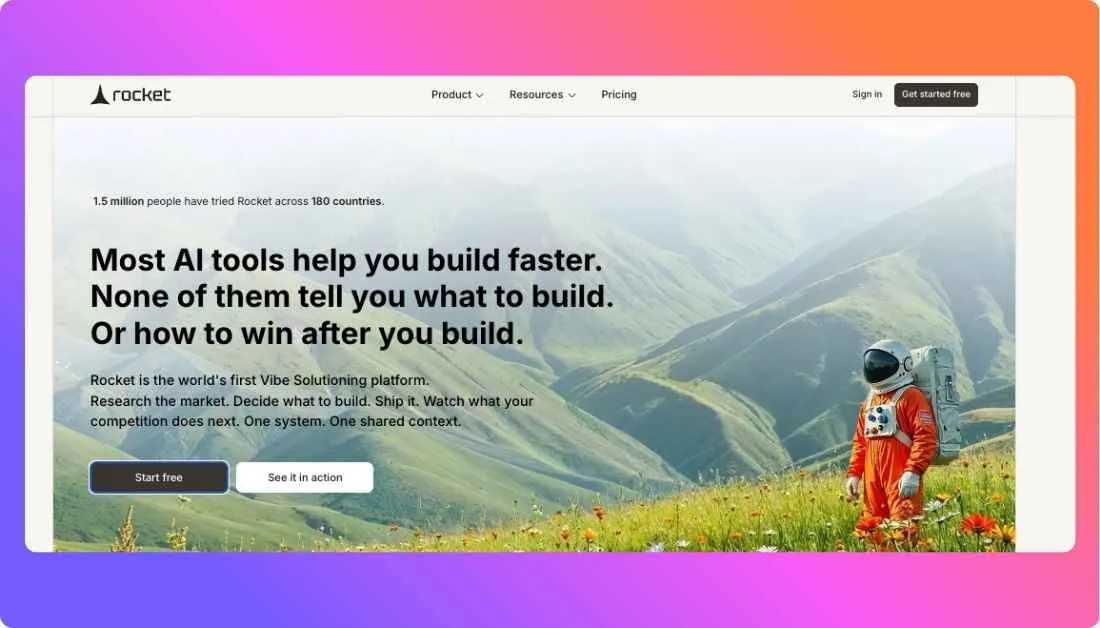
The main appeal is speed. If you want to test a startup idea, create an MVP, build a landing page, or prepare a product concept for clients or investors, Rocket.new can help you move faster. It’s designed for people who want to turn ideas into usable digital products without getting stuck in the slow, traditional software development process.
Understanding the Core Rocket.new Pricing Model
Rocket.new pricing is built around a subscription plus credits model. That means you don’t just pay a monthly fee and use the platform without limits. Each plan gives you access to certain features and a fixed number of credits. These credits are used across Rocket.new’s main product areas, including Build, Solve, and Intelligence.
That’s why the plan you choose should depend on what you want to do. If you only want to test the platform or build a small app, you may not need many credits. But if you’re using Rocket.new to create MVPs, generate product research, build workflows, or track competitors, your credit usage can go up quickly.
Let’s break down the plans first.
Rocket.new Pricing Plans: Free, Build, Solve, and Intelligence
Rocket.new offers different plans for different types of users. Some plans focus only on building. Some combine building with product research. Others include competitor intelligence for teams that want regular market updates.
Here’s a quick breakdown of how Rocket.new plans compare:
| Plan |
Monthly Cost |
Credits |
Best For |
| Free |
$0 |
20 one time credits |
Testing Rocket.new |
| Build |
$25 per month |
100 monthly credits |
Solo builders and small projects |
| Solve + Build |
$250 per month |
1,000 monthly credits |
MVPs, product research, and serious builds |
| Solve + Build + Intelligence |
$350 per month |
1,500 monthly credits |
Teams that need building, research, and competitor tracking |
| Intelligence |
$100 per month per competitor |
500 monthly credits |
Competitor monitoring |
| Build + Intelligence |
$125 per month platform fee |
600 monthly credits |
Building apps with competitor tracking |
The Free plan is best for getting a feel for Rocket.new. You can test how the platform works before paying. The Build plan is the next step for creators, founders, and small teams that want to build more seriously. Solve + Build is better when you also need product research, PRDs, market sizing, or competitive analysis. The higher plans make more sense for teams that want to combine product building with ongoing intelligence.
The Rocket.new Credit System Explained
Okay, this is the part you really need to understand before choosing a Rocket.new plan. Rocket.new uses credits to measure how much you use the platform. Every paid plan gives you a monthly credit allowance, and those credits power different actions across Build, Solve, and Intelligence.
In simple words, credits are like your working balance inside Rocket.new. When you ask the platform to help build an app, create product research, generate a PRD, run competitive analysis, or prepare market insights, that work uses credits.
But it’s not always easy to predict exactly how many credits you’ll use. A small task may use fewer credits. A bigger task with more details, more pages, more research, or deeper analysis may use more. That’s where users need to be careful.
Here’s a simple way to think about it:
| User Activity |
Credit Usage Level |
| Testing a small idea |
Low |
| Creating a landing page |
Low to medium |
| Building an MVP flow |
Medium |
| Generating PRDs and product research |
Medium to high |
| Running competitor intelligence |
High |
| Managing multiple client or startup projects |
High |
This pricing model gives you flexibility because you can use credits across different parts of Rocket.new. You’re not paying separately for every single feature. But it also means you need to keep one eye on your credit balance, especially if you’re building something serious.
For example, the Free plan gives you 20 one time credits. That’s fine for testing the platform, but it won’t be enough for regular product work. The Build plan gives 100 monthly credits, which can work for solo builders or small projects. But if you’re using Rocket.new for research, MVP planning, competitor analysis, and ongoing builds, plans like Solve + Build or Solve + Build + Intelligence will make more sense.
The main thing is this: Rocket.new pricing is not only about the monthly fee. It’s about how far your credits can take you. If you underestimate your usage, you may run out of credits in the middle of a project and need to buy extra credits or move to a higher plan.
Monthly Credits and Extra Credit Packs
Rocket.new paid plans include monthly credits. These credits refresh based on your billing cycle. For users who work on one or two small projects, this may be easy to manage. For agencies, startup teams, or product consultants, credit planning becomes more important.
Rocket.new also allows users to buy additional credits when needed. This helps when you don’t want to upgrade your entire plan just for a temporary spike in usage.
For example, if you’re building a client MVP this month and need more credits than usual, buying extra credits may make more sense than moving to a higher plan. But if you keep needing extra credits every month, upgrading your plan may be the smarter choice.
Is Rocket.new Pricing Worth It for Your Project?
After breaking it down, Rocket.new pricing makes sense for some users, but not for everyone. It depends on what you’re trying to build, how often you plan to use the platform, and how comfortable you are with a credit based pricing model.
The Pros of Rocket.new Pricing: Good for Fast Building and Product Work
There are some clear benefits here. Rocket.new gives you a free plan, so you can test the platform before spending anything. That’s helpful if you’re still exploring AI app builders and want to see whether Rocket.new fits your workflow.
The paid plans also cover different use cases. The Build plan works well for solo creators, founders, and small teams that want to turn ideas into apps, landing pages, or MVPs. Higher plans like Solve + Build are useful when you need more than app generation. You can use Rocket.new for product research, PRDs, market sizing, competitor analysis, and planning.
That makes Rocket.new useful for people who don’t just want to build screens. They want help shaping the product idea too.
The Cons of Rocket.new Pricing: Credits Can Make Costs Hard to Predict
The biggest issue here is predictability. You’re paying a monthly subscription, but your real usage depends on how quickly your credits run out. Since credits power build tasks, product work, and intelligence features, it becomes hard to estimate your monthly cost with full confidence.
This creates a mismatch between value and cost. Rocket.new feels useful in the early build phase because you can move fast, create screens, test ideas, and shape an MVP quickly. But once the app becomes bigger, the credit usage can rise fast too. In one Reddit discussion, a user said Rocket.new’s free token limit “sounds like a lot” but gets used quickly when an app has more than five screens.
Reddit
Over time, it can feel less like a simple monthly plan and more like something you need to watch closely. Instead of only focusing on the app, you may also need to track credits, control usage, and decide whether to buy more credits or upgrade.
The Importance of Predictable AI Pricing for Product Teams
For serious product work, predictable pricing matters. When you’re building an MVP, testing an idea, or managing client projects, you need to know what the tool will cost before you fully depend on it.
This is where users should compare Rocket.new with other AI app builders. Some platforms focus more on fixed plans and full stack app development workflows. For example, Vitara.ai is a strong Rocket.new alternative for founders, startups, and businesses that want to build apps with AI while keeping the development process clear and practical.
Rocket.new is worth it if you want a mix of building, product research, and competitor intelligence in one place. But if your main goal is to build full stack apps faster with more predictable planning, it’s smart to compare Rocket.new with Vitara.ai before choosing a plan.
Choosing the Right AI Platform and Pricing Model
Rocket.new pricing can work well for fast product building, MVP planning, research, and competitor tracking. It gives you flexibility because credits can support different types of work across Build, Solve, and Intelligence. But that same flexibility also means you need to understand your usage before choosing a plan.
Before you commit to Rocket.new or any AI app builder, think about the full journey of your project. Are you only testing an idea, or do you want to build and improve a real product over time? If you’re planning long term product development, pricing clarity matters as much as speed.
This is where comparing alternatives helps. If your main goal is to build full stack apps with AI, manage frontend and backend workflows, and move from idea to working product with more practical planning, Vitara.ai is worth considering first. Rocket.new is useful for building plus research, but the right platform should match your project goals, monthly budget, and how much pricing predictability you need.
FAQs About Rocket.new Pricing
Yes, Rocket.new offers a free plan. It includes 20 one time credits, which are useful for testing the platform and understanding how its AI app building workflow works.
- Free plan: $0
Includes 20 one time credits for testing the platform
- Build plan: $25 per month
Includes 100 monthly credits for building apps, websites, and MVPs
- Solve + Build plan: $250 per month
Includes 1,000 monthly credits with product research, PRDs, and competitive analysis
- Solve + Build + Intelligence plan: $350 per month
Includes 1,500 monthly credits plus competitor tracking and insights
- Intelligence plan: $100 per month per competitor
Includes 500 credits for monitoring competitors and market activity
- Build + Intelligence plan: $125 per month
Includes 600 credits with app building and competitor tracking combined
- Extra credits:
You can buy additional credit packs if your monthly credits run out
The cheapest Rocket.new paid plan is the Build plan. It costs $25 per month and includes 100 monthly credits.
- Credits are your usage balance inside Rocket.new
- Every action like building apps, generating research, or using intelligence features consumes credits
- Simple tasks use fewer credits, complex tasks use more
- Each plan includes a fixed number of monthly credits
- Credits reset every billing cycle
- You can buy extra credits if you run out
- Your total cost depends on how many credits you use
Rocket.new says it does not charge per seat. That means teams can add members without paying a separate fee for every user.
Yes, Rocket.new allows users to buy additional credits when their monthly credits run out. This can help if you need more usage for a short project.
Yes, Rocket.new offers yearly billing. Annual billing gives users one month free compared to monthly billing.
The Build plan can work for early testing and small MVPs. Startups that need product research, PRDs, market sizing, and deeper planning may find the Solve + Build plan more useful.
Rocket.new is worth it if you want an AI platform for building apps, creating product research, and tracking competitors. But if you want a full stack AI app builder with more practical product development workflows, compare it with Vitara.ai first.
Vitara.ai is a strong Rocket.new alternative for founders, startups, and businesses that want to build full stack apps with AI. It supports faster product creation, frontend and backend workflows, and editable app development.