What is Vibe Coding and How Does it Work? A Comprehensive Guide
Key Takeaways
- Vibe coding enables software creation through natural language, shifting effort from manual coding to AI-driven interpretation and code generation.
- AI acts as the primary code writer while humans guide, review, and refine the output, creating a collaborative development process.
- The workflow typically includes defining the goal, writing a prompt, letting the AI generate code, reviewing, and iterating.
- Vibe coding is ideal for rapid prototyping, automation, internal tools, and learning, helping both non-coders and developers move faster.
- It differs from traditional coding by emphasizing outcomes over implementation, though human oversight is still essential for testing and security.
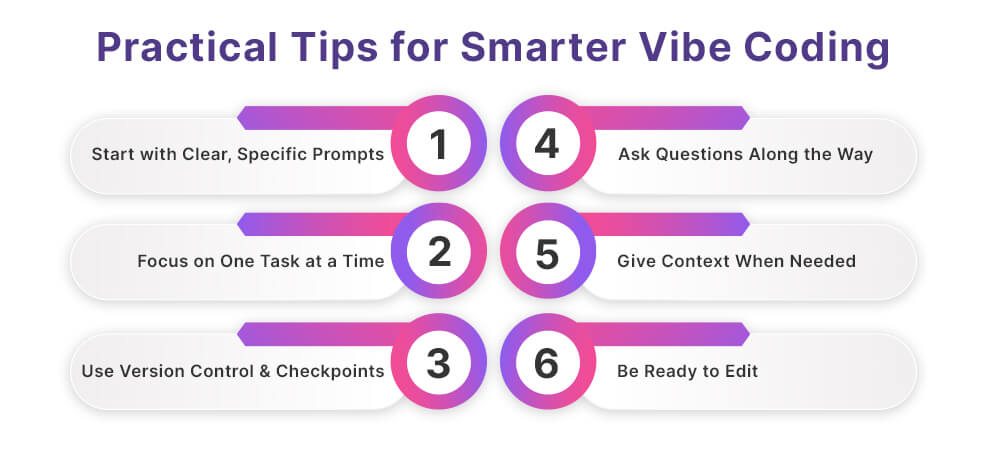
- Clear prompts, small tasks, early testing, and version control deliver the most reliable results and smoother iterations.
What is Vibe Coding?
Vibe coding is a modern approach to programming where humans describe the desired functionality of software using a few sentences as a prompt to LLMs. Instead of writing code line-by-line, users rely on Large Language Models (LLMs) like GPT-4 and DeepSeek to do the heavy lifting. These AI models interpret natural language prompts and return working code to build software.
Imagine building a simple app just by telling an AI what you want it to do. You dont need to know any syntax, no setup, no code blocks. That’s vibe coding in action.
At its core, vibe coding flips the traditional software development process. The user doesn’t need to understand complex algorithms or syntax. They just need to articulate what the program should do.
Think of it as giving instructions to a very smart assistant who knows every programming language. You say, “Create a chatbot that answers questions about weather,” and the AI writes the initial version of the code.
This shift creates two distinct roles:
- The AI (LLM) becomes the primary code generator. It translates human intent into executable software.
- The user becomes the guide, tester, and evaluator. They craft the prompts, check the results, and refine the instructions as needed.
It’s not about getting every detail right in the first try. It’s about collaborating with the AI, shaping the output over iterations, and reaching a working solution, often faster than traditional coding.
How Vibe Coding Works?
Vibe coding isn’t just a buzzword, it’s a practical workflow that turns ideas into functioning software through a conversation with AI. Here’s how it typically unfolds:
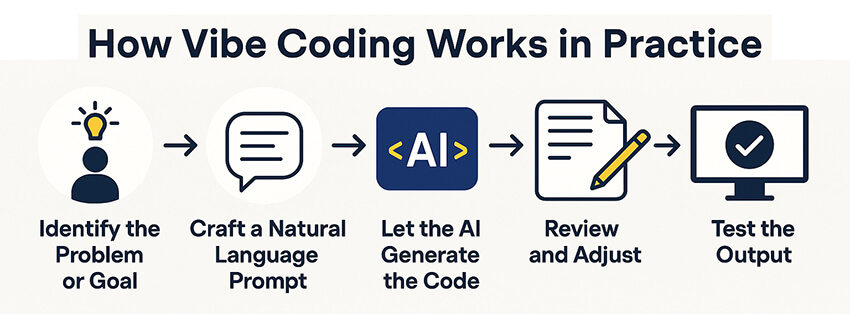
Vibe coding is a practical and transformative way to build software using natural language rather than traditional programming. With the support of advanced AI, especially large language models, users can describe what they want a program to do, and the AI generates the code for them. This removes many of the barriers that have traditionally limited software creation to expert developers.
The entire vibe coding workflow is designed to be intuitive, fast, and collaborative. Here is a detailed look at how vibe coding works in practice.
Step 1: Identify the Problem or Goal
Every vibe coding session starts with a need or an idea. Instead of thinking in terms of how to code a solution, the user focuses on what the software should achieve. This could be a small task, a vibe coding tool to automate work, or an app prototype. For example, a user might say, I want to automate sending a daily email with my calendar agenda.
This step emphasizes intent over implementation, which is the foundation of vibe coding.
Step 2: Write a Clear Prompt in Natural Language
Next, the user translates their goal into a plain language instruction. This prompt tells the AI what to do. The clearer and more specific the prompt, the better the result. For example, a prompt like write a React script that sends a daily email at 8 AM with the user’s Google Calendar events is much more effective than just saying automate my calendar emails.
Vibe coding tools are designed to help users craft better prompts. Tools for vibe coding tools provide features that guide users through prompt refinement and allow them to track how small changes to their instructions impact the code output.
Step 3: Let the AI Generate Code
Once the prompt is submitted, a large language model processes it and generates code that performs the requested task. This code may be written in React, JavaScript, or another programming language depending on the context and prompt.
This is where the power of modern vibe coding tools becomes clear. These coding tools, including platforms like Vitara, DeepSeek, and ChatGPT, turn natural language into functioning code without requiring any prior coding experience.
Step 4: Review the Output and Refine as Needed
After receiving the code, the user tests it to see if it works as expected. If something is not quite right, they can adjust the prompt slightly and regenerate the code. For instance, the user might say, Also make sure the script only includes events that are marked as confirmed.
Step 5: Run, Test, and Improve
The final step is to run the code and test its behavior. If errors appear or the code needs more features, the user simply updates the prompt and repeats the process. This back-and-forth cycle is central to how vibe coding works. It feels more like collaborating with a smart assistant than programming a machine.
Using a vibe coding tools AI streamlines this process further by giving users a place to run, store, and document their experiments. As the code evolves, users can stay organized and productive even across multiple iterations.
Vibe Coding vs Traditional Coding: The Difference
While both vibe coding and traditional coding aim to create functional software, they follow very different paths. Traditional programming relies on manually writing code using strict syntax, deep technical knowledge, and specific tools like code editors, compilers, and debuggers. Vibe coding, on the other hand, is built around collaboration with AI. Users describe what they want the software to do, and tools for vibe coding handle the implementation.
Traditional coding puts the focus on how to build. Vibe coding focuses on what to build.
Here is a side-by-side comparison to highlight the major differences between Vibe coding vs Traditional coding.
A Quick Comparison of Vibe Coding and Traditional Coding:
| Aspect |
Vibe Coding |
Traditional Coding |
| Approach |
Describe desired outcomes in plain language |
Write code line-by-line using programming languages |
| Tool Used |
Large Language Models (LLMs) |
IDEs, compilers, debuggers, and coding frameworks |
| User Skill Level |
Suitable for beginners and non-programmers |
Requires strong technical knowledge |
| Coding Knowledge Required |
Minimal – focuses on intent, not syntax |
High – user must understand logic, syntax, and structure |
| Speed |
Fast – good for quick builds and iteration |
Slower – more precision and planning involved |
| Control and Precision |
Lower – depends on the AI’s interpretation |
High – every line is written and reviewed by the developer |
| Best For |
Rapid prototyping, small tools, idea exploration |
Scalable, secure, and production-grade systems |
| Review Process |
Output reviewed post-generation; often iterative |
Code is reviewed during and after development |
| Security & Maintenance |
Higher risk due to unknowns in generated code |
Easier to secure and maintain with full understanding |
| Learning Curve |
Low – users can start building with basic guidance |
High – requires learning languages, logic, and debugging practices |
When to Choose Vibe Coding
Vibe coding is ideal when speed, simplicity, or experimentation is the priority. It is perfect for situations like:
- Rapid prototyping of ideas
- Building one-off internal tools
- Automating repetitive tasks
- Testing new APIs or concepts
- Enabling non-programmers to participate in development
Situations Where Traditional Coding Still Matters
Traditional software development is still essential when:
- The system needs to be scalable, secure, and maintainable
- You are working on complex architectures or enterprise-grade platforms
- There are strict performance, compliance, or security requirements
- You need deep control over every part of the codebase
In such cases, manual coding gives teams the precision and accountability that vibe coding currently cannot match.
A Hybrid Future
The future of software development may not be one or the other. Many development teams will adopt a hybrid model, using vibe coding tools to speed up ideation, automate tasks, or scaffold initial versions—then refining or scaling those outputs using traditional techniques.
Vibe coding is not replacing developers. It is transforming how they work by freeing them from repetitive tasks and enabling them to focus on solving real problems. For non-coders, it is an opportunity to finally build ideas without needing to learn how to code.
Key Characteristics of Vibe Coding
Vibe coding stands out from traditional development approaches not just because it uses AI, but because of the fundamental shift in how software is conceived, written, and refined. Instead of focusing on the code itself, vibe coding emphasizes intent, conversation, and collaboration between human and machine.
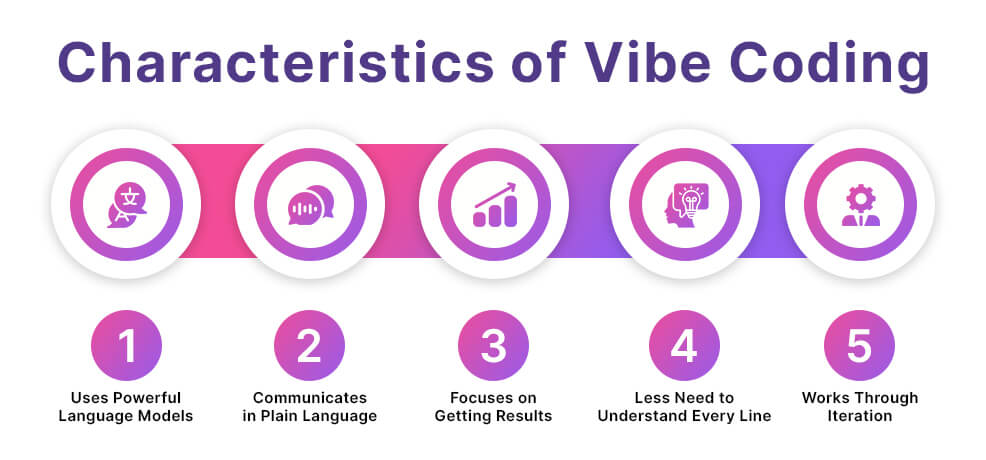
Here are the core characteristics that define vibe coding and explain why it is gaining popularity among developers, entrepreneurs, and non-technical creators.
Natural Language as the Interface
The most defining feature of vibe coding is the use of natural language. Users simply describe what they want a program to do, and the AI interprets this input to generate working code. There is no need to memorize syntax or understand programming logic before getting started.
Whether you want to automate a task or build a chatbot, you can do so by writing a sentence instead of a script.
AI Handles the Technical Complexity
Vibe coding shifts the technical burden to large language models. These models understand a wide range of programming languages and can write complex code in response to relatively simple prompts. They can handle libraries, APIs, error handling, and even some optimization logic.
With the help of modern vibe coding platforms, users can tap into these powerful capabilities without needing to manage dependencies, configuration files, or development environments.
Iterative by Nature
Vibe coding is not about getting the perfect solution in one shot. It works best as an iterative process, where users give the AI a prompt, review the result, refine their instructions, and repeat the cycle until the output meets their needs.
This fast feedback loop encourages experimentation and exploration. Users can quickly test ideas and pivot based on what works, without the heavy cost of rewriting code from scratch.
Focus on Outcomes, Not Implementation
In traditional development, a large portion of time is spent figuring out how to implement a feature. In vibe coding, the focus shifts to the outcome. You describe what the software should do, and let the AI figure out the technical steps.
This characteristics makes vibe coding especially useful for creators who care more about functionality than architecture. For example, an entrepreneur could build a working product demo in a day without hiring a developer.
Minimal Setup Required
Vibe coding tools eliminate the need for complex development environments. There is no need to install dependencies, configure local servers, or write boilerplate code. Vibe code platforms allow users to start coding immediately by simply typing prompts and running code in-browser.
This vibe coding feature of simplicity lowers the barrier to entry and speeds up the development cycle, especially for small tasks or early-stage prototypes.
Reduced Emphasis on Syntax and Rules
In vibe coding, users do not need to memorize syntax rules, language-specific quirks, or software architecture principles. Instead, they rely on the AI’s understanding of best practices to produce code that works.
That said, it is still important to review and test the output, especially when using it in production or security-sensitive environments. Tools for vibe coding support code reviews, multiple versions, and integrations with standard development workflows for safety and control.
Collaboration Between Human and AI
Perhaps the most unique trait of vibe coding is the human-AI partnership. The AI does the coding, but the human directs the vision. Users refine instructions, ask questions, and provide feedback. Over time, the relationship becomes more efficient, and the output improves.
Use Cases and Real Life Examples of Vibe Coding
Vibe coding is not designed to replace every aspect of traditional development, but it opens the door to a wide range of real-world use cases where speed, simplicity, and creativity are key. With the growing ecosystem of tools for vibe coding, even non-programmers can now solve problems that used to require professional development skills.
Here are some of the most common and practical applications of vibe coding today.
Rapid Prototyping and MVP Development
For startups, creators, and product teams, vibe coding offers a fast way to test ideas. Instead of setting up a development environment, writing boilerplate code, and debugging every step, users can simply describe what they want an app or script to do. In response, an AI coding assistant can generate a working version in minutes.
Platforms designed around vibe coding principles often include features that support prompt refinement, quick testing, and version management. This makes them ideal for fast-paced prototyping.
Internal Tools and One-Off Scripts
Small utilities and internal tools are often too niche to justify a full development cycle. Vibe coding makes it easy to build lightweight scripts for data formatting, batch renaming, file conversion, or any other repetitive task. These kinds of projects benefit greatly from the minimal setup and natural-language interface that vibe coding tools offer.
Some platforms, including emerging options in the vibe coding space, let users organize these small projects efficiently and return to them later without starting from scratch.
Automating Everyday Tasks
Sending daily reports, organizing files, connecting APIs, or scraping web data are examples of tasks that can be automated through vibe coding. Users can describe the task in everyday language and receive a working solution without needing to code it manually.
This is especially helpful in professional settings where AI-powered development environments can provide reusable code and keep work consistent across teams.
Learning and Experimentation
For beginners, vibe coding offers a way to explore programming concepts without the steep learning curve. Users can learn how a function works, explore new libraries, or see how an algorithm behaves simply by asking a question or describing a goal.
Some vibe coding tools also offer explanations alongside the code, making them valuable not just for building but for learning and discovery as well.
Building Personal Tools
When users need something highly specific such as a custom file organizer, a tool to clean up text data, or a shortcut for a recurring task, vibe coding makes it possible to build that solution quickly. These “software for one” projects may not need to be perfect, but they get the job done.
This is where a well-designed vibe coding platform can shine by helping users manage different versions, test small changes, and reuse helpful scripts over time.
Exploring APIs and New Technologies
Developers can also benefit from vibe coding when experimenting with APIs or testing new technologies. Instead of reading pages of documentation, they can describe what they want to do and receive a working example. This reduces the time it takes to get up and running.
Some vibe coding environments are especially good at supporting this kind of exploration. They offer context management and code history features to streamline the process.
Ideal for Low-Stakes, High-Speed Development
Not every project needs to be production-ready. Vibe coding is perfect for weekend projects, internal prototypes, early feature demos, or simple tools that solve a specific need. In these cases, working code matters more than polished architecture.
The best tools for vibe coding give users the ability to move quickly, stay organized, and revisit their projects as ideas evolve. Whether building a quick automation or validating a new concept, users benefit from platforms that support fast iteration and flexible development.
Real-World Examples
Vibe coding is gaining real traction, especially among startups aiming to move fast and stay lean.
Many startups are skipping traditional wireframes and jumping straight into prompt-driven prototypes. This helps founders test and launch MVPs faster with fewer engineering resources.
Vibe Coding Tools Powering This Shift:
- Vitara: Focused on enterprise-grade code governance. Suitable for teams scaling AI-generated projects.
- Replit Ghostwriter: Used by early-stage teams for fast code generation inside the browser.
- Cursor: Helps developers build real apps through code-prompt loops. Ideal for full-stack workflows.
- GitHub Copilot: Common in enterprise and freelance coding. Autocompletes everything from boilerplate to logic-heavy code.
- Lovable: Built for non-coders. Founders use it to turn product ideas into working app mockups in minutes. (Also Read: Lovable Alternatives)
- Opal (by Google): Allows users to create server functions with natural language. Best for backend-heavy projects.
In a recent year, 25% of startups used AI-assisted tools like vibe coding to build their core platforms. This reflects a growing industry shift toward prompt-based software creation, particularly in early-stage product development.
Best Practices for Vibe Coding: Tips for Vibe Coders
Vibe coding may feel like magic when your idea turns into working code after a single prompt, but like any creative process, it works best with the right habits and techniques. Whether you are just starting out or looking to get more consistent results, following these best practices can improve your experience and increase the reliability of your outcomes.
Start with Clear and Specific Prompts
Avoid vague instructions like build a dashboard or create an automation tool. The more specific your prompt, the better the code you receive. A strong prompt includes the purpose, the language or platform if necessary, and any required conditions.
For example, instead of saying generate a chart, a clearer prompt would be create a React script that uses matplotlib to generate a bar chart showing monthly sales from a CSV file.
Best tools for vibe coding help refine your instructions over time by storing prompt histories and offering suggestions for improvement.
Focus on One Task at a Time
Large language models work best when given a clear and focused objective. Trying to handle multiple tasks in one prompt can lead to confusion or partial results. Break complex goals into smaller steps. Tackle one feature or function at a time, then build from there.
This modular approach makes it easier to understand the generated code and simplifies troubleshooting.
Test Early and Often
Even if the AI produces working code, it is important to test it right away. Small errors, edge cases, or missing details are common. Running the code and checking its behavior quickly will help you avoid confusion later.
If your project involves external tools or services, test those integrations first before adding more complexity.
Save Your Versions
Because vibe coding is iterative, it is easy to lose track of previous attempts or working states. Use version control or checkpoints to save your progress. Some platforms designed for vibe coding allow you to store multiple versions of prompts and generated code in one place, which makes it easier to review and roll back changes if needed.
Ask Questions and Learn from the AI
Vibe coding is not just about getting code. It is also a great way to learn. You can ask the AI why it used a certain method or how a particular function works. Many users find that working this way deepens their understanding of programming concepts without the need for formal courses.
Provide Context When Necessary
If you are working on a multi-part project, help the AI understand the bigger picture by providing brief summaries or reminding it of earlier steps. This can improve consistency and prevent the AI from drifting off-topic as the project grows.
Some advanced tools for vibe coding support session memory or allow you to manually add context to prompts, which can improve continuity across multiple interactions.
Treat the Output as a Draft
Even when the AI generates functional code, it is rarely perfect on the first try. Think of the output as a draft that needs review. Read through the logic, check for security gaps, and test different scenarios. This is especially important for scripts that handle data, user inputs, or sensitive information.
Know When to Stop and Refactor
As you iterate, your project may become more complex. At some point, it might make sense to step back and restructure the code manually. While vibe coding is excellent for exploration and automation, a cleaner architecture might be needed for long-term use or team collaboration.
Many users combine top vibe coding tools with traditional development practices at this stage, using the AI to generate drafts and then refining them with human expertise.
By following these vibe coding best practices, you will get better results from vibe coding and avoid common pitfalls. Whether you are using it for learning, building tools, or experimenting with new ideas, a thoughtful approach makes all the difference.
Final Thoughts
Vibe coding is transforming how people interact with software development. By turning natural language into working code, it reduces barriers, accelerates innovation, and makes programming more accessible than ever. Whether you are an individual automating your daily work or a company building new digital products, vibe coding offers a faster and more flexible way to bring ideas to life.
Vibe coding is not just a trend. It is a practical shift in how we think about building software, and those who adapt early will be better positioned to create faster, think bigger, and innovate more freely.
Frequently Asked Questions About Vibe Coding
Vibe coding is a modern approach to programming where you describe what you want software to do using natural language. Instead of writing code manually, you rely on artificial intelligence to generate the code for you. It allows anyone, even without a technical background, to build apps, automate tasks, and explore software ideas.
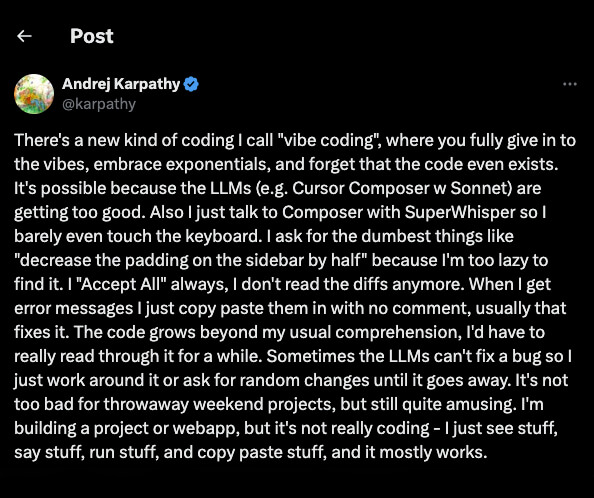
The term “vibe coding” was popularized by AI researcher Andrej Karpathy in a tweet that captured a new approach to programming with AI.
Vibe coding matters because it changes who can build AI-powered software and how fast they can do it. Instead of spending months learning programming languages, users can now describe what they want in plain language and get working code in return.
This approach unlocks development for non-coders, speeds up innovation, and reduces the technical bottleneck that often slows down businesses and creators.
No, it’s not the same. Traditional programming involves writing every line of code manually and having a deep understanding of logic, syntax, and structure. Vibe coding skips that step. Instead, users describe the outcome they want, and the AI generates the code. It’s more about guiding the process and testing results than crafting the solution by hand.
Not necessarily. One of its biggest advantages is that you don’t need formal coding skills to start vibe coding. Anyone can describe what they want an app or script to do and get AI-generated code. However, knowing the basics of programming logic, debugging, or testing can help you work more effectively with the AI and make better decisions about the output.
Not exactly. Low-code and no-code platforms use visual interfaces and pre-built components. Vibe coding is more flexible. It uses natural language prompts to generate custom code, often allowing for deeper control and broader applications. While both reduce the need to write code manually, vibe coding provides more freedom and adaptability.
Vibe coding uses natural language prompts to generate actual code, often through powerful AI models. In contrast, low-code and no-code platforms rely on visual interfaces, drag-and-drop tools, and pre-built components.
With vibe coding, you’re not limited to a platform’s templates, you can generate flexible, custom code guided by your own words. It offers more control than no-code, without needing traditional coding expertise.
Vibe coding relies on Large Language Models (LLMs) trained to understand and generate code. Tools like ChatGPT, Lovable, GitHub Copilot, Replit Ghostwriter, Bolt.new and Cursor are commonly used. These tools can interpret your natural language prompts and output working code in multiple languages, from JavaScript to Python and beyond.
It can be, but it depends on how it’s used. AI-generated code is often a great starting point, especially for simple tasks or prototypes. However, it might not always follow best practices, include proper error handling, or meet security standards. That’s why it’s important to test the code thoroughly, review the logic, and apply human oversight before using it in production environments.
Vibe coding offers several key benefits:
- Faster development: You can move from idea to working code quickly.
- Lower barrier to entry: Non-coders can build functional tools with natural language prompts.
- Boosts productivity: Developers can automate repetitive tasks and explore new ideas faster.
- Encourages innovation: Quick prototyping allows for more experimentation without heavy resource investment.
It’s a smarter, more accessible way to build.
While powerful, vibe coding has limitations:
- Code quality may vary: The AI might generate inefficient or insecure code.
- Lack of understanding: Users might rely on code they don’t fully comprehend.
- Debugging challenges: Fixing issues can be harder without knowing how the code works.
- Overreliance on AI: It may reduce learning opportunities for new developers.
That’s why human oversight, testing, and critical thinking remain essential.
Yes, but it should be done thoughtfully. Larger businesses can benefit from using vibe coding for internal tools, prototypes, or repetitive development tasks. With the right policies and oversight, vibe coding can increase productivity without sacrificing quality or security.
No, but it helps. You can get started with vibe coding without knowing any programming syntax. However, understanding basic programming concepts like variables, functions, and file handling can help you write better prompts, review the code more effectively, and make improvements when needed.
There are several best tools that support vibe coding workflows. These include GPT-4, GitHub Copilot, DeepSeek, and other AI-powered code generation platforms. Some platforms, such as Vitara.AI, are designed specifically for managing prompt-based development. They provide helpful features like prompt history, version control, and organized workspaces for building and refining code.
Vibe coding can be used by both individuals and teams. Many platforms that support vibe coding offer features like shared workspaces, version control, and collaboration tools, making it easy for multiple users to work on the same project. Teams can quickly test ideas, build internal tools, or automate processes together using natural language prompts.
Prompt quality has a direct impact on the results. Clear, specific, and goal-focused prompts lead to more accurate and usable code. Vague or overly broad prompts often result in incomplete or incorrect outputs. That is why many tools for vibe coding now include features that help users improve prompt clarity and track prompt versions over time.
A good vibe coding tool should make it easy to write prompts, test code, manage iterations, and learn along the way. Features like prompt history, version tracking, inline code explanations, and project organization help improve the experience.