10 Powerful Ways AI Is Transforming Efficiency and Innovation in the Logistics Industry
Key Takeaways
- AI in logistics reduces delays, improves accuracy, and lowers costs by optimizing routes, inventory, and real-time decisions.
- McKinsey reports that AI can cut logistics operational costs by up to 15% while significantly improving service levels.
- Predictive analytics and automation help logistics teams prevent stockouts, manage risks, and scale operations smoothly.
- AI-driven capabilities like dynamic pricing, fraud detection, and autonomous delivery are reshaping logistics efficiency.
- Successful AI adoption starts with clean data, the right tools, and logistics-focused AI partners.
Moving goods from one point to another is no longer a straightforward task. The logistics world today is a fast-moving puzzle of tight delivery windows, rising costs, and constant demand shifts.
To stay competitive, businesses can’t just add more trucks or warehouse space. They need sharper tools and smarter systems. That’s where Artificial Intelligence is making a difference.
AI is reshaping logistics by solving everyday problems with better data, faster decisions, and less guesswork. It helps plan routes in real time, predicts inventory needs before stock runs out, and keeps supply chains running smoothly even when unexpected disruptions hit.
According to McKinsey, businesses using AI in logistics can reduce operational costs by up to 15% and improve service levels significantly.
This article breaks down 10 real-world ways AI is transforming logistics efficiency. From warehouses to delivery routes, you’ll see how smart technology is changing the game and what that means for logistics teams everywhere.
What is AI in Logistics: Core Concepts & Technologies
Artificial Intelligence in logistics refers to the use of smart systems that can learn from data, spot patterns, and make decisions that improve how goods are moved and managed.
These systems don’t just follow rules, they adapt and get better over time. Whether it’s forecasting demand, optimizing delivery routes, or managing inventory, AI helps logistics teams work more efficiently and respond quickly to changing conditions.
Key Technologies Powering AI in Logistics
Several technologies work together to make AI useful in the supply chain:
- Machine Learning (ML): Trains systems to learn from past data, improving over time. For example, predicting demand spikes based on seasonal trends.
- Computer Vision: Helps machines “see” using images or video. Useful for scanning barcodes, tracking inventory, or guiding warehouse robots.
- Natural Language Processing (NLP): Powers chatbots and voice assistants that support customer service or warehouse operations.
- Robotics and Automation: AI-guided machines that sort, pick, and pack items faster than manual labor.
- IoT (Internet of Things): Connects devices like GPS trackers and sensors to collect real-time data from trucks, warehouses, or cargo containers.
- Predictive Analytics: Uses historical data to forecast delays, stock needs, or equipment failures before they happen.
Why AI Matters in Modern Logistics
Meeting customer expectations is harder than ever. Faster delivery. Lower costs. Zero room for mistakes. What once felt like a competitive edge is now the basic standard.
If your logistics operations still rely on traditional systems, delays and inefficiencies become hard to avoid. Manual tracking slows decisions. Disconnected tools create blind spots. Growth starts to feel like a struggle instead of an opportunity.
This is where AI changes the equation.
AI-powered logistics solutions bring intelligence into every step of the supply chain. From optimizing routes to predicting demand in advance, AI removes guesswork and replaces it with clarity. It helps businesses move faster, operate leaner, and scale without losing control.
Why AI Has Become Essential for Logistics
- Stronger Operational Efficiency
AI reduces manual effort across daily operations. It automates repetitive tasks, minimizes human error, and streamlines workflows. This leads to faster processing, smoother coordination, and fewer disruptions. According to Statista, many organizations expect automation to reshape supply chains over the next few years. Businesses that delay adoption risk falling behind.
- Lower Costs with Smarter Resource Use
AI directly impacts profitability. It identifies waste in fuel usage, route planning, labor allocation, and warehouse space. McKinsey reports that many companies using AI have already seen measurable cost savings. When operations become smarter, expenses naturally shrink.
- Faster Decisions with Real-Time Insights
Logistics runs on timing. A small delay can trigger a chain reaction across shipments and customers. AI processes real-time data instantly. It adjusts routes during traffic disruptions, predicts delivery risks, and reacts before problems grow. Teams no longer wait for reports. They act on live intelligence.
- Effortless Scalability for Growing Operations
Growth brings complexity. More orders. More routes. More warehouses. AI scales with the business without adding equal pressure on teams. It handles demand spikes, seasonal surges, and expansion across regions with consistency and control.
10 Key AI Use Cases Transforming Logistics
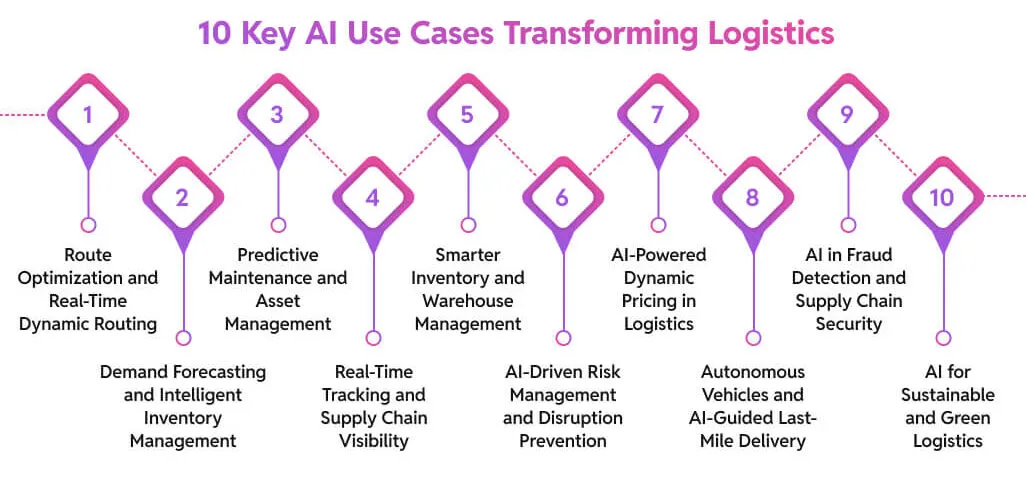
AI helps logistics teams solve real problems from route delays to stock management. It doesn’t work as one big system but as many smart tools across the supply chain.
Here are ten ways AI is making logistics faster, easier, and more reliable.
1. Route Optimization and Real-Time Dynamic Routing
In logistics, every minute on the road counts. Delays caused by traffic, road closures, or poor route planning not only slow deliveries, they drive up fuel and labor costs. That’s where AI makes a real difference.
AI-powered route optimization tools analyze live traffic updates, weather reports, vehicle load, and delivery time windows. Instead of using fixed plans, these systems adjust routes in real time. If a road is suddenly blocked or weather conditions shift, the AI recalculates and reroutes instantly.
This flexibility means drivers spend less time stuck in traffic, deliveries arrive faster, and fuel usage drops. It’s not just about getting from point A to B it’s about getting there smarter.
Why logistics teams love it:
- Helps reduce fuel consumption and delivery times
- Adapts instantly to changing road or weather conditions
- Improves driver productivity and vehicle usage
- Enhances last-mile delivery performance
Whether managing five trucks or five hundred, businesses using AI for route planning gain tighter control over time, cost, and customer satisfaction. It’s one of the fastest ways to boost efficiency without increasing fleet size.
2. Demand Forecasting and Intelligent Inventory Management
Guesswork is one of the biggest risks in logistics. Too much stock ties up capital. Too little stock leads to missed sales and unhappy customers. AI removes that uncertainty.
AI-driven demand forecasting studies historical sales, seasonal trends, market shifts, and real-time order data. It predicts what customers will need before they place the order. This allows logistics teams to prepare inventory at the right place and at the right time.
At the warehouse level, AI keeps stock balanced automatically. It flags slow-moving items, highlights fast-selling products, and triggers smart replenishment alerts. Instead of reacting to shortages, teams stay ahead of them.
The result is fewer stockouts, lower storage costs, and smoother order fulfillment. Warehouses run leaner. Customers get what they want on time.
Why this application matters:
- Prevents overstocking and sudden shortages
- Improves inventory turnover and cash flow
- Reduces storage and handling costs
- Supports faster and more accurate order fulfillment
With AI-driven inventory intelligence, logistics operations move from reactive control to predictive planning. That shift alone can transform both service quality and profitability.
3. Predictive Maintenance and Asset Management
Breakdowns in logistics are costly. A stalled delivery truck or a malfunctioning conveyor belt doesn’t just delay operations it impacts customer trust and piles on unexpected expenses. That’s why many logistics teams are shifting from reactive fixes to proactive planning.
With AI, maintenance becomes predictive instead of reactive. These systems study patterns from equipment sensors, past breakdowns, usage history, and environmental data. They can tell when a truck’s brakes might wear out or when a warehouse system shows early signs of failure.
Instead of waiting for something to break, teams get alerts well in advance. This allows them to schedule repairs at the right time avoiding surprise downtime, emergency repairs, or replacement costs.
How it helps logistics teams:
- Detects equipment issues before they cause failures
- Reduces unplanned downtime and emergency costs
- Extends the life of delivery vehicles and machinery
- Helps plan smarter maintenance schedules without disrupting operations
4. Real-Time Tracking and Supply Chain Visibility
One of the biggest frustrations in logistics is not knowing where something is. Whether it’s a delayed shipment or a missing package, lack of visibility can throw entire operations off course. That’s exactly where AI brings peace of mind.
AI-powered tracking systems connect with GPS, sensors, and IoT devices across the supply chain. They don’t just show where a truck is, they analyze delivery progress, flag risks, and predict arrival times with surprising accuracy. If a delay is likely, the system sends instant updates so teams can act fast and customers aren’t left guessing.
This kind of real-time visibility helps logistics teams make better decisions on the fly. It also builds trust. When clients know their orders are being monitored at every step, they feel confident because transparency always wins.
With AI doing the heavy lifting behind the scenes, what was once a black box becomes a clear window into the entire logistics process.
5. Smarter Inventory and Warehouse Management
Managing inventory isn’t just about counting what’s on the shelf. It’s about knowing what needs restocking, what’s moving fast, and what’s just taking up space. For many logistics teams, keeping that balance is a constant challenge.
AI changes how warehouses work by turning static storage into a dynamic, self-optimizing system. It tracks stock levels in real time, learns which items move faster, and helps prioritize how space and labor are used. Instead of reacting to orders, the system is already prepared.
Automation plays a big role here too. AI-powered tools can sort, pick, and pack items without human input. And when humans are involved, AI still assists, guiding workers to the most efficient routes, flagging errors before they happen, and speeding up order fulfillment.
6. AI-Driven Risk Management and Disruption Prevention
Logistics doesn’t follow a straight line. A single missed handoff, weather delay, or supplier hiccup can throw everything off. The more complex the supply chain, the harder it is to see trouble coming until it’s already here.
AI helps you stay a few steps ahead.
By constantly scanning data from suppliers, shipments, weather updates, and even news events, AI systems can flag risks before they become real problems. Think of it as early warning radar for your entire operation. It might detect a pattern of late deliveries from a vendor, rising fuel prices in a certain region, or a port slowdown before it hits the headlines.
And it doesn’t stop at alerts. AI suggests ways to respond rerouting shipments, adjusting delivery timelines, or switching suppliers temporarily. The goal isn’t just to react faster, but to reduce the impact altogether.
You can’t eliminate risk in logistics. But with AI watching your blind spots, you can deal with disruptions calmly, not chaotically.
7. AI-Powered Dynamic Pricing in Logistics
Pricing in logistics isn’t fixed. It shifts with demand, distance, delivery speed, fuel rates, and even competitor behavior. AI makes it easier to keep up and stay profitable without relying on guesswork.
Here’s how AI improves pricing decisions in logistics:
- Adapts to Market Changes Instantly
AI monitors demand spikes, competitor rates, and external factors like fuel prices or delivery zones to adjust pricing in real time.
- Improves Profit Margins Without Losing Customers
By analyzing customer behavior, shipping urgency, and service history, AI finds the sweet spot of competitive rates that still protect your margins.
- Enables Personalized Pricing Strategies
Logistics providers can offer custom pricing based on order frequency, client volume, or loyalty keeping top customers happy while maximizing value.
- Reduces Revenue Leakage
AI flags inconsistencies in pricing models, incorrect rate applications, or missed surcharge opportunities that human systems often overlook.
- Supports Transparent Communication
When prices shift, AI can provide reasoning based on clear data, making it easier to explain changes to clients and keep trust intact.
8. Autonomous Vehicles and AI-Guided Last-Mile Delivery
Last-mile delivery often causes the most strain in logistics. It eats up time, racks up costs, and adds complexity when routes change or traffic slows things down. AI helps logistics teams take back control of that final stretch.
Autonomous vehicles, robots, and drones now handle deliveries in controlled environments. These machines rely on AI to process traffic patterns, avoid obstacles, and make fast decisions while on the move. Logistics companies already use these tools in pilot programs to deliver small packages, groceries, and even pharmaceuticals.
Even when drivers are involved, AI supports them. It organizes delivery stops in the most efficient order, suggests alternate routes when delays pop up, and ensures tighter schedules with less manual planning.
By reducing human effort in high-volume zones and automating repetitive tasks, AI transforms the last mile into a faster, more reliable process. As delivery volumes continue to rise, businesses that adopt AI-guided delivery gain an edge others struggle to match.
9. AI in Fraud Detection and Supply Chain Security
Supply chains move fast and that speed can create blind spots. Fraud, theft, and hidden risks often slip through unnoticed until it’s too late. AI helps logistics companies tighten their defenses without slowing operations down.
AI systems monitor transactions, supplier records, shipment data, and route histories in real time. They look for unusual patterns like repeated delivery failures, mismatched documentation, or unauthorized location changes. When something doesn’t look right, the system raises a red flag instantly.
Teams no longer need to sift through endless reports to catch a problem. AI does it in seconds and points them exactly where to look.
More importantly, AI learns from every incident. It continuously updates its threat models to stay ahead of new fraud tactics. That means better protection over time, not just one-time fixes.
By actively tracking anomalies and securing every link in the chain, AI helps logistics businesses prevent losses, reduce risk, and protect their reputation.
10. AI for Sustainable and Green Logistics
AI plays a major role in helping logistics companies operate more sustainably without sacrificing speed or efficiency.
Here’s how AI supports green logistics efforts:
- Reduces Fuel Consumption
AI finds the most efficient delivery routes, cuts idle time, and avoids traffic-heavy zones leading to fewer emissions per trip.
- Optimizes Energy Use in Warehouses
It monitors equipment usage, lighting, and climate systems to recommend energy-saving adjustments that lower operational costs.
- Supports Smarter Fleet Transitions
For companies moving to electric vehicles, AI helps plan charging schedules, optimize routes, and reduce battery strain.
- Minimizes Packaging Waste
AI analyzes order patterns and product dimensions to suggest the most efficient packaging using fewer materials and reducing waste.
- Tracks Carbon Footprint Accurately
It collects real-time data on fuel use, delivery volumes, and energy consumption helping companies report sustainability metrics with confidence.
- Improves Overall Environmental Compliance
AI helps businesses stay aligned with emissions targets, green policies, and evolving regulations without slowing down their operations.
Challenges in Implementing AI in Logistics
AI holds incredible promise for logistics, but getting there isn’t always easy. Many companies hit roadblocks that slow down adoption or create frustration before real results show up.
Here are some of the biggest challenges logistics teams face when implementing AI:
- Outdated Systems and Tech Limitations
Many logistics firms still rely on older software and rigid infrastructure. These systems aren’t built for real-time data exchange or flexible AI integration, which makes it hard to connect new tools without major upgrades.
- Messy, Incomplete, or Siloed Data
AI needs clean, consistent, and connected data to work well. But in logistics, information often lives in different formats across departments. This makes it difficult for AI to spot patterns or deliver reliable predictions.
- Shortage of Skilled People
Hiring people who understand both logistics and AI is tough. There’s a real talent gap when it comes to data scientists, AI engineers, and logistics tech specialists. Without the right people, even the best tools can fall short.
- Internal Resistance to Change
AI often requires new workflows, automation, and decision-making models. That kind of change can feel intimidating. Without clear communication and proper training, teams may resist the shift or use AI inconsistently.
- High Initial Investment and Unclear ROI
Getting started with AI isn’t cheap. Hardware, software, integration, and staff training all come at a cost. Some businesses hesitate to move forward if they’re unsure when and how the investment will pay off.
How Businesses Can Implement AI in Logistics?
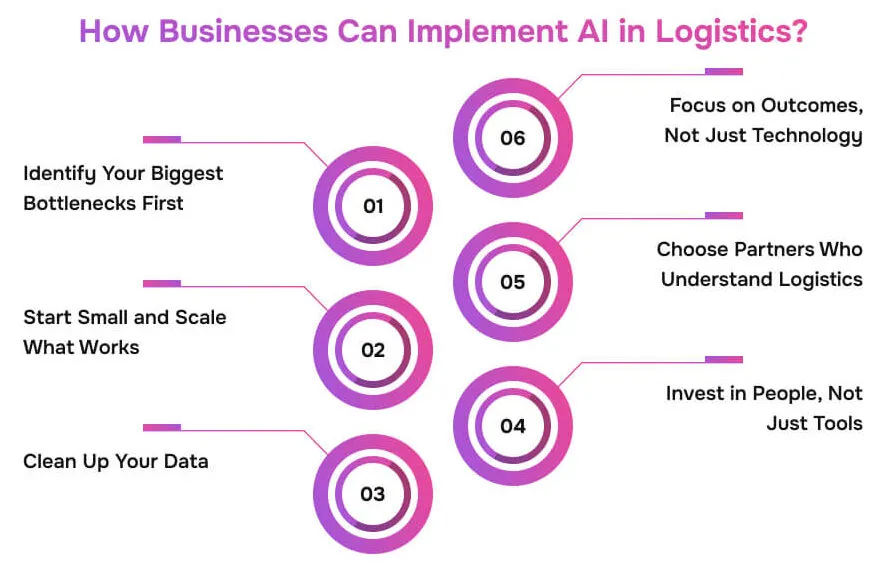
Adopting AI doesn’t require a full tech overhaul on day one. The smartest logistics teams don’t try to do everything at once they focus on starting where it matters most.
Here’s how businesses can begin their AI journey with confidence and clarity:
- Identify Your Biggest Bottlenecks First
Look at areas where delays, errors, or inefficiencies regularly slow you down. That could be delivery routing, inventory forecasting, or customer support. Start with a pain point that AI can solve quickly and measurably.
- Start Small and Scale What Works
Instead of launching AI across the entire supply chain, begin with a focused pilot. Use one tool. Solve one problem. Measure the impact. Once it proves value, expand step by step.
- Clean Up Your Data
Before implementing any AI system, make sure your data is accurate, organized, and accessible. Break down silos. Standardize formats. Good data is the fuel that powers effective AI.
- Invest in People, Not Just Tools
AI systems don’t run themselves. Upskill your existing team or bring in experts who understand both logistics and data. Provide training so your staff knows how to use the tools not fear them.
- Choose Partners Who Understand Logistics
Not every AI vendor understands the realities of delivery routes, warehouse chaos, or customer deadlines. Work with providers who specialize in logistics and can tailor solutions to your operation.
- Focus on Outcomes, Not Just Technology
Make sure every AI effort is tied to a clear business goal: faster deliveries, fewer errors, lower costs. Let those goals guide your decisions, not the hype around technology itself.
The Future of AI in Logistics
AI has already changed how logistics operates but it’s only the beginning. The next phase will bring smarter, more adaptive systems that learn and respond in real time.
- Autonomous Delivery Will Become Commonplace
Companies will rely on self-driving trucks and drones to improve delivery speed and cut labor costs.
- Supply Chains Will Self-Correct in Real Time
AI will automatically reroute shipments and adjust inventory flows before disruptions cause delays.
- Sustainability Tracking Will Go Smart
Businesses will use AI to monitor emissions and optimize resources for greener logistics operations.
- AI Tools Will Be More Accessible to All
Smaller logistics providers will adopt AI-as-a-Service platforms without needing big budgets or IT teams.
- Humans and AI Will Collaborate More Closely
People will focus on strategy and decision-making, while AI handles the data and automation.
Conclusion
AI has already started to change the way logistics works and it’s only picking up speed. From optimizing delivery routes to managing inventory and preventing disruptions, AI gives logistics teams tools that make everyday operations smarter, faster, and more reliable.
Businesses that embrace AI now gain more than just efficiency. They build systems that adapt quickly, make decisions in real time, and create better experiences for customers and teams alike. Whether it’s improving last-mile delivery or reducing fuel costs, AI helps move logistics forward in a way that traditional tools simply can’t.
Businesses that embrace AI now gain more than just efficiency. They build systems that adapt quickly, act in real time, and create better experiences for customers and teams alike. Whether it’s improving last-mile delivery or reducing fuel costs, AI helps move logistics forward in a way that traditional tools simply can’t.
Starting small, staying focused on real problems, and building with the right data and people supported by strong AI development capabilities can make all the difference. AI in logistics isn’t about replacing what works, it’s about making it work better, at every step.
Frequently Asked Questions
AI in logistics uses smart systems that learn from data to improve how goods move. It helps teams plan better, respond faster, and avoid common delays by making real-time decisions.
AI is making logistics faster, smarter, and more efficient. It improves route planning, automates warehouses, predicts demand, and helps teams make real-time decisions with better accuracy.
AI brings several real, measurable benefits to logistics operations here are the ones that matter most:
- Faster deliveries
AI finds the best routes and avoids delays with real-time traffic and weather updates.
- Lower operating costs
It reduces fuel use, cuts labor waste, and improves warehouse efficiency.
- Smarter inventory control
AI forecasts demand and prevents overstock or stockouts.
- Better customer experience
Real-time tracking and accurate delivery times build trust and satisfaction.
- Greater supply chain visibility
Teams get live updates across shipments, inventory, and operations all in one view.
The cost depends on how and where you use it. Many businesses start small with route optimization or demand forecasting tools, which are cost-effective and easy to scale over time.
- Legacy systems often block smooth AI integration.
- Poor data quality weakens prediction accuracy.
- Skill gaps slow down implementation and maintenance.
- Employee resistance makes change harder to adopt.
- High upfront costs create hesitation without clear ROI.
- Start with your biggest pain point
Focus on the area where delays or costs hurt most like routing, inventory, or tracking.
- Set a clear goal
Know what outcome you want: faster delivery, fewer errors, or reduced overhead.
- Look for logistics-specific tools
Choose AI solutions built for supply chain needs not just generic platforms.
- Check integration ease
Make sure the tool works well with your existing systems and data setup.
- Consider scalability
Pick a solution that can grow as your business expands.
- Evaluate support and training
Ensure the provider offers onboarding, training, and ongoing help for your team.