Top 10 AI PoC Use Cases for Enterprises to Validate Before Scaling
Artificial intelligence is becoming a strategic priority for enterprises, but jumping directly into full-scale AI development can be expensive, risky, and difficult to justify without proof. That is why many enterprises start with an AI Proof of Concept.
An AI PoC is a focused, time-bound experiment that helps a business validate whether an AI idea is technically feasible, commercially useful, and practical enough to scale. Instead of building a full AI product, enterprises use PoCs to test one use case, one data set, one workflow, and one measurable business outcome.
In this article, we will explore the top AI PoC use cases for enterprises, along with what each PoC should validate, the data required, success metrics, and ideal business departments.
What Is an AI PoC?
An AI Proof of Concept is a small-scale validation project built to answer a specific question: can AI solve this business problem with acceptable accuracy, cost, speed, security, and user value?
Validate Enterprise AI Ideas Faster
Prismetric helps enterprises test AI PoC use cases with real data, clear KPIs, and scalable planning.
Start Your AI PoC
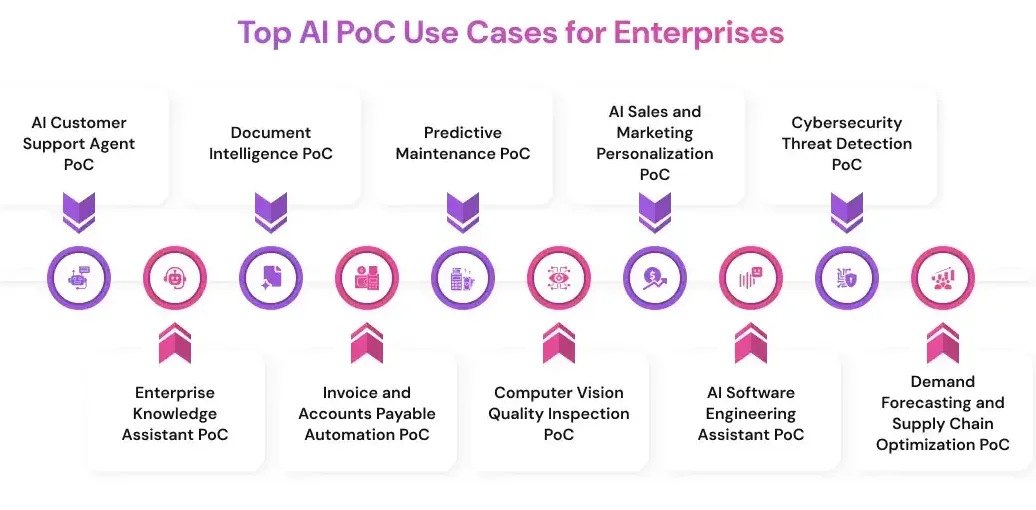
Top 10 AI PoC Use Cases for Enterprises That Can Drive Real Impact
AI PoCs work best when they are linked to a real business problem. Enterprises should not test AI only because it is trending. They should begin with use cases where the outcome can be measured, the data is available, and the business value is clear.
Here are some practical AI PoC use cases enterprises can validate before investing in full-scale AI development.
1. AI Customer Support Agent PoC
Customer support is one of the most practical areas to begin with an AI PoC. Enterprises can test whether an AI agent can understand customer queries, give accurate answers, and escalate complex issues to human agents when required.
For example, the PoC can be limited to the top 30 to 50 recurring customer questions instead of automating the complete support process.
A customer support AI PoC can help validate:
- How accurately the AI responds to common queries
- Whether it can reduce average response time
- How well it handles escalation to human agents
- Whether it can reduce support team workload
The success of this PoC can be measured through ticket deflection rate, first-contact resolution, escalation accuracy, and customer satisfaction score.
2. Enterprise Knowledge Assistant PoC
Large enterprises often have information scattered across internal portals, PDFs, policy documents, SOPs, training manuals, and knowledge bases. Employees may spend a lot of time searching for the right answer or depending on other teams for basic information.
An enterprise knowledge assistant PoC helps test whether AI can retrieve accurate answers from approved company data. This is useful for HR, IT, legal, operations, and customer-facing teams.
The main goal is to check whether the AI can provide answers with proper context and trusted sources. If employees can find information faster and with fewer errors, the use case can be expanded further.
3. Document Intelligence PoC
Enterprises that deal with large volumes of contracts, invoices, insurance claims, reports, or compliance documents can use document intelligence as an AI PoC use case.
This PoC checks whether AI can:
- Extract key details from documents
- Classify different document types
- Summarize long files
- Identify missing information
- Highlight risks or unusual patterns
For legal teams, this could mean identifying important clauses in contracts. For insurance companies, it could mean extracting claim details. For finance teams, it could mean reviewing invoices and reports faster.
The outcome can be measured through extraction accuracy, processing speed, error reduction, and manual review time saved.
4. Invoice and Accounts Payable Automation PoC
Finance departments often handle repetitive and rule-based tasks, which makes invoice automation a strong AI PoC use case. Enterprises can test whether AI can read invoices, extract details, match them with purchase orders, detect duplicates, and route exceptions for review.
This PoC does not need to cover the entire accounts payable process. It can begin with a few selected vendors, invoice formats, or transaction types.
A successful PoC should show whether AI can reduce manual data entry, improve invoice validation speed, and identify mismatches before payment approval.
5. Predictive Maintenance PoC
For manufacturing, logistics, energy, and utility enterprises, equipment downtime can directly affect productivity and revenue. A predictive maintenance PoC helps test whether AI can identify early signs of machine failure before breakdowns happen.
This use case usually depends on:
- IoT sensor data
- Machine performance logs
- Maintenance records
- Temperature or vibration data
- Past failure history
The PoC can start with one machine, one production line, or one asset category. The goal is to check whether AI can predict possible failures early enough for the maintenance team to take action.
If the model helps reduce unplanned downtime or improves maintenance planning, the enterprise can consider scaling it across more assets.
6. Computer Vision Quality Inspection PoC
Computer vision is a useful AI PoC use case for enterprises where visual inspection plays an important role. This includes manufacturing, pharma, food processing, retail, automotive, and warehouse operations.
The PoC can test whether AI can detect:
- Product defects
- Damaged packaging
- Missing labels
- Cracks or dents
- Color variations
- Safety issues
The most important factor here is accuracy. The system should detect defects without creating too many false positives or rejecting good products unnecessarily.
A good computer vision PoC should also use real production images or video feeds instead of only clean sample data.
7. AI Sales and Marketing Personalization PoC
Sales and marketing teams can use AI PoCs to test personalization before applying it across the entire customer journey.
For example, an ecommerce company can test AI-powered product recommendations for one category. A B2B company can test whether AI can score leads based on CRM data, website activity, and campaign engagement.
This type of PoC can be used for:
- Lead scoring
- Product recommendations
- Customer segmentation
- Personalized email suggestions
- Next-best-action recommendations
The impact can be measured through conversion rate, engagement rate, lead quality, sales productivity, and revenue influenced by AI-driven recommendations.
Turn AI Use Cases into Proof
Prismetric builds AI PoCs for automation, forecasting, support, security, and enterprise workflow validation.
Validate Your Use Case
8. AI Software Engineering Assistant PoC
Enterprises with large software teams can use an AI PoC to understand whether AI can improve developer productivity.
The PoC may focus on one specific engineering workflow, such as code generation, unit test creation, code review, bug detection, documentation, or legacy code explanation.
Instead of applying AI across the entire development department, the enterprise can test it with one team or one repository. This makes it easier to measure whether AI is actually improving speed and quality.
Useful KPIs for this PoC include development cycle time, pull request review speed, test coverage, bug reduction, and developer satisfaction.
9. Cybersecurity Threat Detection PoC
Security teams often manage a large number of alerts every day. Many of these alerts may be low priority, repetitive, or false positives. An AI cybersecurity PoC can help validate whether AI can detect unusual activity, prioritize alerts, summarize incidents, and support faster response.
This PoC can be tested using security logs, SIEM alerts, endpoint data, user access logs, network activity, and past incident reports.
The use case should begin with a focused area, such as one threat category, one system, or one type of alert. If AI can reduce alert noise and help analysts identify high-risk events faster, it can become a valuable part of the enterprise security workflow.
10. Demand Forecasting and Supply Chain Optimization PoC
Demand forecasting is a strong AI PoC use case for retail, ecommerce, manufacturing, logistics, and distribution businesses. The goal is to test whether AI can improve planning by predicting demand, inventory needs, delivery delays, or route inefficiencies.
The PoC can begin with a limited scope, such as:
- One product category
- One region
- One warehouse
- One supplier group
- One delivery route
The AI model can use historical sales data, inventory records, supplier timelines, seasonal demand, pricing data, and market signals.
Even a small improvement in forecast accuracy can help enterprises reduce overstocking, prevent shortages, improve delivery planning, and make supply chain operations more efficient.
These AI PoC use cases allow enterprises to test AI in a focused and measurable way. The goal is not to build a complete AI system immediately. The goal is to validate whether the idea works with real business data, solves a real operational problem, and has enough value to move toward MVP, pilot, or full-scale AI deployment.
Comparison Table: Top Enterprise AI PoC Use Cases
| Step |
Stage |
Key Focus |
Process |
Outcome |
| Step 1 |
Initial consultation and requirement gathering |
Understanding the business problem, goals, users, and AI expectations |
Business consultation, requirement documentation, and objective clarification |
A clear requirement specification document for the AI PoC |
| Step 2 |
Feasibility analysis |
Assessing technical viability, data readiness, and business feasibility |
Technical assessment, data readiness review, and risk analysis |
A feasibility report with insights, risks, and recommendations |
| Step 3 |
Conceptual design |
Defining how the AI solution will work and fit into the business workflow |
AI workflow design, model approach planning, and prototype architecture |
A conceptual AI PoC design with technical and visual direction |
| Step 4 |
Development phase |
Building the core AI functionality needed to prove the concept |
Agile development, core AI feature development, and regular updates |
A functional AI PoC that demonstrates the proposed AI solution |
| Step 5 |
Testing and validation |
Checking performance, accuracy, usability, and business alignment |
Functional testing, model performance testing, and user testing |
A validated AI PoC ready for iteration or scale planning |
| Step 6 |
Feedback and iteration |
Refining the AI PoC based on user, stakeholder, and technical feedback |
Feedback collection, implementing changes, and re-testing |
An improved AI PoC aligned with business goals and user expectations |
| Step 7 |
Final presentation |
Presenting results and planning the next stage of AI development |
Demonstration, stakeholder review, and next steps planning |
A successful AI PoC presentation with clear scaling recommendations |
AI PoC Success Criteria Enterprises Should Define
Before starting an AI PoC, enterprises should clearly define what success looks like. Without measurable criteria, it becomes difficult to decide whether the PoC is worth scaling or not.
Some important success criteria include:
- Accuracy target
- Response time
- Cost per query, user, or transaction
- Manual effort reduction
- Error reduction
- User satisfaction score
- Data quality requirements
- Security and compliance standards
- Integration feasibility
- Expected ROI
For example, instead of saying, “We want to test an AI support chatbot,” a better PoC goal would be:
“We want to validate whether an AI support agent can resolve 40% of tier-1 tickets with 90% escalation accuracy and a response time under 3 seconds.”
This makes the PoC more measurable and helps stakeholders take a clear go/no-go decision after the trial.
Common Reasons AI PoCs Fail
AI PoCs usually fail when they are planned like experiments without clear business direction. Many enterprises start with excitement around AI but do not define the problem, data, users, or success metrics properly.
Common reasons include:
- Choosing a use case that is too broad
- Starting without clean or accessible data
- Not defining measurable KPIs
- Building around technology instead of business value
- Ignoring security and compliance requirements
- Testing with unrealistic sample data
- Not involving real users or business teams
- Skipping integration planning
- Treating the PoC as a final product
- Not defining the next step after validation
A successful AI PoC should stay focused, measurable, and connected to a real business outcome. That is what helps enterprises move from experimentation to confident AI implementation.
Which AI PoC Use Case Should Enterprises Start With?
Enterprises should start with an AI PoC use case that is narrow, measurable, and supported by available data. The goal is to validate one clear business problem instead of testing too many AI possibilities at once.
The best first AI PoC usually has:
- A clear business owner
- A painful operational problem
- Accessible historical data
- A measurable baseline
- Low-to-medium integration complexity
- A clear go/no-go decision
- Strong potential ROI
For many enterprises, the best starting points are customer support automation, internal knowledge assistants, document intelligence, invoice automation, and predictive maintenance. These use cases are easier to scope, easier to measure, and often show visible productivity gains in a short time.
The right AI PoC should help the enterprise answer one simple question: is this use case valuable enough to move toward MVP, pilot, or full-scale AI development?
How to Move From AI PoC to MVP
Once an AI PoC proves that the idea is feasible, the next step is to convert it into an AI MVP or pilot. At this stage, the focus shifts from validation to building a usable solution for real users and real workflows.
The transition should include:
- Reviewing PoC results against success criteria
- Identifying technical, data, and integration limitations
- Improving model accuracy and reliability
- Adding production-ready security and compliance controls
- Designing user workflows and interfaces
- Integrating the solution with enterprise systems
- Adding monitoring, feedback loops, and human review
- Defining core MVP features
- Estimating development and operational costs
- Preparing a roadmap for scaling
Moving from PoC to MVP should happen only when the use case shows clear business value, reliable performance, and practical scalability.
Why Prismetric Is a Trusted Partner for Enterprise AI PoC Development
Building an AI PoC is not just about testing a model or creating a quick demo. It requires the right mix of business understanding, data analysis, AI engineering, and product development expertise. This is where Prismetric can help enterprises move from AI ideas to practical validation.
At Prismetric, we help businesses identify the right AI use cases, define measurable PoC goals, assess data readiness, and build focused AI proof of concepts that are aligned with real business outcomes. Whether you want to validate an AI chatbot, predictive analytics model, document intelligence system, computer vision solution, or generative AI assistant, our team can help you test the idea before investing in full-scale development.
What makes Prismetric a reliable AI PoC development partner is our structured approach. We focus on feasibility, accuracy, scalability, security, and ROI from the beginning so that enterprises can make confident decisions after the PoC stage.
Move from AI Idea to MVP
Prismetric validates AI PoCs and helps businesses plan the next step toward MVP and deployment.
Plan Your AI MVP
With Prismetric, enterprises can:
- Validate AI ideas with clear success metrics
- Reduce development risks before full-scale investment
- Test AI solutions using real business data
- Identify technical, data, and integration challenges early
- Move smoothly from AI PoC to MVP, pilot, and production
If your enterprise has an AI idea but is unsure about its feasibility, Prismetric can help you turn that idea into a focused, measurable, and business-ready AI PoC.
Final Thoughts
AI PoCs help enterprises validate ideas before making major investments in full-scale AI development. The right PoC should be narrow, measurable, and connected to a clear business outcome.
Whether the goal is customer support automation, predictive maintenance, document intelligence, supply chain forecasting, cybersecurity, or software engineering productivity, the best AI PoC is the one that answers a real business question using real data.
If your enterprise has multiple AI ideas but is unsure where to start, begin with a focused AI PoC. It can help reduce risk, build stakeholder confidence, and create a clear path toward AI MVP, pilot, and full-scale deployment.
FAQs About AI PoC Use Cases for Enterprises
The best AI PoC use cases for enterprises are the ones that solve a clear business problem and can be measured with available data. Some common examples include:
- Customer support automation
- Enterprise knowledge assistants
- Document intelligence
- Invoice and accounts payable automation
- Predictive maintenance
- Computer vision quality inspection
- Demand forecasting
- Cybersecurity threat detection
- AI-powered software engineering assistance
- Sales and marketing personalization
Enterprises should start with a use case that is narrow, measurable, and supported by available data. Customer support automation, document processing, internal knowledge search, invoice automation, and predictive maintenance are often good starting points because they are easier to scope and measure.
An example of an AI PoC is testing whether an AI support agent can resolve 40% of tier-1 customer queries with 90% escalation accuracy and a response time under 3 seconds.
This type of PoC helps validate:
- Whether the AI can answer common queries correctly
- How often it needs human support
- Whether it can reduce response time
- Whether the results justify full-scale AI development
Enterprises should choose an AI PoC use case based on practical business and technical factors, such as:
- Business value
- Data availability
- Technical feasibility
- Integration complexity
- Security and compliance needs
- User adoption potential
- Expected ROI
The use case should solve a real business problem, not just demonstrate AI capabilities.
The required data depends on the use case. A customer support PoC may need FAQs, support tickets, and chat history. A predictive maintenance PoC may need IoT sensor data, machine logs, and maintenance records. A document intelligence PoC may need contracts, invoices, reports, or claims documents.
An enterprise AI PoC usually takes a few weeks to a few months. The timeline depends on the complexity of the use case, data readiness, model requirements, integrations, security checks, and success criteria.
AI PoC success should be measured using predefined business and technical metrics. Common success criteria include:
- Accuracy
- Response time
- Cost per query or transaction
- Manual effort reduction
- Error reduction
- User satisfaction
- Data quality
- Integration feasibility
- Security and compliance readiness
- Expected ROI
The goal is to decide whether the AI use case is ready to move toward MVP, pilot, or full-scale deployment.
An AI PoC validates whether an AI idea is technically feasible and valuable. An AI MVP is a usable version of the product built with core features for real users.
In simple terms:
- AI PoC answers: “Can this work?”
- AI MVP answers: “Will users use this?”
- AI pilot answers: “Can this work in a real environment?”
- Full-scale deployment answers: “Can this scale across the business?”
AI PoCs often fail because they are not connected to a clear business outcome. Other common reasons include poor data quality, unclear KPIs, broad project scope, lack of user involvement, weak integration planning, and ignoring security or compliance needs.
Common generative AI PoC use cases for enterprises include:
- AI chatbots
- Enterprise knowledge assistants
- Contract summarization
- Report generation
- Email drafting
- Customer support agents
- Code generation
- Meeting summarization
- AI-powered document analysis
These use cases are useful when enterprises want to test how generative AI can improve productivity, content creation, decision-making, and internal operations.
Yes, small and mid-sized businesses can also build AI PoCs. In fact, starting with a PoC is useful for businesses with limited budgets because it helps validate the idea before investing in full-scale AI development.
SMBs can start with focused use cases such as:
- AI chatbot for customer support
- Invoice processing automation
- Sales lead scoring
- Document summarization
- Product recommendation engine
After a successful AI PoC, the enterprise can move toward an AI MVP or pilot. This usually includes improving model accuracy, adding security controls, designing user workflows, integrating with business systems, adding monitoring, and preparing a roadmap for full-scale deployment.