Generative AI for Internal Audit: Use Cases, Benefits and Implementation
Key Takeaways
- Generative AI speeds up audit cycles by summarizing reports, data, and documents, saving hours from planning through reporting.
- Tools like ChatGPT and Gemini are entering audit workflows, with 41 percent of CAEs already using or planning to adopt GenAI within a year.
- Auditors apply GenAI to summarize risks, draft memos, suggest controls, and prepare interviews, making audits more strategic.
- Early adopters report up to 40 percent reduction in manual workload, along with more consistent outputs and real-time insights.
- Teams that start small, train users, and keep humans in the loop achieve faster adoption with lower risk and higher trust.
- From compliance to training, GenAI scales well for both small audit teams and large enterprises.
Internal audit is no longer just a compliance checkpoint. It’s a strategic function, expected to deliver fast insights, spot emerging risks, and help organizations stay one step ahead. But traditional tools struggle to keep up with today’s pace of change. That’s where Generative AI (GenAI) steps in.
GenAI is rewriting the rules of internal auditing. With its ability to process massive volumes of data, summarize findings, and even draft reports, it empowers audit teams to work smarter, not just harder. What once took weeks can now take hours. And what was buried in spreadsheets can now be surfaced with a single prompt.
Adoption isn’t a distant idea. According to Gartner, 41% of Chief Audit Executives (CAEs) are either using or actively planning to use GenAI within the year. Tools like ChatGPT and Gemini are quietly becoming part of the auditor’s toolkit.
The momentum is global. A KPMG survey of 1,800 companies found that nearly all (99%) expect to use AI by 2027. Of those, 97% plan to deploy GenAI specifically, especially within financial reporting and audit. The shift is underway, and it’s accelerating fast.
The question now isn’t if GenAI will reshape internal audit, but how fast you can catch up.
This article explores how GenAI is transforming internal audit, where it fits across key audit phases, and how to implement it safely. You’ll also discover real-world use cases, practical steps, and ways to navigate risks with confidence.

Understanding the Role of Generative AI in Internal Auditing
Generative AI, or GenAI, refers to artificial intelligence models that can create human-like content. For internal auditors, this means faster documentation, sharper insights, and fewer manual tasks. It’s not just about automation. It’s about intelligent assistance that adapts to your needs in real time.
Unlike traditional AI, which analyzes and predicts, GenAI can summarize audit reports, draft planning memos, and even suggest follow-up questions. It enhances decision-making by turning raw data into useful narratives, saving auditors time and boosting the quality of their work.
In an audit environment where speed, accuracy, and adaptability are essential, GenAI acts like a digital co-pilot. It helps auditors keep up with growing data volumes, changing regulations, and increasing expectations without sacrificing precision or control.
How Does Generative AI Work in Auditing?
Generative AI operates by analyzing vast datasets to find patterns, relationships, and context. It then uses this understanding to create new content, like summaries, audit observations, or risk flags that mimic human reasoning. This makes it a powerful tool for handling large volumes of audit data quickly and efficiently.
At the core of GenAI are foundation models like GPT-4, Google Gemini, or Claude. These models are pre-trained on a wide variety of information and can be fine-tuned with internal data to improve relevance. In an audit setting, here’s how the process typically works:
How Auditors Use GenAI:
- Input a prompt such as:
“Summarize key risks from the Q2 IT controls report”
- Upload relevant data like audit workpapers, policies, or financial statements
- Receive outputs in the form of:
- Summarized findings
- Draft reports or memos
- Suggested audit procedures
- Lists of control gaps or risk indicators
This interaction allows auditors to shift from manual drafting to high-value analysis.
What Makes GenAI Different:
- Probabilistic output: The same question can return slightly different answers each time, depending on context and phrasing.
- Conversational interface: It responds in natural language, reducing the learning curve for non-technical users.
- Customizable behavior: GenAI can be trained on your organization’s data to reflect internal audit standards, tone, and priorities.
Important Considerations:
While GenAI adds speed and flexibility, it’s not perfect. It can occasionally produce inaccurate or biased content. That’s why human validation is essential. Every output should be reviewed for:
- Accuracy
- Completeness
- Regulatory alignment
- Contextual relevance
Auditors should treat GenAI as a support tool, not a replacement. Think of it as a digital assistant that accelerates tasks but still needs your professional judgment to get it right.
Generative AI Use Cases for Internal Audits
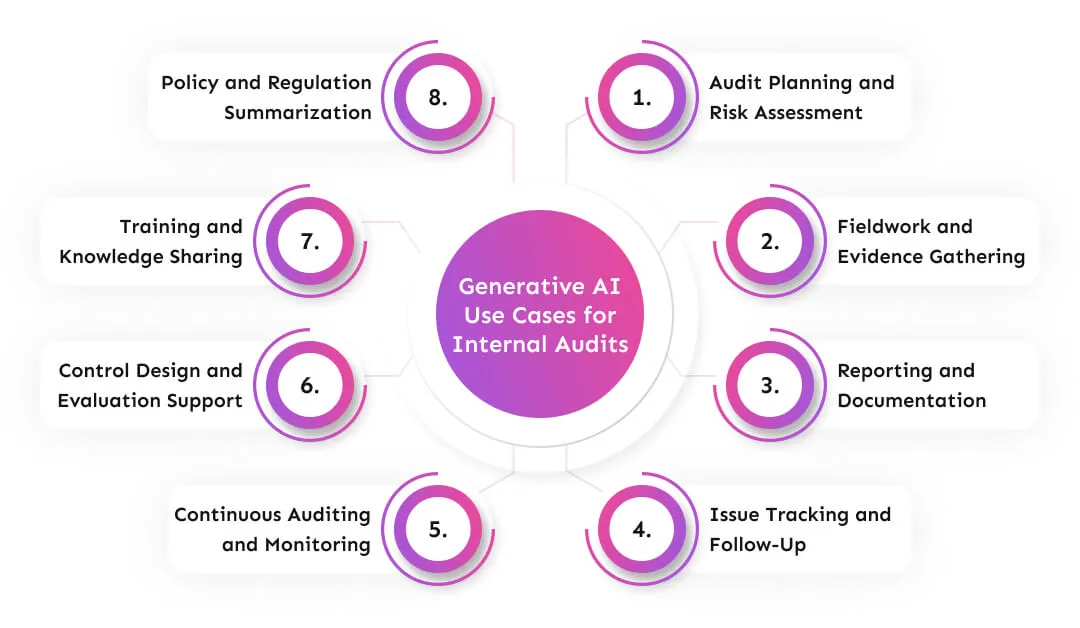
Generative AI isn’t just a buzzword in audit circles. It’s already being used to streamline everyday audit tasks, improve reporting quality, and speed up decision-making. From planning to follow-up, GenAI Use Cases are supporting auditors at every stage of the audit lifecycle.
1. Audit Planning and Risk Assessment
Planning sets the tone for the entire audit. GenAI helps audit teams prepare faster and more effectively by processing large sets of information in less time.
How GenAI supports this phase:
- Risk analysis from historical data
GenAI can review past audit reports, policy documents, and internal controls to highlight recurring risk areas.
- Stakeholder summary generation
It can create briefing documents summarizing what key stakeholders need to know before the audit begins.
- Pre-audit questionnaires and scoping documents
Drafts initial questionnaires or scoping notes based on audit objectives and industry standards.
This reduces time spent on manual research and enhances the auditor’s ability to focus on risk-prone areas from day one.
2. Fieldwork and Evidence Gathering
GenAI can significantly reduce the effort required to analyze documents, emails, and data logs during fieldwork. It acts as a real-time assistant, helping auditors surface relevant insights quickly.
Common uses during fieldwork:
- Document summarization
Upload a lengthy contract or control policy, and GenAI will provide a concise summary.
- Exception analysis
GenAI can scan data entries to flag potential anomalies or inconsistencies based on preset criteria.
- Interview preparation
Suggests tailored interview questions based on the audit area and past issues.
These capabilities allow auditors to cover more ground with greater precision, without compromising audit depth.
3. Reporting and Documentation
Writing audit reports can be time-consuming, especially when dealing with complex findings. GenAI helps draft clear, structured reports by converting raw audit notes and summaries into polished content. Auditors can input key points, and GenAI can format them into standard templates, saving time and ensuring consistency across teams.
4. Issue Tracking and Follow-Up
After an audit, keeping track of remediation efforts is critical. GenAI can assist by generating follow-up emails, status updates, and reminders based on previous audit findings. It can also summarize progress from status reports, helping auditors stay updated without manually reviewing every document.
5. Continuous Auditing and Monitoring
For organizations moving toward continuous audit models, GenAI can monitor incoming data streams and generate alerts or summaries when risk indicators are triggered. This allows auditors to maintain oversight in real time, focusing attention where it’s needed most and reducing the lag between issue identification and response.
6. Control Design and Evaluation Support
GenAI can help auditors assess whether existing controls are well-designed for identified risks. By analyzing policy documents, frameworks, and past audit issues, it can suggest control improvements or identify gaps. This is especially helpful when auditors need to validate controls against new regulatory requirements or evolving risk factors.
7. Training and Knowledge Sharing
Internal audit teams often need to upskill quickly when entering unfamiliar business areas. GenAI can serve as an on-demand trainer by summarizing regulations, generating quick guides, or explaining industry-specific risks. It also helps standardize knowledge across distributed audit teams, especially in global organizations.
8. Policy and Regulation Summarization
Auditors frequently work with new or changing regulations. GenAI can take a dense policy document and produce an easy-to-understand summary that highlights what matters most for compliance. This helps auditors stay informed without getting buried in legal text.
Benefits of Integrating Generative AI in Internal Audit
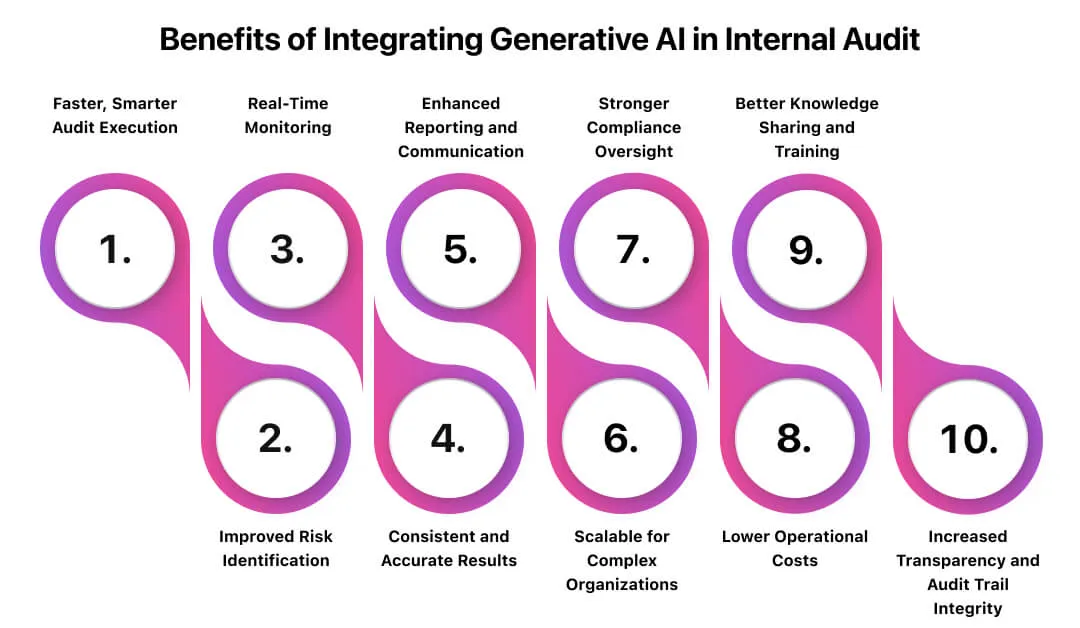
1. Faster, Smarter Audit Execution
Generative AI speeds up audit cycles by automating time-consuming tasks like document reviews, checklists, and report writing. This allows auditors to focus more on risk analysis and critical thinking, rather than routine processing.
2. Improved Risk Identification
By analyzing historical data and identifying unusual patterns, GenAI helps auditors uncover potential risks earlier. It enables proactive audit planning by flagging anomalies and highlighting areas that require deeper investigation.
3. Real-Time Monitoring
With GenAI, internal audit teams can continuously monitor transactions and control activities. This real-time visibility helps detect issues as they happen, reducing reliance on periodic audits and allowing for quicker corrective actions.
4. Consistent and Accurate Results
GenAI applies the same logic to every task, minimizing human error and ensuring consistency across different audits. It improves the reliability of findings and helps maintain uniform standards in reporting and assessment.
5. Enhanced Reporting and Communication
AI-generated reports are structured, clear, and tailored to their audience. Auditors can turn findings into insights faster, while interactive visuals and summaries help stakeholders understand the results without digging through dense documentation.
6. Scalable for Complex Organizations
Generative AI handles large volumes of audit data across departments, systems, or regions with ease. This scalability allows audit functions to grow without needing to scale up resources at the same rate.
7. Stronger Compliance Oversight
GenAI helps auditors stay aligned with evolving regulations by automatically checking audit evidence against compliance requirements. It also flags potential gaps early, reducing the risk of regulatory violations.
8. Lower Operational Costs
By automating repetitive audit tasks, GenAI reduces the time and effort spent on routine work. This leads to cost savings and more efficient use of internal audit resources.
9. Better Knowledge Sharing and Training
AI tools can create summaries, quick guides, or simulations to support auditor learning. This helps teams build knowledge faster and share best practices across different roles or locations.
10. Increased Transparency and Audit Trail Integrity
GenAI maintains clear documentation of actions taken during audits, which improves traceability. This transparency is valuable during reviews, investigations, or external assessments.
Also Read:
Top Generative AI Development Companies
Common Risks and Limitations of Using GenAI for Internal Audit
1. Resistance to Change
Not all audit teams are ready to adopt AI tools. Some auditors may be hesitant due to unfamiliarity, fear of job disruption, or concern about accuracy. Without clear communication and training, adoption can stall before it starts.
2. Skill Gaps and Lack of AI Readiness
Auditors aren’t expected to be data scientists, but some AI literacy is essential. Without the right skills to craft prompts, validate outputs, or interpret AI responses, the technology may be underused or misapplied.
3. Over-Reliance on AI Outputs
GenAI is a tool, not a decision-maker. Over-relying on its responses without applying human judgment can lead to incomplete findings or missed risks. Audit teams must always review and validate AI-generated content.
4. Misuse of Generated Content
Using GenAI to draft audit findings or risk statements without proper context can be risky. If the input is vague or inaccurate, the output may mislead. This could affect report quality or lead to poor decisions.
5. Lack of Transparency (Black-Box Problem)
Many GenAI models don’t clearly show how conclusions are reached. This lack of explainability can create trust issues, especially when auditors need to justify decisions or methodologies to stakeholders.
Best Practices for Implementing Generative AI in Internal Audit
When a mid-sized audit team first introduced generative AI into their workflow, they started with excitement but also confusion. The tools were powerful, but no one quite knew where to begin. Sound familiar? Here’s how they turned that chaos into clarity, and how you can, too.
1. Start Small and Focused
Instead of rolling GenAI into every audit process, the team chose one area. They started with report writing and tested how well GenAI could turn bullet points into full summaries. It worked well, and more importantly, it gave the team confidence. Starting small helps build trust and reduces resistance.
2. Train Your Team, Not Just Your Tool
The team realized early that the tool was only as good as the people using it. So they set up short weekly sessions. They practiced writing prompts, reviewed outputs together, and shared tips. Within weeks, everyone from new auditors to seniors was using GenAI with purpose.
3. Define Clear Use Cases
Not every task needs GenAI. The team listed where it helped most, like summarizing interviews, generating risk insights, or drafting follow-up emails. With clear use cases, they avoided wasting time on tasks where GenAI didn’t add value.
4. Set Guardrails Early
To avoid misuse, they created simple rules. Every GenAI-generated report had to be reviewed by a human. Sensitive data wasn’t shared with open tools. The team also created a list of approved prompts and outputs to keep things consistent and secure.
5. Make IT and Audit Work Together
The audit team didn’t try to do everything alone. They brought in IT early. Together, they made sure the right tools were in place, security settings were solid, and data access was handled properly. This partnership helped avoid roadblocks and kept the rollout smooth.
6. Keep a Human in the Loop
One mistake the team avoided was letting GenAI run on autopilot. For every output the AI created, a human reviewed it. This helped catch errors, add judgment, and protect the quality of audit results. GenAI is powerful, but it still needs oversight.
7. Create a Feedback Loop
As the team used GenAI more, they tracked what worked and what didn’t. If a prompt gave weak results, they rewrote it. If the AI missed something, they flagged it. Over time, their prompt library got stronger, and the AI’s output improved.
8. Scale Slowly and Stay Flexible
After success in a few areas, the team expanded GenAI into other tasks like risk assessments and interview prep. But they moved slowly, adding only what made sense. They adjusted as they went, staying flexible to avoid wasted effort or over-complication.
Also Read: AI Workflow Automation: Tools, Benefits and Use Cases
How Prismetric Can Elevate Your Internal Audit with Generative AI
Prismetric isn’t just a technology provider it’s a strategic partner for businesses ready to modernize internal audit functions. With deep expertise in AI development and enterprise automation, Prismetric helps audit teams unlock the real potential of Generative AI.
Whether you’re starting small or planning a full-scale transformation, Prismetric delivers custom GenAI solutions tailored to your business and audit environment. From automating documentation to analyzing complex datasets, their tools streamline audit processes while maintaining accuracy and compliance.
What sets Prismetric apart is its ability to build AI systems that adapt to your specific needs. Their team works closely with auditors and IT leaders to design secure, intelligent workflows that enhance performance without adding complexity. You can expect AI models trained on your internal frameworks, ensuring relevance and precision in every output.
Prismetric also ensures that implementation is smooth and scalable. Their solutions can integrate with your existing audit platforms and data sources, reducing the learning curve for your team. They also provide hands-on support and training, so your auditors are confident using GenAI from day one.
If your goal is to improve efficiency, reduce manual workload, and gain real-time insights without compromising audit integrity, Prismetric’s Generative AI solutions are built to deliver exactly that.
Conclusion
Generative AI is no longer a futuristic concept in internal audit. It is a practical tool that is already reshaping how audit teams work, think, and deliver value. From planning and fieldwork to reporting and monitoring, GenAI offers speed, accuracy, and insight that traditional methods cannot match.
But to truly benefit, organizations need more than just the right tools. They need the right strategy, governance, and partner to implement it effectively. By embracing GenAI with a clear plan and trusted expert that provides generative ai development services, audit teams can stay ahead of risks, improve decision-making, and transform the role of internal audit for the better.
Frequently Asked Questions
Generative AI in internal audit refers to the use of AI models like GPT-4 to automate and enhance audit tasks. It helps auditors draft reports, analyze data, identify risks, and create summaries faster and more accurately.
GenAI improves audit quality by reducing human error, ensuring consistent reporting, and highlighting anomalies that may go unnoticed. It also helps auditors focus on higher-risk areas by automating routine tasks.
Yes, if implemented correctly. Generative AI must be used with human oversight and proper data governance. Clear policies, secure data handling, and model validation are essential to ensure safe and accurate use.
Absolutely. GenAI tools can be scaled for teams of any size. Starting with simple use cases like report drafting or risk summaries makes adoption easier, even for smaller teams with limited resources.
Risks include over-reliance on AI outputs, misuse of generated content, lack of transparency in how results are produced, and possible data privacy concerns. These can be managed with strong controls and human validation.
Traditional automation follows fixed rules. Generative AI can understand context and generate human-like responses. It is more flexible and can assist with tasks like drafting narratives, summarizing interviews, and analyzing unstructured data.
Prismetric provides tailored GenAI solutions that align with your audit processes, risk frameworks, and compliance needs. They offer secure integration, custom training, and ongoing support to help your team adopt AI confidently.