Computer Vision in Finance: Real Use Cases, Benefits, and Future-Ready Solutions
Key Takeaways
- Computer vision automates KYC, document checks, and compliance tasks, cutting hours of manual review from financial workflows.
- Fraud detection improves as vision AI spots forged documents, risky behavior, and ATM anomalies with higher accuracy.
- The computer vision market is projected to reach 58.33 billion dollars by 2032, showing rapid adoption in finance.
- Faster onboarding and real-time risk insights help banks deliver smoother customer journeys and stronger security.
Computer vision has quietly become one of those technologies you don’t notice until it’s everywhere. Finance teams, banks, and fintech startups rely on it more than most people realize.
If you’ve ever snapped a photo of an ID to open an account or deposited a check with your phone, you’ve already seen it in action. Behind the scenes, AI is scanning documents, spotting fraud, and accelerating decisions that once took hours. It continues to reshape how financial systems think and respond.
And the momentum keeps building. The market reached 17.84 billion dollars last year, and analysts expect it to climb to 58.33 billion dollars by 2032 with roughly 15.9 percent yearly growth. Companies across banking and healthcare are turning to vision AI to interpret visual data they couldn’t handle before, pushing real transformation in how work gets done.
What is computer vision and why it matters in financial services
Computer vision is a field of AI that teaches machines to interpret visual information the way people do. It takes images or videos, breaks them into patterns, and turns them into insights that software can act on in real time. In financial services, this becomes especially valuable because so many tasks rely on documents, identity checks, and visual risk signals.
Its importance becomes clear when you look at how quickly the fintech space is expanding. The global fintech market was valued at 394.88 billion in 2025 and is projected to reach 1760.18 billion dollars by 2034 with a compound annual growth rate of about 16.2 percent. Growth at this scale shows how financial organizations are leaning on automation, faster decision making, and advanced verification tools. Computer vision supports this momentum by improving accuracy, reducing friction, and helping teams keep up with rising demand.
How Computer Vision is Transforming Finance: Key Use Cases
Computer vision is quietly reshaping the way financial institutions operate. Tasks that once required slow, manual review now move with the accuracy and speed of automated visual intelligence. The use cases below show how finance teams are already putting it to work.
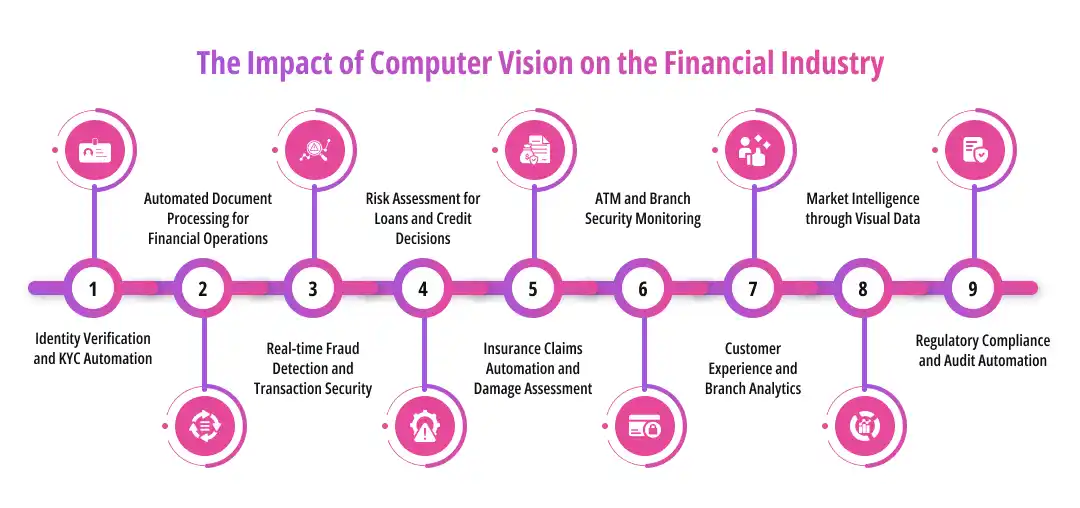
Identity Verification and KYC Automation
Banks and fintech platforms use computer vision to streamline identity checks, making onboarding faster and more secure. When a customer uploads an ID photo or records a selfie, vision models scan for document authenticity, confirm liveness, and extract the details needed for compliance. It removes friction from the signup process and reduces the burden on manual review teams.
Business Benefits
- Faster onboarding with fewer customer drop-offs
- Lower identity fraud risk through automated document validation
- Consistent decision making across large user volumes
- Reduced dependence on manual KYC review
Real-World Example
Revolut uses computer vision to validate identity documents and compare them with real-time selfies. This approach helped the company onboard millions of global users while meeting strict regulatory standards and preventing fraudulent signups.
Automated Document Processing for Financial Operations
Financial institutions handle enormous volumes of documents every day, from loan applications to bank statements to compliance forms. Computer vision speeds up this workflow by extracting text, identifying fields, classifying document types, and flagging incomplete or suspicious files. Instead of waiting hours or days for human review, decisions move forward as soon as the system analyzes each document.
Business Benefits
- Shorter processing cycles for loans, mortgages, and claims
- Higher data accuracy compared to manual keying
- Lower operational costs tied to back-office paperwork
- Better scalability during peak periods
- Improved compliance through consistent data extraction
Real-World Example
JPMorgan Chase adopted an AI-driven system called COiN to analyze commercial loan agreements using computer vision and machine learning. The platform reviews thousands of contracts in seconds, a task that previously consumed more than 360,000 hours of manual legal work each year.
Real-time Fraud Detection and Transaction Security
Financial fraud often hides in plain sight, and computer vision gives institutions a faster way to spot it before damage is done. Vision models can analyze ATM camera feeds, detect card skimming devices, monitor unusual customer behavior, and flag forged documents that slip through traditional checks. By combining visual signals with transaction data, banks catch threats earlier and reduce losses that typically go unnoticed until after the fact.
Business Benefits
- Earlier detection of high-risk or fraudulent activity
- Fewer false positives compared to rule-based systems
- Lower financial losses from scams and forged documents
- Stronger security across ATMs, branches, and digital channels
Real-World Example
HSBC uses AI-driven visual analysis to detect suspicious behavior at ATMs and identify fraudulent attempts in real time. This initiative strengthened their global security footprint and helped reduce losses linked to identity fraud and card-present attacks.
Risk Assessment for Loans and Credit Decisions
Lenders rely on thousands of small details to understand a borrower’s risk, and computer vision helps surface those details faster and with more accuracy. Vision models can read bank statements, verify income documents, review collateral images, and highlight inconsistencies that need human attention. This gives underwriting teams clearer insights while shortening the time it takes to approve or decline an application.
Business Benefits
- Faster loan approvals supported by accurate document insights
- Better risk scoring through consistent visual analysis
- Fewer manual errors during underwriting
- Higher customer satisfaction due to shorter wait times
- Improved fraud detection in income and identity documents
Real-World Example
Upstart uses AI, including computer vision components, to evaluate borrower data and automate parts of the underwriting workflow. Their system processes applicant documents quickly and provides lenders with more precise risk profiles, contributing to faster approvals and increased lending efficiency.
Insurance Claims Automation and Damage Assessment
Insurance teams often spend days reviewing photos, inspecting damage in person, and closing claims. Computer vision speeds up this cycle by analyzing images of damaged vehicles or property, identifying what needs repair, estimating cost ranges, and flagging suspicious submissions. Customers get answers faster, and insurers reduce the strain on their assessment teams.
Business Benefits
- Shorter claim settlement times
- Lower operational costs tied to physical inspections
- More consistent and objective damage evaluations
- Better fraud detection in claim submissions
Real-World Example
Lemonade transformed its claims process with an AI system known as AI Jim, which uses computer vision to review claim images and validate them automatically. The company reports that over 30 percent of claims are handled without human intervention, with settlement times as low as three seconds.
ATM and Branch Security Monitoring
Banks manage thousands of physical touchpoints, and keeping them secure is a constant challenge. Computer vision helps by monitoring ATM sites and branch areas in real time, spotting suspicious behavior, detecting tampering attempts, and alerting security teams before incidents escalate. It acts like an always-awake security analyst that never misses visual cues humans might overlook.
Business Benefits
- Improved detection of ATM skimming and tampering attempts
- Faster response to unusual or high-risk behavior
- Reduced losses tied to physical fraud and theft
- Lower reliance on manual monitoring across multiple locations
- Stronger compliance with safety and surveillance standards
Real-World Example
Santander uses computer vision in its ATM network to identify skimming devices and unusual user patterns. Their system flags anomalies instantly, helping security teams intervene before customers are affected and reducing successful fraud attempts across several regions.
Customer Experience and Branch Analytics
Modern banks want to understand how customers move, wait, and interact within branches, and computer vision helps them see the full picture. Vision systems track queue lengths, measure foot traffic, and identify service bottlenecks, giving teams the insights they need to improve layout, staffing, and overall experience. It turns everyday branch activity into data that’s easy to understand and act on.
Business Benefits
- Shorter wait times through smarter staff allocation
- Better branch layout decisions backed by real movement patterns
- Improved customer satisfaction by addressing bottlenecks early
- Deeper insights into visitor behavior and service demand
Real-World Example
Bank of America uses computer vision analytics in select branches to measure queue activity and predict staffing needs. The insights help managers reduce customer wait times and tailor services more effectively across busy locations.
Market Intelligence through Visual Data
Financial institutions are tapping into computer vision to understand markets in ways traditional datasets never allowed. By analyzing satellite images, retail parking lot activity, farmland conditions, or cargo movement, vision systems reveal trends that help teams forecast demand, evaluate investments, and spot risks earlier. It turns real-world visuals into actionable intelligence that supports sharper financial decisions.
Business Benefits
- More accurate forecasting using real-world visual signals
- Early detection of market shifts that affect portfolio performance
- Stronger investment decisions backed by alternative data
- Competitive advantage through insights not available in public datasets
Real-World Example
Hedge funds working with Orbital Insight use satellite imagery to track store traffic, construction activity, and supply chain patterns. These insights help investors predict company performance before earnings reports, giving them a more informed position in the market.
Regulatory Compliance and Audit Automation
Compliance teams often face mountains of documentation, strict timelines, and complex verification tasks. Computer vision helps by scanning forms, matching signatures, checking document integrity, and flagging issues that auditors need to review. It reduces the repetitive work that slows compliance processes and gives teams clearer visibility across large, fast-moving datasets.
Business Benefits
- Less manual review effort for compliance and audit teams
- Higher accuracy in document checks and signature verification
- Faster reporting cycles with fewer bottlenecks
- Stronger oversight across all submitted documents
- Lower risk of human oversight in high-volume environments
Real-World Example
Deloitte integrated computer vision into its audit tools to analyze scanned documents, confirm signatures, and detect irregularities at scale. The technology helps auditors review data more efficiently and makes it easier to identify potential compliance issues in large engagements.
Transform Your Finance Business Operations with Prismetric’s Future Proof Computer Vision Development Services
Prismetric provides computer vision development services across the USA, Canada, Australia, Germany and many other regions, helping financial businesses adopt AI solutions that actually solve day to day challenges. In a space where speed, accuracy and compliance shape every decision, having the right technology partner can make a meaningful difference. Prismetric supports that shift by building computer vision systems that enhance how finance teams work without disrupting the tools they already rely on.
At Prismetric, computer vision is designed to improve real business outcomes. Their solutions help automate document checks, verify identities, extract information from financial forms, detect anomalies that hint at fraud and analyze visual data at a scale that humans simply cannot match. This frees your teams to focus on higher value tasks while strengthening accuracy and reducing operational delays.

Whether you need a smarter KYC workflow, a faster loan processing pipeline or a more reliable fraud detection system, Prismetric develops customized AI models that fit your goals and regulatory expectations. They also integrate these systems smoothly into your existing infrastructure so the transition feels seamless for customers and staff. With continued support and optimization, your solution keeps improving as your business grows.
If you are looking to remove manual bottlenecks, speed up customer journeys and make sharper decisions from visual data, Prismetric can help you turn everyday financial processes into strategic advantages with technology built for both today’s demands and tomorrow’s expansion.
Frequently Asked Questions
Computer vision speeds up the tasks that normally slow financial teams down and replaces manual steps with fast, accurate automation.
- Reads and extracts data from documents instantly
- Verifies identities with higher accuracy and fewer errors
- Flags unusual patterns or risk signals in real time
- Reduces manual workload for operations and compliance teams
- Creates faster, smoother experiences for customers
Yes. When implemented correctly, computer vision follows strict data security and privacy standards. Most systems run on encrypted infrastructure with clear access controls. Financial businesses can also choose on premise or private cloud deployments when they need additional layers of protection for regulatory compliance.
Absolutely. Vision models pick up visual patterns humans often miss, like altered documents, forged signatures, suspicious ATM behavior or unusual submission patterns. When combined with transaction data, it becomes a powerful early warning system that helps banks stop fraud before it grows into a costly issue.
Not at all. With the right development partner, financial institutions of any size can adopt computer vision. Custom solutions can be built to match your existing workflow, and integration can be done without overhauling current systems. This makes adoption smooth even for teams without deep AI expertise.
Most organizations see faster processing times, fewer manual errors, stronger security and better compliance. Customer onboarding becomes quicker, underwriting becomes more consistent and claims or document review cycles shrink dramatically. Over time, these improvements translate into measurable savings and a stronger competitive edge.