Agentic AI in Marketing: Transforming Campaigns, Customer Engagement, and Business Growth
Marketing has entered a new era where speed, personalization, and intelligent decision-making are no longer optional advantages. Businesses today operate in an environment where customers expect relevant interactions, seamless digital experiences, and real-time responses across every touchpoint. Traditional marketing automation and generative AI tools have helped brands accelerate specific tasks, but they often fall short when it comes to independently planning, adapting, and executing complete marketing workflows.
This is where agentic AI in marketing is emerging as a transformative force.
Unlike conventional automation systems that follow fixed rules or generative AI tools that respond to prompts, agentic AI systems can understand business goals, evaluate customer and campaign data, make decisions, and execute multi-step marketing actions with minimal human intervention. These autonomous AI agents are capable of analyzing real-time signals, identifying opportunities, personalizing customer interactions, optimizing campaign performance, and continuously learning from outcomes.
For enterprises, this shift is redefining the role of marketing teams. Instead of spending valuable time on repetitive execution, manual segmentation, campaign monitoring, and performance reporting, marketers can focus on strategy, creativity, brand positioning, and customer experience design. Agentic AI acts as an intelligent digital workforce that enhances marketing operations while keeping human teams in control of strategic direction and governance.
From autonomous campaign orchestration and dynamic audience segmentation to real-time personalization and predictive performance optimization, agentic AI is helping businesses build more agile, data-driven, and customer-centric marketing ecosystems.
In this article, we will explore what agentic AI in marketing means, how it differs from generative AI and traditional marketing automation, how it works, and why it is becoming a critical capability for modern businesses looking to enhance customer engagement and accelerate growth.
What is Agentic AI in Marketing?
Agentic AI in marketing refers to the use of autonomous AI systems that can plan, decide, act, and optimize marketing activities based on predefined goals, real-time data, and business rules. These systems are designed to go beyond content generation or task automation by independently managing complex, multi-step workflows across the marketing lifecycle.
In simple terms, agentic AI enables businesses to move from manually managing campaigns to orchestrating intelligent AI agents that can execute marketing actions on their behalf.
For example, a generative AI tool can help a marketer write an email subject line or create ad copy. However, an agentic AI system can identify a drop in customer engagement, analyze which audience segment is affected, recommend a reactivation strategy, generate personalized content, launch a campaign across multiple channels, monitor performance, and optimize the journey based on customer response.
This ability to combine reasoning, decision-making, execution, and continuous learning makes agentic AI a significant advancement in marketing technology.
Agentic AI marketing systems are typically built around a few core capabilities:
- They understand business goals such as increasing conversions, improving retention, reducing churn, or boosting return on ad spend.
- They analyze customer data, campaign performance, behavioral signals, and market context.
- They make decisions based on predefined rules, predictive models, and real-time insights.
- They execute actions across connected platforms such as CRM, CDP, email marketing tools, ad platforms, analytics systems, and content management systems.
- They learn from performance data and continuously refine future recommendations or actions.
The true value of agentic AI lies in its ability to connect marketing intelligence with marketing execution. Instead of simply providing insights, it helps businesses act on those insights faster and more effectively.
For instance, an AI marketing agent can monitor paid campaign performance throughout the day, pause underperforming ad variants, shift budget toward high-performing audiences, create new messaging variations, and generate a performance summary for the marketing team. Similarly, a customer journey agent can personalize email, SMS, push notifications, and website experiences based on each customer’s behavior, preferences, and lifecycle stage.
This makes agentic AI especially valuable for businesses managing large-scale marketing operations, high-volume customer interactions, complex customer journeys, and multi-channel campaigns.
At its core, agentic AI does not eliminate the need for marketers. Instead, it elevates their role. Marketers remain responsible for strategy, creative direction, brand governance, ethical decision-making, and customer understanding, while AI agents handle repetitive, data-intensive, and execution-heavy workflows.
This combination of human intelligence and autonomous AI execution enables businesses to build faster, smarter, and more adaptive marketing systems.
Why Agentic AI is Becoming Important for Modern Marketing
The growing importance of agentic AI in marketing is directly connected to the increasing complexity of customer engagement. Today’s customers interact with brands across websites, mobile apps, search engines, social platforms, marketplaces, email, SMS, ads, chatbots, and offline channels. Every interaction generates data, and every data point creates an opportunity to deliver a more relevant experience.
However, most marketing teams struggle to act on this data in real time.
Manual campaign management is slow. Traditional automation is rule-bound. Generative AI requires continuous prompting. Analytics dashboards provide insights but do not execute decisions. As a result, businesses often face delays between identifying an opportunity and taking action.
Agentic AI helps close this gap by enabling marketing systems to sense, reason, act, and optimize continuously.
This means a business can move from reactive marketing to proactive marketing. Instead of waiting for a marketer to review reports and manually adjust a campaign, an AI agent can detect a performance issue and recommend or execute the next best action. Instead of creating the same customer journey for every user, agentic AI can adapt messaging, timing, channel, and offer based on each customer’s behavior.
For businesses, this creates several strategic advantages:
- Faster campaign execution
- More relevant customer experiences
- Improved personalization at scale
- Better use of marketing budgets
- Continuous performance optimization
- Reduced manual workload for marketing teams
- Stronger alignment between data, content, and activation
Agentic AI is also becoming important because marketing teams are under pressure to do more with fewer resources. They are expected to create more content, run more experiments, personalize more deeply, report more accurately, and deliver measurable business impact. Agentic AI supports this shift by taking over repetitive and operationally complex tasks while allowing marketers to focus on higher-value strategic initiatives.
As brands compete for attention in increasingly crowded digital environments, the ability to respond quickly and intelligently to customer behavior can become a major differentiator. Agentic AI gives businesses the capability to build always-on marketing systems that are not only automated but also adaptive and outcome-driven.
Agentic AI vs Generative AI vs Traditional Marketing Automation
To understand the true potential of agentic AI in marketing, it is important to distinguish it from generative AI and traditional marketing automation. While these technologies are often used together, they serve different purposes within the marketing ecosystem.
Traditional marketing automation is designed to execute predefined workflows. It follows fixed rules created by marketers, such as sending a welcome email when a user signs up or triggering a cart abandonment message after a specific period. These systems are useful for repeatable tasks but have limited ability to adapt independently when customer behavior or campaign conditions change.
Generative AI, on the other hand, focuses primarily on creating content. It can generate blog outlines, social media captions, email copy, ad variations, product descriptions, images, scripts, and campaign ideas based on human prompts. It enhances productivity but still depends heavily on marketers to define the task, review the output, and decide what to do next.
Agentic AI goes a step further. It can understand goals, analyze data, make decisions, use tools, and complete multi-step marketing workflows. Rather than simply creating content or following static rules, agentic AI acts as an autonomous marketing partner that can plan and execute actions based on real-time context.
| Capability |
Traditional Marketing Automation |
Generative AI |
Agentic AI |
| Primary function |
Executes predefined workflows |
Creates content from prompts |
Plans, decides, acts, and optimizes |
| Input required |
Rules and triggers |
Human prompts |
Goals, data, context, and guardrails |
| Adaptability |
Limited |
Moderate |
High |
| Decision-making ability |
Rule-based |
Human-led |
AI-assisted or autonomous |
| Execution capability |
Executes fixed tasks |
Generates outputs |
Completes multi-step workflows |
| Human involvement |
Required for setup and updates |
Required for prompting and approval |
Required for strategy, governance, and oversight |
| Example |
Sends an email after signup |
Writes welcome email copy |
Builds, launches, tests, and optimizes a welcome journey |
The difference can be understood through a simple campaign example.
A traditional automation tool can send a discount email to users who abandoned their cart. A generative AI tool can write five versions of that email. An agentic AI system can identify which users are most likely to return, decide whether a discount is necessary, choose the best channel, personalize the message, test different offers, monitor performance, and optimize the journey automatically.
This makes agentic AI especially powerful for modern marketing environments where customer behavior changes quickly and campaign success depends on real-time decisions.
However, this does not mean agentic AI replaces generative AI or automation. In fact, the most effective marketing systems will combine all three. Traditional automation can handle predictable workflows, generative AI can support content creation, and agentic AI can orchestrate decisions and actions across the entire marketing process.
Together, these technologies enable businesses to create a more intelligent, scalable, and responsive marketing ecosystem.
How Agentic AI Works in Marketing
Agentic AI in marketing works by combining data, reasoning, automation, and decision-making into a connected workflow. Rather than waiting for human prompts at every step, AI agents operate based on defined goals, available data, system integrations, and governance rules.
A typical agentic AI marketing system follows five key stages: perception, reasoning, planning, execution, and optimization.
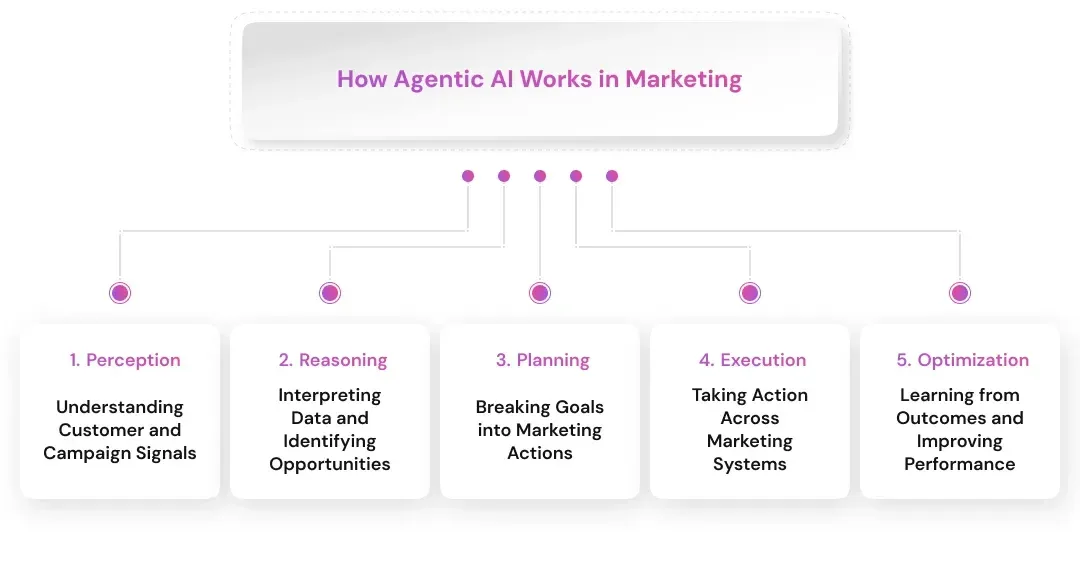
1. Perception: Understanding Customer and Campaign Signals
The first step in an agentic AI workflow is perception. At this stage, the AI agent gathers and interprets data from multiple marketing and business systems.
This data can include:
- Customer profiles from CRM and CDP platforms
- Website and app behavior
- Email engagement data
- Ad campaign performance
- Purchase history
- Product interactions
- Social media signals
- Customer support conversations
- Search behavior
- Content engagement metrics
- Lead scoring and sales activity
By analyzing these signals, the agent builds a contextual understanding of what is happening across the customer journey.
For example, an AI agent may detect that a specific customer segment is engaging with product pages but not converting. It may also identify that users from a particular acquisition channel have a lower repeat purchase rate. These insights become the foundation for the next stage of decision-making.
The strength of agentic AI lies in its ability to process large volumes of data continuously and identify patterns that human teams may not notice quickly enough.
2. Reasoning: Interpreting Data and Identifying Opportunities
Once the AI agent collects relevant signals, it begins reasoning over the data. This means it evaluates what the data indicates, compares it with business goals, and determines whether action is needed.
For example, if the goal is to improve customer retention, the agent may analyze churn indicators such as reduced engagement, delayed repeat purchases, declining email open rates, or negative support interactions. It can then identify which customers are at risk and determine what type of intervention may be most effective.
In a paid media scenario, the agent may review campaign performance, identify underperforming ad sets, compare audience segments, and determine where budget should be reallocated.
Reasoning allows agentic AI to move beyond basic automation. Instead of following a fixed trigger, it evaluates context and decides what action is most likely to support the desired business outcome.
This stage is critical because marketing decisions are rarely one-dimensional. A customer may not convert because of pricing, timing, product fit, message fatigue, poor targeting, or lack of trust. Agentic AI can analyze multiple variables simultaneously and recommend or execute the most relevant next step.
3. Planning: Breaking Goals into Marketing Actions
After identifying an opportunity or issue, the AI agent creates a plan of action. This plan may include selecting the right audience, choosing the most effective channel, generating content variations, defining test groups, setting timing rules, allocating budget, or creating a customer journey path.
For instance, if the agent identifies a group of inactive customers with high lifetime value, it may plan a reactivation campaign that includes:
- Segmenting customers by purchase history and engagement level
- Creating personalized email and SMS messages
- Testing different offers
- Choosing the best send time
- Coordinating retargeting ads
- Monitoring campaign performance
- Escalating unusual results to a human marketer
This planning capability is what makes agentic AI different from simple automation. It does not just perform one isolated task; it can coordinate multiple connected steps to achieve a business goal.
The agent can also operate within predefined guardrails. For example, a business can specify that the agent may recommend campaign changes independently but must request human approval before launching high-budget campaigns, using promotional discounts, or publishing customer-facing content.
4. Execution: Taking Action Across Marketing Systems
Once the plan is created, the agent executes the required actions across connected platforms. This may involve updating a CRM record, launching an email campaign, creating an ad variation, changing a segment, generating a report, assigning a task, or adjusting campaign settings.
The execution layer depends heavily on system integrations. To operate effectively, agentic AI systems need access to the tools that marketing teams already use, such as:
- Customer relationship management platforms
- Customer data platforms
- Marketing automation tools
- Content management systems
- Digital asset management platforms
- Advertising platforms
- Analytics dashboards
- Ecommerce systems
- Project management tools
For example, a campaign optimization agent may connect with an ad platform to pause a low-performing creative, update audience targeting, and shift budget toward a higher-performing segment. A lifecycle marketing agent may connect with an email platform and CRM to trigger a personalized onboarding journey for new customers.
This ability to act across systems transforms agentic AI from a recommendation engine into an execution partner.
However, execution should not mean uncontrolled autonomy. Businesses must define clear approval rules, access permissions, brand guidelines, and compliance checks to ensure that every AI-led action aligns with organizational standards.
5. Optimization: Learning from Outcomes and Improving Performance
The final stage of agentic AI in marketing is optimization. After executing an action, the agent monitors the results and learns from performance data.
It can evaluate metrics such as:
- Open rates
- Click-through rates
- Conversion rates
- Engagement levels
- Revenue generated
- Cost per acquisition
- Return on ad spend
- Customer retention
- Churn rate
- Lead quality
- Customer lifetime value
Based on these outcomes, the agent can refine future decisions. It may identify which message resonates best with a specific segment, which channel performs better for a particular audience, or which offer drives the highest conversion without reducing margins.
This creates a continuous improvement loop where campaigns become more adaptive over time.
Instead of launching a campaign, waiting for results, manually reviewing reports, and then making adjustments days or weeks later, businesses can use agentic AI to optimize campaigns in near real time. This allows marketing teams to respond faster to customer behavior, market changes, and performance signals.
Ready to Transform Your Marketing Workflows with Agentic AI?
Prismetric helps businesses build agentic AI solutions that automate campaign execution, personalize customer journeys, optimize performance, and reduce manual marketing workload.
Get Started for Free
Key Characteristics of Agentic AI Marketing Systems
Agentic AI in marketing is not defined by a single capability. Its true strength lies in the way it combines intelligence, autonomy, adaptability, and execution into one connected marketing system. Unlike traditional tools that perform isolated tasks, agentic AI systems operate with a broader understanding of business goals, customer behavior, campaign context, and performance outcomes.
For businesses, this means agentic AI can function as a strategic layer across marketing operations, helping teams move from fragmented task management to intelligent campaign orchestration.
Here are the key characteristics that make agentic AI a powerful advancement for modern marketing.
Goal-Driven Decision-Making
Agentic AI systems are designed to work toward specific business goals. These goals may include improving customer engagement, increasing conversions, reducing churn, enhancing customer lifetime value, optimizing return on ad spend, or accelerating lead generation.
Instead of simply following predefined instructions, an AI marketing agent evaluates data and determines which actions can help achieve the desired outcome.
For example, if the goal is to improve retention, the agent may analyze customer behavior, identify users at risk of churn, create personalized re-engagement journeys, and recommend offers or content based on customer preferences. If the goal is to increase ad efficiency, the agent may monitor campaign performance, detect underperforming audiences, and reallocate budgets toward better-performing segments.
This goal-oriented approach enables businesses to build marketing systems that are not just automated but outcome-driven.
Autonomous Workflow Execution
One of the most important characteristics of agentic AI is its ability to execute workflows with minimal human intervention. While traditional marketing automation requires marketers to define fixed rules in advance, agentic AI can independently plan and perform multiple steps based on changing conditions.
This may include:
- Building audience segments
- Generating campaign content
- Selecting channels
- Scheduling communications
- Adjusting campaign settings
- Monitoring performance
- Creating reports
- Recommending next steps
- Triggering follow-up actions
For marketing teams, this autonomy reduces the operational burden associated with campaign execution. Instead of manually managing every task, marketers can define goals, set guardrails, and supervise AI agents as they execute routine and data-intensive workflows.
This allows businesses to scale marketing operations without proportionally increasing manual effort.
Real-Time Context Awareness
Agentic AI systems can analyze real-time customer and campaign signals to make context-aware decisions. This is especially important in marketing, where customer intent, behavior, preferences, and engagement patterns can change quickly.
For instance, a customer who browses a product category multiple times, reads a comparison guide, and interacts with a pricing page may require a different marketing response than a customer who has only opened a newsletter. Similarly, a campaign that performs well in one region or audience segment may not deliver the same results across another.
Agentic AI can interpret these contextual differences and adapt marketing actions accordingly.
By using real-time data from CRM systems, customer data platforms, analytics tools, advertising platforms, ecommerce systems, and engagement channels, AI agents can help businesses deliver more relevant customer experiences at the right time and through the right channel.
Adaptive Learning
Marketing performance is constantly influenced by customer behavior, market conditions, competitor actions, seasonality, product demand, pricing changes, and channel algorithms. Static workflows often fail to keep pace with these changes.
Agentic AI addresses this challenge through adaptive learning.
After executing a campaign or action, the agent monitors outcomes and uses performance data to refine future decisions. It can learn which messages generate better engagement, which audiences respond to specific offers, which channels drive higher conversions, and which timing patterns improve customer response.
This continuous learning loop enables businesses to improve marketing performance over time.
For example, an AI agent managing lifecycle campaigns may discover that high-value customers respond better to educational content before receiving an offer, while first-time buyers engage more with product comparison messages. Based on this insight, the agent can adjust future campaigns to improve relevance and effectiveness.
Multi-Step Reasoning
Agentic AI does not simply complete one isolated task. It can break complex marketing goals into multiple connected steps and execute them in a logical sequence.
For example, the goal “increase conversions from trial users” may require several coordinated actions:
- Analyze trial user behavior
- Identify users with low activation
- Segment users based on product usage
- Create personalized onboarding messages
- Trigger in-app guidance
- Send educational emails
- Notify sales teams for high-value accounts
- Monitor activation rate
- Optimize messages based on response
A traditional automation tool may handle some of these steps if they are manually configured. However, an agentic AI system can reason through the workflow, decide what is required, and coordinate actions across multiple tools.
This makes agentic AI especially valuable for complex marketing environments where campaigns involve multiple audiences, channels, assets, systems, and performance metrics.
Human-Governed Autonomy
Although agentic AI systems can operate autonomously, their effectiveness depends on strong governance. Businesses must define what agents can do independently, what requires human approval, and what actions are restricted.
This human-governed approach ensures that agentic AI supports business goals while maintaining brand consistency, legal compliance, ethical standards, and customer trust.
For example, an AI agent may be allowed to generate campaign recommendations, create draft content, and optimize low-risk audience segments. However, it may need human approval before launching a high-budget advertising campaign, publishing regulated claims, changing brand messaging, or applying major promotional discounts.
This balance between autonomy and oversight is critical for enterprise adoption. Agentic AI works best when businesses treat it as an intelligent execution partner, not an uncontrolled replacement for human judgment.
Benefits of Agentic AI in Marketing
Agentic AI offers businesses a strategic opportunity to enhance marketing performance, improve operational efficiency, and create more personalized customer experiences. As customer journeys become more complex and marketing teams face increasing pressure to deliver measurable outcomes, agentic AI enables organizations to operate with greater speed, intelligence, and scalability.
Here are the major benefits of agentic AI in marketing.
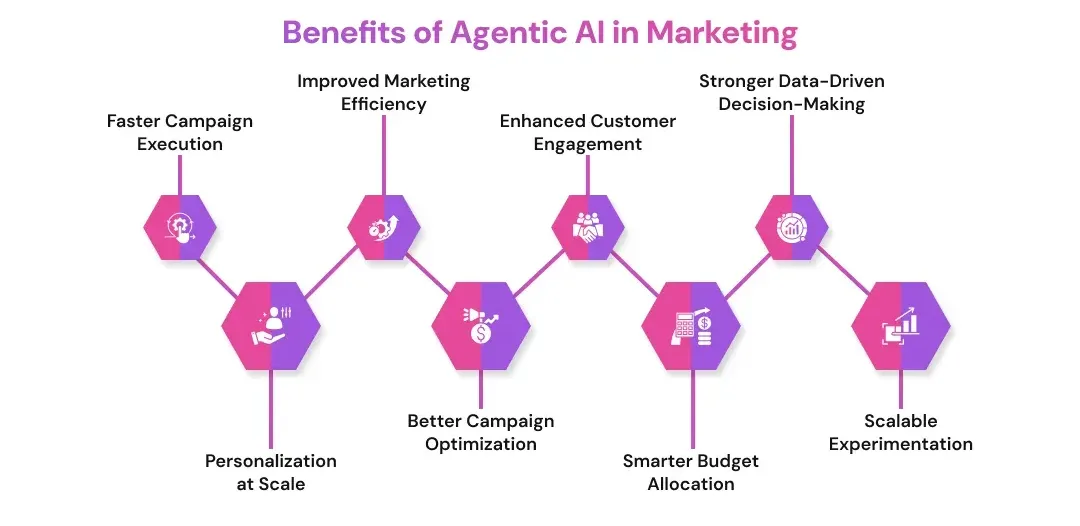
Faster Campaign Execution
Speed is one of the biggest advantages of agentic AI. Traditional campaign execution often involves multiple manual steps, including audience research, segmentation, content creation, approvals, scheduling, testing, performance monitoring, and reporting. These steps can slow down go-to-market timelines and reduce a brand’s ability to respond to customer behavior in real time.
Agentic AI accelerates this process by automating and orchestrating many of these tasks.
An AI agent can analyze campaign goals, identify target segments, generate content variations, recommend channels, schedule messages, monitor results, and optimize performance. This helps businesses reduce delays caused by manual handoffs and operational bottlenecks.
For marketing teams, faster execution means more time to focus on strategy, creativity, experimentation, and customer experience innovation.
Personalization at Scale
Personalization has become a core expectation in modern marketing. Customers want brands to understand their needs, preferences, purchase behavior, and journey stage. However, delivering personalized experiences at scale is difficult when teams rely only on manual segmentation and static automation rules.
Agentic AI enables businesses to personalize customer interactions dynamically.
AI agents can analyze customer data, behavioral signals, engagement history, product interest, and lifecycle stage to determine the most relevant message, offer, channel, and timing for each user. Instead of creating one-size-fits-all campaigns, businesses can deliver more contextual and individualized experiences across email, SMS, push notifications, websites, ads, and apps.
For example, a retail brand can use agentic AI to identify customers interested in a specific product category, recommend relevant items, adjust messaging based on browsing history, and trigger follow-up communications based on real-time behavior.
This level of personalization can help brands improve engagement, strengthen customer relationships, and increase conversion opportunities.
Improved Marketing Efficiency
Marketing teams often spend significant time on repetitive and operational tasks such as creating reports, updating campaign settings, checking performance dashboards, building audience lists, repurposing content, and coordinating workflows across tools.
Agentic AI helps reduce this manual workload.
By automating routine processes and managing multi-step workflows, AI agents allow marketers to focus on higher-value activities such as strategy, positioning, storytelling, creative development, and customer research. This improves team productivity while reducing the time spent on execution-heavy tasks.
For businesses, improved efficiency can also lead to better resource allocation. Teams can manage more campaigns, test more ideas, and personalize more customer journeys without requiring a proportional increase in headcount or operational complexity.
Better Campaign Optimization
Traditional campaign optimization is often delayed because marketers need time to review data, identify performance issues, and manually implement changes. By the time adjustments are made, businesses may have already lost valuable traffic, budget, or engagement opportunities.
Agentic AI enables continuous optimization.
AI agents can monitor campaign performance in real time, detect anomalies, identify winning variations, pause underperforming assets, adjust audiences, recommend budget shifts, and refine messaging based on live results. This helps businesses respond faster to performance changes and improve campaign outcomes.
For example, if an ad creative is generating clicks but not conversions, the agent can analyze audience quality, landing page behavior, and messaging alignment to recommend or execute improvements. If an email campaign has a low open rate among a specific segment, the agent can test new subject lines, send times, or personalization strategies.
This continuous feedback loop helps marketing teams make faster and more data-driven decisions.
Enhanced Customer Engagement
Agentic AI helps businesses engage customers more effectively by delivering timely, relevant, and context-aware interactions. Instead of relying on generic communication flows, brands can use AI agents to respond to customer behavior as it happens.
For example, if a customer shows interest in a product but does not complete a purchase, an agent can determine whether the best next step is a product recommendation, a comparison guide, a reminder, a limited-time offer, or a retargeting ad. If a customer engages with educational content but is not ready to buy, the agent can continue nurturing the relationship with relevant resources.
This ability to adapt engagement strategies based on customer intent helps brands create more meaningful interactions.
Over time, better engagement can lead to stronger trust, improved customer satisfaction, increased loyalty, and higher lifetime value.
Smarter Budget Allocation
Marketing budgets are often spread across multiple channels, campaigns, audiences, and creative assets. Optimizing spend manually can be challenging, especially when performance changes throughout the day or across different customer segments.
Agentic AI can help businesses allocate budgets more intelligently.
AI agents can evaluate campaign performance, compare channel efficiency, detect underperforming audiences, and recommend or execute budget adjustments. This ensures that marketing spend is directed toward the channels and campaigns most likely to deliver business impact.
For example, if a paid search campaign is driving high-intent leads while a social campaign is generating low-quality traffic, an agent can recommend reallocating budget. If a certain audience segment is converting at a higher rate, the agent can prioritize that segment in future campaigns.
This helps businesses improve return on ad spend and reduce wasted marketing expenditure.
Stronger Data-Driven Decision-Making
Marketing teams have access to more data than ever before, but turning that data into timely decisions remains a major challenge. Dashboards and reports can show what happened, but they often require human interpretation before action can be taken.
Agentic AI bridges the gap between insight and execution.
AI agents can analyze large volumes of marketing data, identify trends, detect risks, explain performance changes, and recommend next best actions. In more advanced systems, agents can also execute approved actions automatically.
This helps businesses move from passive reporting to proactive decision-making.
Instead of reviewing campaign data only after a campaign ends, marketers can use agentic AI to monitor performance continuously and optimize strategies while campaigns are still active.
Scalable Experimentation
Testing is essential for marketing growth, but most teams are limited by time, resources, and operational complexity. Running A/B tests across multiple audiences, messages, channels, and offers can quickly become difficult to manage manually.
Agentic AI makes experimentation more scalable.
AI agents can generate test ideas, create content variations, define test groups, launch experiments, monitor results, identify winners, and apply learnings to future campaigns. This enables businesses to test more frequently and learn faster.
For example, an agent can test different email subject lines, landing page messages, ad creatives, product recommendations, and promotional offers across multiple customer segments. It can then determine which variations perform best and optimize future campaigns accordingly.
This creates a culture of continuous experimentation without overwhelming marketing teams.
Agentic AI in Marketing Use Cases
Agentic AI can be applied across the entire marketing lifecycle, from customer acquisition and engagement to retention, analytics, and operations. Its ability to reason, act, and optimize makes it particularly valuable for businesses managing large customer bases, complex journeys, and multi-channel campaigns.
Use Case Summary Table
| Marketing Function |
Agentic AI Use Case |
Business Impact |
| Campaign management |
Autonomous campaign orchestration |
Faster execution and better coordination |
| Customer engagement |
Hyper-personalized journeys |
Improved relevance and engagement |
| Audience targeting |
Real-time segmentation |
More accurate targeting |
| Paid media |
Dynamic ad optimization |
Better budget efficiency |
| Content marketing |
Content creation and versioning |
Faster asset production |
| Retention |
Churn prediction and prevention |
Higher customer lifetime value |
| Analytics |
Automated insights and reporting |
Faster decision-making |
| Compliance |
Brand and legal review |
Reduced risk |
| Operations |
Workflow automation |
Improved team productivity |
Below are some of the most impactful use cases of agentic AI in marketing.
1. Autonomous Campaign Orchestration
One of the most powerful applications of agentic AI is autonomous campaign orchestration. Instead of requiring marketers to manually coordinate every step of a campaign, AI agents can plan, launch, monitor, and optimize campaigns across multiple channels.
An autonomous campaign agent can:
- Analyze campaign objectives
- Identify the right audience
- Select communication channels
- Generate content variations
- Schedule messages
- Monitor performance
- Adjust campaigns based on engagement
- Recommend next steps
For example, a business launching a product campaign can use agentic AI to create separate journeys for new customers, existing customers, high-value buyers, and inactive users. The agent can personalize messaging, determine channel priority, and optimize each journey based on real-time performance.
This helps businesses deliver more coordinated and responsive marketing experiences.
2. Real-Time Audience Segmentation
Audience segmentation is a foundational part of marketing, but static segments often fail to capture how customer behavior changes over time. A customer’s intent, preferences, and readiness to buy can shift based on recent interactions, browsing patterns, purchase history, and engagement signals.
Agentic AI enables real-time audience segmentation.
AI agents can continuously analyze customer data and update segments based on live behavior. This allows businesses to target customers more accurately and deliver messages that align with their current journey stage.
For example, an ecommerce brand can use an agent to identify customers who are browsing premium products, customers who are likely to churn, customers who respond well to discounts, and customers who may be ready for a cross-sell offer.
By making segmentation dynamic, agentic AI helps businesses improve relevance and campaign performance.
3. Hyper-Personalized Customer Journeys
Agentic AI allows businesses to move beyond basic personalization, such as using a customer’s name in an email. It enables deeper, behavior-based personalization across the entire customer journey.
AI agents can personalize:
- Product recommendations
- Email content
- Website experiences
- Push notifications
- SMS messages
- Ad creatives
- Offers and promotions
- Timing and frequency
- Channel selection
For instance, a travel company can use agentic AI to personalize offers based on destination searches, past bookings, budget range, travel season, and engagement history. A fintech company can personalize onboarding journeys based on customer goals, product usage, and risk profile.
This level of personalization helps businesses create more relevant experiences that improve engagement and increase conversion opportunities.
4. Autonomous A/B Testing and Experimentation
A/B testing is essential for improving marketing performance, but manual testing can be slow and limited. Marketers need to create variations, define audiences, monitor performance, analyze results, and apply learnings.
Agentic AI can automate and scale this process.
AI agents can create test variations, launch experiments, monitor real-time performance, identify winning combinations, and optimize future campaigns based on results. This allows businesses to run more experiments with less manual effort.
For example, an agent can test different versions of a landing page headline, email subject line, ad creative, call-to-action, or pricing message. It can then determine which version works best for each audience segment and apply those insights automatically.
This makes marketing experimentation faster, smarter, and more scalable.
5. Dynamic Ad Optimization
Paid advertising requires constant monitoring and optimization. Campaign performance can fluctuate based on audience behavior, competition, bidding conditions, creative fatigue, and platform algorithms. Managing these variables manually can be challenging, especially for businesses running campaigns across multiple platforms.
Agentic AI can help optimize advertising performance dynamically.
AI agents can analyze ad performance, monitor budget usage, detect underperforming creatives, adjust bids, refine targeting, and recommend budget reallocation. They can also generate new creative variations when existing ads begin to lose effectiveness.
For example, if a campaign is delivering high impressions but low conversions, the agent may analyze landing page behavior, audience quality, and creative messaging to identify the issue. It can then recommend new targeting, revised messaging, or a different offer.
This helps businesses improve advertising efficiency and maximize return on ad spend.
6. Content Creation and Versioning
Modern marketing requires a constant flow of content across channels, formats, audiences, and regions. Creating, adapting, and personalizing this content manually can be time-consuming.
Agentic AI can support content creation and versioning at scale.
AI agents can transform a single campaign brief into multiple content assets, including email copy, ad variations, landing page sections, social captions, product descriptions, push notifications, and sales enablement materials. They can also adapt messaging for different audience segments, buyer personas, lifecycle stages, and geographic markets.
For example, a B2B company can use an AI agent to convert a whitepaper into LinkedIn posts, email nurture sequences, sales outreach messages, landing page copy, webinar scripts, and industry-specific ad variations.
This allows marketing teams to maintain consistency while increasing content output and speed.
7. Customer Retention and Churn Prevention
Retaining customers is often more cost-effective than acquiring new ones. However, identifying churn risk early and responding with the right engagement strategy can be difficult without real-time intelligence.
Agentic AI can help businesses detect churn signals and trigger personalized retention actions.
An AI agent can analyze customer behavior such as reduced product usage, declining engagement, delayed repeat purchases, negative feedback, or support interactions. Based on these signals, it can segment at-risk customers and recommend retention strategies.
For example, a subscription business can use an agent to identify users who are likely to cancel and trigger personalized educational content, renewal offers, customer success outreach, or product recommendations.
This helps businesses improve retention, strengthen customer relationships, and increase lifetime value.
8. Marketing Analytics and Performance Reporting
Marketing teams often spend considerable time collecting data, preparing reports, and explaining campaign performance. While dashboards provide visibility, they do not always deliver actionable insights.
Agentic AI can transform marketing analytics by turning reporting into intelligent decision support.
AI agents can monitor campaign performance, detect anomalies, identify trends, summarize results, explain what changed, and recommend the next best action. They can also generate executive summaries, channel-specific reports, and performance updates for different stakeholders.
For example, an agent may detect that conversion rates dropped after a landing page update, identify the affected traffic source, and recommend a rollback or test variation. It can also prepare a concise performance summary for the marketing team.
This helps businesses make faster, more informed decisions.
9. Brand Governance and Compliance Review
As businesses scale content production and campaign execution, maintaining brand consistency and compliance becomes more challenging. This is especially important in industries such as finance, healthcare, insurance, and legal services, where marketing claims must be carefully reviewed.
Agentic AI can support brand governance by reviewing content against predefined guidelines, tone of voice, legal requirements, accessibility standards, and compliance rules.
An AI governance agent can check whether messaging aligns with brand positioning, whether claims are supported, whether required disclaimers are included, and whether content meets regional or industry-specific requirements.
This helps businesses reduce risk while increasing the speed of content review and approval.
10. Marketing Operations Automation
Agentic AI can also streamline marketing operations by automating internal workflows that slow teams down. These may include campaign request routing, asset discovery, project updates, task assignments, approval tracking, quality checks, and documentation.
For example, a marketing operations agent can receive a campaign request, identify required assets, assign tasks to team members, check whether tracking links are active, confirm that campaign assets follow naming conventions, and update the project management system.
This reduces operational friction and helps marketing teams work more efficiently across departments.
Looking to Build Intelligent AI Agents for Your Marketing Operations?
Prismetric develops custom AI agents for campaign orchestration, audience segmentation, content generation, paid media optimization, reporting, and marketing workflow automation.
Talk to Our AI Experts
Risks and Challenges of Agentic AI in Marketing
While agentic AI brings significant opportunities for marketing transformation, businesses must also approach its implementation with careful planning, governance, and accountability. Since agentic AI systems can make decisions and execute actions across marketing workflows, the risks are more complex than those associated with basic automation or standalone generative AI tools.
For enterprises, the challenge is not just adopting agentic AI but adopting it responsibly. A successful implementation requires strong data foundations, clear permissions, human oversight, brand governance, and continuous performance monitoring.
Below are the key risks and challenges businesses must address before scaling agentic AI in marketing.
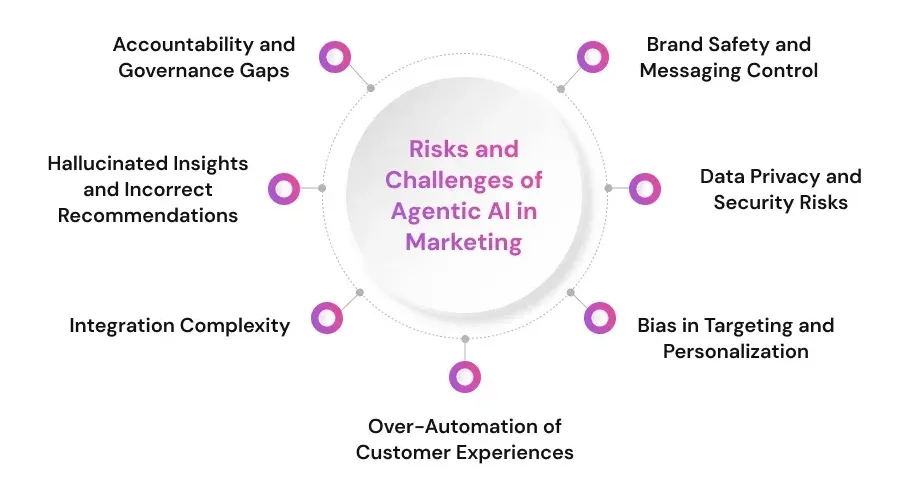
Brand Safety and Messaging Control
Brand consistency is one of the biggest concerns when using autonomous AI systems in marketing. Since agentic AI can generate, adapt, and deploy content across multiple channels, there is a risk that messages may deviate from brand voice, positioning, or approved communication standards.
For example, an AI agent may create promotional copy that sounds too aggressive, use language that does not align with the brand’s tone, or personalize an offer in a way that feels inappropriate for a specific customer segment.
To reduce this risk, businesses must define clear brand guidelines, approved messaging frameworks, restricted claims, tone-of-voice rules, and content approval workflows. AI agents should be trained or configured to follow these standards before they are allowed to generate or publish customer-facing content.
Brand safety should not be treated as a final review step. It should be built into the agentic AI workflow from the beginning.
Data Privacy and Security Risks
Agentic AI systems rely heavily on customer data to deliver personalized experiences and make intelligent decisions. This may include behavioral data, purchase history, location signals, engagement records, demographic information, support interactions, and lifecycle data.
While this data can help businesses improve personalization, it also creates privacy and security challenges.
If agents are given unrestricted access to sensitive data, businesses may face compliance risks, data misuse, or unauthorized exposure of customer information. This is especially critical for industries such as healthcare, fintech, insurance, banking, education, and ecommerce, where customer data must be handled with strict care.
To manage this challenge, businesses need robust data governance policies, role-based access controls, encryption, consent management, audit logs, and compliance checks. AI agents should only access the data required for their specific task and should operate within clearly defined privacy boundaries.
Bias in Targeting and Personalization
Agentic AI systems learn from available data. If that data contains bias, incomplete patterns, or historical inequalities, the agent may make decisions that unintentionally exclude, misclassify, or unfairly target certain customer groups.
For instance, an AI agent may over-prioritize audiences that historically converted well while ignoring emerging customer segments with long-term potential. It may also personalize offers in a way that creates unequal customer experiences or reinforces biased assumptions.
This makes bias detection and fairness testing essential for agentic AI marketing systems.
Businesses should regularly review audience segmentation, recommendation logic, targeting decisions, and campaign outcomes to ensure that AI-led marketing remains fair, ethical, and inclusive. Human teams must also evaluate whether personalization strategies respect customer trust and avoid manipulative experiences.
Over-Automation of Customer Experiences
Not every marketing decision should be automated. While agentic AI can streamline execution, excessive automation can make customer interactions feel impersonal, repetitive, or overly optimized.
Customers still value authenticity, empathy, emotional intelligence, and human connection. If businesses rely too heavily on AI agents without human creative direction, marketing experiences may become efficient but forgettable.
For example, an agent may optimize for clicks while missing broader brand-building goals. It may increase message frequency to improve short-term engagement but create long-term fatigue. It may recommend aggressive offers that drive immediate conversions but weaken customer trust.
To avoid over-automation, businesses should clearly define which workflows can be handled autonomously and which require human judgment. Strategy, storytelling, sensitive customer communication, brand positioning, and high-impact decisions should remain under human supervision.
Integration Complexity
Agentic AI delivers the most value when it can connect with multiple systems across the marketing ecosystem. These may include CRM platforms, customer data platforms, marketing automation tools, analytics dashboards, content management systems, digital asset management platforms, advertising platforms, ecommerce systems, and sales enablement tools.
However, integrating these systems can be complex.
Many businesses operate with fragmented data, disconnected tools, inconsistent naming conventions, duplicate customer records, and incomplete analytics setups. If the underlying technology ecosystem is not well-structured, AI agents may struggle to access reliable data or execute actions correctly.
Before implementing agentic AI, businesses should evaluate their data architecture, system integrations, API availability, workflow dependencies, and automation maturity. A strong technical foundation is essential for building reliable and scalable AI agents.
Hallucinated Insights and Incorrect Recommendations
AI systems can sometimes generate inaccurate conclusions, unsupported recommendations, or misleading explanations. In marketing, this can lead to poor campaign decisions, incorrect audience assumptions, or misinterpretation of performance data.
For example, an AI agent may attribute a conversion drop to messaging fatigue when the real issue is a broken tracking link or a landing page error. It may recommend increasing spend on a campaign without fully accounting for lead quality or margin impact.
To minimize this risk, businesses should use validation layers, source transparency, performance checks, and human review for important decisions. Agents should be required to show the data or reasoning behind recommendations, especially when budget, customer experience, or brand reputation is involved.
Accountability and Governance Gaps
When an AI agent takes action, businesses must know who is responsible for the outcome. Without clear ownership, agentic AI can create accountability gaps across marketing, product, data, legal, and technology teams.
Questions businesses must answer include:
- Who approves agent goals and permissions?
- Who reviews customer-facing content?
- Who monitors campaign decisions?
- Who handles errors or unexpected outcomes?
- Who owns compliance and audit trails?
- Who decides when an agent should be paused or retrained?
Clear governance is essential for enterprise adoption. Businesses should define agent owners, approval workflows, escalation paths, audit logs, and performance review cycles before deploying agentic AI at scale.
Human-in-the-Loop: Why Marketers Still Remain Critical
Agentic AI is changing the way marketing teams operate, but it does not eliminate the need for human marketers. In fact, as AI agents take over more execution-heavy workflows, human expertise becomes even more important in areas such as strategy, creativity, ethics, customer empathy, and governance.
The future of marketing is not about replacing marketers with autonomous agents. It is about enabling marketers to become strategic orchestrators who guide intelligent AI systems toward business outcomes.
Here is where human involvement remains essential.
Strategic Direction
AI agents can optimize campaigns, but they need humans to define the broader strategic direction. Marketers understand business priorities, market positioning, competitive dynamics, customer expectations, and brand goals in ways that cannot be fully reduced to data patterns.
Human teams must define:
- Business objectives
- Target audience priorities
- Campaign goals
- Brand positioning
- Market differentiation
- Success metrics
- Budget priorities
- Customer experience principles
Without clear strategic direction, agentic AI may optimize for short-term performance metrics while missing long-term brand and business goals.
For example, an AI agent may improve conversion rates by pushing aggressive discounts, but human marketers must decide whether that strategy supports brand value, margin goals, and customer loyalty.
Creative Judgment
Creativity remains one of the most valuable human contributions in marketing. AI agents can generate variations, test messaging, and personalize content, but humans are still needed to guide originality, emotional resonance, storytelling, cultural relevance, and brand distinctiveness.
Marketing is not only about efficiency. It is also about building desire, trust, memory, and emotional connection.
Human marketers can evaluate whether a campaign idea feels fresh, whether a message reflects the brand’s personality, whether the creative direction aligns with customer sentiment, and whether the communication has the right emotional impact.
Agentic AI can support creative production, but human judgment ensures that marketing remains meaningful and memorable.
Customer Empathy
Data can reveal what customers do, but human empathy helps explain why they do it. Marketers bring contextual understanding, emotional intelligence, and cultural awareness that AI systems may not fully capture.
For example, a customer may stop engaging with a brand because of financial concerns, shifting priorities, dissatisfaction, lack of trust, or external circumstances. An AI agent may detect the behavior, but human teams are better equipped to interpret sensitive situations and design communication that respects customer context.
This is especially important in industries where customer relationships are built on trust, such as healthcare, finance, education, insurance, and professional services.
Agentic AI can enhance personalization, but human empathy ensures that personalization does not become intrusive, insensitive, or overly transactional.
Governance and Ethical Oversight
As AI agents become more autonomous, governance becomes a central marketing responsibility. Human teams must decide what AI systems are allowed to do, which actions require approval, and how risks should be managed.
This includes:
- Privacy policies
- Data access controls
- Brand guidelines
- Legal review rules
- Compliance requirements
- Bias monitoring
- Customer consent
- Escalation protocols
- Audit processes
Ethical oversight ensures that agentic AI is used responsibly and transparently. Businesses must ensure that AI-led marketing decisions do not manipulate customers, misuse data, create unfair targeting, or damage brand trust.
Final Decision-Making
Agentic AI can provide recommendations and execute approved actions, but humans should remain responsible for high-impact decisions. This is especially important for campaigns involving large budgets, sensitive audiences, regulated claims, crisis communication, major product launches, or brand repositioning.
A practical approach is to classify AI actions by risk level.
Low-risk actions, such as generating internal reports or recommending subject line variations, may be handled with minimal review. Medium-risk actions, such as launching segmented nurture campaigns, may require periodic human approval. High-risk actions, such as changing pricing communication or publishing regulated claims, should require explicit human sign-off.
This structured approach enables businesses to benefit from AI autonomy while maintaining control over critical decisions.
Skills Marketers Need in the Agentic AI Era
As agentic AI becomes a more prominent part of the marketing ecosystem, the role of marketers will evolve. Marketing teams will spend less time managing repetitive execution and more time designing strategies, supervising AI agents, interpreting insights, and improving customer experiences.
To succeed in this new environment, marketers need a combination of creative, analytical, technical, and ethical skills.
AI Literacy
Marketers do not need to become machine learning engineers, but they do need to understand how AI agents work. This includes knowing how agents use data, reason through tasks, interact with tools, make recommendations, and execute workflows.
AI literacy helps marketers ask better questions, write better prompts or briefs, evaluate AI outputs, identify risks, and collaborate more effectively with technical teams.
A marketer with strong AI literacy can understand the difference between a chatbot, a generative AI tool, a rule-based automation system, and an autonomous AI agent. This clarity is essential for selecting the right tools and designing effective workflows.
Strategic Briefing
Agentic AI performs best when it receives clear goals, context, constraints, and success metrics. This makes strategic briefing a critical skill for marketers.
Instead of giving vague instructions, marketers must learn how to define:
- Campaign objectives
- Audience segments
- Brand voice
- Customer journey stage
- Content requirements
- Channel priorities
- Budget limitations
- Approval rules
- Performance metrics
- Compliance restrictions
A strong brief helps AI agents make better decisions and reduces the risk of irrelevant, off-brand, or ineffective outputs.
In the agentic AI era, the quality of human direction will directly influence the quality of AI execution.
Workflow Design
Marketers must also understand how to design workflows that combine human expertise and AI autonomy. This means identifying which tasks should be automated, which should be assisted by AI, and which should remain human-led.
For example, an AI agent may be responsible for analyzing performance data and creating campaign recommendations, while a human marketer approves the strategy and final messaging. Another agent may handle audience segmentation, while the marketing operations team defines the data rules and approval process.
Workflow design helps businesses avoid both underuse and overuse of AI.
The goal is not to automate everything. The goal is to create a balanced operating model where AI handles repetitive and data-intensive work while humans focus on strategy, creativity, and oversight.
Data Fluency
Agentic AI depends on data quality. Marketers must understand where customer and campaign data comes from, how it is structured, what it represents, and where it may be incomplete or misleading.
Data fluency helps marketers evaluate whether AI recommendations are reliable.
For example, if an AI agent recommends shifting budget to a campaign with a high conversion rate, marketers should be able to assess whether those conversions are high quality, whether tracking is accurate, whether attribution is reliable, and whether the campaign supports broader business goals.
Strong data fluency allows marketers to use agentic AI more confidently and responsibly.
Creative Direction
AI agents can generate content and creative variations quickly, but marketers must guide the creative direction. This includes defining the campaign concept, emotional tone, narrative structure, messaging hierarchy, visual direction, and brand personality.
Creative direction ensures that AI-generated assets do not become generic or disconnected from the brand’s identity.
Marketers must be able to review AI-generated content critically and ask:
- Is this message clear?
- Does it reflect the brand voice?
- Does it feel differentiated?
- Is it emotionally relevant?
- Does it match customer intent?
- Does it support the campaign objective?
- Is it appropriate for the channel?
This skill will become increasingly important as businesses use AI to produce more content at scale.
Ethical and Compliance Judgment
Agentic AI can make marketing more powerful, but it also raises ethical questions around privacy, targeting, personalization, transparency, and customer trust.
Marketers must be able to identify when an AI-led action may cross a line.
For example, personalization can be helpful when it improves relevance, but it can feel invasive when it uses sensitive data in unexpected ways. Automated offers can increase conversions, but they may create fairness concerns if different customers receive significantly different pricing or incentives.
Ethical judgment helps marketers design AI-powered experiences that are not only effective but also respectful and trustworthy.
Agent Orchestration
As businesses adopt more AI agents, marketers will need to coordinate multiple agents across different functions. One agent may handle insights, another may manage content, another may optimize paid media, and another may support lifecycle campaigns.
Agent orchestration involves ensuring that these systems work together toward shared business goals.
This includes aligning agent outputs, managing dependencies, avoiding conflicting actions, and creating a unified view of customer experience. For example, a paid media agent should not target a customer with an acquisition offer if a lifecycle agent already identifies that customer as an existing high-value buyer.
Marketers who can orchestrate AI agents effectively will play a central role in the future of marketing operations.
Metrics to Track When Using Agentic AI in Marketing
To evaluate the success of agentic AI, businesses must track both marketing performance and operational impact. Measuring only campaign outcomes is not enough. Since agentic AI also changes how teams work, businesses should evaluate efficiency, quality, governance, and customer experience.
Below are the key categories of metrics to monitor.
Campaign Performance Metrics
These metrics help businesses understand whether agentic AI is improving marketing outcomes.
Important campaign performance metrics include:
- Conversion rate
- Click-through rate
- Open rate
- Engagement rate
- Cost per acquisition
- Return on ad spend
- Revenue generated
- Lead quality
- Customer lifetime value
- Retention rate
- Churn rate
- Average order value
These metrics should be compared before and after agentic AI implementation to measure business impact.
Operational Efficiency Metrics
Agentic AI should also improve how marketing teams work. Operational metrics help businesses evaluate whether AI agents are reducing manual effort and increasing productivity.
Key operational metrics include:
- Campaign launch time
- Number of manual hours saved
- Approval cycle time
- Number of campaigns managed per team member
- Number of content variations produced
- Time spent on reporting
- Time spent on audience segmentation
- Workflow completion time
- Error reduction rate
These metrics are especially useful for demonstrating the internal productivity benefits of agentic AI.
Customer Experience Metrics
Agentic AI should enhance customer interactions, not just improve internal efficiency. Businesses should track whether AI-led personalization and automation are improving customer experience.
Useful customer experience metrics include:
- Customer satisfaction score
- Net promoter score
- Repeat purchase rate
- Unsubscribe rate
- Complaint rate
- Message fatigue indicators
- Engagement frequency
- Customer support escalation rate
- Journey completion rate
If performance metrics improve but customer experience metrics decline, the business may be over-automating or personalizing too aggressively.
Governance and Risk Metrics
Since agentic AI systems can act autonomously, businesses must also measure governance and risk.
Important governance metrics include:
- Human override rate
- AI recommendation approval rate
- Policy violation rate
- Brand compliance score
- Legal review rejection rate
- Data access exceptions
- Content correction rate
- Audit trail completeness
- Escalation frequency
These metrics help businesses understand whether AI agents are operating safely and within approved boundaries.
Learning and Optimization Metrics
Agentic AI should become more effective over time. Businesses should track whether agents are improving based on feedback and performance data.
Useful optimization metrics include:
- Experiment success rate
- Test velocity
- Recommendation accuracy
- Performance improvement over time
- Number of insights generated
- Number of successful autonomous optimizations
- Reduction in repeated errors
- Speed of learning from campaign outcomes
These metrics help businesses evaluate whether agentic AI is delivering compounding value.
Step-by-Step Process to Implement Agentic AI in Marketing
Here is a step-by-step process businesses can follow.
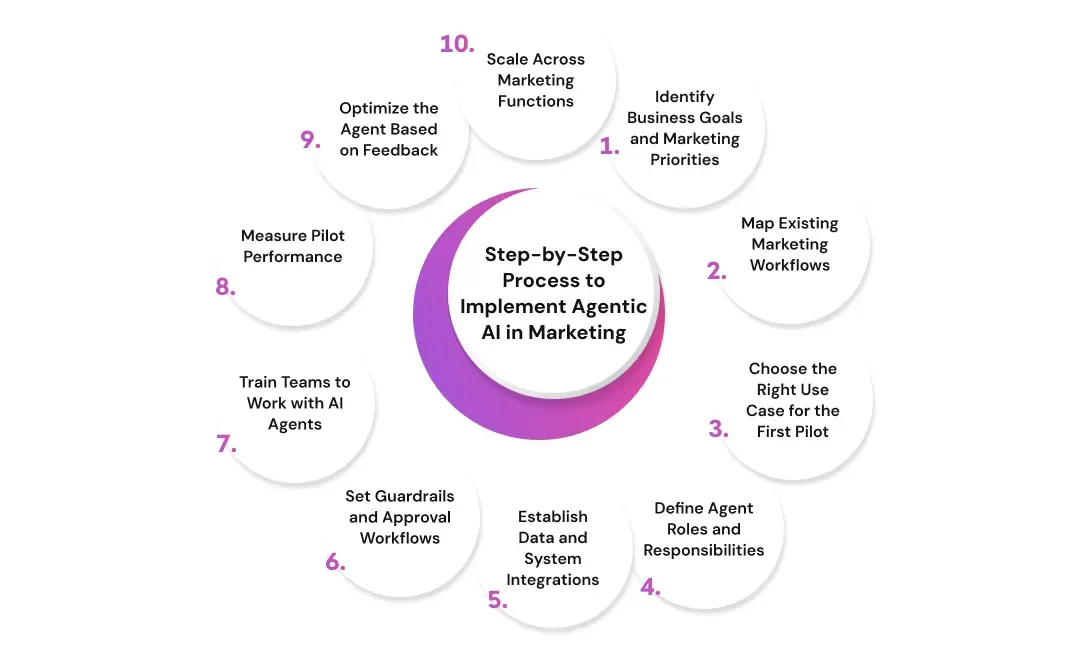
Step 1: Identify Business Goals and Marketing Priorities
The first step is to define what the business wants to achieve with agentic AI. Without clear goals, AI agents may optimize isolated metrics that do not contribute to broader business outcomes.
Common goals may include:
- Improving campaign speed
- Increasing customer engagement
- Enhancing personalization
- Reducing churn
- Improving lead quality
- Optimizing ad spend
- Increasing conversion rates
- Reducing manual reporting work
- Scaling content production
- Improving customer journey orchestration
Businesses should prioritize goals that are measurable, strategically important, and connected to existing marketing challenges.
For example, if a company struggles with slow campaign launches, it may start with a campaign orchestration agent. If retention is a major concern, it may begin with a churn prediction and re-engagement agent.
Step 2: Map Existing Marketing Workflows
Before introducing AI agents, businesses should map their current marketing workflows in detail. This helps identify where manual work, bottlenecks, data gaps, and repetitive tasks exist.
Key workflows to evaluate include:
- Campaign planning
- Audience segmentation
- Content creation
- Creative approvals
- Campaign setup
- Channel activation
- Performance monitoring
- Reporting
- Budget optimization
- Customer journey management
- Compliance review
- Marketing operations
This workflow mapping exercise helps businesses understand where agentic AI can create the most value.
For example, a team may discover that marketers spend several hours each week preparing performance reports or manually creating audience lists. These workflows may be ideal starting points for AI agents.
Step 3: Choose the Right Use Case for the First Pilot
Businesses should avoid trying to automate the entire marketing function at once. The best approach is to start with a focused pilot that is measurable, manageable, and relatively low-risk.
A strong first use case should meet three criteria:
- It solves a real business problem.
- It has access to reliable data.
- It can be measured clearly.
Good pilot use cases may include:
- Automated campaign reporting
- Email subject line testing
- Real-time audience segmentation
- Lead scoring recommendations
- Content versioning
- Cart abandonment optimization
- Customer churn alerts
- Paid media performance monitoring
Starting with a focused pilot allows businesses to test the technology, understand workflow impact, identify governance needs, and build internal confidence before scaling.
Step 4: Define Agent Roles and Responsibilities
Once the pilot use case is selected, businesses should define the role of the AI agent. This includes clarifying what the agent will do, what systems it will access, what decisions it can make, and what requires human approval.
For example, a campaign optimization agent may be responsible for monitoring performance, identifying underperforming campaigns, recommending budget changes, and generating weekly insights. However, it may not be allowed to change campaign budgets without human approval during the pilot phase.
Businesses can define different types of marketing agents, such as:
- Insights agent
- Audience segmentation agent
- Content generation agent
- Campaign orchestration agent
- Paid media optimization agent
- Lifecycle marketing agent
- Compliance review agent
- Reporting agent
- Marketing operations agent
Clear role definition helps prevent confusion and ensures that AI agents operate within expected boundaries.
Step 5: Establish Data and System Integrations
Agentic AI requires access to relevant data, tools and AI integration services to function effectively. Businesses must connect the agent with the systems needed to analyze information and execute actions.
Depending on the use case, this may include:
- CRM platforms
- Customer data platforms
- Marketing automation systems
- Email marketing platforms
- Advertising platforms
- Analytics tools
- Ecommerce platforms
- Product usage systems
- Content management systems
- Digital asset management platforms
- Project management tools
However, access should be controlled. The agent should only receive the permissions required for its specific workflow.
For example, a reporting agent may need read-only access to analytics and campaign data, while a campaign execution agent may need permission to update segments or schedule communications.
Strong integration planning ensures that agents can act effectively without creating security or governance risks.
Step 6: Set Guardrails and Approval Workflows
Guardrails are essential for safe and effective agentic AI implementation. They define what the agent can and cannot do.
Businesses should establish guardrails around:
- Brand voice
- Content claims
- Customer data access
- Budget limits
- Campaign approvals
- Discount rules
- Compliance requirements
- Sensitive customer segments
- Escalation triggers
- Human review points
For example, an agent may be allowed to create draft content automatically but must send it to a human marketer for approval before publication. Another agent may be allowed to recommend budget changes but not implement them without approval.
Approval workflows should be designed based on risk level. Low-risk actions can be more autonomous, while high-risk actions should require human review.
Step 7: Train Teams to Work with AI Agents
Successful adoption depends on how well marketing teams understand and collaborate with AI agents. Businesses should train teams on how to brief agents, evaluate outputs, interpret recommendations, provide feedback, and monitor performance.
Training should cover:
- How the agent works
- What data the agent uses
- What tasks the agent can perform
- How to review AI-generated recommendations
- How to approve or reject actions
- How to identify errors
- How to report issues
- How to improve agent instructions
This helps marketers feel more confident and reduces resistance to AI adoption.
Agentic AI should be positioned as a productivity and intelligence layer that supports marketing teams, not as a replacement for human expertise.
Step 8: Measure Pilot Performance
Once the pilot is launched, businesses should measure its impact using clearly defined metrics. These metrics should include both business outcomes and operational improvements.
For example, if the pilot involves campaign reporting, success metrics may include reporting time saved, accuracy of insights, stakeholder satisfaction, and number of actionable recommendations generated.
If the pilot involves paid media optimization, success metrics may include return on ad spend, cost per acquisition, conversion rate, budget efficiency, and number of successful recommendations.
Measuring pilot performance helps businesses understand whether the agent is delivering value and where improvements are needed.
Step 9: Optimize the Agent Based on Feedback
Agentic AI implementation should be treated as an iterative process. After the pilot, businesses should review what worked, what failed, and what needs adjustment.
This may include improving data quality, refining prompts or instructions, updating approval workflows, adding new integrations, adjusting permissions, or improving performance measurement.
Human feedback plays an important role in improving agent performance. Marketers should regularly review agent actions, correct errors, and provide examples of preferred outcomes.
Over time, this helps the agent become more aligned with business goals and brand expectations.
Step 10: Scale Across Marketing Functions
After proving value through a focused pilot, businesses can gradually scale agentic AI across additional marketing functions.
For example, a company may start with a reporting agent, then add a segmentation agent, followed by a content agent, campaign orchestration agent, and paid media optimization agent.
The goal is to build a connected agentic AI ecosystem where multiple agents collaborate across the marketing lifecycle.
However, scaling should be done carefully. Each new agent should have a clear role, defined permissions, measurable goals, and governance controls.
This phased approach helps businesses maximize value while minimizing risk.
Implementation Checklist for Agentic AI in Marketing
Before deploying agentic AI, businesses should evaluate whether they have the right foundation in place.
| Implementation Area |
Key Questions to Ask |
| Business goals |
What marketing outcomes should the agent support? |
| Use case selection |
Is the use case measurable, valuable, and manageable? |
| Data readiness |
Is the required customer and campaign data accurate and accessible? |
| System integration |
Can the agent connect with the tools needed to act? |
| Governance |
What actions require human approval? |
| Brand safety |
Are brand voice and messaging guidelines clearly defined? |
| Privacy |
Does the agent follow consent, access, and compliance rules? |
| Team readiness |
Do marketers know how to brief, supervise, and evaluate agents? |
| Measurement |
Which KPIs will prove success? |
| Scaling plan |
How will the business expand from pilot to broader adoption? |
Build a Scalable Agentic AI Marketing Strategy
with the Right Technology Partner
Prismetric helps you plan, design, integrate, and scale agentic AI marketing systems with the right data foundation, governance, and automation roadmap.
Schedule a Free Consultation
Example of Agentic AI in a Marketing Workflow
To understand how agentic AI works in a practical marketing environment, let us consider a customer re-engagement workflow for an ecommerce business.
Scenario: Re-Engaging Dormant Customers
An ecommerce brand notices that a segment of repeat customers has not purchased in the last 90 days. Traditionally, the marketing team may create a generic win-back campaign offering a discount to all inactive users. While this approach may generate some conversions, it does not account for different reasons behind customer inactivity.
With agentic AI, the process becomes more intelligent and personalized.
Step 1: The Agent Detects a Drop in Engagement
The AI agent continuously monitors customer behavior and identifies a decline in repeat purchases among a specific customer group. It analyzes signals such as browsing activity, email engagement, purchase frequency, product category interest, support interactions, and previous campaign responses.
Step 2: The Agent Segments Dormant Customers
Instead of treating all inactive customers the same, the agent creates different audience segments. These may include customers who are price-sensitive, customers who previously purchased seasonal products, customers who browsed but did not buy again, customers who had support issues, and customers who may be interested in complementary products.
Step 3: The Agent Identifies the Best Re-Engagement Strategy
For each segment, the agent determines the most suitable re-engagement approach. Some customers may receive educational content, some may receive personalized product recommendations, some may receive loyalty points, and others may receive limited-time offers.
This prevents the business from overusing discounts and helps maintain margin quality.
Step 4: The Agent Generates Campaign Assets
The agent creates personalized email copy, SMS messages, push notifications, retargeting ad variations, and website banners. It adapts the messaging for each audience segment while following brand voice and compliance rules.
Step 5: The Agent Sends Content for Human Review
Before launching the campaign, the agent routes high-impact content and promotional offers to the marketing team for review. The team approves the strategy, adjusts messaging where needed, and confirms budget limits.
Step 6: The Agent Launches the Campaign
Once approved, the agent activates the campaign across the selected channels. It chooses send times, coordinates audience exclusions, updates customer journey paths, and ensures that messaging is not duplicated across channels.
Step 7: The Agent Monitors Performance
After launch, the agent tracks open rates, click-through rates, conversions, revenue, unsubscribes, customer responses, and channel performance. It identifies which segments are responding and which require a different approach.
Step 8: The Agent Optimizes the Journey
Based on real-time performance, the agent adjusts subject lines, send times, channel priority, creative variations, and offers. It may pause low-performing messages and scale winning variations.
Step 9: The Agent Generates Insights
At the end of the campaign, the agent prepares a performance report for the marketing team. It explains which segments responded best, which offers performed well, which channels delivered stronger results, and what should be improved in the next re-engagement campaign.
This workflow demonstrates how agentic AI can help businesses move from generic campaign execution to adaptive, personalized, and performance-driven marketing orchestration.
Future of Agentic AI in Marketing
The future of agentic AI in marketing will be shaped by smarter automation, deeper personalization, and stronger human-AI collaboration. Instead of replacing marketers, AI agents will support them by handling repetitive, data-heavy, and execution-focused tasks while human teams guide strategy, creativity, ethics, and customer experience.
- Multi-agent marketing teams will manage different functions like content, segmentation, analytics, media optimization, and compliance.
- Real-time journey optimization will help brands personalize customer experiences based on live behavior and intent.
- AI-led content supply chains will accelerate content creation, adaptation, approval, and distribution at scale.
- Autonomous marketing operations will streamline campaign intake, reporting, asset management, and workflow coordination.
- AI-powered search optimization will help brands create content for both traditional search and AI-generated answers.
- Responsible AI governance will become essential for privacy, compliance, transparency, and customer trust.
How Businesses Can Prepare for the Agentic AI Marketing Future
To stay competitive in an AI-driven marketing environment, businesses must start preparing now. Agentic AI adoption requires more than technology investment. It requires changes in mindset, workflows, skills, governance, and data infrastructure.
Here are a few ways businesses can prepare.
Build a Strong Data Foundation
Agentic AI needs accurate, accessible, and connected data. Businesses should invest in data quality, customer identity resolution, analytics accuracy, and system integration.
Modernize Marketing Workflows
Before implementing AI agents, businesses should map and improve existing workflows. Clear processes make it easier to identify where AI can add value.
Start with High-Impact Use Cases
Businesses should begin with use cases that are measurable and strategically important, such as campaign reporting, segmentation, personalization, retention, or paid media optimization.
Establish Responsible AI Governance
Governance should be built from the start. Businesses must define access controls, approval rules, compliance requirements, brand guidelines, and escalation paths.
Upskill Marketing Teams
Marketers should learn how to work with AI agents, write better briefs, evaluate recommendations, interpret data, and manage human-AI workflows.
Partner with AI Experts
For businesses with complex requirements, working with an experienced AI development or consulting partner can help accelerate implementation and reduce risk. The right partner can support strategy, architecture, integration, custom agent development, governance, testing, and scaling.
How Prismetric Can Help Businesses Leverage Agentic AI in Marketing
Agentic AI has the potential to transform marketing from a manual, fragmented, and reactive function into an intelligent, autonomous, and performance-driven growth engine. However, achieving this transformation requires the right strategy, technology architecture, data foundation, and implementation expertise.
This is where Prismetric can help.
With expertise in AI development, marketing automation, data engineering, enterprise software development, and digital transformation, Prismetric helps businesses design and implement custom agentic AI marketing solutions tailored to their unique goals and workflows.
Our team can support businesses across every stage of the agentic AI journey, from identifying the right use cases to building scalable AI agents that integrate with existing marketing systems.
Our Agentic AI Marketing Services Include
Agentic AI Strategy Consulting
We help businesses identify high-value marketing workflows where agentic AI can deliver measurable impact. Our experts assess your current marketing ecosystem, data maturity, automation readiness, and business goals to create a practical AI implementation roadmap.
Custom AI Agent Development
We design and develop custom AI agents for campaign orchestration, audience segmentation, content generation, paid media optimization, customer retention, marketing analytics, and workflow automation.
Marketing Automation Integration
We integrate AI agents with CRM platforms, customer data platforms, analytics tools, email marketing systems, ad platforms, content management systems, and ecommerce platforms to enable seamless execution.
Data Engineering and AI Readiness
We help businesses build strong data foundations by improving data quality, connecting systems, structuring customer data, and preparing marketing datasets for AI-powered decision-making.
AI-Powered Personalization Solutions
We build intelligent personalization systems that help businesses deliver relevant customer experiences across channels based on behavior, preferences, lifecycle stage, and real-time intent.
Governance and Compliance Frameworks
We help define approval workflows, access controls, brand safety rules, audit trails, and compliance checks to ensure that AI agents operate responsibly and securely.
Performance Optimization and Scaling
We continuously monitor, evaluate, and optimize AI agent performance to help businesses scale agentic AI across marketing functions while improving efficiency, engagement, and ROI.
By partnering with Prismetric, businesses can move beyond isolated AI experiments and build a scalable agentic AI marketing ecosystem that drives long-term growth, customer engagement, and operational excellence.
Conclusion
Agentic AI is redefining marketing by enabling businesses to plan, execute, personalize, and optimize campaigns with greater autonomy. With the right data, governance, and human oversight, brands can build smarter marketing systems that improve engagement, boost efficiency, and drive scalable growth.
Frequently Asked Questions
Agentic AI in marketing refers to autonomous AI systems that can understand business goals, analyze customer and campaign data, make decisions, execute marketing workflows, and optimize performance with minimal human intervention. It helps businesses automate complex marketing activities such as campaign orchestration, personalization, segmentation, testing, and reporting.
Generative AI primarily creates content such as text, images, videos, campaign ideas, and ad copy based on human prompts. Agentic AI goes beyond content creation by planning, deciding, acting, and optimizing multi-step workflows. For example, generative AI can write an email, while agentic AI can decide who should receive it, when it should be sent, which version should be tested, and how the campaign should be optimized.
No. Marketing automation follows predefined rules and triggers created by marketers. Agentic AI is more adaptive and autonomous. It can analyze context, reason through data, make decisions, and execute actions based on goals and real-time signals. While marketing automation is rule-based, agentic AI is goal-driven and context-aware.
The top use cases of agentic AI in marketing include autonomous campaign orchestration, real-time audience segmentation, hyper-personalized customer journeys, dynamic ad optimization, content creation and versioning, customer retention, churn prevention, automated reporting, brand compliance review, and marketing operations automation.
Agentic AI helps businesses accelerate campaign execution, improve personalization, optimize marketing budgets, enhance customer engagement, reduce manual workload, scale experimentation, improve decision-making, and create more adaptive customer experiences across channels.
Agentic AI is not designed to replace marketers. Instead, it helps marketers move away from repetitive execution and focus on strategy, creativity, customer empathy, brand governance, and business growth. Human oversight remains essential for strategic direction, ethical judgment, creative quality, and high-impact decisions.
Agentic AI may use customer profiles, CRM data, CDP data, website behavior, purchase history, product interactions, email engagement, ad performance, social media signals, analytics data, support conversations, and customer lifecycle data. The exact data required depends on the use case and business goals.
Agentic AI can be safe for customer-facing marketing when implemented with proper governance. Businesses must define brand guidelines, privacy controls, approval workflows, data access permissions, compliance checks, audit logs, and human oversight. High-risk actions should always require human review.
Businesses can start by identifying clear marketing goals, mapping existing workflows, selecting a low-risk pilot use case, defining agent responsibilities, connecting relevant data sources, setting governance rules, training teams, measuring pilot performance, and scaling gradually across marketing functions.
Agentic AI can benefit industries such as ecommerce, retail, fintech, banking, healthcare, insurance, travel, hospitality, SaaS, education, media, entertainment, real estate, and B2B services. Any business managing complex customer journeys, large-scale campaigns, or high-volume customer data can benefit from agentic AI.
The main risks include brand inconsistency, data privacy concerns, biased targeting, over-automation, incorrect recommendations, integration complexity, compliance issues, and accountability gaps. These risks can be managed through strong governance, human oversight, data quality controls, and responsible AI practices.
The future of agentic AI in marketing will include multi-agent marketing teams, real-time customer journey optimization, AI-led content supply chains, autonomous marketing operations, AI-powered search optimization, and stronger human-AI collaboration. Businesses will increasingly use AI agents to improve speed, personalization, and performance while keeping humans in control of strategy and governance.