10 Best Healthcare AI Development Companies in 2026
Key Takeaways
- Healthcare AI development companies build custom systems for clinical, operational, administrative, and patient-facing workflows.
- Strong partners combine AI engineering with healthcare data, interoperability, privacy, security, and workflow knowledge.
- Custom healthcare AI development can involve machine learning, generative AI, NLP, computer vision, RAG, predictive analytics, and AI agents.
- EHR integration, model validation, monitoring, and human review can matter as much as model performance.
- Healthcare AI product companies sell defined platforms, while development companies build around an organization’s specific requirements.
- A useful shortlist should compare healthcare expertise, deployment evidence, integration skills, technical depth, and long-term support.
TL;DR
Healthcare AI development companies build custom AI systems for hospitals, providers, HealthTech companies, MedTech businesses, payers, and other healthcare organizations. The strongest partners combine healthcare knowledge with AI engineering, interoperability, data security, model validation, and production deployment.
Healthcare AI adoption is already moving into everyday medical work. According to the American Medical Association’s 2026 Physician Survey on Augmented Intelligence, 81% of physicians reported professional awareness or use of AI, up from 38% reporting at least one AI use case in 2023. The wider use of AI in healthcare now spans clinical, patient-facing, and operational workflows.
Choosing among AI development companies for healthcare requires more than comparing technical skills. Healthcare projects may involve PHI, EHR or EMR systems, FHIR or HL7 interoperability, clinical validation, regulatory requirements, and human oversight. The companies in this list are assessed on healthcare experience, technical depth, integration capability, security readiness, production evidence, and post-launch support.
Build Healthcare AI Around Real Clinical and Operational Workflows
Prismetric helps develop AI solutions for diagnostics, patient support, medical imaging, administrative automation, RAG, NLP, and predictive healthcare workflows.
Discuss Your Healthcare AI Project
What a Healthcare AI Development Company Does
A healthcare AI development company turns a healthcare problem into a working AI-enabled system. Unlike a product vendor that offers a predefined platform, a development partner can build custom AI healthcare solutions around an organization’s workflows, data sources, integrations, security requirements, and deployment environment.
Healthcare AI software development usually covers four areas. Application engineering includes clinical assistants, patient-support tools, medical imaging systems, and healthcare administrative automation. AI engineering can involve machine learning, NLP, computer vision, generative AI, RAG, predictive models, and AI agents. Integration connects these systems with EHRs, healthcare databases, APIs, and FHIR or HL7 interfaces. Production controls cover privacy, validation, monitoring, auditability, and human review.
Projects that rely heavily on unstructured clinical text may require dedicated natural language processing services, while medical imaging workflows may need computer vision development. Generative applications can also require generative AI development services when the system needs contextual generation, summarization, copilots, or RAG-based assistance.
McKinsey’s fourth-quarter 2025 healthcare survey was the first in its series in which 50% of respondents said their organizations had implemented generative AI. This matters because production use exposes requirements that prototypes often miss, including data quality, security, workflow integration, governance, and ongoing monitoring.
3 Types of Healthcare AI Development Companies
Healthcare organizations generally work with three types of development partners:
- Enterprise healthcare technology firms: Support large programs involving data platforms, interoperability, cloud modernization, and enterprise AI implementation.
- Healthcare-focused AI development companies: Build custom AI healthcare solutions for providers, HealthTech businesses, MedTech companies, and payers.
- AI and software engineering specialists: Bring deeper expertise in machine learning, generative AI, RAG, NLP, computer vision, AI agents, and data engineering.
The right fit depends on project scope. A hospital connecting AI with several clinical systems may need strong interoperability and governance experience, while a HealthTech startup may prioritize rapid product development and scalable architecture. Teams testing a new healthcare AI concept can also start with an AI proof of concept before committing to a larger production build.
Healthcare AI development companies are also different from healthcare AI product companies. OpenEvidence, Abridge, Ambience Healthcare, Tempus AI, Hippocratic AI, Aidoc, and Quibim primarily offer their own AI products or platforms. Development companies instead build or integrate systems around a client’s specific workflows, data, users, and technology environment.
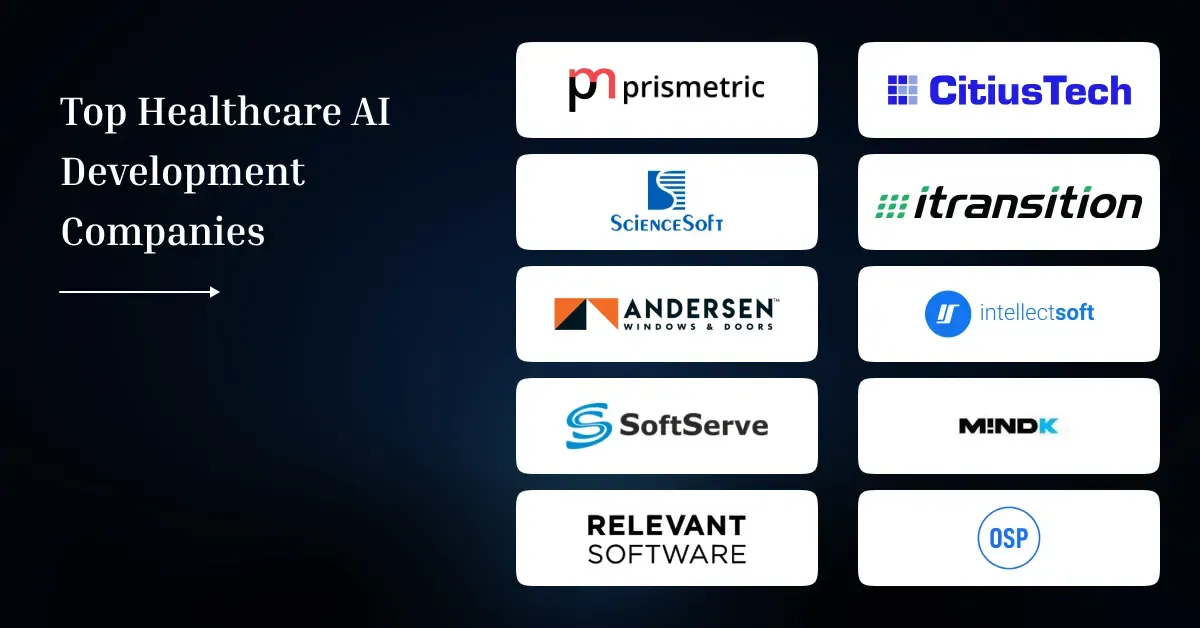
The 10 Best Healthcare AI Development Companies in 2026
The best healthcare AI development companies combine AI engineering with healthcare-specific capabilities such as EHR integration, clinical data processing, privacy controls, model validation, and production monitoring. This list compares providers based on public evidence across healthcare experience, AI depth, interoperability, security, deployment capability, and post-launch support.
The ranking focuses on suitability for custom healthcare AI development, not company size or overall market share.
Disclosure: Prismetric is included in this ranking, so we want to be clear about why. Its position is based on the same factors used to assess every company on the list, including healthcare AI experience, technical depth, interoperability, security readiness, production evidence, and post-launch support.
We did not treat brand visibility or service-page claims as enough on their own. Prismetric earned a place because of its documented healthcare AI capabilities, published project evidence, and experience across machine learning, generative AI, NLP, computer vision, RAG, and AI agents. The same evidence-first standard was applied to every company reviewed.
| Company |
Best For |
Healthcare AI Strengths |
Delivery Profile |
| Prismetric |
Custom healthcare AI products |
ML, GenAI, RAG, NLP, computer vision, AI agents |
Custom development and integration |
| CitiusTech |
Enterprise healthcare AI |
Healthcare data, AI/ML, GenAI, interoperability |
Healthcare-focused enterprise specialist |
| ScienceSoft |
Regulated healthcare AI projects |
AI transformation, analytics, clinical workflows |
Consulting plus software engineering |
| Itransition |
EHR-connected AI and modernization |
AI copilots, analytics, medical imaging, EHR integration |
Enterprise custom development |
| Andersen |
Healthcare AI and EHR engineering |
ML, AI agents, EHR/EMR, clinical automation |
Large engineering teams |
| Intellectsoft |
MedTech and connected-care products |
AI-enabled apps, EHRs, telehealth, analytics |
Product and digital engineering |
| SoftServe |
Enterprise AI, data, and cloud programs |
GenAI, agentic AI, analytics, medical imaging |
Enterprise consulting and engineering |
| MindK |
HealthTech startups and scale-ups |
Agentic AI, RCM automation, FHIR, LLMOps |
Product-focused healthcare AI development |
| Relevant Software |
Custom GenAI healthcare products |
RAG, NLP, clinical decision support, FHIR |
Custom software and AI engineering |
| OSP Labs |
Healthcare operations and RCM |
AI agents, NLP, predictive analytics, EHR integration |
Healthcare-focused development |
1. Prismetric
Prismetric develops custom healthcare AI solutions using machine learning, NLP, computer vision, generative AI, RAG, predictive analytics, and AI agents. Its healthcare capabilities also cover EHR and EMR integration, remote monitoring, healthcare data engineering, model testing, and post-launch monitoring. A published healthcare case study reports a 25% increase in diagnostic accuracy, 40% faster treatment planning, and a 30% reduction in administrative work.
For healthcare organizations exploring more autonomous workflows, agentic AI in healthcare can support use cases such as documentation, scheduling, prior authorization, claims processing, and patient follow-up when permissions and human checkpoints are clearly defined.
Experience: 14+ years in IT
Major Locations: USA, India, Australia, Germany
Healthcare AI Expertise: Diagnostics, predictive analytics, NLP, RAG, medical imaging, workflow automation
Evidence: Published AI-powered healthcare platform case study
Best For: Organizations that need custom AI built around existing healthcare workflows and systems.
Connect AI With EHR, EMR, FHIR, and Healthcare Data
Build AI that works securely with clinical systems, databases, APIs, imaging platforms, and healthcare workflows while maintaining the right access and human oversight.
Plan Your Healthcare AI Integration
2. CitiusTech
CitiusTech focuses on healthcare and life sciences, giving it deeper domain specialization than general-purpose AI firms. Its AI capabilities include data science, generative AI, MLOps, patient-risk models, information extraction, denial management, and regulatory ML operations. It also supports EHR and clinical decision-support systems using FHIR, HL7, and DICOM.
Founded: 2005
Major Locations: USA, India, UK, Middle East, Singapore, and Europe
Healthcare AI Expertise: Enterprise AI, GenAI, MLOps, healthcare data, interoperability
Evidence: Healthcare-specific AI solutions and public case studies
Best For: Large providers, payers, MedTech companies, and life sciences organizations.
3. ScienceSoft
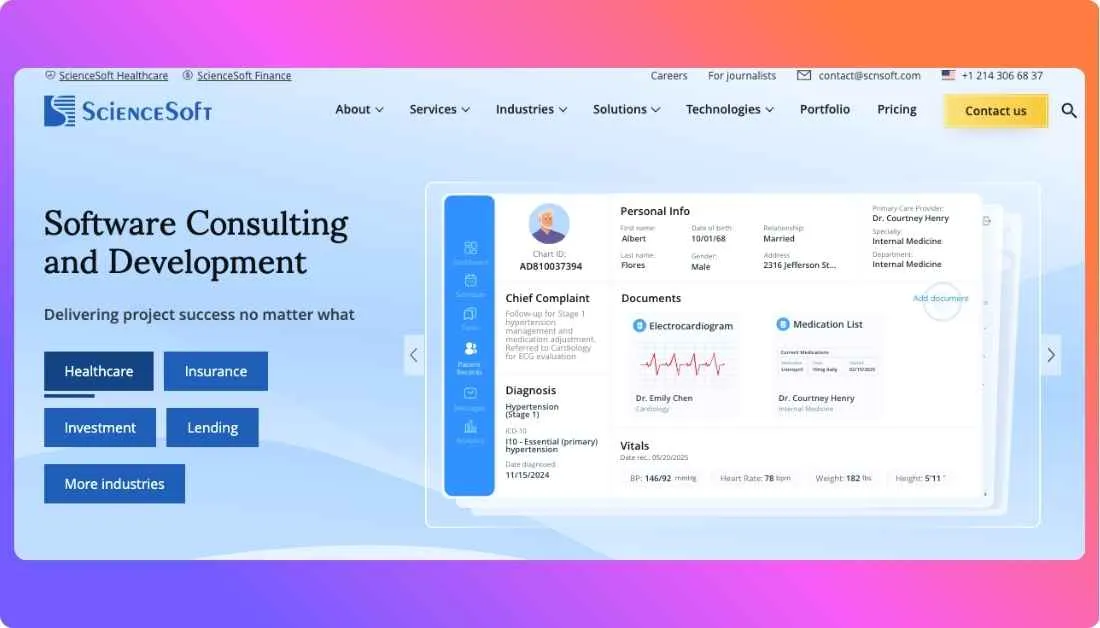
ScienceSoft combines healthcare software engineering with AI transformation, analytics, integration, modernization, and security services. The company reports 21 years in healthcare IT and AI and more than 150 healthcare projects. Its AI work covers clinical documentation, EHR workflows, diagnostic decision support, digital pathology, medication management, and medical-device intelligence.
Founded: 1989
Headquarters: United States
Healthcare AI Expertise: AI transformation, analytics, clinical workflows, agents, model validation
Evidence: Healthcare project portfolio with ISO 9001 and ISO 27001 management practices
Best For: Organizations combining AI adoption with healthcare software modernization and compliance needs.
4. Itransition
Itransition develops healthcare software and AI systems for medical data analytics, remote monitoring, clinical documentation, predictive analytics, and medical image analysis. One public project describes an AI medical copilot that transcribes visits, adds information to EHR records, and helps clinicians retrieve patient-history information.
Experience: IT services since 1998
Healthcare AI Expertise: AI copilots, NLP, medical imaging, predictive analytics, EHR-connected workflows
Technology Evidence: Microsoft Cloud for Healthcare, Azure OpenAI, APIs, and healthcare integration
Best For: Organizations modernizing existing healthcare systems while adding AI capabilities.
5. Andersen
Andersen combines healthcare software engineering with custom AI, machine learning, AI agents, and EHR/EMR development. Its healthcare AI capabilities include clinical documentation automation, diagnostic triage support, hospital resource planning, prior-authorization workflows, and patient-support applications.
Experience: 19+ years in software development
Headquarters: Dallas, USA
Healthcare AI Expertise: ML, AI agents, EHR/EMR systems, clinical and administrative automation
Evidence: Dedicated healthcare AI and EHR development offerings
Best For: Healthcare enterprises that need broader engineering capacity around AI-enabled clinical or operational systems.
6. Intellectsoft
Intellectsoft develops custom healthcare software across EHRs, telehealth, Internet of Medical Things (IoMT), mobile health, and AI-enabled applications. Its healthcare portfolio includes patient information systems, telemedicine platforms, analytics, and AI-powered health applications. The company reports more than 10 years of healthcare-domain experience and provides development from discovery through maintenance.
Experience: 17+ years in mobile and enterprise software development
Healthcare AI Expertise: AI/ML applications, analytics, mobile health, telehealth, IoMT
Evidence: Published healthcare projects and full-cycle healthcare engineering services
Best For: MedTech and digital-health teams building connected patient or clinician applications
7. SoftServe
SoftServe combines healthcare expertise with AI, data, cloud, and digital engineering. Its healthcare work covers clinical decision support, medical imaging, conversational AI, patient engagement, claims optimization, and generative AI. The company also develops agentic healthcare platforms that connect AI with patient intake, compliance, and operational workflows.
Delivery Profile: Global digital engineering and consulting company
Healthcare AI Expertise: Generative AI, agentic AI, medical imaging, analytics, patient engagement
Evidence: Public healthcare solutions, client stories, and AI/ML healthcare resources
Best For: Large healthcare and life sciences organizations combining AI with data, cloud, and platform modernization
8. MindK
MindK focuses on AI-native healthcare products and workflow automation, with particular depth in revenue cycle management. Its healthcare capabilities include AI agents for eligibility checks, prior authorization, patient onboarding, claims automation, and voice or chat workflows. The company also works with HL7 FHIR and EHR integrations, helping AI operate across existing healthcare systems.
Healthcare Focus: Providers, payers, HealthTech, MSOs, and billing companies
Healthcare AI Expertise: Agentic AI, RCM automation, interoperability, voice and chat agents
Evidence: MindK reports that its RCM platform is used by 300+ clinics
Best For: HealthTech startups and scale-ups building AI-native products or automating revenue workflows
9. Relevant Software
Relevant Software develops healthcare platforms that combine custom engineering with AI/ML, clinical analytics, and interoperability. Its healthcare capabilities include FHIR, HL7, DICOM, SMART on FHIR, IoMT, and cloud infrastructure. The company also provides LLMOps for testing, releasing, monitoring, and improving language-model systems after deployment.
Experience: 12+ years in healthcare and connected-device projects
Healthcare AI Expertise: AI/ML, clinical analytics, LLMOps, IoMT, FHIR integration
Evidence: Published healthcare projects and ISO 27001:2022 certification
Best For: Teams that need custom healthcare software with AI, interoperability, and production model operations
10. OSP Labs
OSP Labs focuses on healthcare technology and builds AI systems for clinical, administrative, and revenue-cycle workflows. Its capabilities include AI agents and copilots, NLP and LLM applications, predictive analytics, denial management, patient-flow tools, and EHR-connected automation. OSP also supports HL7 FHIR APIs and integrations with major healthcare systems.
Healthcare Focus: Healthcare technology and digital transformation
Healthcare AI Expertise: AI agents, GenAI, NLP, predictive analytics, RCM automation
Evidence: OSP reports 700+ healthcare projects and dedicated interoperability capabilities
Best For: Healthcare organizations embedding AI into operational, billing, or connected clinical systems
How a Healthcare AI Build Reaches Production
A healthcare AI prototype can work well in a controlled test and still fail in production. Real deployment adds patient data, EHR integrations, user permissions, workflow constraints, security reviews, and ongoing model monitoring. McKinsey’s 2026 healthcare survey found that integration challenges were the most-cited barrier to scaling generative AI, while 43% of respondents identified risk and safety as an implementation roadblock.
A typical production path includes six stages:
- Use-case discovery: Define the clinical or operational problem, users, expected outcome, and where human judgment remains necessary. Early AI consulting can help organizations assess feasibility, priorities, data readiness, and implementation requirements before development begins.
- Data and compliance planning: Identify data sources, PHI exposure, consent requirements, access controls, and data-quality gaps.
- Model and architecture design: Select the AI approach, infrastructure, retrieval layer, APIs, and evaluation methods.
- Healthcare-system integration: Connect the solution with EHRs, databases, imaging systems, devices, or other workflow tools.
- Validation and security testing: Test accuracy, bias, failure modes, privacy controls, auditability, and human-review points.
- Deployment and monitoring: Track performance, model drift, user feedback, security issues, and changing workflow requirements.
This staged approach matters because healthcare AI is not only a model-development problem. The system must continue to perform safely and predictably as data, users, integrations, and operating conditions change.
How to Evaluate a Healthcare AI Development Company
A strong healthcare AI partner should show evidence that it can move from an idea to a secure, integrated, and maintainable system. Buyers should evaluate the following areas before shortlisting a vendor:
- Healthcare track record: Look for deployed healthcare systems, relevant case studies, and experience with the type of workflow being automated.
- Data privacy and security: Review PHI handling, encryption, identity and access management, audit logs, cloud security, and support for applicable privacy requirements.
- Interoperability expertise: Check experience with FHIR, HL7, DICOM, SMART on FHIR, EHR or EMR integrations, and healthcare APIs where the project requires them.
- AI engineering depth: Assess capabilities across machine learning, NLP, computer vision, generative AI, RAG, AI agents, model evaluation, and MLOps.
- Validation and human oversight: Ask how the team tests outputs, handles uncertain results, monitors model behavior, and keeps clinicians or staff involved where judgment is required.
- Regulatory understanding: Determine whether the solution is ordinary healthcare software or could fall within medical-device regulation. The FDA reported more than 1,600 AI-enabled medical devices authorized for marketing in the United States as of September 2026.
- Post-launch support: Confirm how the company handles monitoring, retraining, integration changes, security updates, and production incidents.
These checks reflect what healthcare users themselves value. In the AMA’s 2026 survey, 88% of physicians said strong safety and efficacy validation was important for broader AI adoption, while 86% emphasized data privacy. That makes validation and governance core vendor-selection criteria, not secondary technical details.
How Prismetric Builds Production Healthcare AI
Prismetric describes a six-stage healthcare AI development process that starts with workflow discovery and data preparation, then moves through model development, clinical-system integration, security checks, deployment, and performance monitoring. This structure connects model development with the healthcare systems and operating conditions in which the software will actually run.
Its published healthcare AI capabilities include generative AI with RAG, NLP for unstructured clinical text, computer vision for medical imaging, remote patient monitoring, anomaly detection, and integration with EHR, EMR, PACS, and HIS environments. Prismetric also describes building secure healthcare data pipelines to prepare and govern information used by AI systems.
For production use, the company states that models are validated before deployment and monitored afterward, with retraining and support used as requirements or performance change. For buyers, the practical value is that model development, integration, security, and monitoring are treated as connected parts of the same healthcare AI system rather than separate technical tasks.
Validate Your Healthcare AI Before Moving to Production
Test model accuracy, privacy controls, interoperability, failure cases, security, and human-review requirements before scaling AI into live healthcare environments.
Start Your Healthcare AI PoC
Case Study: AI-Powered Healthcare Platform
Prismetric published an AI-powered healthcare platform project in which a provider needed to improve diagnostic workflows, treatment planning, and patient-data management. The platform combined machine learning, predictive analytics, natural language processing, and cloud-based data management while adding security controls for sensitive healthcare information.
Challenges
- Diagnostic variability could delay treatment or lead to inconsistent decisions.
- Generic treatment approaches made personalization more difficult.
- Manual patient-data management increased administrative work for healthcare teams.
Solution
- Machine learning analyzed healthcare data to support diagnostic and treatment workflows.
- Predictive models used patient history and health data to support more personalized treatment planning.
- NLP processed EHR information, medical notes, and patient histories, while automated data management reduced repetitive record-handling tasks.
Results
According to Prismetric’s published case study, the platform delivered:
- 25% increase in diagnostic accuracy
- 40% faster treatment planning
- 30% reduction in administrative work
These are company-reported project results rather than independent industry benchmarks, but they provide a practical example of how AI development can connect model capabilities with measurable healthcare workflows.
Wrapping Up
The best healthcare AI development company depends on the problem being solved. A hospital integrating AI across several clinical systems may prioritize interoperability and governance, while a HealthTech startup may need faster product engineering and specialized AI expertise.
Before choosing a partner, compare healthcare experience, AI capabilities, FHIR or HL7 integration skills, data-security practices, model validation, production evidence, and post-launch support. The strongest vendor is the one whose technical and healthcare experience matches the actual workflow, data, and deployment environment.
Frequently Asked Questions
A healthcare AI development company designs and builds custom AI systems for healthcare organizations. These systems may support clinical documentation, medical imaging, predictive analytics, patient engagement, administrative automation, decision support, or healthcare data processing. Development can also include EHR integration, testing, deployment, monitoring, and ongoing model improvement.
The companies covered in this list are Prismetric, CitiusTech, ScienceSoft, Itransition, Andersen, Intellectsoft, SoftServe, MindK, Relevant Software, and OSP Labs. The best choice depends on the project because companies differ in healthcare specialization, AI engineering depth, interoperability experience, deployment scale, and post-launch support.
A healthcare AI product company usually sells its own predefined platform or application. A development company builds or integrates software around a client’s workflows, data, systems, users, and technical requirements. For example, a provider may hire a development partner when an existing product cannot support its integration or customization needs.
Organizations should evaluate healthcare experience, AI engineering expertise, EHR interoperability, security controls, model validation, regulatory knowledge, deployment experience, and post-launch support. Relevant case studies are also useful because they show whether the company has moved healthcare AI beyond prototypes and into working production environments.
Healthcare AI development cost varies based on project scope, data requirements, model complexity, integrations, compliance needs, infrastructure, testing, and ongoing monitoring. A focused proof of concept requires less work than an enterprise platform connected to several clinical systems. A reliable estimate therefore requires a defined use case and technical assessment.
Timelines depend on the complexity of the system. A narrow proof of concept can be developed faster than a production platform that requires healthcare-data preparation, EHR integration, security reviews, validation, and deployment. Projects usually move faster when the organization already has accessible data, clear workflows, and defined success criteria.
Experienced healthcare AI developers can design technical controls that support HIPAA requirements, including access management, encryption, audit logging, secure data handling, and appropriate cloud architecture. However, compliance depends on the complete system, organizational processes, contracts, and how protected health information is handled—not on the AI model alone.
Yes. Healthcare AI systems can connect with EHR and EMR platforms through APIs and interoperability standards such as FHIR and HL7. The exact approach depends on the EHR, available interfaces, data permissions, and workflow. Integration experience is important because useful AI output must reach clinicians or staff within the systems they already use.