AI in SDLC: How Artificial Intelligence Is Reshaping Software Development
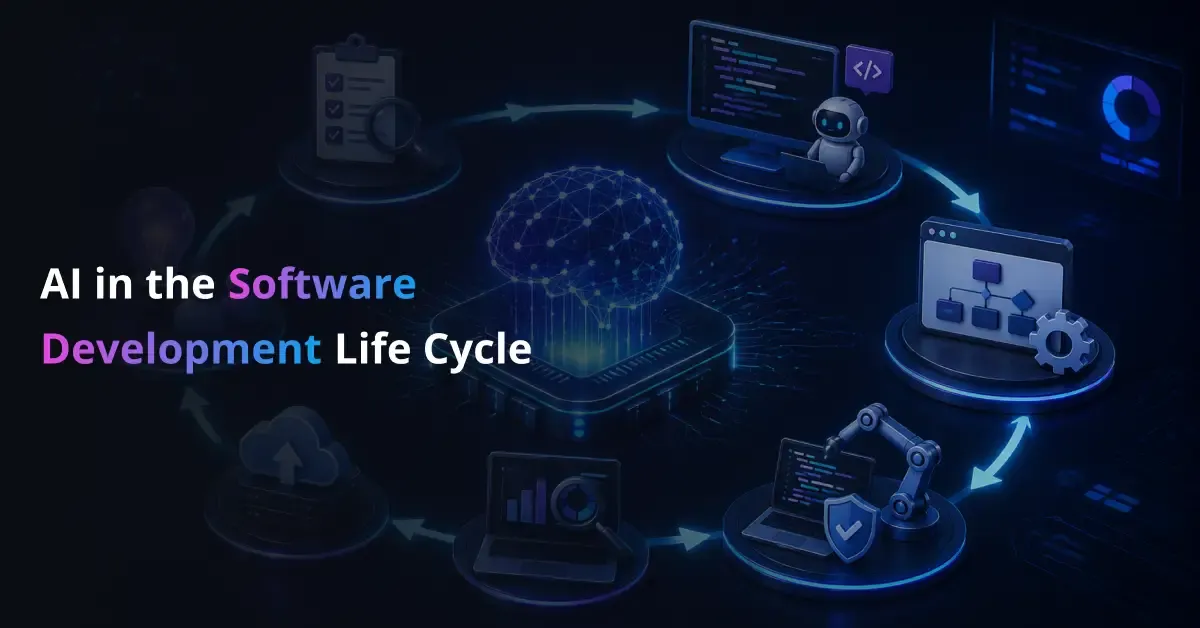
Artificial intelligence (AI) is changing how software moves from an initial requirement to a production application. AI in SDLC applies AI capabilities across planning, design, development, testing, deployment and maintenance to automate routine work and support technical decisions. As these capabilities become integrated across development workflows, the software development life cycle (SDLC) becomes less dependent on sequential handoffs and more focused on continuous specification, generation, validation and feedback.
What Is AI in the Software Development Life Cycle?
AI in the Software Development Life Cycle refers to the use of artificial intelligence technologies to support or automate activities throughout the process of building, releasing and maintaining software. These technologies can include machine learning (ML), generative AI, large language models (LLMs), AI coding assistants and AI agents.
An AI-powered SDLC can process requirements, generate code, create tests, analyze failures and interpret operational data. For example, a development team might use generative AI to convert a feature description into acceptance criteria, generate an initial implementation and create corresponding unit tests. Developers can then review the outputs against technical requirements before changes move further through the lifecycle.
AI in SDLC differs from the AI development lifecycle. AI in SDLC describes the use of AI to support software engineering activities, whereas an AI development lifecycle typically refers to building and operating AI or machine learning systems, including activities such as data preparation, model training and model monitoring.
How AI Changes the Traditional SDLC
Traditional software development typically organizes work into stages such as planning, design, coding, testing, deployment and maintenance. Agile and DevOps practices have already made these stages more iterative, but AI-driven software development can increase the amount of work performed concurrently.
| Traditional SDLC |
AI-driven SDLC |
| Sequential handoffs |
Parallel workflows |
| Developers primarily write code |
Developers define intent and review output |
| Tests often follow implementation |
Tests can develop alongside code |
| Context is fragmented |
Context moves across stages |
| Feedback arrives later |
Feedback becomes continuous |
| Human execution dominates |
Human governance combines with AI execution |
Instead of waiting for one stage to finish before another begins, AI-powered software development can support coding, testing, documentation and review in parallel. This shift makes specification quality and continuous validation more important.
How AI Is Used Across Each Stage of the SDLC
AI capabilities vary by development stage, but they generally support a combination of information processing, content generation, automation and analysis.
| SDLC stage |
What AI can do |
Human responsibility |
| Planning |
Summarize information and organize work |
Define business goals and priorities |
| Requirements |
Convert input into structured specifications |
Validate requirements and constraints |
| Design |
Suggest architectures and prototypes |
Evaluate technical tradeoffs |
| Development |
Generate, explain and refactor code |
Review correctness and maintainability |
| Testing |
Generate tests and analyze failures |
Validate coverage and critical behavior |
| Deployment |
Analyze pipelines and release signals |
Control high-risk production changes |
| Maintenance |
Analyze incidents and technical debt |
Prioritize and verify corrective actions |
1. Planning and Requirements
During planning, generative AI development capabilities can process stakeholder notes, product documentation, support requests and other unstructured information to identify requirements and organize them into structured development inputs. Teams can use these outputs to prepare user stories, acceptance criteria, backlog items and technical specifications.
Clear specifications are particularly important when AI agents perform multi-step development tasks. By providing architectural constraints, expected behavior and acceptance criteria before implementation begins, teams give AI systems more relevant context for generating usable outputs. Human review remains necessary to confirm that the resulting specification reflects business requirements rather than merely producing a technically plausible interpretation.
2. Software Design and Architecture
AI can assist software design by generating potential architecture patterns, application flows, database schemas, application programming interface (API) structures and prototype concepts from defined requirements. These capabilities can reduce the manual effort involved in exploring multiple design options.
Architecture decisions still depend on factors that an AI system might not fully capture, including existing infrastructure, security requirements, operational constraints and long-term maintenance needs. Development teams therefore use AI-generated designs as inputs to technical evaluation rather than treating them as automatic architectural decisions.
3. Coding and Development
AI coding tools support development through code completion, natural-language-to-code generation, documentation, debugging, refactoring and explanations of unfamiliar code. These capabilities can help developers reduce time spent on repetitive implementation work and concentrate more attention on architecture, business logic and complex technical decisions.
The role of AI is also expanding beyond code suggestions. AI agents in software development can perform multi-step tasks such as examining repository files, modifying several components, running tests and revising changes after receiving feedback. Greater autonomy increases the importance of repository context, automated validation and developer review because generated code must still meet the same functional, security and maintainability requirements as manually written code.
4. Testing and Quality Assurance
AI in software testing can help teams generate unit and integration tests, identify edge cases, analyze failed tests and detect potential regressions. Generative AI tools can also create test data or explain why a particular test failed, reducing some of the manual investigation required during quality assurance.
Faster code generation makes automated validation more important. When development teams can produce larger volumes of code in less time, weak testing processes can allow defects to move through the pipeline more quickly. AI-generated tests can increase coverage, but developers still need to confirm that tests reflect expected application behavior and critical business requirements.
5. Deployment and CI/CD
AI in CI/CD can support deployment by analyzing build failures, identifying patterns in pipeline performance and highlighting release risks. AI systems can also process logs, test results and infrastructure information to help teams determine why a deployment failed or where additional investigation is required.
When these capabilities are connected to continuous integration and continuous delivery workflows, development and operational information can move between stages more quickly. Effective DevOps implementation can also help teams use deployment results and production signals as feedback for future development rather than treating deployment as the end of the software delivery process.
6. Operations and Maintenance
During operations and maintenance, AI can analyze application logs, classify bug reports, summarize incidents and identify patterns associated with performance problems. These capabilities can help IT and development teams narrow the scope of investigations and prioritize issues that require attention.
AI can also support legacy application maintenance and modernization by explaining unfamiliar code, suggesting refactoring opportunities and identifying dependencies between components. Human review remains important because changes to established systems can affect business processes,integrations and security controls that might not be fully represented in the available codebase.
What are the benefits of AI in SDLC?
Faster development cycles
Faster development is a benefit of AI in SDLC. By automating repetitive analysis, documentation and coding tasks, AI can reduce manual effort and help teams move from requirements to working software more efficiently.
Improved developer productivity
Improved productivity comes from augmenting developers rather than maximizing generated code. AI-assisted software development can handle boilerplate, explain unfamiliar components and surface relevant context, leaving time for architecture and review.
Stronger software quality
Stronger quality is possible when AI supports testing, code analysis and earlier defect detection. With continuous validation, teams can identify problems closer to where they are introduced.
These benefits of AI depend on implementation quality. Productivity gains can be limited when teams lack clear specifications, reliable testing or effective review processes.
Risks and Challenges of Using AI in SDLC
AI-generated code can be incorrect even when it appears technically plausible. Large language models generate outputs from patterns in available context and training data, which means generated code can contain logic errors, insecure practices or assumptions that do not match the application.
Security and privacy also require attention. Development tools can process source code, documentation, credentials or other sensitive information, so organizations need policies governing which data can be shared with AI systems and how generated dependencies or code changes are reviewed.
Higher generation speed can also create a review bottleneck. If AI produces code faster than engineers can evaluate it, teams may increase code volume without improving delivery quality. Poorly reviewed output can contribute to defects, inconsistent architecture and technical debt.
Governance provides a framework for managing these risks. AI governance in software development can include approved tools, access controls, automated testing, security scanning, audit records and risk-based human review. These controls help organizations use AI automation while maintaining accountability for the software that reaches production.
Best Practices for Implementing AI Across the SDLC
Effective AI in SDLC adoption requires more than adding coding assistants to existing workflows. Organizations need processes that give AI systems relevant context while maintaining testing, security and human accountability.
- Start with defined use cases. Teams can begin with activities such as code explanation, test generation or documentation before expanding automation into higher-risk workflows.
- Strengthen requirements and specifications. Clear requirements give AI systems better context and reduce ambiguity during code generation and testing.
- Control access to development data. Organizations should define which repositories, documentation and systems AI tools can access and protect sensitive information through appropriate permissions.
- Maintain human review for high-risk changes. Architecture, security-sensitive code and production decisions can require approval from experienced developers or specialized teams.
- Scale testing with code generation. Automated testing and security checks help validation capacity keep pace as AI produces changes more quickly.
- Measure development outcomes. Teams can track factors such as lead time, defects, review effort and rework instead of measuring success only by the amount of AI-generated code.
These practices allow organizations to expand AI-assisted development gradually while identifying where automation provides value and where additional controls are required.
From AI-Assisted to Agentic Software Development
Agentic AI can plan tasks, modify files, run tests and respond to feedback. Greater autonomy makes context, validation and human oversight increasingly important.
Frequently Asked Questions
AI supports planning, coding, testing, deployment and maintenance.
AI is more likely to shift work toward specification, review, architecture and governance.