How AI is Transforming RPA for Scalable Business Growth
Key Takeaways
- AI enhances RPA by adding intelligence to automation, allowing businesses to handle complex and decision-based tasks with speed and accuracy.
- The AI and RPA market is expected to reach $11.8 billion by 2033, highlighting the global shift toward intelligent automation.
- Industries such as finance, healthcare, and retail combine AI and RPA to cut costs, improve accuracy, and deliver smarter services.
- Technologies like NLP, machine learning, and computer vision enable bots to process unstructured data, learn patterns, and adapt over time.
- Prismetric supports AI-powered RPA adoption with tailored strategies that improve automation outcomes across departments and industries.
In 2026, the fusion of Artificial Intelligence (AI) and Robotic Process Automation (RPA) is not just a trend; it’s a revolution reshaping industries globally. Businesses are increasingly adopting these technologies to automate repetitive tasks, streamline operations, and improve efficiency. As organizations strive to stay competitive, the combination of AI and RPA is becoming a game changer in the automation landscape.
RPA focuses on automating rule based tasks, allowing businesses to reduce human error and free up valuable time for employees to focus on more complex activities. Meanwhile, AI brings the ability to handle complex decision making, analyze unstructured data, and continuously learn from new information. Together, these technologies are paving the way for smarter, more agile business operations.
The rise of AI in RPA is driving significant market growth. The global market is projected to grow from $3.3 billion in 2023 to approximately $11.8 billion by 2033, at a compound annual growth rate (CAGR) of 32.5%. This rapid growth demonstrates the increasing adoption and transformative power of AI-driven RPA solutions, enabling businesses to scale, adapt, and thrive in an ever-changing landscape.
In this article, we will explore how integrating AI with RPA leads to Intelligent Process Automation (IPA), enhancing scalability, adaptability, and intelligence in business operations. We’ll also dive into real world applications, challenges, and the future potential of this powerful technology duo.

Understanding RPA and AI
In this section we will learn about basics RPA and AI. so lets see what are they.
What is RPA?
Robotic Process Automation (RPA) is like having digital robots that can do repetitive, rule based tasks for you. Imagine a robot that can open emails, copy information, and paste it into a spreadsheet all without needing a human to do it manually. These software robots work tirelessly, following clear instructions to complete tasks quickly and accurately. Businesses use RPA to save time, reduce mistakes, and improve productivity, making work more efficient and freeing up employees for more creative tasks.
What is Artificial Intelligence?
Artificial Intelligence (AI) is different from RPA. While RPA can only follow simple rules, AI has the ability to think and learn. AI mimics human intelligence by recognizing patterns, making decisions, and even improving itself over time. It’s like teaching a computer to understand pictures, answer questions, or predict what might happen next.
For example, AI can analyze lots of data and make decisions, like recommending the next best product to buy based on what you like. The more it learns, the smarter it gets, just like how humans improve with experience.
Together, RPA and AI can transform how businesses operate, making them faster, smarter, and more capable of handling complex tasks.
What is the Difference between RPA and AI?
Now lets understand the difference.
RPA is fantastic for automating repetitive tasks that don’t change, while AI is the one that can adapt and learn. RPA is more like a machine that does one thing really well, and AI is like a brain that can figure out different things. Together, they make an amazing team: RPA does the boring work, and AI brings the thinking power!
Here’s a quick comparison to help you understand:
| Feature |
RPA |
AI |
| Core Function |
Automates simple, repetitive tasks |
Mimics human thinking and learning |
| Learning Ability |
Doesn’t learn or change on its own |
Learns from experience and improves over time |
| Task Type |
Focused on one specific task |
Can work on many different tasks |
| Data Handling |
Works best with clear, structured data |
Can handle both structured and unstructured data |
| Speed |
Helps with fast, efficient work |
Helps with complex decision making and improvements |
| Adaptability |
Fixed rules, does not adapt |
Adapts to new information and situations |
| Scope of Use |
Task specific, well defined processes |
Broader applications, including problem solving |
Key Components of Using AI in RPA
AI adds powerful thinking abilities to RPA through a few key technologies. These components help bots do more than just follow instructions—they let bots understand language, learn from data, and even see what’s on a page or screen.
Natural Language Processing (NLP)
Natural Language Processing (NLP) helps bots understand and work with human language, like the text in emails, customer chats, or legal documents. Instead of just scanning for keywords, AI can now read and understand meaning, tone, and context. This means bots can extract the right details, respond more naturally, and handle tasks like summarizing conversations or filling forms with accurate info.
Machine Learning (ML)
Machine learning teaches bots how to spot patterns and improve from experience. Instead of needing a rule for every situation, bots can use ML to make predictions or decisions based on past data. For example, in fraud detection, a bot can learn what suspicious behavior looks like and flag similar cases on its own, getting smarter as more data comes in.
Computer Vision
Computer vision lets bots “see” by analyzing images, scanned documents, or even video. It’s what allows a system to read a handwritten form, recognize a signature, or pull numbers off a scanned invoice. This technology helps RPA bots handle work that used to require human eyes, like reviewing medical records, IDs, or receipts.
How Do AI and RPA Work Together?
When AI and RPA come together, they form a powerful team that can tackle both simple and complex tasks, making business processes smarter and more efficient. While RPA handles repetitive, rule based tasks, AI adds the capability to think, learn, and adapt. This combination allows organizations to automate not only the mundane tasks but also those that require decision-making, analysis, and even prediction.
Here’s how they work together:
- Automating Complex Processes: While RPA is great for tasks that follow a set pattern, AI brings flexibility. For example, in data entry, RPA can fill out forms based on specific rules, but AI can handle situations where the data is unstructured, like scanning a document and interpreting handwritten information using Optical Character Recognition (OCR). Together, they ensure that both structured and unstructured data are processed smoothly.
- Continuous Improvement: AI allows RPA to improve over time. Imagine a situation where an RPA bot encounters a situation it hasn’t been programmed for. AI steps in, learns from the data, and helps the RPA bot handle similar tasks in the future with more precision and less manual intervention. This continuous learning capability ensures that automation becomes smarter with use.
- Enhanced Decision Making: AI can analyze large datasets and recognize patterns that humans might miss. RPA can then take action based on AI’s insights, like triggering an alert if something unusual is detected in the data. For example, in fraud detection, AI can analyze transactions for irregularities, and RPA can instantly flag or even block suspicious transactions without human input.
- Scalability and Flexibility: By combining AI and RPA, businesses can scale automation quickly. RPA’s ability to handle high volume tasks without errors, paired with AI’s ability to tackle more complex decision making, allows organizations to automate an entire range of processes across different departments, from HR to finance to customer service.
In short, AI and RPA don’t just work in isolation but they complement each other, enhancing both their strengths. AI adds intelligence and flexibility, while RPA ensures speed and accuracy. Together, they help businesses achieve smarter, faster, and more scalable automation.
How Are Industries Using AI and RPA Together?
Industries across the globe are tapping into the power of AI and RPA to enhance their operations and stay competitive. By combining the speed and accuracy of RPA with the intelligence and adaptability of AI, businesses can transform their processes, reduce costs, and improve overall efficiency. Here’s how different sectors are leveraging this dynamic duo:
Finance and Banking
In the financial sector, AI and RPA work hand in hand to streamline operations like fraud detection, loan processing, and regulatory compliance. RPA handles repetitive tasks like processing transactions and updating customer records, while AI analyzes financial data, detects unusual patterns, and even predicts market trends. For instance, AI can analyze transaction data to detect fraud, and RPA can automatically flag suspicious activity or block transactions. This integration reduces the risk of human error, speeds up processing times, and enhances decision making.
Healthcare
Healthcare providers are using AI and RPA to improve patient care and streamline administrative tasks. RPA automates time consuming tasks such as billing, claims processing, and scheduling, while AI helps in diagnosing diseases, analyzing medical records, and predicting patient outcomes. For example, AI-powered tools can scan medical images for signs of diseases like cancer, while RPA can schedule appointments, submit claims, and update patient information without human intervention. This collaboration frees up medical staff to focus on patient care and reduces operational costs.
Retail and E-commerce
In the retail industry, AI and RPA are revolutionizing customer service and supply chain management. RPA handles order processing, inventory management, and returns, while AI analyzes customer behavior, personalizes shopping experiences, and optimizes pricing strategies. For example, AI can recommend products based on past purchases, while RPA ensures that orders are fulfilled, shipped, and tracked in real time. Together, they create a seamless experience for customers and improve operational efficiency for businesses.
Human Resources
AI and RPA are also transforming human resources. RPA automates tasks like employee onboarding, payroll processing, and benefits administration, while AI is used for talent acquisition, employee sentiment analysis, and performance management. AI can sift through resumes, analyze candidates’ skills, and recommend the best fit for a role. RPA then takes over the administrative tasks, such as sending out offer letters or processing new hire documentation, allowing HR teams to focus on more strategic initiatives.
Manufacturing
In manufacturing, AI and RPA are improving production efficiency and quality control. RPA automates repetitive tasks on the production line, such as data entry and inventory updates, while AI monitors machinery, predicts maintenance needs, and ensures product quality. For instance, AI-powered systems can predict when a machine is likely to break down, allowing RPA to automatically schedule maintenance or alert workers. This reduces downtime, lowers maintenance costs, and ensures higher product quality.
Telecommunications
In the telecom industry, AI and RPA are used to improve customer experience and streamline network operations. RPA handles tasks like billing, service provisioning, and troubleshooting, while AI powers predictive maintenance, network optimization, and customer support chatbots. AI analyzes network data to identify potential issues before they arise, while RPA ensures that customer complaints are resolved quickly and efficiently. Together, they ensure seamless service delivery and customer satisfaction.
Insurance
The insurance industry is harnessing the power of AI and RPA to enhance underwriting, claims processing, and fraud detection. RPA automates data collection, policy updates, and customer interactions, while AI analyzes large volumes of claims data, identifies patterns, and detects potential fraud. For instance, AI can assess the risk level of a policyholder based on historical data, and RPA can automatically process claims and issue payments. This integration speeds up claims resolution and improves customer satisfaction.
Energy and Utilities
AI and RPA are transforming the energy and utilities sector by optimizing operations and predictive maintenance. RPA automates meter reading, billing, and regulatory reporting, while AI monitors energy consumption patterns, predicts equipment failures, and optimizes energy distribution. AI-powered systems can predict when turbines or power lines need maintenance, and RPA can automatically schedule maintenance tasks. This combination helps reduce downtime, improve energy efficiency, and minimize operational costs.
Education
In the education sector, AI and RPA are streamlining administrative tasks and enhancing personalized learning experiences. RPA automates student enrollment, record management, and grading, while AI personalizes learning pathways, analyzes student performance, and offers tutoring recommendations. For example, AI can analyze a student’s progress and suggest additional resources or customized assignments, while RPA can handle routine administrative processes, allowing educators to focus on teaching.
Legal
In the legal industry, AI and RPA are streamlining document review, contract management, and legal research. RPA automates repetitive tasks like organizing case files, managing client records, and preparing routine legal documents. AI helps in analyzing vast amounts of legal text, identifying precedents, and even predicting case outcomes. For instance, AI can sift through thousands of contracts to find key clauses, while RPA can ensure that contracts are sent, signed, and archived correctly.
Hospitality
The hospitality industry is using AI and RPA to improve customer service and operational efficiency. RPA handles booking management, billing, and customer feedback collection, while AI powers personalized recommendations, virtual concierges, and chatbots.
For example, AI can suggest activities based on a guest’s preferences, while RPA ensures that reservation details are updated across multiple systems without errors. This combination enhances the guest experience and optimizes back-end operations for hotel staff.
Benefits of Using AI in RPA
When AI and RPA team up, the results are powerful. Individually, they’re useful. Together, they unlock smart, scalable, and truly transformative automation. Here are the key benefits businesses are seeing when they combine AI’s brainpower with RPA’s muscle:
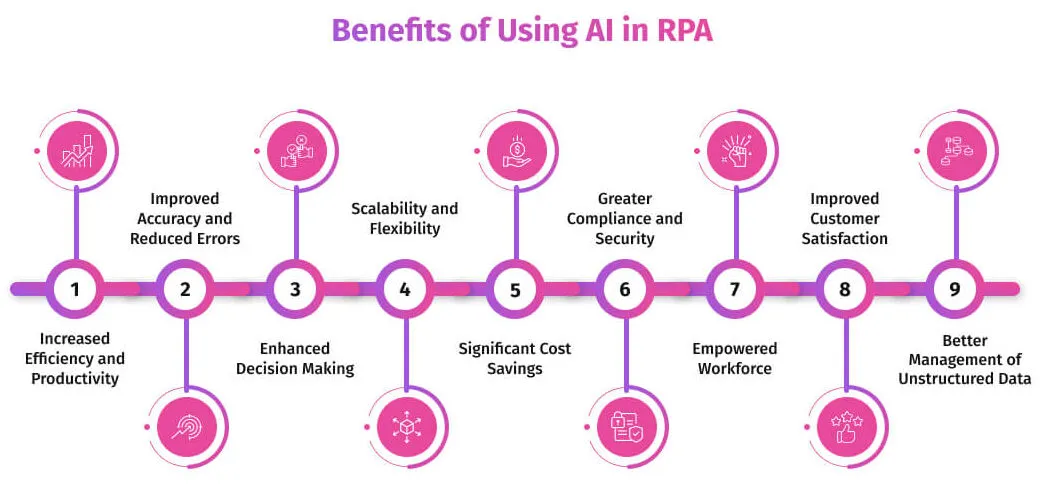
1. Increased Efficiency and Productivity
AI helps bots do more than just follow rules. It lets them learn and make smarter choices. This means work gets done faster and better.
2. Improved Accuracy and Reduced Errors
RPA is already precise, but AI takes it further. It understands context and reduces mistakes. Together, they make processes more reliable.
3. Enhanced Decision Making
AI can quickly analyze large amounts of data. It finds useful insights and helps teams make better decisions. RPA then puts those decisions into action.
4. Scalability and Flexibility
AI and RPA can grow with your business. They work across departments and adapt to different types of tasks. This makes scaling easier and more affordable.
5. Significant Cost Savings
By doing more work with fewer resources, businesses save money. AI and RPA reduce manual work and speed up processes. Over time, this leads to big cost reductions.
6. Greater Compliance and Security
Automated workflows follow rules consistently. AI helps track changes and spot issues. This makes it easier to stay compliant and secure.
7. Empowered Workforce
When bots take care of boring, repetitive tasks, employees can focus on more meaningful work. This leads to happier teams and better results.
8. Improved Customer Satisfaction
AI helps understand customer needs. RPA ensures quick and accurate service. The result is faster support and better experiences.
9. Better Management of Unstructured Data
AI can read emails, images, and documents. It helps RPA handle data that isn’t neatly organized. This opens up more ways to automate.
Challenges of Integrating AI with RPA
Combining AI with RPA can be powerful, but it’s not always easy. One major challenge is data quality. AI needs large amounts of clean, structured, and relevant data to work effectively. Unfortunately, many businesses still rely on scattered systems and outdated data, which makes it difficult for AI to perform well. Legacy platforms also often lack the flexibility to support AI-driven features, leading to integration issues.
Another common hurdle is the shortage of skilled professionals who understand both AI and RPA. These technologies require close collaboration between technical teams, business analysts, and process experts, but many organizations still operate in silos. Training AI models, managing ongoing performance, and ensuring secure deployment all require careful planning and ongoing support. Without a clear strategy, it becomes hard to scale intelligent automation successfully.
How to Implement AI and RPA in Your Business
Adopting AI and RPA isn’t about installing a single tool. It’s about building a thoughtful automation strategy. Below are the key steps to help your business get started with smart, scalable automation.
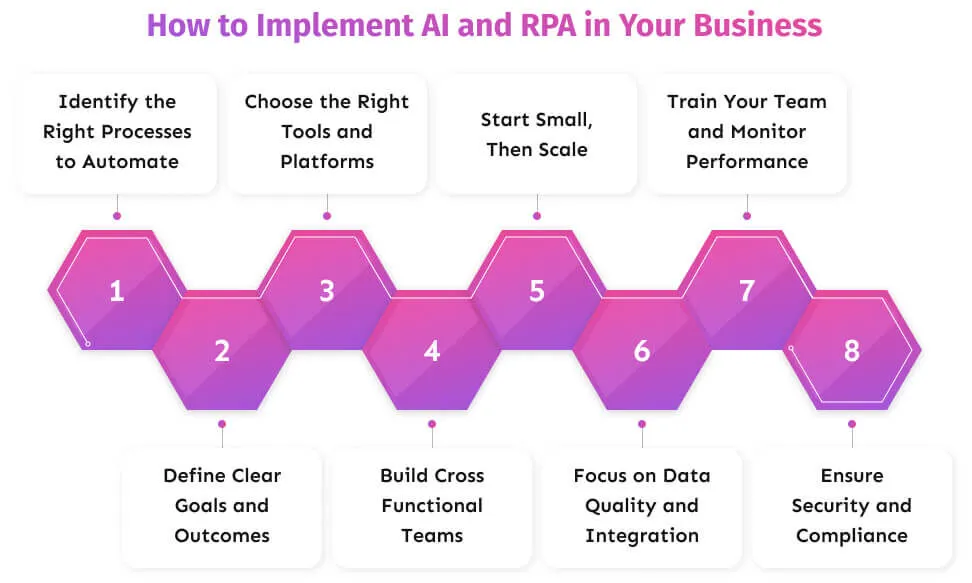
1. Identify the Right Processes to Automate
Start by looking for repetitive, rule based tasks that consume a lot of time. These might include invoice processing, customer onboarding, or data entry. Then, identify tasks that involve unstructured data or decisions where AI can add value.
2. Define Clear Goals and Outcomes
Know what you want to achieve. Are you looking to reduce costs, speed up processing, or improve accuracy? Clear goals will guide your technology choices and help you measure success.
3. Choose the Right Tools and Platforms
Select automation tools that support both RPA and AI features. Many platforms now offer integrated solutions with NLP, machine learning, and computer vision capabilities. Make sure the platform fits your business size, budget, and technical needs.
4. Build Cross Functional Teams
AI and RPA need input from IT, business users, and process experts. Form a team that brings these perspectives together to map out workflows, define rules, and train AI models.
5. Start Small, Then Scale
Begin with a pilot project. Choose one process, automate it fully, and test the results. Once you see value, scale the approach to other areas. This reduces risk and builds momentum.
6. Focus on Data Quality and Integration
AI systems need clean, reliable data to function well. Invest time in data preparation and ensure your automation tools can connect with existing systems like CRMs, ERPs, and databases.
7. Train Your Team and Monitor Performance
Offer training so employees can manage, improve, and expand automation over time. Also, set up dashboards to monitor performance, track errors, and measure ROI.
8. Ensure Security and Compliance
Automation must follow security protocols and industry regulations. Use audit trails, access controls, and encryption to protect sensitive data and maintain compliance.
Unlock efficiency with our AI Integration.
How Prismetric Helps Businesses Succeed with AI and RPA
Prismetric is more than just a service provider. It’s a trusted partner that helps businesses unlock the full potential of intelligent automation. With expertise in AI development and robotic process automation, Prismetric supports organizations through every step of their automation journey. Whether you’re starting small or scaling across teams, they guide you with tailored solutions and practical insights.
At the core of Prismetric’s offerings are integrated AI automation services. These include AI consulting, natural language processing, machine learning, computer vision, AI agents, and more. Their solutions fit seamlessly into your existing systems like CRMs, ERPs, and cloud platforms, helping improve accuracy, speed, and overall efficiency.
Here’s how Prismetric supports AI and RPA implementation in real business environments:
- AI Automation Consultation: Expert guidance to evaluate your processes and build a step by step roadmap for automation success.
- AI Process Automation and Integration: From smart chatbots to intelligent document handling, Prismetric blends AI with RPA to create powerful workflows.
- Machine Learning and Predictive Insights: Use data-driven models to detect patterns, predict trends, and automate smarter decisions.
- Advanced AI Capabilities: Custom AI solutions like generative tools, enterprise bots, and vision based systems to handle complex, modern needs.
- Industry Specific Automation: Tailored automation strategies for sectors like finance, healthcare, logistics, retail, and education.
Prismetric stands out with its strong technical foundation, skilled global team, and customer first approach. With a focus on security, seamless integration, and long term scalability, it helps businesses move forward with confidence and clarity.
Conclusion
The fusion of AI and RPA is reshaping the future of business automation. Together, they offer a smarter, faster, and more flexible way to handle both simple and complex tasks freeing teams to focus on innovation rather than repetition.
As AI continues to evolve, businesses that embrace intelligent automation today will be better prepared for tomorrow. With the right strategy and the right partner, like Prismetric, companies can unlock new levels of efficiency, insight, and growth.