Top Generative AI Use Cases and Real World Examples for 2026
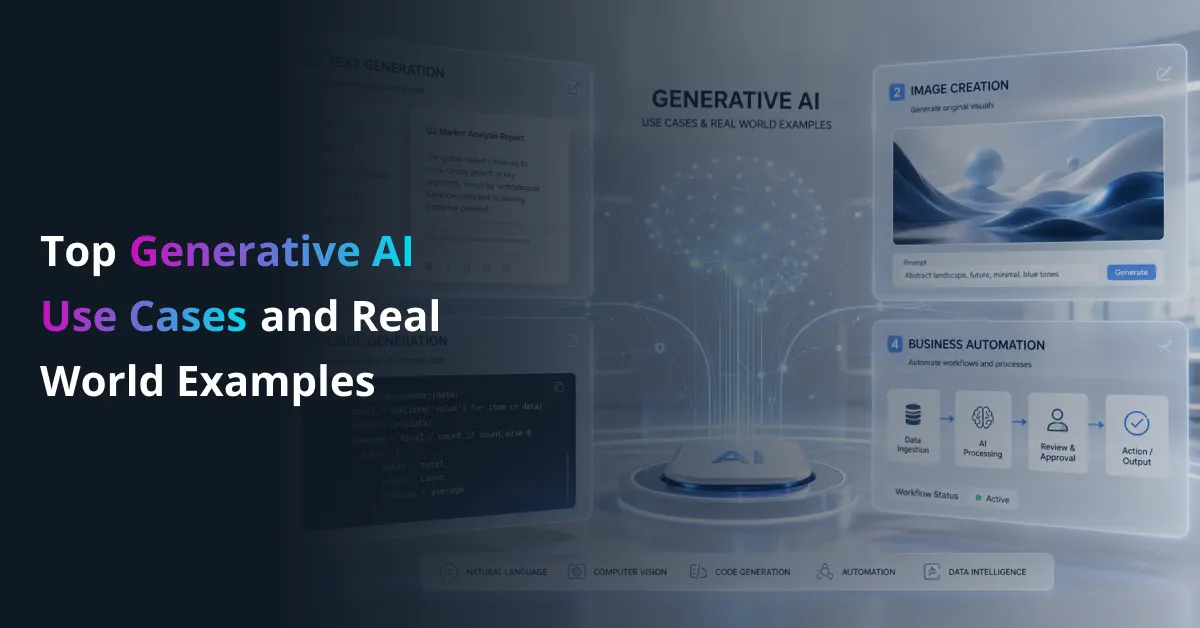
Generative AI use cases are no longer limited to writing text, creating images, or testing AI tools. Businesses now use generative AI to improve customer support, speed up software development, automate document work, personalize marketing, support financial analysis, create training content, and build smarter digital products.
The adoption is growing fast. In the US, the generative AI market is expected to reach USD 33.78 billion by 2030, growing at a CAGR of 36.3% from 2024 to 2030. McKinsey reports that generative AI use among organizations jumped from 33% in 2023 to 71% in 2024.
This clearly shows one thing. Generative AI has moved from experiment to execution.
For business owners, CTOs, product leaders, and enterprise teams, the real question is not whether generative AI is useful. The real question is where it can create the most value. Some businesses use it to reduce manual work. Some use it to improve customer experience. Others use it to build AI agents, internal copilots, knowledge assistants, code generation tools, and industry specific automation systems.
In this guide, we’ll look at the top generative AI use cases across major industries. We’ll also explore practical examples, business benefits, emerging trends, risks, and how businesses can choose the right generative AI solution for their needs.
TL;DR: What Are the Top Generative AI Use Cases?
Generative AI use cases include customer support automation, content creation, code generation, document summarization, healthcare documentation, financial analysis, product recommendations, legal contract review, and AI agents for business workflows. Businesses use generative AI to save time, reduce manual work, improve decisions, and create more personalized customer and employee experiences.
Quick Summary of the Top Generative AI Use Cases
Generative AI helps businesses create content, automate tasks, analyze data, support customers, write code, and improve decision making. The best use cases are the ones that solve real business problems, save time, reduce manual effort, and improve the way teams work.
Here are the most common generative AI use cases businesses are using today:
- Content creation for blogs, ads, emails, product descriptions, and social media posts
- AI chatbots and virtual assistants for customer support and internal help desks
- Code generation, bug fixing, testing, and software documentation
- Enterprise knowledge assistants that answer questions from company data
- Sales and marketing automation for outreach, lead research, and campaign ideas
- Document review, summarization, and report generation
- Personalized customer experiences in retail, banking, healthcare, and education
- Product design, prototyping, and creative concept generation
- Medical documentation, drug discovery, and healthcare support
- Fraud detection, risk analysis, and financial planning
- Manufacturing quality checks, predictive maintenance, and process improvement
- Legal contract review, compliance support, and case research
- AI agents for multi step workflows such as ticket handling, data analysis, and task automation
What is a Generative AI Use Case?
A generative AI use case is a practical way a business uses AI to create something useful. This can include text, images, code, reports, product ideas, summaries, customer replies, training material, or business documents. Instead of only analyzing data, generative AI creates new outputs based on the information it receives.
For example, a healthcare business can use generative AI to summarize patient notes. A software business can use it to generate code or test cases. A retail business can use it to create personalized product recommendations. In simple words, a generative AI use case shows where AI can save time, reduce manual work, and improve business results.
Generative AI vs Traditional AI
Traditional AI helps businesses analyze data, detect patterns, predict outcomes, and make decisions. Generative AI goes one step further. It creates new content, code, images, reports, responses, designs, summaries, and ideas based on the data or prompts it receives.
The difference is simple. Traditional AI usually answers, predicts, or classifies. Generative AI creates something new that teams can use in real work.
| Point |
Traditional AI |
Generative AI |
| Main purpose |
Predicts, analyzes, or classifies data |
Creates new content, ideas, code, or outputs |
| Common use |
Fraud detection, demand forecasting, recommendation engines |
Chatbots, content creation, code generation, document summaries |
| Output type |
Scores, predictions, alerts, patterns |
Text, images, audio, video, code, reports |
| Example |
Predicting whether a transaction is risky |
Writing a customer support reply for that transaction issue |
| Business value |
Helps teams make better decisions |
Helps teams create faster and automate more work |
For example, traditional AI can tell an ecommerce business which customer is likely to buy again. Generative AI can create a personalized email, product suggestion, and offer message for that same customer.
Both are useful. In many business systems, they work together. Traditional AI finds the pattern. Generative AI turns that pattern into a useful action, message, document, or workflow.
Generative AI Use Cases by Business Function
Generative AI creates the most value when it solves a clear business problem. That’s why it helps to look at use cases by business function, not only by industry.
Automating Business Workflows
Generative AI can handle repetitive work that usually takes hours of manual effort. It can read documents, summarize information, draft reports, prepare email replies, extract key details, and help teams complete routine tasks faster.
This is useful for departments that deal with large amounts of text, data, forms, tickets, reports, or internal requests.
Common examples include:
- Creating meeting summaries from call transcripts
- Drafting internal reports from raw business data
- Summarizing contracts, invoices, and policy documents
- Creating employee onboarding documents
- Preparing customer support replies
- Extracting key details from PDFs and forms
- Generating weekly performance updates
Pro tip: Start with workflows that happen every week. These tasks are easier to automate, easier to test, and easier to measure.
Building Software Faster
Generative AI is becoming a practical support system for software teams. It can help developers write code, review code, create test cases, explain old code, generate documentation, and speed up routine software development work.
It does not replace skilled developers. It helps them spend less time on repetitive coding tasks and more time on architecture, logic, security, and product quality.
Businesses use generative AI in software development for:
- Code generation
- Bug fixing suggestions
- Test case creation
- API documentation
- Code explanation
- Legacy code modernization
- UI component generation
- Developer onboarding support
Pro tip: Use AI generated code as a draft. Always review it for security, performance, scalability, and business logic before using it in production.
Creating Content and Media
Marketing, sales, ecommerce, education, and media teams use generative AI to create content faster. It can help with blogs, emails, ads, product descriptions, scripts, social posts, images, videos, and campaign ideas.
The biggest benefit is speed. Teams can test more ideas, create more variations, and personalize content for different audiences without starting from a blank page every time.
Common examples include:
- Blog outlines and first drafts
- Social media captions
- Email campaign copy
- Product descriptions
- Ad copy variations
- Video scripts
- Image and design concepts
- Sales proposal drafts
- Training content
Pro tip: Do not publish AI generated content as it is. Add human judgment, brand voice, original examples, product knowledge, and fact checking before publishing.
Improving Business Decisions
Generative AI can make business data easier to understand. It can turn complex reports, dashboards, spreadsheets, and research documents into simple summaries that decision makers can act on.
This helps leaders save time and spot patterns faster. Instead of going through long reports, they can ask questions and get clear explanations in plain language.
Businesses use generative AI for:
- Sales performance summaries
- Financial report interpretation
- Market research summaries
- Customer behavior analysis
- Demand forecasting explanations
- Risk analysis reports
- Competitor research summaries
- Executive dashboard insights
Pro tip: Use generative AI for decision support, not final decision making. Human review is still needed when decisions involve money, compliance, legal risk, or customer impact.
Enhancing Customer and Employee Experiences
Generative AI can make digital experiences more personal, faster, and easier to use. Businesses use it to answer customer questions, guide employees, recommend products, personalize communication, and reduce friction across support and internal workflows.
This is one of the most valuable areas because it improves both external and internal experiences.
Common examples include:
- AI chatbots for customer support
- Internal HR assistants
- Employee onboarding assistants
- Personalized product recommendations
- Smart help desk assistants
- AI powered knowledge search
- Personalized learning paths
- Customer email response generation
Pro tip: Connect AI assistants with trusted business data. This helps reduce wrong answers and makes the experience more reliable for customers and employees.
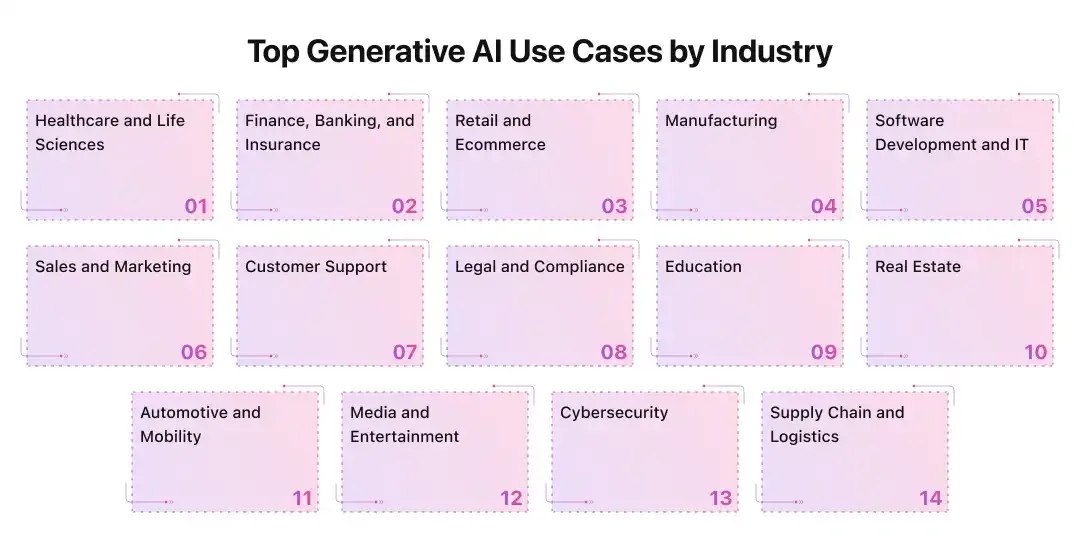
Top Generative AI Use Cases by Industry
Generative AI is not used the same way in every industry. In the sections below, we’ll explore how different industries use generative AI to improve speed, accuracy, personalization, productivity, and decision making.
Healthcare and Life Sciences
Generative AI in healthcare helps teams work faster with patient data, clinical notes, medical reports, research documents, and drug discovery workflows. It supports doctors, hospitals, pharma businesses, and life sciences teams by reducing manual documentation and improving access to useful insights.
Key use cases include:
- Clinical Documentation Support: Generative AI can create summaries of doctor notes, discharge records, consultation details, and treatment updates. This helps healthcare professionals spend less time on paperwork and more time on patient care.
- Patient History Summarization: AI can review medical records, lab reports, prescriptions, and past visits to create a clear patient summary. Doctors can use this to understand the case faster before consultation or treatment planning.
- Drug Discovery and Research Support: Life sciences teams can use generative AI to scan research papers, analyze molecular data, and identify possible drug candidates. This can speed up early stage research and reduce repetitive literature review work.
- Clinical Trial Document Generation: Generative AI can help prepare trial protocols, patient communication drafts, consent documents, and regulatory summaries. This improves consistency and saves time for clinical research teams.
- Medical Image Analysis Support: AI can assist radiologists and specialists by highlighting patterns in X rays, MRIs, CT scans, and other imaging data. The final diagnosis still needs expert review, but AI can make the review process faster.
- Virtual Health Assistants: Healthcare providers can use AI assistants to answer common patient questions, explain medication instructions, send reminders, and guide patients through basic care steps.
Business Impact:
Generative AI can reduce documentation pressure, improve research speed, support better patient communication, and help healthcare teams make faster decisions with organized medical information.
Finance, Banking, and Insurance
Generative AI helps finance, banking, and insurance businesses work faster with customer data, transaction records, policy documents, loan files, and risk reports. It improves decision support, speeds up document heavy processes, and helps teams deliver more personalized financial services.
Key use cases include:
- Fraud Detection Support: Generative AI can review transaction patterns, customer behavior, and unusual account activity to create risk summaries. This helps fraud teams detect suspicious cases faster and take timely action.
- Loan and Credit Document Review: Banks can use generative AI to summarize loan applications, credit reports, income documents, and borrower profiles. This helps underwriting teams review cases faster without missing key details.
- Insurance Claim Processing: Insurance providers can use AI to read claim forms, policy documents, damage reports, and customer notes. It can highlight missing details, summarize the claim, and help teams respond faster.
- Personalized Financial Advice: Generative AI can help banks and fintech platforms create personalized savings tips, investment summaries, and product suggestions based on customer goals and financial behavior.
- Financial Report Generation: Finance teams can use AI to prepare monthly reports, expense summaries, cash flow notes, and performance updates. This reduces manual reporting work and gives leaders faster visibility into financial health.
- Customer Support Chatbots: Banks and insurance businesses can use AI assistants to answer common customer questions about accounts, payments, policies, claims, and loan status.
Business Impact:
Generative AI can reduce document review time, improve fraud response, speed up claims processing, and help financial teams serve customers with more personal and timely support.
Retail and Ecommerce
Generative AI helps retail and ecommerce businesses create more personal shopping experiences, improve product discovery, and manage customer communication at scale. It also supports product content, pricing insights, customer service, and inventory planning, which makes online and offline retail operations faster and more responsive.
Key use cases include:
- Product Description Generation: Generative AI can create clear product descriptions, feature highlights, size guides, and category content. This helps ecommerce teams publish product pages faster while keeping the messaging consistent.
- Personalized Product Recommendations: AI can suggest products based on browsing history, purchase behavior, cart activity, and customer preferences. This improves product discovery and can help increase average order value.
- AI Shopping Assistants: Retailers can use AI assistants to answer product questions, compare items, suggest sizes, and guide customers through purchase decisions. This creates a more helpful shopping experience.
- Customer Review Summaries: Generative AI can summarize hundreds of customer reviews into clear insights about quality, fit, delivery, pricing, and common complaints. This helps buyers decide faster and helps brands improve products.
- Marketing Content Creation: Ecommerce teams can use AI to create email campaigns, ad copy, social posts, offer messages, and seasonal promotion content. This helps teams test more campaigns without slowing down creative work.
- Pricing and Promotion Support: AI can review sales trends, competitor pricing, customer demand, and margin data to suggest better pricing or offer ideas. This helps retail teams plan promotions with more confidence.
- Inventory and Demand Insights: Generative AI can summarize sales trends, return patterns, seasonal demand, and stock movement. Retail teams can use these insights to reduce overstock, avoid stockouts, and plan better inventory.
Business Impact:
Generative AI can help retailers improve customer engagement, speed up product content creation, reduce support load, and make smarter pricing, inventory, and marketing decisions.
Manufacturing
Generative AI helps manufacturing businesses improve production planning, equipment maintenance, quality checks, and operational decision making. It can turn machine data, inspection reports, maintenance logs, and supplier documents into useful insights for faster action.
Key use cases include:
- Predictive Maintenance Reports: Generative AI can review machine data, sensor readings, and maintenance history to summarize possible equipment risks. This helps maintenance teams fix issues before they cause downtime.
- Quality Inspection Support: AI can support visual inspection by identifying product defects, surface issues, or production irregularities. This helps manufacturers improve product quality and reduce manual inspection pressure.
- Production Issue Summaries: Generative AI can summarize shift reports, downtime notes, and operator feedback. Managers can quickly understand what went wrong and what needs attention.
- Process Optimization Suggestions: AI can analyze production data and suggest ways to reduce waste, improve throughput, or balance workloads across production lines. This helps teams make better operational decisions.
- Supplier Document Review: Manufacturers can use generative AI to review supplier contracts, compliance documents, delivery updates, and purchase records. This helps procurement teams identify risks and respond faster.
Business Impact:
Generative AI can help manufacturers reduce downtime, improve quality control, speed up reporting, and make production workflows more efficient.
Software Development and IT
Generative AI helps software development and IT teams write, review, test, document, and maintain software faster. It also supports IT operations by helping teams understand system issues, automate support tasks, and improve knowledge access across complex technical environments.
Key use cases include:
- Code Generation: Generative AI can create code snippets, functions, UI components, and basic modules from natural language prompts. This helps developers move faster on repetitive coding tasks.
- Bug Fixing Support: AI can review error messages, logs, and code blocks to suggest possible fixes. Developers can use these suggestions to troubleshoot faster and reduce debugging time.
- Test Case Creation: Generative AI can create unit tests, integration test cases, and edge case scenarios based on software requirements. This helps QA and development teams improve test coverage.
- API and Technical Documentation: AI can generate API documentation, release notes, setup guides, and developer instructions. This makes technical knowledge easier to maintain and share.
- Legacy Code Explanation: IT teams can use generative AI to understand old codebases with limited documentation. AI can explain what a function does, identify dependencies, and suggest refactoring options.
- IT Help Desk Assistance: Generative AI can answer common IT support questions, summarize tickets, suggest resolutions, and route issues to the right team. This reduces pressure on internal IT teams.
- System Monitoring Summaries: AI can summarize logs, alerts, incident reports, and performance data. IT leaders can quickly understand what happened, what changed, and what needs action.
Business Impact:
Generative AI can help software and IT teams reduce repetitive work, improve documentation, speed up debugging, strengthen testing, and keep systems easier to manage.
Sales and Marketing
Generative AI helps sales and marketing teams create faster, personalize better, and reach the right audience with more relevant messages. It supports content creation, lead research, campaign planning, sales communication, and performance analysis without slowing down the team.
Key use cases include:
- Personalized Sales Outreach: Generative AI can create email drafts, LinkedIn messages, and follow up notes based on a prospect’s industry, role, pain points, and company details. This helps sales teams make outreach feel more relevant.
- Lead Research Summaries: AI can summarize company information, decision maker profiles, recent updates, and possible buying signals. Sales teams can use this before calls or outreach.
- Marketing Content Creation: Teams can use generative AI to create blog outlines, landing page copy, ad variations, email campaigns, and social media content. This helps marketers test more ideas in less time.
- Campaign Planning Support: AI can suggest campaign angles, audience segments, content themes, and channel ideas based on goals and customer behavior. This gives marketing teams a faster starting point.
- Sales Proposal Drafting: Generative AI can help create proposal drafts, service summaries, product explanations, and client specific pitch content. Sales teams can then refine the message with proof, pricing, and business context.
Business Impact:
Generative AI can help sales and marketing teams create content faster, personalize outreach, improve campaign planning, and reduce the time spent on repetitive communication tasks.
Customer Support
Generative AI helps customer support teams respond faster, reduce ticket volume, and give customers more consistent answers. It can support both self service and human agents by summarizing issues, drafting replies, and finding the right information from approved help content.
Key use cases include:
- AI Support Chatbots: Generative AI chatbots can answer common customer questions about accounts, billing, orders, returns, subscriptions, and product usage. This helps customers get instant answers without waiting for an agent.
- Ticket Summarization: AI can summarize long support tickets, email threads, and chat conversations into short issue notes. This helps agents understand the problem faster before replying.
- Suggested Agent Replies: Generative AI can create response drafts based on customer issues, past conversations, and help center articles. Agents can review, edit, and send replies faster.
- Customer Sentiment Analysis: AI can detect frustration, urgency, confusion, or satisfaction in customer messages. Support managers can use this to prioritize sensitive cases and improve response quality.
- Help Center Content Creation: Support teams can use AI to draft FAQs, troubleshooting guides, product tutorials, and knowledge base articles. This improves self service and reduces repetitive tickets.
- Call and Chat Transcript Summaries: Generative AI can summarize support calls and live chat transcripts with key issues, actions taken, and follow up steps. This helps teams keep better records and improve handoffs.
Business Impact:
Generative AI can reduce response time, improve agent productivity, lower support workload, and give customers faster answers across chat, email, calls, and self service channels.
Legal and Compliance
Generative AI helps legal and compliance teams review large volumes of contracts, policies, case documents, and regulatory content faster. It can reduce manual document work, support legal research, and help teams spot risks before they turn into bigger issues.
Key use cases include:
- Contract Review and Summarization: Generative AI can summarize contracts, highlight key clauses, and point out renewal dates, payment terms, obligations, and risks. This helps legal teams review documents faster without reading every line from scratch.
- Clause Comparison: AI can compare two contract versions and show what changed in pricing terms, liability clauses, termination rules, or data protection language. This makes contract negotiation and revision tracking easier.
- Legal Research Support: Generative AI can review case laws, legal documents, regulations, and internal notes to create research summaries. Lawyers can use this as a starting point before doing deeper legal analysis.
- Compliance Document Review: Compliance teams can use AI to review policies, audit reports, vendor documents, and regulatory checklists. It can help identify missing information, outdated clauses, or possible compliance gaps.
- Policy Drafting: Generative AI can create first drafts of internal policies, privacy notices, employee guidelines, and compliance documents. Teams can then review, refine, and approve the final version.
- Client Intake Summaries: Law firms can use AI to summarize client intake forms, emails, and case details. This helps legal teams understand the matter faster before the first consultation.
Business Impact:
Generative AI can help legal and compliance teams save review time, reduce document pressure, improve risk visibility, and prepare legal drafts faster while keeping expert review in control.
Education
Generative AI helps schools, universities, edtech platforms, and training businesses create more personalized learning experiences. It can support teachers with content creation, help students understand difficult topics, and make learning more adaptive for different skill levels.
Key use cases include:
- Personalized Learning Paths: Generative AI can create learning plans based on a student’s progress, strengths, and weak areas. This helps learners get content that matches their pace instead of following one fixed path.
- Lesson Plan Creation: Teachers can use AI to create lesson outlines, classroom activities, examples, and practice questions. This saves preparation time and gives educators more room to focus on teaching quality.
- Quiz and Assessment Generation: Generative AI can create quizzes, assignments, test questions, and answer explanations based on a topic or chapter. This helps educators assess students faster and keep practice material fresh.
- Virtual Tutoring Support: AI tutors can explain concepts, answer student questions, and provide step by step guidance outside classroom hours. This gives students extra support when teachers are not immediately available.
- Student Feedback Drafting: Generative AI can help teachers prepare feedback on assignments, essays, and projects. The teacher can review and adjust the final response to keep it accurate and personal.
Business Impact:
Generative AI can help education teams reduce content preparation time, improve student support, personalize learning, and make digital education platforms more engaging.
Real Estate
Generative AI helps real estate businesses create better property content, respond to buyer inquiries faster, and make property discovery easier. Agents, brokers, builders, and property platforms can use it to improve listings, lead follow up, market insights, and customer communication.
Key use cases include:
- Property Description Generation: Generative AI can create listing descriptions from property details such as location, size, price, amenities, room count, and nearby facilities. This helps agents publish accurate and engaging listings faster.
- Virtual Staging Content: AI can help create staging ideas, room concepts, furniture layouts, and visual descriptions for empty or under construction properties. This helps buyers imagine how the space may look after setup.
- Buyer Inquiry Responses: Real estate teams can use AI to draft replies for questions about pricing, availability, floor plans, amenities, financing, and site visits. This helps agents respond faster to interested buyers.
- Market Trend Summaries: Generative AI can summarize local property trends, rental prices, demand patterns, and neighborhood insights. This helps agents and investors make better decisions.
- Lead Follow Up Emails: AI can create personalized follow up messages based on buyer interest, budget, location preference, and property type. This helps sales teams keep leads warm without writing every message from scratch.
- Property Comparison Reports: Generative AI can compare multiple properties based on price, location, features, size, and investment value. This helps buyers evaluate options more easily.
Business Impact:
Generative AI can help real estate businesses save time on listing content, improve buyer communication, support faster lead follow up, and make property decisions easier for customers.
Automotive and Mobility
Generative AI helps automotive and mobility businesses improve vehicle design, maintenance, customer support, fleet operations, and in vehicle experiences. It can turn vehicle data, service records, driver behavior, and customer queries into useful insights for faster decisions.
Key use cases include:
- Vehicle Design Support: Generative AI can create design concepts, feature ideas, interior layouts, and engineering suggestions based on customer needs, safety goals, and performance requirements. This helps automotive teams explore more design options faster.
- Predictive Maintenance Summaries: AI can review sensor data, service history, and vehicle performance reports to identify possible maintenance issues. This helps service teams fix problems before they become costly breakdowns.
- In Vehicle AI Assistants: Generative AI can power smart voice assistants inside vehicles. Drivers can ask for route help, vehicle settings, maintenance alerts, nearby services, or simple troubleshooting guidance.
- Fleet Performance Analysis: Mobility businesses can use AI to summarize fuel usage, driver behavior, route delays, service needs, and vehicle utilization. This helps fleet managers reduce costs and improve operational planning.
- Customer Support and Sales Assistance: Automotive businesses can use AI chatbots to answer questions about vehicle features, pricing, financing, service booking, and test drives. This helps customers get faster support during the buying or ownership journey.
Business Impact:
Generative AI can help automotive and mobility businesses improve vehicle maintenance, reduce fleet costs, speed up customer support, and create smarter driver experiences.
Media and Entertainment
Generative AI helps media and entertainment businesses create, edit, personalize, and distribute content faster. Studios, gaming businesses, streaming platforms, publishers, and creative teams can use it to speed up production while keeping human creativity at the center.
Key use cases include:
- Script and Story Idea Generation: Generative AI can create story concepts, scene ideas, dialogue drafts, and character arcs. Writers can use these ideas as a starting point and refine them with their own creative direction.
- Video and Ad Concept Creation: Creative teams can use AI to generate campaign ideas, short video scripts, ad angles, and visual concepts. This helps production teams test more creative directions before finalizing one.
- Subtitle and Caption Generation: AI can create subtitles, captions, translations, and short summaries for videos. This helps media businesses make content more accessible across regions and platforms.
- Music and Sound Concept Support: Generative AI can help create music ideas, background sound concepts, jingles, and audio variations. Music teams can then polish the output based on mood, brand, and audience.
- Game Content Creation: Gaming businesses can use AI to create character ideas, missions, dialogue, maps, levels, and in game assets. This helps game studios speed up content production and keep gameplay more engaging.
- Personalized Content Recommendations: Streaming platforms can use generative AI to create better recommendations based on viewing history, genre interest, watch time, and user behavior. This improves user engagement and retention.
- Audience Insight Summaries: AI can summarize comments, reviews, ratings, social media reactions, and viewer behavior. Media teams can use these insights to understand what audiences like and what needs improvement.
Business Impact:
Generative AI can help media and entertainment businesses reduce production time, create more content variations, improve audience engagement, and support creative teams with faster idea development.
Cybersecurity
Generative AI helps cybersecurity teams detect threats faster, understand security alerts, and respond to incidents with better clarity. It can analyze logs, emails, network activity, threat reports, and user behavior to help security teams reduce noise and focus on real risks.
Key use cases include:
- Threat Report Summarization: Generative AI can summarize long threat intelligence reports into clear findings, affected systems, attack methods, and recommended actions. This helps security teams understand risks faster.
- Phishing Email Analysis: AI can review suspicious emails, links, attachments, sender details, and message patterns. It can help teams identify possible phishing attempts before they affect users.
- Security Alert Prioritization: Cybersecurity teams often deal with too many alerts. Generative AI can group related alerts, explain severity, and highlight which cases need urgent attention.
- Incident Response Support: AI can help draft incident summaries, response steps, investigation notes, and communication updates. This helps teams act faster during security events.
- Vulnerability Explanation: Generative AI can explain technical vulnerabilities in simple language for IT leaders, developers, and business teams. This makes it easier to understand the risk and decide the next action.
Business Impact:
Generative AI can help cybersecurity teams reduce alert fatigue, speed up investigation, improve response planning, and make security risks easier for business leaders to understand.
Supply Chain and Logistics
Generative AI helps supply chain and logistics businesses improve planning, communication, forecasting, and issue handling. It can analyze shipment data, supplier updates, warehouse records, demand trends, and delivery issues to help teams make faster operational decisions.
Key use cases include:
- Demand Forecast Summaries: Generative AI can review sales history, seasonal demand, market signals, and inventory data to explain future demand patterns. This helps supply chain teams plan stock levels with more confidence.
- Shipment Delay Updates: AI can summarize delay reasons from route data, carrier updates, weather conditions, and warehouse reports. Logistics teams can use these summaries to send faster and clearer updates to customers.
- Supplier Communication Drafts: Generative AI can create purchase order updates, vendor follow up emails, delivery reminders, and issue resolution messages. This helps procurement and supply chain teams save time on routine communication.
- Inventory Planning Insights: AI can review stock movement, return patterns, warehouse capacity, and order frequency to highlight inventory risks. This helps businesses reduce overstock, avoid stockouts, and improve replenishment planning.
- Warehouse Process Support: Generative AI can help create packing instructions, shift summaries, safety guidelines, and process documentation. This makes warehouse operations easier to manage and train.
- Risk Reporting: AI can summarize supplier risks, route disruptions, cost changes, and delivery bottlenecks. Leaders can use these reports to prepare backup plans before problems affect customers.
Business Impact:
Generative AI can help supply chain and logistics businesses improve visibility, reduce delays, manage supplier communication faster, and make better planning decisions across inventory, warehousing, and delivery operations.
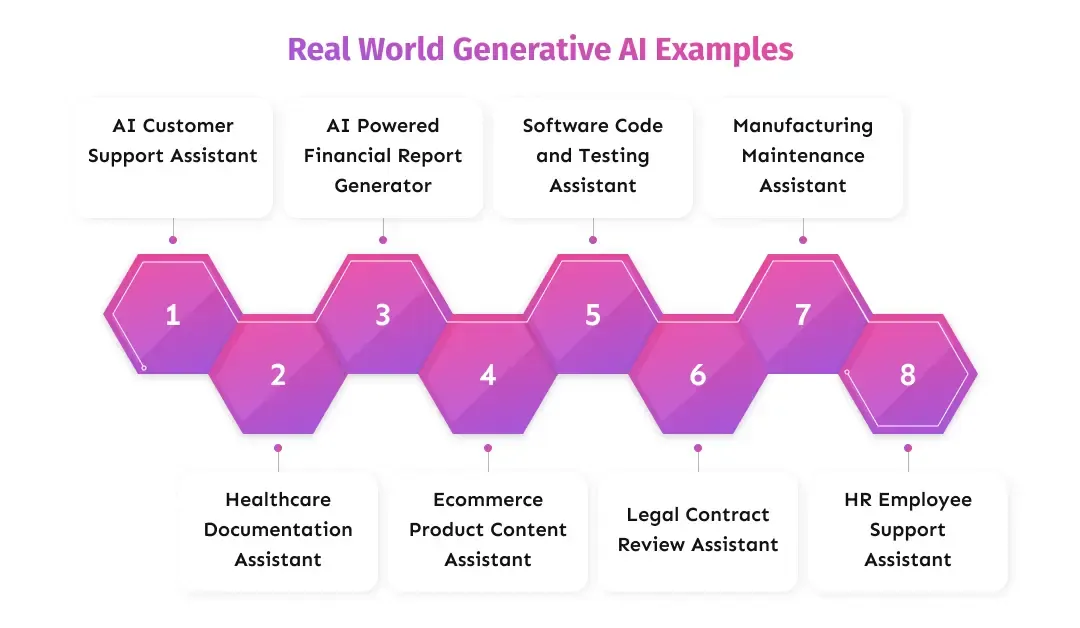
Real World Generative AI Examples
Real world generative AI examples show how businesses can move beyond basic AI experiments. The real value comes when AI connects with business data, internal tools, customer workflows, and daily team operations.
Here are some practical examples of how businesses can use generative AI in real work.
AI Customer Support Assistant
A SaaS business can use generative AI to answer common customer questions about pricing, billing, product setup, login issues, and feature usage. The assistant can also summarize long support conversations before handing them to a human agent.
This helps support teams respond faster and gives customers quick answers without waiting in a long queue.
Business outcome:
- Faster response time
- Lower ticket load
- Better customer experience
- More productive support agents
Healthcare Documentation Assistant
A hospital or clinic can use generative AI to summarize doctor notes, patient history, lab results, and discharge instructions. The system can create structured summaries that doctors review before adding them to patient records.
This reduces documentation pressure and helps care teams spend more time with patients.
Business outcome:
- Less admin work for healthcare staff
- Faster patient record review
- Better clinical documentation support
- Improved communication between care teams
AI Powered Financial Report Generator
A finance team can use generative AI to create monthly performance summaries from spreadsheets, accounting data, expense reports, and revenue dashboards. Instead of manually writing reports, teams can get a first draft with key numbers, trends, and risks.
Finance leaders can then review the output and add final business judgment.
Business outcome:
- Faster financial reporting
- Clearer performance visibility
- Reduced manual report writing
Ecommerce Product Content Assistant
An ecommerce business can use generative AI to create product descriptions, category content, comparison copy, buying guides, and personalized email campaigns. It can also rewrite content for different customer groups.
For example, the same product can be described differently for budget buyers, premium buyers, and first time buyers.
Business outcome:
- Faster product page creation
- More consistent brand messaging
- Improved shopping experience
Software Code and Testing Assistant
A software development team can use generative AI to write code snippets, create test cases, explain old code, prepare API documentation, and suggest bug fixes. Developers still review the final output, but AI helps reduce routine work.
This is useful for teams that manage large codebases or tight release timelines.
Business outcome:
- Faster development cycles
- Better test coverage
- Easier developer onboarding
- Less time spent on repetitive coding tasks
Legal Contract Review Assistant
A legal team can use generative AI to summarize contracts, compare clauses, highlight renewal dates, and identify risky terms. The AI can create a quick review summary before lawyers do the final legal check.
This helps legal teams handle document heavy work with better speed and structure.
Business outcome:
- Faster contract review
- Better risk visibility
- Reduced manual document reading
- More time for high value legal analysis
Manufacturing Maintenance Assistant
A manufacturing business can use generative AI to summarize machine logs, sensor data, service records, and maintenance notes. The system can alert teams about possible equipment issues and explain what may need attention.
This helps maintenance teams act before small issues cause production delays.
Business outcome:
- Reduced downtime risk
- Faster maintenance planning
- Better production visibility
HR Employee Support Assistant
An HR team can use generative AI to answer employee questions about leave policy, benefits, onboarding, payroll, holidays, and internal processes. It can also help create job descriptions, interview questions, and training material.
This reduces repeated HR queries and gives employees faster answers.
Business outcome:
- Less manual HR support work
- Faster employee onboarding
- Better access to company policies
- More consistent internal communication
Emerging Generative AI Use Cases in 2026
Generative AI is moving beyond simple content creation and chatbot replies. In 2026, businesses are focusing more on AI systems that can search company knowledge, understand different content formats, support older systems, and complete multi step tasks with human control.
These emerging use cases are especially useful for enterprises that want generative AI to work inside real business processes.
AI Agents
AI agents are generative AI systems that can plan, decide, and complete tasks across different tools. Instead of only answering a question, they can take action based on a goal, available data, and approved workflow rules.
Businesses can use AI agents for:
- Customer Support Automation: AI agents can check customer history, read the issue, suggest a solution, create a reply, and escalate complex cases to a human agent.
- Sales Follow Up Workflows: Sales teams can use AI agents to research leads, draft follow up emails, update CRM records, and suggest the next best action.
- Finance and Admin Tasks: AI agents can review invoices, match them with purchase orders, flag mismatches, and prepare approval notes.
- IT Help Desk Support: AI agents can troubleshoot basic issues, create tickets, suggest fixes, and route requests to the right IT team.
RAG Based Enterprise Search
RAG means retrieval augmented generation. In simple words, it allows generative AI to search trusted business data first and then create an answer based on that information.
This is useful because many businesses have knowledge spread across PDFs, CRMs, ERPs, help desks, policy documents, emails, and internal portals.
Businesses can use RAG based enterprise search for:
- Internal Knowledge Assistants: Employees can ask questions about policies, processes, products, or tools and get answers from approved company documents.
- Customer Support Knowledge Search: Support agents can find accurate answers from help articles, past tickets, and product documents faster.
- Legal and Compliance Search: Legal teams can search contracts, regulations, policies, and case documents without manually reading every file.
Multimodal AI
Multimodal AI can understand and generate different types of content, such as text, images, audio, video, charts, documents, and screenshots. This makes generative AI more useful for industries that depend on visual, voice, and document based workflows.
Instead of only reading text, multimodal AI can understand what is inside a form, image, medical scan, product photo, video frame, or voice note.
Businesses can use multimodal AI for:
- Document Understanding: AI can read invoices, forms, contracts, IDs, reports, and scanned documents to extract key information.
- Medical Image Support: Healthcare teams can use multimodal AI to assist in reviewing X rays, scans, and medical images with expert supervision.
- Retail Visual Search: Ecommerce platforms can let users upload an image and find similar products based on color, style, shape, or pattern.
- Video and Audio Summaries: Media, training, and support teams can summarize long videos, meetings, calls, and webinars into clear notes.
- Manufacturing Visual Inspection: Factories can use multimodal AI to review product images and detect visible defects during quality checks.
Legacy System Modernization
Many enterprises still depend on old software systems that are difficult to update, poorly documented, or built on outdated technologies. Generative AI can help teams understand these systems faster and plan modernization with less risk.
This does not mean replacing everything at once. It means using AI to understand old code, document system logic, and support gradual improvement.
Businesses can use generative AI for legacy modernization in:
- Code Explanation: AI can explain old code, functions, dependencies, and business logic in simple language for modern development teams.
- Documentation Creation: Teams can use AI to create missing technical documentation from old codebases, database structures, and system workflows.
- Refactoring Support: Generative AI can suggest cleaner code structures, modernization paths, and migration options for outdated applications.
- System Knowledge Transfer: New developers can use AI assistants to understand legacy systems faster without depending only on senior team members.
Agentic Cybersecurity
Agentic cybersecurity uses AI agents to support security teams with threat detection, alert analysis, investigation, and response planning. These systems can review large volumes of security data and help analysts understand what needs attention first.
The key is control. Businesses should use agentic cybersecurity with human approval, especially when actions affect systems, users, or sensitive data.
Businesses can use agentic cybersecurity for:
- Security Alert Triage: AI agents can group similar alerts, explain severity, and highlight urgent threats for security teams.
- Phishing Investigation: AI can review suspicious emails, links, attachments, and sender behavior to help identify phishing risks.
- Incident Response Drafting: Security teams can use AI to prepare response steps, investigation notes, and executive summaries during incidents.
- Vulnerability Prioritization: AI agents can summarize vulnerabilities, business impact, affected systems, and recommended fixes.
- Threat Intelligence Summaries: AI can read long threat reports and turn them into clear action points for security teams.
How to Choose the Right Generative AI Use Case
Choosing the right generative AI use case starts with one simple question. Which business process takes too much time, depends on repeated manual work, or slows down customer experience?
The best use case is not always the most advanced one. It is the one that solves a real problem, gives measurable value, and can be tested safely with your existing data and systems.
Start with a Clear Business Problem
Do not begin with “we need generative AI.” Begin with the actual business challenge.
For example:
- Support teams spend too much time answering repeated questions
- Sales teams take hours to personalize outreach
- Doctors spend too much time on clinical documentation
- Legal teams review similar contracts manually
- Developers spend time writing repetitive test cases
Check the Data Availability
Generative AI works better when it has access to useful, clean, and relevant data. If the data is scattered, outdated, incomplete, or poorly organized, the output may not be reliable.
Before choosing a use case, check:
- Do you have enough data for this workflow?
- Is the data stored in one place or across many tools?
- Is the data accurate and updated?
- Does the AI need access to private or sensitive information?
- Can the output be verified by a human?
Estimate the Business Value
A good generative AI use case should create visible value. That value can come from time savings, cost reduction, faster response, better customer experience, or improved team productivity.
Look for use cases that can answer questions like:
- How many hours can this save every week?
- Can this reduce support tickets or manual reviews?
- Can this improve customer response time?
- Can this help teams create content or reports faster?
- Can this reduce errors in repeated tasks?
Review the Risk Level
Not every use case has the same risk. Some AI outputs are low risk, such as first drafts, summaries, or internal notes. Others need strong control, especially in healthcare, finance, legal, cybersecurity, and customer facing decisions.
High risk use cases may involve:
- Personal customer data
- Medical information
- Financial decisions
- Legal advice
- Security actions
- Compliance documents
- Automated customer communication
Decide the Right AI Approach
Different generative AI use cases need different approaches. A simple content assistant may only need prompt engineering. An enterprise knowledge assistant may need RAG. A workflow automation system may need AI agents.
Common options include:
- Prompt based AI for content drafts, summaries, and simple support tasks
- RAG based AI for answers from company documents and internal data
- Fine tuned models for industry specific language or repeated patterns
- AI agents for multi step workflows across tools and systems
- Multimodal AI for documents, images, audio, video, and visual data
Start Small and Test First
The safest way to adopt generative AI is to start with a focused pilot. Pick one use case, define success metrics, test it with a small team, and improve it before scaling.
A simple process works best:
- Select one business problem
- Define the expected outcome
- Prepare the required data
- Build a small proof of concept
- Test output quality with real users
- Add human review and guardrails
- Measure time saved, accuracy, and user feedback
- Scale only after the results are clear
Use a Simple Selection Checklist
Before finalizing a generative AI use case, ask these questions:
- Is the problem common and repeated?
- Will solving it save time or cost?
- Is enough quality data available?
- Can the output be checked by humans?
- Is the risk level manageable?
- Can success be measured clearly?
- Can it integrate with existing tools?
- Can the pilot be tested in a few weeks?
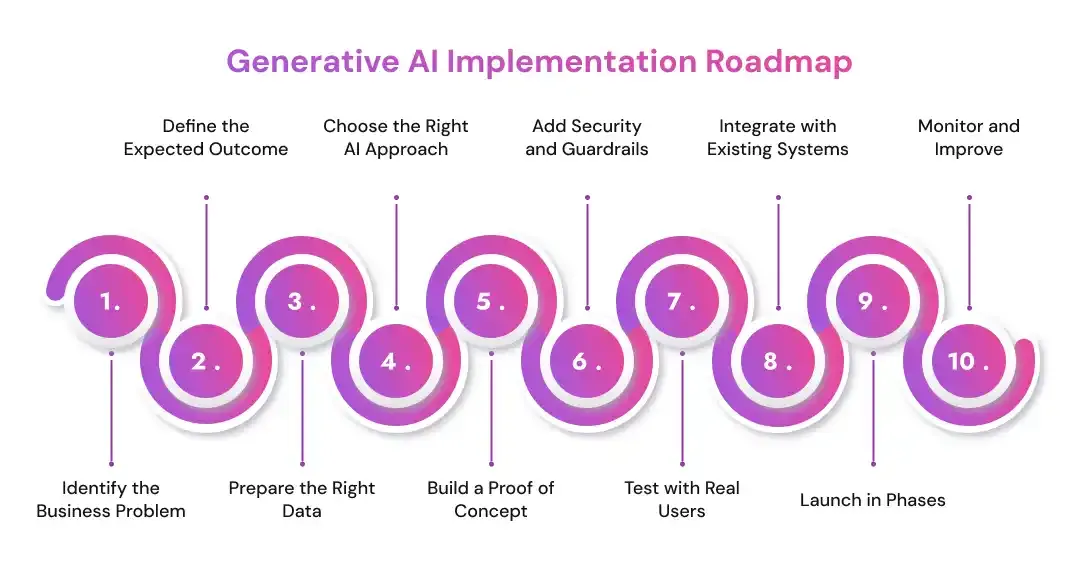
Generative AI Implementation Roadmap
A generative AI project works best when businesses follow a clear step by step roadmap. This helps teams choose the right use case, prepare reliable data, test safely, and scale only when the solution creates real business value.
Step 1: Identify the Business Problem
Start with one clear problem that generative AI should solve. Choose a workflow where teams spend too much time writing, reading, summarizing, checking, or answering repeated questions.
Step 2: Define the Expected Outcome
Set a clear goal before development starts. This can be faster response time, reduced manual work, better report quality, improved customer support, or higher team productivity.
Step 3: Prepare the Right Data
Collect the documents, records, FAQs, reports, tickets, or business data the AI system needs. Clean and updated data helps generative AI give more useful and reliable outputs.
Step 4: Choose the Right AI Approach
Select the right approach based on the use case. Simple content tasks may need prompt based AI, while enterprise search may need RAG and workflow automation may need AI agents.
Step 5: Build a Proof of Concept
Create a small version of the generative AI solution before building the full system. Test it with one workflow, one team, and one measurable goal.
Step 6: Add Security and Guardrails
Add data privacy rules, access control, audit logs, approval flows, and output checks from the beginning. This is especially important for healthcare, finance, legal, and enterprise use cases.
Step 7: Test with Real Users
Let a small group of real users test the solution in their daily workflow. Their feedback will show where the AI is helpful, where it fails, and what needs improvement.
Step 8: Integrate with Existing Systems
Connect the AI solution with tools your teams already use, such as CRM, ERP, help desk, project management, or document systems. This makes adoption easier and improves business value.
Step 9: Launch in Phases
Do not roll out the solution to everyone at once. Start with one team, improve the system based on feedback, and then expand it step by step.
Step 10: Monitor and Improve
Track accuracy, adoption, time saved, cost, user feedback, and output quality after launch. Regular monitoring helps keep the generative AI solution safe, useful, and aligned with business goals.
Risks and Best Practices for Generative AI Adoption
Generative AI can create strong business value, but it also needs careful planning. The same system that can write reports, answer customers, and summarize data can also create wrong answers, expose sensitive data, or produce biased outputs if teams use it without control.
The goal is not to avoid generative AI. The goal is to use it safely, with clear rules, trusted data, and human review where needed.
Common Risks of Generative AI
- Inaccurate Outputs: Generative AI can sometimes create answers that sound confident but are wrong. This is often called hallucination, which means the AI produces information that is not fully accurate or verified.
- Data Privacy Issues: AI systems may process sensitive customer, employee, financial, legal, or medical data. If access is not controlled, private information can be exposed or misused.
- Bias in AI Responses: Generative AI can reflect bias from training data or business data. This can affect hiring, lending, healthcare, customer service, and other decision sensitive areas.
- Compliance Risks: Industries like healthcare, finance, insurance, and legal services must follow strict rules. AI outputs in these areas need review, records, and clear accountability.
- Security Concerns: AI tools connected with internal systems can create security risks if access control is weak. Teams must decide what AI can read, write, change, or trigger.
- Copyright and IP Concerns: AI generated content, designs, code, or media may create ownership and originality questions. Businesses should review outputs before using them commercially.
- Over Dependence on AI: Teams may start trusting AI output too quickly. This can lead to poor decisions if human review is removed from high risk workflows.
Best Practices for Safe Generative AI Adoption
- Start with Low Risk Use Cases: Begin with internal summaries, content drafts, knowledge search, or support assistance. Avoid fully automated decisions in sensitive areas during the early stage.
- Use Human Review for Sensitive Outputs: Keep humans in control when AI supports medical, financial, legal, hiring, or security related work. AI can assist, but people should approve final decisions.
- Connect AI with Trusted Data: Use approved company documents, verified knowledge bases, and updated business data. This improves answer quality and reduces the chances of wrong information.
- Add Clear Access Controls: Limit what each user and AI system can access. A sales assistant should not have access to private HR files, and a support bot should not see confidential finance records.
- Create AI Usage Guidelines: Define what employees can use AI for, what data they cannot enter, and which outputs need approval. Simple rules help teams avoid careless mistakes.
- Monitor AI Outputs Regularly: Review answers, summaries, recommendations, and generated content often. This helps teams find errors, improve prompts, update data, and build trust.
- Keep Audit Logs: Track who used the AI system, what data it accessed, and what output it produced. This is useful for compliance, quality checks, and internal accountability.
- Test Before Scaling: Run a small pilot before rolling AI across the business. Measure accuracy, user feedback, time saved, error rate, and workflow fit before expanding.
Generative AI Tools, Platforms, and Frameworks
Choosing the right generative AI tools depends on the business use case, data type, security needs, budget, and integration requirements. A simple content assistant may need only an LLM and prompt setup. An enterprise AI system may need cloud infrastructure, RAG, vector databases, AI agent frameworks, monitoring, and security controls.
The goal is not to pick the most popular tool. The goal is to choose the right stack for the problem you want to solve.
Popular Generative AI Platforms
Generative AI platforms help businesses build, test, deploy, and manage AI applications. These platforms usually provide access to foundation models, development tools, security features, and deployment support.
Common platforms include:
- Amazon Bedrock: Amazon Bedrock helps teams build generative AI applications and agents using different foundation models with AWS infrastructure, security, and deployment capabilities.
- Google Vertex AI: Vertex AI helps teams train, deploy, and manage ML models and AI applications. It also supports Gemini for text, image, and video based generative AI workflows.
- Microsoft Azure AI and Azure OpenAI: Azure provides access to foundation models from Microsoft, OpenAI, Hugging Face, Meta, Cohere, and other providers through its model catalog.
- OpenAI API: Businesses use OpenAI models for chatbots, copilots, content generation, coding assistants, knowledge search, and automation workflows.
- Anthropic Claude: Claude is often used for long document understanding, enterprise assistants, writing support, summarization, and reasoning focused use cases.
- Google Gemini: Gemini supports text, image, video, and multimodal AI use cases, which makes it useful for document understanding, visual workflows, and enterprise AI applications.
- Open Source Models: Models such as Llama, Mistral, and other open weight models are useful for businesses that need more control, private deployment, or custom model hosting.
Common Generative AI Architecture Components
A generative AI solution is not only a model. Most business grade systems need several components working together to make the output accurate, secure, and useful.
Key components include:
- Large Language Models: LLMs create text, summaries, code, answers, and reasoning based responses.
- Vector Databases: Vector databases store searchable versions of documents, FAQs, policies, reports, and knowledge base content.
- RAG Pipelines: RAG helps AI search trusted business data before creating an answer. This improves accuracy for enterprise knowledge assistants and customer support bots.
- Prompt Engineering: Prompts guide how the AI should respond, what tone it should use, what format it should follow, and what limits it should respect.
- APIs and System Integrations: APIs connect generative AI with CRMs, ERPs, help desks, databases, apps, and internal tools.
- Monitoring and Evaluation: Monitoring helps teams track accuracy, cost, response quality, user feedback, and failure patterns after launch.
- Security and Access Controls: These controls decide what data the AI can access, who can use it, and which outputs need approval.
AI Agent Frameworks
AI agent frameworks help developers build AI systems that can plan tasks, call tools, use memory, follow workflows, and work across multiple systems. These are useful when businesses want AI to do more than answer questions.
Common frameworks include:
- LangChain: LangChain is an open source framework for building AI applications and agents with integrations across models, tools, and databases.
- LangGraph: LangGraph helps teams build stateful AI agents and complex agent workflows. It is useful for multi step tasks where the AI needs memory, control, and workflow logic.
- LlamaIndex: LlamaIndex is often used for connecting LLMs with business documents, knowledge bases, and structured or unstructured data.
- Semantic Kernel: Semantic Kernel helps developers connect AI models with business logic, plugins, and enterprise workflows.
- CrewAI and AutoGen: These frameworks help developers build multi agent systems where different AI agents can handle different roles inside a workflow.
How Prismetric Helps Businesses Build Generative AI Solutions
Prismetric helps businesses turn generative AI ideas into practical, secure, and scalable solutions. The focus is not only on building an AI tool, but on solving a real business problem with the right model, data, architecture, and workflow.
From AI agents and RAG based knowledge assistants to custom LLM applications, Prismetric works with businesses to design generative AI systems that fit their operations, users, and long term goals.
Key ways Prismetric helps include:
- Generative AI Use Case Discovery: Prismetric helps businesses identify where generative AI can create real value. This includes finding workflows that need faster content creation, document processing, customer support, data analysis, automation, or decision support.
- Custom Generative AI Development: The team builds custom generative AI applications based on specific business needs. These can include AI chatbots, copilots, content assistants, document review tools, code assistants, reporting tools, and workflow automation systems.
- RAG Based AI Solutions: Prismetric helps businesses build RAG based systems that answer questions using trusted company data. This is useful for internal knowledge assistants, customer support bots, legal search tools, training assistants, and enterprise document search.
- AI Agent Development: Businesses can use Prismetric to build AI agents that handle multi step workflows. These agents can support sales follow ups, support ticket handling, data analysis, HR queries, finance reviews, and internal task automation.
- LLM Integration with Existing Systems: Prismetric connects generative AI solutions with business tools such as CRMs, ERPs, help desks, databases, websites, mobile apps, and internal platforms. This helps teams use AI inside their current workflows instead of managing another disconnected tool.
- Data Security and Compliance Focus: The team adds access control, privacy rules, audit logs, human approval steps, and output checks where needed. This is especially useful for finance, healthcare, legal, insurance, and enterprise AI use cases.
- Testing, Optimization, and Support: Prismetric tests the AI solution with real users, reviews output quality, improves prompts, checks accuracy, and supports the system after launch. This helps businesses keep the solution useful, safe, and aligned with changing needs.
Final Thoughts
Generative AI is becoming a practical business tool, not just a technology trend. It can help businesses create content, support customers, write code, review documents, analyze data, improve decisions, and automate daily workflows.
The most successful generative AI use cases start with a clear business problem. A company that wants faster customer support may need an AI chatbot. A legal team may need contract summarization. A software team may need code and testing support. A large enterprise may need a RAG based knowledge assistant or AI agents connected with internal systems.
The key is to start small, test carefully, and scale with the right guardrails. Businesses should focus on data quality, security, human review, and measurable outcomes before expanding generative AI across teams.
With the right strategy and implementation partner, generative AI can reduce manual work, improve productivity, and help businesses build smarter digital experiences for customers, employees, and operations.
FAQs About Generative AI Use Cases
The top generative AI use cases for businesses include customer support chatbots, content creation, code generation, document summarization, financial reporting, sales outreach, legal contract review, healthcare documentation, product recommendations, and AI agents for workflow automation. The best use case depends on the business problem, data availability, and expected outcome.
A generative AI use case is a practical way a business uses AI to create useful outputs. These outputs can include text, images, code, reports, summaries, emails, documents, product ideas, or customer responses. For example, a support team can use generative AI to create faster replies from approved help content.
Generative AI is widely used in healthcare, finance, banking, insurance, retail, ecommerce, manufacturing, software development, education, legal, real estate, media, cybersecurity, and logistics. These industries use generative AI to save time, improve decisions, automate workflows, and create more personalized customer experiences.
Healthcare businesses use generative AI for clinical note summaries, patient history review, medical documentation, drug discovery support, clinical trial documents, and virtual health assistants. It helps doctors and care teams work faster with medical information, but expert review remains necessary for diagnosis, treatment, and patient care decisions.
Finance and banking businesses use generative AI for fraud detection support, loan document review, financial report generation, personalized banking advice, customer support, and risk summaries. It helps teams process large amounts of financial data faster while improving customer communication and internal decision support.
Retail and ecommerce businesses use generative AI to create product descriptions, recommend products, summarize customer reviews, power AI shopping assistants, create marketing content, and analyze demand patterns. These use cases help businesses improve product discovery, personalize customer journeys, and manage content at scale.
Software teams use generative AI for code generation, bug fixing, test case creation, technical documentation, API guides, code explanation, and legacy system modernization. It helps developers move faster on repetitive tasks, but human review is still needed for security, logic, performance, and production quality.
Real world generative AI examples include AI chatbots for customer support, healthcare documentation assistants, legal contract review tools, financial report generators, ecommerce product content assistants, HR policy bots, and software testing assistants. These solutions work best when they connect with trusted business data and existing workflows.
Traditional AI usually predicts, classifies, detects, or recommends based on data patterns. Generative AI creates new outputs such as text, code, images, reports, summaries, and conversations. For example, traditional AI can predict customer churn, while generative AI can create a personalized retention email for that customer.
The main risks of generative AI include inaccurate outputs, data privacy issues, biased responses, compliance gaps, security concerns, copyright questions, and overdependence on AI generated answers. Businesses can reduce these risks with human review, access controls, audit logs, trusted data sources, and clear usage guidelines.
Businesses should start with a clear problem that involves repeated manual work, high documentation effort, slow response time, or large information volume. Then they should check data quality, risk level, expected ROI, integration needs, and human review requirements before building a proof of concept.
The timeline depends on the use case, data readiness, integrations, security needs, and complexity. A simple AI content assistant or chatbot may take a few weeks. A RAG based enterprise search tool, AI agent, or custom generative AI system may take longer because it needs data preparation, testing, and system integration.
The cost depends on the type of solution, model choice, data volume, integrations, security requirements, and ongoing usage. A simple AI assistant costs less than an enterprise grade AI agent or RAG based knowledge system. Businesses should estimate cost based on development, infrastructure, model usage, testing, and maintenance.
Yes, generative AI can be integrated with CRMs, ERPs, help desks, databases, mobile apps, websites, document systems, analytics tools, and internal platforms. These integrations help businesses use AI inside their daily workflows instead of managing it as a separate tool.
AI agents help generative AI move from answering questions to completing multi step tasks. They can research information, call tools, update systems, draft responses, summarize data, and route work based on rules. Businesses use AI agents for support, sales, IT, finance, HR, and internal workflow automation.