LLM vs LAM: What’s the Real Difference and When to Use Each
Key Takeaways
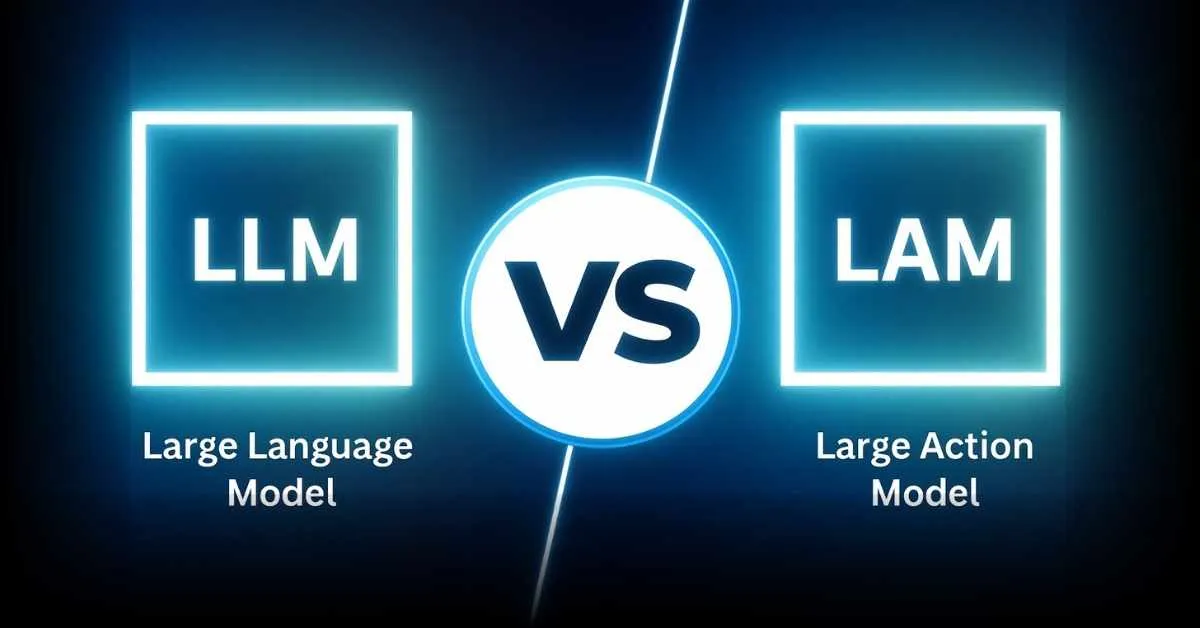
- LLMs specialize in language tasks such as writing, summarizing, and translation, while LAMs focus on taking actions and completing tasks.
- LLMs work best for content generation and question answering, whereas LAMs automate workflows across apps and tools.
- LAMs can act independently by logging into systems, completing returns, and sending emails, while LLMs cannot execute real-world actions.
- Use LLMs when language understanding is required and LAMs when AI must complete multi-step instructions.
- The future of AI combines LLMs as planners and LAMs as doers to create end-to-end intelligent agents.
- Prismetric develops tailored LLM and LAM solutions for language automation, task execution, or hybrid business needs.
Artificial intelligence is no longer just about understanding what we say. It is learning to act on it. As AI continues to evolve, a new conversation has gained momentum with LLMs and LAMs leading the way. These two types of models are shaping the future in very different ways. But what do they actually do, and how do you know which one fits your needs?
This article breaks down the core differences between LLMs and LAMs in plain English. We’ll show how each model works, where they shine, and how to choose the right one for your needs. Whether you’re building a chatbot, automating a process, or deploying an AI agent in the real world.
What Are LLMs?
Large Language Models (LLMs) are a type of artificial intelligence built to understand and generate human language. They can read, write, translate, summarize, and even solve complex problems using natural text.
At the core of every LLM is a smart design called the transformer architecture. This structure helps the model figure out which words matter most in a sentence. It uses a method called attention, which lets the model focus on the most important parts of a conversation or prompt. The model learns patterns by training on massive amounts of text. This training process is called pretraining.
Once trained, LLMs become incredibly useful. They can:
- Write articles, stories, or emails in seconds
- Summarize long documents into key points
- Translate languages instantly
- Generate code or fix errors in programming
- Solve problems through step-by-step reasoning
These abilities come from not just raw power, but smarter prompting. For example, using a chain-of-thought prompt helps LLMs explain their reasoning clearly.
To get even more value from a general-purpose LLM, businesses can invest in LLM fine-tuning services. Fine-tuning adapts a pre-trained model to your specific domain, improving its accuracy, tone, and performance in real-world applications. Whether you’re building a legal assistant, financial chatbot, or healthcare solution, fine-tuning ensures the LLM speaks your language.
One well-known example is the Llama 4 series by Meta. The Scout and Maverick models can handle multiple inputs like text, images, and even audio. These advanced features make them more flexible than earlier versions. According to Reuters, Llama 4 sets a new standard for both speed and accuracy in language-based tasks.
Also Read:Top LLM Models of the Year You Should Know
What Are LAMs?
Large Action Models (LAMs) are the next step in AI evolution. Unlike LLMs, which focus on understanding and generating language, LAMs can actually take actions based on what they understand. These actions can be digital, physical, or a mix of both.
LAMs use language as an interface, but they go beyond words. They can interact with tools, make decisions, and complete multi-step tasks without constant human input. While they still rely on deep learning and transformer-based models like LLMs, LAMs are trained differently. They focus on workflows, decision chains, and real-world task execution.
For example, instead of just explaining how to process a product return, a LAM could:
- Log into the right system
- Pull up the customer’s details
- Create the return order
- Send confirmation, all without user guidance
This ability makes LAMs powerful in business automation, robotics, and agent-based systems.
Platforms like CloudOffix, SuperAnnotate, and AryaxAI are already exploring LAM use cases. These include customer service agents that solve problems end-to-end and AI systems that can handle tasks across apps, tools, or APIs.
LAMs are also multimodal, meaning they can work with text, images, audio, or even video inputs. This makes them useful in situations where decisions depend on more than just words.
Side-by-Side Comparison of LLMs and LAMs
Understanding the theory behind LLMs and LAMs is useful, but a direct comparison makes the differences easier to see. Below is a clear breakdown of how they stack up across purpose, use cases, resources, and real-world maturity.
| Aspect |
LLM (Large Language Model) |
LAM (Large Action Model) |
| Core Purpose |
Understand and generate text |
Understand instructions and execute actions |
| Typical Use Cases |
Chatbots, summarization, translation, content creation, coding assistance |
Workflow automation, digital agents, robotics, multi-step decision making |
| Resource Profile |
Requires high compute and large text datasets for training |
Needs integration with tools, APIs, or environments; more efficient in task-specific domains (Sapien, Arion Research LLC) |
| Maturity & Feasibility |
Mature and widely available; examples include GPT and Meta’s Llama 4 (Reuters, TechRadar) |
Still emerging; early research and limited real-world use; hype risk highlighted by Trinetix |
| Data Needs |
Trained on massive text corpora |
Can learn from structured actions, workflows, or multimodal data |
| Interaction Style |
Responds in text form, conversation-driven |
Executes commands, may combine language with actions like clicks, navigation, or system tasks |
| Scalability |
Easier to scale with larger models and datasets |
Scalability depends on integration complexity with external systems |
| Strengths |
Excellent for reasoning, creativity, and language-rich tasks |
Strong at task automation, tool usage, and goal-directed execution |
| Limitations |
Cannot perform real-world actions directly |
Still young, limited availability, and can be unpredictable |
When to Use LLMs and When to Use LAMs
Not every task calls for the same kind of AI. Large Language Models (LLMs) and Large Action Models (LAMs) serve different goals. Choosing the right one depends on whether you need language understanding or autonomous action. In some cases, using both can give you the best of both worlds.
When to Use LLMs?
Use an LLM when your focus is on working with text or natural language. LLMs are excellent at:
- Answering questions based on text input
- Summarizing long documents
- Translating languages
- Writing emails, articles, or product descriptions
- Generating or reviewing code
- Assisting with creative writing and brainstorming
If your system needs to understand language and respond fluently, an LLM is the right choice. It works well in flexible, open-ended scenarios where clear communication is the goal.
To bring these capabilities into your product or platform, consider professional LLM development services. With custom LLM integration, you can build intelligent chatbots, language-based tools, or content automation systems tailored to your business needs.
When to Use LAMs?
Use a LAM when your goal is to get things done, not just talk about them. LAMs are designed for:
- Automating workflows across multiple tools or systems
- Carrying out multi-step instructions
- Making decisions based on changing inputs
- Controlling apps, APIs, or robotic systems
- Acting as autonomous agents in real or virtual environments
If your project requires the AI to take action without ongoing input, a LAM is a better fit. These models excel in execution-heavy tasks that go beyond language.
When to Use Both Together?
In many cases, the best solution is a combination of both.
Use an LLM as the planner and a LAM or tool executor as the doer. This setup allows the LLM to understand the user’s intent, break it into steps, and pass those steps to a LAM or integrated system to complete the task.
Example:
A user says, “Find the latest invoices and email them to my client.”
The LLM understands the request, structures the steps, and the LAM executes them across systems like file storage, invoicing software, and email.
This hybrid approach gives you the language power of LLMs and the execution strength of LAMs.
What Is the Future of LLM and LAM
The future of LLMs looks strong and steady. These models will continue to improve in speed, accuracy, and efficiency. As new techniques like retrieval-augmented generation and fine-tuned domain training evolve, LLMs will become even more reliable for professional tasks like legal writing, customer support, and software development. Multimodal capabilities are also expanding, allowing LLMs to handle more than just text.
LAMs, on the other hand, are just getting started. Their growth will depend on how well they integrate with real-world tools, systems, and environments. We can expect LAMs to play a major role in automation, robotics, and enterprise AI workflows. As research advances, LAMs will likely shift from controlled demos to real-world impact—taking action, making decisions, and learning from outcomes with minimal human input.
Final Thoughts
Throughout this guide, we explored what LLMs and LAMs are, how they differ, and when to choose one over the other. From text generation to real-world task execution, both models serve unique roles in the evolving AI landscape. The LLM vs. LAM conversation is not about choosing sides. It is about selecting the right tool for the job.
As AI technology moves forward, the line between language and action will continue to fade. Future systems will not only understand commands but will also carry them out with purpose. This means combining the strengths of both LLMs and LAMs to create smarter, more capable AI.
If you want to unlock the full potential of artificial intelligence, we are here to help. Prismetric offers expert generative AI development services that bring your ideas to life. Whether you need advanced language models, autonomous agents, or a fully integrated AI system, we are ready to build secure and scalable solutions tailored to your business.
LLMs (Large Language Models) are designed to understand and generate human language. They excel at tasks like answering questions, writing content, summarizing documents, and translating text. These models are trained on massive datasets of written language and use deep learning to predict and generate text based on user prompts.
LAMs (Large Action Models) go a step further. They understand instructions and take actions, not just respond with words. Think of them as AI agents that can interact with software, complete workflows, and make decisions in real time. While LLMs are conversation-focused, LAMs are task-focused.
Also Read:
How to Build an AI Agent?
For most business automation needs, LAMs are the better fit.
LLMs can help create documents, draft emails, and support customer interactions with intelligent responses. But they stop at language. They cannot log in to your CRM or send a follow-up email on their own.
LAMs can do all that. They complete tasks across systems with little to no human input. They understand instructions and follow through with real action across your digital tools.
Example:
A LAM can receive a customer return request, open the order system, process the return, and send a confirmation email.
No, LLMs cannot directly perform those tasks.
They can write the email or generate a step-by-step plan to book the appointment. But they do not connect to tools or systems that actually complete the task. Their role stops at providing helpful, language-based output.
LAMs, however, are built to act. They can access calendars, check availability, create the meeting, and send invitations without any manual steps.
LLM example:
Suggests how to phrase a meeting request.
LAM example:
Checks your schedule and books the meeting.
LAMs are already being used in industries that need smart, hands-off automation. These models don’t just respond. They act, based on real-time context.
Examples:
- Customer Support: AI agents that not only answer customer queries but also process refunds, update tickets, and send follow-up emails.
- eCommerce: Automated inventory managers that monitor stock levels, place supplier orders, and update product listings.
- Healthcare: Assistants that schedule appointments, pull patient records, and send prescriptions to pharmacies.
- Finance: Systems that gather reports, analyze trends, and generate compliance documents for audits.
Each of these tasks involves multiple steps, tools, and systems. A LAM understands the flow and completes it without manual help.
LAMs are designed to handle sequences of actions. They don’t just give advice on what to do. They actually follow through.
Here’s how they handle complexity:
- Understand intent from natural language.
- Break it down into steps.
- Interact with systems like APIs, apps, and software tools.
- Adjust based on context, such as changing inputs or user preferences.
LLMs, while powerful in language generation, lack the built-in capability to execute tasks across systems. They can suggest steps, but they don’t take them.
Yes, and this combination is incredibly powerful.
LLMs are excellent planners. They understand human language, clarify intent, and generate structured steps. LAMs are the doers. They take those steps and complete them using connected tools or environments.
No, a LAM is not just a better or upgraded LLM. It’s a different type of AI built for a different purpose.
LLMs focus on language. They are experts in generating, interpreting, and responding to text. Their strength lies in communication, content creation, and reasoning with words.
LAMs focus on action. They use language as a starting point but move beyond it to interact with systems, tools, and real-world processes.
You can think of LLMs as consultants. They tell you what to do. LAMs are like assistants. They do the job for you.
Start with your goal. What do you need the AI to do?
If your goal is to generate text, answer questions, or support a user in conversation, an LLM is the right fit. These models are fast, flexible, and highly skilled with language tasks.
If you need the AI to complete actions, follow instructions, or interact with systems, choose a LAM. These models are better suited for automation, integration, and task execution.
Key considerations:
- Task type: Language generation or real-world action?
- Integration needs: Does the AI need to connect with tools or software?
- Level of autonomy: Do you want suggestions or full task completion?